

P0171 on 2011-2017 Cadillac CTS: System Too Lean Causes and Fixes
For a 2011-2017 Cadillac CTS, code P0171 is most often caused by a vacuum leak from a cracked PCV hose or a faulty Mass Airflow (MAF) sensor. On CTS-V models, the PCV hose is a known failure point covered by a special service bulletin. On 2.0T and 3.6L models, the brittle plastic PCV/breather tubes are also the primary suspect. Inspecting these components first can save significant time and money.
- Start your diagnosis by thoroughly inspecting all PCV and vacuum hoses for cracks, especially the lines on top of the engine.
- For CTS-V models, the PCV hose is a known weak point and should be the first part you check.
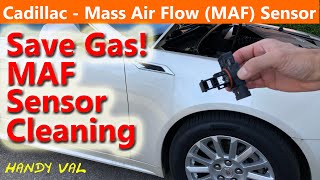
- Cleaning the Mass Air Flow (MAF) sensor is a simple, low-cost diagnostic step that can often resolve the issue.
- If both P0171 and P0174 codes are present, the cause is almost certainly a leak or fault that affects the entire engine, not an individual component on one bank.
- Do not replace the O2 sensor unless you have ruled out all other possibilities, as it is rarely the root cause of a P0171 code.
What's Unique About the 2011-2017 Cadillac CTS

The 2011-2017 Cadillac CTS spans two vehicle generations with multiple engine options (2.0T LTG, 3.6L LFX, 6.2L LSA/LT4), each having unique weak points for this code. Manufacturer bulletins specifically point to a cracked PCV hose on supercharged CTS-V models (LSA engine) as a direct cause. [Bulletin #15317] Other bulletins highlight issues with casting flaws near the MAF sensor that can disrupt airflow and trigger a P0171 code across different engines. [Bulletin #PIP5446A] Owner forums and repair videos frequently corroborate these findings, with cracked PCV/breather hoses being a very common fix, especially on the 2.0L Turbo and 3.6L V6 engines, where the plastic becomes brittle and breaks.
Diagnostic Flowchart

Tap your situation to follow the diagnostic path that matches what you're seeing on this vehicle.
Generation note: The 2011-2017 range covers the end of the second generation (2011-2014) and the start of the third generation (2014-2017). Second-gen engines include the 3.0L V6 (LF1), 3.6L V6 (LLT/LFX), and 6.2L V8 (LSA). Third-gen engines include the 2.0L Turbo I4 (LTG), 3.6L V6 (LFX/LGX), and 6.2L V8 (LT4). While the causes are often similar (vacuum leaks, MAF issues), specific parts like PCV hoses are engine-dependent and have known failure patterns for each. [18, Bulletin #15317]
Symptoms You May Notice
- Check Engine Light (MIL) is on
- Rough or unstable idle
- Engine sputtering or hesitation, especially on light throttle application [PIP5446A]
- Reduced engine power or 'limp mode'
- Poor fuel economy
- Engine misfires
- Hissing or whistling noise from the engine bay, indicating a vacuum leak
- Replacing the oxygen (O2) sensor first. The O2 sensor is usually just reporting the problem, not causing it. The actual cause is typically an air leak or a fuel delivery issue.
- Replacing fuel injectors or the fuel pump without confirming low fuel pressure. Vacuum leaks are far more common and should be ruled out first.
Most Likely Causes

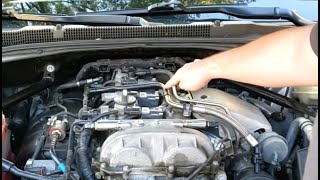
- Cracked or Leaking PCV/Vacuum Hoses 🔴 High Probability → Shop Vacuum Hose The plastic and rubber hoses in the Positive Crankcase Ventilation (PCV) system become brittle from heat and age, leading to cracks. This is a very common failure on GM engines of this era. For the 2.0T LTG, the multi-piece hose assembly is notorious for cracking at its junctions. 🎬 See this walkthrough for replacing a brittle PCV hose For the 6.2L LSA V8 in the CTS-V, a specific PCV hose is known to fail, prompting a special coverage campaign from GM (TSB 15317). The 3.6L V6 also suffers from brittle vacuum lines.
How to confirm: Visually inspect all vacuum and PCV hoses for obvious cracks, splits, or loose connections. A common failure point on the 2.0T is where the hose connects to the intake or at T-junctions. A smoke test is the most effective way to find small, hard-to-see leaks.
Typical fix: Replace the cracked hose assembly. Aftermarket versions are available, sometimes with improved connector designs.
Est. part cost: $25-$90 - Dirty or Faulty Mass Air Flow (MAF) Sensor 🔴 High Probability → Shop Fuel Injection Air Flow Meter The MAF sensor can become contaminated with dirt and oil, causing inaccurate airflow readings. A GM Technical Service Bulletin (PIP5446A) also notes that manufacturing defects ('cast flashing') in the air filter housing near the sensor can disrupt airflow and trigger this code.
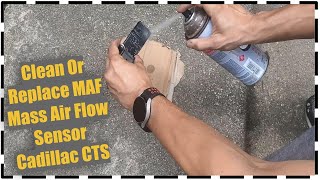
How to confirm: Remove and inspect the sensor. Clean it carefully with a dedicated MAF sensor cleaner, spraying the wire and not touching it. 🎬 Watch: How to safely clean your MAF sensor If cleaning doesn't resolve the issue, the sensor may need replacement. Observing fuel trim data and MAF readings (in grams/sec) with a scan tool can also help diagnose a faulty sensor.
Typical fix: Clean the MAF sensor. If the problem persists or flashing is found in the housing, replace the sensor or air filter housing lid.
Est. part cost: $60-$150 - Leaking Intake Manifold Gaskets 🟡 Medium Probability → Shop Engine Intake Manifold The intake manifold gaskets can degrade over time, allowing unmetered air to enter the engine. This is a common cause for lean codes on both banks (P0171 & P0174) on the V6 and V8 engines.
How to confirm: With the engine running, carefully spray brake cleaner or a combustible fluid around the intake manifold sealing area. If the engine RPM changes, a leak is present. A smoke test is a safer and more definitive method. In one owner's video, the leak was audible.
Typical fix: Replace the upper and lower intake manifold gaskets. This is more involved than a hose replacement.
Est. part cost: $40-$100 - Cracked Air Intake Tube 🟡 Medium Probability → Shop Engine Air Intake Resonator The large flexible duct between the air filter box/MAF sensor and the throttle body can develop cracks, especially in the ribbed, flexible sections. This allows a large amount of unmetered air into the engine, directly causing a lean condition.
How to confirm: Remove the air intake tube and carefully inspect it from all angles, flexing it to reveal any hidden cracks or tears. A smoke test will also easily identify this leak.
Typical fix: Replace the air intake tube.
Est. part cost: $50-$150 - Weak Fuel Pump or Clogged Fuel Filter ⚪ Low Probability → Shop Fuel Filter While less common than vacuum leaks, a failing fuel pump, clogged filter, or faulty fuel pressure regulator can restrict fuel flow, preventing the engine from getting the fuel it needs to match the air volume.
How to confirm: Perform a fuel pressure test using a fuel pressure gauge connected to the fuel rail. Compare the reading to the manufacturer's specification. On some platforms, a failing Fuel Pump Control Module (FPCM) can also be a cause.
Typical fix: Replace the fuel pump module or the fuel filter.
Est. part cost: $200-$500
Rare But Worth Checking
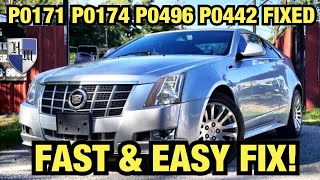
- Leaking EVAP Purge Valve: → Shop Vapor Canister A purge valve stuck open can create a vacuum leak, causing lean codes. This was identified in a video for a 2014 CTS that also had P0496 and P0442 codes, where replacing the purge valve and a cracked vacuum hose fixed all issues.
- Faulty Oxygen (O2) Sensor: → Shop Oxygen Sensor While the O2 sensor reports the lean condition, it can sometimes fail and give false readings. However, it's more common for other issues to be the root cause. It should be one of the last components to be replaced after all other possibilities are ruled out.
- Exhaust Leak: An exhaust leak before the upstream O2 sensor can draw in outside air, making the sensor incorrectly read a lean condition. This is less common but possible.
Diagnosis Steps
- Read all stored trouble codes with an OBD-II scanner. Note if P0174 or other codes are present, as this helps narrow the cause.
- Use a scan tool to monitor short-term (STFT) and long-term (LTFT) fuel trims at idle and while holding RPMs around 2500. High positive numbers (e.g., LTFT > 15-20%) confirm the PCM is adding significant fuel to combat a lean condition.
- Visually inspect the entire air intake system from the air filter to the intake manifold. Check the large intake duct for cracks and ensure all clamps are tight.
- Carefully inspect all PCV and vacuum hoses. On the 2.0T and 3.6L, these are known to become brittle and crack. On CTS-V models, specifically inspect the PCV hose noted in TSB #15317.
- Perform a smoke test. This is the most definitive way to identify hard-to-see vacuum leaks from hoses, intake gaskets, or EVAP components.
- Remove, inspect, and clean the Mass Air Flow (MAF) sensor using a dedicated cleaner. Inspect the air filter housing for 'cast flashing' per TSB PIP5446A.
- If no vacuum leaks are found, test the fuel pressure to rule out a weak fuel pump or clogged filter.
- As a final step, test the oxygen sensor's operation with a scan tool to ensure it is switching correctly and not providing false lean readings.
Parts You'll Likely Need
- PCV Hose / Breather Tube
(OEM #12673868 (for 2.0T LTG), 12599298 (for 6.2L LSA per TSB 15317))— This is one of the most common failure points for P0171 on modern GM engines, including the 2.0T, 3.6L, and 6.2L found in the CTS. The plastic becomes brittle and cracks. [18, 28, Bulletin #15317]
Trusted brands: ACDelco, Dorman
OEM price range: $50-$90
Aftermarket price range: $25-$60
Related Codes That Often Appear With This One
- P0174 — This is the 'System Too Lean' code for Bank 2. When both P0171 and P0174 are present, it strongly suggests a problem that affects the entire engine, such as a MAF sensor issue, a major vacuum leak at the intake manifold/air tube, or a fuel delivery problem.
- P0101 — This code relates to the Mass Air Flow (MAF) sensor performance. It often appears with P0171 when the MAF sensor is dirty, faulty, or there's an air leak between the sensor and the throttle body, as noted in TSB PIP5446A.
- P0496, P0442 — These are EVAP (Evaporative Emission) system codes. A faulty EVAP purge valve can get stuck open, creating a vacuum leak that triggers P0171 and P0174 alongside EVAP codes.
Technical Service Bulletins (TSBs) & Recalls

- 15317: Special Coverage for cracked PCV hose on 2011 CTS-V, causing P0171/P0174.
- PIP5446A: Addresses rough idle and lean/rich codes (P0171, P0174, etc.) caused by excess casting flash near the MAF sensor.
- PIP5529B: General diagnostic assistance bulletin for a MIL with a combination of codes including P0171.
- PI0940A: Preliminary information bulletin regarding investigation into P0171 codes.
Platform-Specific Known Issues
- Cracked PCV Hose on CTS-V (6.2L LSA): → Shop PCV Valve Hose On 2011 CTS-V models, the PCV hose is known to crack, causing P0171 and/or P0174 codes. GM issued Special Coverage Adjustment #15317 to replace the hose (Part No. 12599298) for free for 10 years/120,000 miles.
- Brittle PCV Hoses on 2.0T LTG Engine: → Shop PCV Valve Hose The PCV hose assembly on the 2.0L Turbo engine is a very high-failure item. It frequently cracks at its various connection points, causing a significant vacuum leak and P0171. Many owners have documented this repair online.
- MAF 'Cast Flashing' Defect (Multiple Engines): TSB #PIP5446A notes that some vehicles may experience sputtering, rough idle, and code P0171 due to 'cast flashing' (a manufacturing defect) in the air filter housing near the Mass Air Flow sensor. This disrupts airflow and requires inspection and replacement of the air cleaner lid.
- Disconnected Vacuum Line Under Intake (2.0T LTG): A repair video for a Cadillac ATS with the 2.0T engine documented a hard-to-find vacuum leak. A line located under the intake manifold had completely disconnected from its nipple, causing a massive leak that was only found after smoking the system.
Mechanic-Grade Diagnostic Values
- Long-Term Fuel Trim (LTFT) and Short-Term Fuel Trim (STFT) — expected: Between -10% and +10% at idle on a warm engine.. Failure: P0171 sets when LTFT is ≥ 15% AND the sum of STFT and LTFT is ≥ 30% for over 10 seconds. Values sustained over +20% confirm a significant lean condition.
- Low-Pressure Fuel System Pressure (In-tank pump) — expected: Key On, Engine Off (pump commanded on): 345-690 kPa (50-100 psi). At idle: 300-400 kPa (43-58 psi).. Failure: Pressure below the specified range indicates a weak pump, clogged filter, or faulty fuel pump control module. Pressure should not drop more than 34 kPa (5 psi) in 1 minute after the pump is turned off.
- Mass Air Flow (MAF) Sensor Reading (at idle, warm engine) — expected: Approximately 4-7 g/s for V6/V8 engines, and 3-6 g/s for the 2.0T engine.. Failure: A reading significantly lower than expected (e.g., under 2.5 g/s for the 2.0T) suggests the sensor is dirty/faulty or there is a large vacuum leak after the sensor.
- Upstream Oxygen Sensor (O2) Voltage — expected: Should fluctuate rapidly and consistently between approximately 100 mV and 900 mV (0.1V - 0.9V).. Failure: A sensor that is stuck low (e.g., reading below 200mV) or has a very slow, lazy response indicates a lean condition. This confirms the lean state but doesn't pinpoint the cause.
Scan Tool Commands That Help
- GDS2 / Tech2: Fuel Trim Reset — After performing a repair like fixing a vacuum leak or replacing a MAF sensor. This forces the ECM to immediately relearn fuel strategies, allowing you to quickly verify if the fix was successful by observing the new trim values.
- GDS2 / Tech2: Fuel Pump Enable — When testing the low-pressure fuel system. This command runs the in-tank fuel pump with the engine off, allowing you to safely check for maximum pressure and leak-down with a mechanical gauge.
- GDS2 / Tech2: Injector Balance Test — If you suspect a fuel delivery issue specific to one bank (P0171 without P0174) and have already ruled out vacuum leaks. This test can help identify a single clogged or weak injector on Bank 1.
- GDS2 / Tech2: EVAP Purge/Seal — To test the EVAP purge valve solenoid if it is suspected of being stuck open and causing a vacuum leak. This command allows you to open and close the valve to check for proper function.
Wiring & Ground Locations
- G101 — On some GM platforms, located at the front of the engine on the lower block.. This ground point is often responsible for the Engine Control Module (ECM), Transmission Control Module (TCM), and the Mass Air Flow (MAF) Sensor. A poor connection here can cause erratic sensor readings and incorrect ECM calculations, potentially leading to a P0171 code.
- G103 — Located at the left rear of the engine compartment on the cowl, often above the brake booster.. This is a major body and module ground. It grounds the Body Control Module (BCM) and the Data Link Connector (DLC). A fault here can cause widespread communication and diagnostic issues, complicating the troubleshooting of engine codes.
- G107 — On some GM engine bays, located on the engine near the ignition coils.. Grounds the ignition coils. While not a direct cause of a lean code, a poor ground here can lead to weak spark and misfires, which can sometimes accompany or be confused with lean condition symptoms.
Real Owner Repair Stories
- YouTube user 'Just a Dude' (2013 Cadillac CTS 3.0L V6) — Check Engine Light with codes P0171 and P0174 (both banks lean).
❌ Tried (didn't work) The owner was preparing to replace the intake manifold gaskets, suspecting them to be the cause.
✅ What actually fixed it While preparing for the gasket job, the owner discovered a disconnected and broken PCV vacuum hose right at the intake manifold. Reconnecting the hose resolved the codes without needing to replace the gaskets. - Go-Parts.com diagnostic article citing mechanic repair (2016 Cadillac CTS 2.0T) — P0171, rough idle, hesitation.
❌ Tried (didn't work) A smoke test of the intake system showed no leaks.
✅ What actually fixed it After removing the intake manifold, the mechanic found a vacuum line for the active engine mount system had fallen off its nipple on the back of the engine. This hidden, unmetered air leak was the cause. Reconnecting the hose fixed the issue. - YouTube user 'The Pull Up King Mobile Mechanic' (2014 Cadillac ATS 2.0T (same engine/platform)) — P0171 and an audible hissing noise from the engine bay.
✅ What actually fixed it The mechanic identified a disconnected plastic PCV line as the source of the hissing and the lean code. Reconnecting the line fixed the problem.
"I Checked Everything" — The Actual Cause
- In one documented case on a 2016 CTS 2.0T, the vehicle passed a smoke test, leading the mechanic to believe there were no vacuum leaks. However, the actual cause was a vacuum line for the active engine mount system that had fallen off its connection point under the intake manifold. This type of leak is often missed by smoke tests if the test is not performed correctly or if the leak is in an unusual subsystem not typically checked.
When the Usual Fixes Don't Work
- While intake manifold gaskets are listed as a medium-probability cause, real-world owner experiences suggest this should be one of the last items to check. In a documented repair on a 2013 CTS, the owner was prepared to replace the intake gaskets to fix P0171/P0174, only to find the true cause was a simple disconnected PCV hose that was discovered during disassembly. This reinforces that the most common causes—brittle and disconnected hoses—should be exhaustively ruled out before attempting a more labor-intensive repair like intake gaskets.
OEM Part Supersession History
12633740, 12654851, 12662657→12673868— GM updated the part design for the 2.0T LTG engine's PCV tube assembly, likely to improve durability and prevent the cracking that was common on earlier versions.
Model Year Variations Within This Range
- 2013-2015: For models with the 2.0L LTG or 2.5L LCV engine, GM issued bulletin #PI0940A which notes that a P0171 code can be caused by a leak in the engine mount vacuum control system. This is a specific known issue for these earlier third-generation models that is less common on other years.
Helpful Videos


The information in this article is provided for general reference and educational purposes only. Vehicle specifications, procedures, and part compatibility can vary by production date, trim level, and region. Always consult your vehicle's factory service manual and verify part numbers before purchasing or performing repairs. Safety-critical components such as airbags, seat belts, and braking systems should be installed by a qualified professional.
- Cadillac CTS:
- 🧭 Diagnostic Flowchart
- 🎬 Helpful Videos
- What's Unique About the 2011-2017 Cadillac CTS
- Symptoms You May Notice
- Most Likely Causes
- Rare But Worth Checking
- Diagnosis Steps
- Parts You'll Likely Need
- Related Codes That Often Appear With This One
- Technical Service Bulletins (TSBs) & Recalls
- Platform-Specific Known Issues
- Mechanic-Grade Diagnostic Values
- Scan Tool Commands That Help
- Wiring & Ground Locations
- Real Owner Repair Stories
- "I Checked Everything" — The Actual Cause
- When the Usual Fixes Don't Work
- OEM Part Supersession History
- Model Year Variations Within This Range
- 🎟️ Get 5% Off