

P0171 on 2010-2017 Chevrolet Equinox: Lean Code Causes and Fixes
On the 2.4L Equinox, P0171 is very often caused by a clogged PCV orifice in the plastic intake manifold, leading to a major vacuum leak. On V6 models, common causes include vacuum leaks and dirty MAF sensors. The fix for the 2.4L PCV issue may require intake manifold replacement.
- For the 2.4L engine, the most likely cause of P0171 is a clogged PCV orifice inside the intake manifold, a well-documented issue.
- For V6 engines, start by checking for vacuum leaks from aging hoses and gaskets, and a faulty EVAP purge valve.
- Before replacing any parts, inspect for obvious vacuum leaks and try cleaning the Mass Air Flow (MAF) sensor.
- Do not immediately replace the oxygen sensor; it is usually reporting the problem, not causing it.
- A smoke test is the most reliable method for finding hard-to-see vacuum leaks.
What's Unique About the 2010-2017 Chevrolet EQUINOX

The second-generation Equinox, especially with the 2.4L Ecotec engine, is particularly known for PCV (Positive Crankcase Ventilation) system issues that directly cause the P0171 code. A small, fixed orifice for the PCV system is integrated into the plastic intake manifold. This orifice can become clogged with carbon and oil deposits, especially on engines with high oil consumption—another known issue for this platform. This blockage creates excessive crankcase pressure, which can blow out seals (most notably the rear main seal) or cause a massive vacuum leak as the system tries to compensate, making it a primary suspect for a lean code on the 2.4L engine.
Diagnostic Flowchart

Tap your situation to follow the diagnostic path that matches what you're seeing on this vehicle.
Symptoms You May Notice

- Check Engine Light is on
- Rough or unstable idle
- Engine hesitation or stumbling on acceleration
- Reduced engine power or 'Service Stabilitrack' message
- Poor fuel economy
- Whistling or hissing noise from the engine bay (indicating a vacuum leak)
- Strong vacuum when trying to remove the oil fill cap with the engine running
- Oil leaking from seals, especially a major leak from the rear main seal
- Rattling noise from the timing chain area (can be caused by low oil pressure from a major leak)
- Replacing the upstream oxygen sensor. The O2 sensor is often correctly reporting the lean condition, not causing it. The problem is usually unmetered air or a lack of fuel. Replacing the sensor without diagnosing the root cause will not fix the issue.
Most Likely Causes

- Clogged PCV Orifice in Intake Manifold (2.4L Engine) 🔴 High Probability → Shop Engine Intake Manifold The 2.4L Ecotec engine has a fixed PCV orifice in the intake manifold that is prone to clogging with carbon and freezing moisture, especially on engines that consume oil. GM issued Special Coverage 14882 to address this, which can cause high crankcase pressure, leading to vacuum leaks or blown seals.
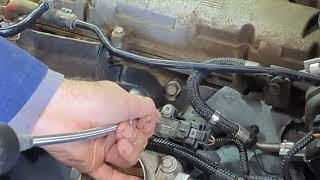
How to confirm: Check for excessive vacuum at the oil cap or a whistling noise. A formal crankcase pressure test can be performed by a dealer. Often, the ultimate confirmation is seeing oil pushed into the air filter housing or a catastrophic rear main seal leak. Some mechanics attempt to drill out the clog without removing the manifold. 🎬 Watch: How to clean the PCV orifice without removing the manifold.
Typical fix: The official fix is to replace the intake manifold. Some mechanics have developed methods to clean the orifice, but success is not guaranteed. If the rear main seal has failed, it must also be replaced, which is a labor-intensive job requiring transmission removal.
Est. part cost: $150-$300 for a new intake manifold (e.g., Dorman 615-300 or ACDelco 12639087). - Vacuum Leak 🔴 High Probability Hoses and gaskets become brittle over time. Common leak points include the intake manifold gaskets, the air intake boot between the MAF sensor and throttle body, and small vacuum lines like the one going to the MAP sensor or brake booster.
How to confirm: Perform a visual inspection of all vacuum hoses. A smoke test is the most effective way to find leaks. You can also carefully spray brake cleaner or propane around suspected areas while monitoring short-term fuel trims with a scan tool; a jump in the readings indicates a leak.
Typical fix: Replace the cracked hose or faulty gasket.
Est. part cost: $10-$150 depending on the part - Leaking/Sticking EVAP Purge Valve 🟡 Medium Probability → Shop Vapor Canister The EVAP purge solenoid can get stuck open, creating a constant vacuum leak that introduces unmetered fuel vapors into the intake manifold, which the ECM interprets as a lean condition.
How to confirm: With the engine running, disconnect the electrical connector and the vacuum line from the purge valve to the intake manifold. If you can feel suction from the valve's port, it is stuck open and needs to be replaced.
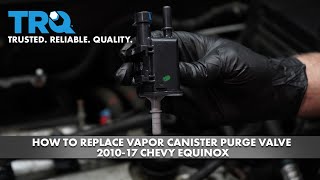
Typical fix: Replace the EVAP purge valve solenoid. A common part number is ACDelco 12610560. 🎬 See this step-by-step guide to replacing the EVAP purge valve.
Est. part cost: $25-$60 - Dirty or Faulty Mass Air Flow (MAF) Sensor 🟡 Medium Probability → Shop Fuel Injection Air Flow Meter Oil and dirt can contaminate the sensor's delicate wires, causing it to under-report the amount of air entering the engine. The ECM then commands less fuel than necessary, creating a lean condition.
How to confirm: Remove the MAF sensor and inspect for contamination. Cleaning with a dedicated MAF sensor cleaner may resolve the issue. If cleaning doesn't work, the sensor may be faulty and can be diagnosed by monitoring its readings on a scan tool.
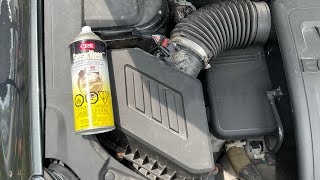
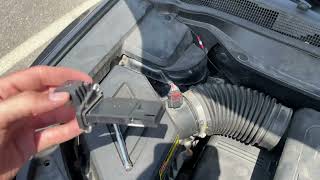
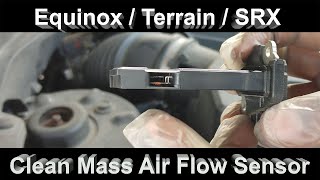
Typical fix: Clean the sensor with MAF sensor cleaner. If the problem persists, replace the MAF sensor. A common OEM part is ACDelco 213-4222 (GM 15865791). Always replace the engine air filter 🎬 Watch: A quick walkthrough on cleaning your MAF sensor. at the same time.
Est. part cost: $15 for cleaner, $70-$150 for a new sensor - Cracked Exhaust Manifold ⚪ Low Probability → Shop Exhaust Manifold The exhaust manifolds on some 2.4L engines are known to crack. A crack before the upstream oxygen sensor can allow outside air to be drawn into the exhaust stream, making the O2 sensor falsely report a lean condition.
How to confirm: Visually inspect the exhaust manifold for cracks, often near the welds or flanges. You may also hear a ticking or exhaust leak sound, especially when the engine is cold.
Typical fix: Replace the cracked exhaust manifold and gasket.
Est. part cost: $150-$400 - Low Fuel Pressure / Weak Fuel Pump ⚪ Low Probability → Shop Fuel Pump These direct-injection engines have two fuel pumps. A failing high-pressure fuel pump (HPFP) located on the engine is a more likely cause for a lean code than the in-tank pump. It can fail to deliver the required pressure to the injectors.
How to confirm: Connect a scan tool and monitor both the low-side and high-side fuel pressure readings. Compare the desired pressure with the actual pressure. A significant discrepancy on the high-pressure side under load points to a failing HPFP.
Typical fix: Replace the high-pressure fuel pump.
Est. part cost: $250-$500 for an HPFP
Rare But Worth Checking
- Incorrect Camshaft or Injectors Installed: → Shop Engine Camshaft According to TSB #PIP5203C, if major engine work was recently performed, the installation of an incorrect intake camshaft, actuator sprocket, or fuel injectors can cause a P0171 code. This is rare but critical to check if the code appeared after a repair.
- Engine Control Module (ECM) Software: TSB #PIP5028D suggests that in some cases, an update to the ECM calibration may be required to resolve P0171, especially if it appears with other codes like P0128.
Diagnosis Steps
- Read the codes with an OBD-II scanner and check freeze frame data to see the engine conditions when the code was set.
- Check long-term and short-term fuel trims. High positive numbers (e.g., >15%) confirm the ECM is compensating for a lean condition.
- If you have a 2.4L engine, immediately investigate the PCV system. Check for high vacuum at the oil fill cap (it should be hard to remove with the engine running). Inspect the air filter box for signs of oil being pushed into it.
- Inspect the entire air intake system from the air filter to the intake manifold for cracks, loose clamps, or disconnected hoses, paying close attention to the flexible intake boot.
- Listen for hissing or whistling sounds from the engine bay at idle, which can pinpoint a vacuum leak.
- Check for a stuck-open EVAP purge valve by testing for vacuum at its port when it should be closed.
- Remove and inspect the Mass Air Flow (MAF) sensor. Clean it with dedicated MAF sensor cleaner and replace the air filter.
- If no obvious leaks are found, perform a smoke test to find hidden vacuum leaks in gaskets or hoses.
- Check fuel pressure using a scan tool, monitoring both low-side and high-side (for direct injection) desired vs. actual pressures to rule out a weak fuel pump.
- Inspect the exhaust manifold for cracks, especially on 2.4L models.
- If all else fails, consider testing the upstream oxygen sensor's response, but remember it is rarely the root cause.
Parts You'll Likely Need
- Intake Manifold (2.4L)
(OEM #12639087)— The integrated PCV orifice clogs, and replacement of the manifold is the most reliable, manufacturer-recommended fix.
Related Codes That Often Appear With This One
- P0174 — P0174 is 'System Too Lean, Bank 2'. On V6 engines, if a problem like a vacuum leak or faulty MAF sensor affects the entire engine, both P0171 and P0174 will often set together.
- P0300 — P0300 is 'Random/Multiple Cylinder Misfire'. A severe lean condition can prevent proper combustion, leading to misfires across multiple cylinders.
- P0496 — P0496 is 'EVAP Flow During a Non-Purge Condition'. This code often appears with P0171 when the EVAP purge valve is stuck open, as it is the root cause for both the vacuum leak (P0171) and the improper vapor flow (P0496).
Technical Service Bulletins (TSBs) & Recalls
- 14882: Special Coverage Adjustment – Plugged PCV Orifice In Intake Manifold. Covers the primary issue on 2.4L engines, extending the warranty for this specific repair to 10 years/120,000 miles.
- PIE-0433A: Engineering Information request for data on vehicles with P0171/P0174 codes.
- PIP5203C: Notes that incorrect camshafts, actuators, or fuel injectors installed during prior repairs can cause P0171.
- PIP5028D: Suggests an ECM software update may be needed in some cases, particularly when P0171 is paired with P0128.
Platform-Specific Known Issues
- Catastrophic Rear Main Seal Failure (2.4L): The most severe consequence of the clogged PCV orifice is a blown rear main seal. The excessive crankcase pressure literally pushes the seal out, causing a massive and sudden oil leak. This often happens in cold weather when moisture in the PCV system freezes and creates a complete blockage. Owners report losing all engine oil in a matter of minutes, which can lead to engine seizure if not stopped immediately. The repair is very expensive as it requires removing the transmission to access the seal.
Mechanic-Grade Diagnostic Values
- Long-Term Fuel Trim (LTFT) and Short-Term Fuel Trim (STFT) — expected: Close to 0% at idle and under steady load.. Failure: Consistently positive values above +10%, with total trims (LTFT + STFT) exceeding +25% will set the code. High trims at idle that improve with RPM suggest a vacuum leak. High trims that worsen with RPM suggest a fuel delivery or MAF sensor issue.
- Mass Air Flow (MAF) Sensor Reading (2.4L Engine) — expected: Approximately 2.4-3.0 grams/second (g/s) at a stable, warm idle. The reading should be roughly equal to or slightly higher than the engine displacement in liters.. Failure: A reading significantly lower than 2.4 g/s at idle suggests a dirty or failing sensor, or unmetered air entering after the sensor. The reading should rise smoothly and linearly with RPM, up to 15-25 g/s at 2500 RPM.
- Low-Side Fuel Pressure (In-Tank Pump) — expected: Approximately 55 PSI.. Failure: Pressure significantly below the target indicates a weak in-tank fuel pump or clogged filter.
- High-Side Fuel Pressure (HPFP) — expected: At idle, desired and actual pressure should be around 500 PSI. TSB #PIE-0433A mentions pressures can reach 2000-2500 PSI if the incorrect camshaft is installed.. Failure: Pressure that is significantly lower than desired under load (e.g., 200-300 PSI at idle when 500 is commanded) points to a failing HPFP. Pressure that bleeds off immediately after shutting the engine off also indicates a faulty HPFP.
- Crankcase Pressure Test (2.4L PCV issue) — expected: Slight negative pressure (vacuum) at idle and when RPM is raised to 1500.. Failure: Zero or positive pressure indicated on a manometer when RPM is raised to 1500 confirms a clogged PCV orifice in the intake manifold, as per GM Special Coverage 14882.
Scan Tool Commands That Help
- GDS2 (GM Dealer Scan Tool): Catalyst Monitor Test State — While not a direct cause of P0171, if a lean condition is suspected of damaging the catalytic converter (causing a P0420), this function can manually run the internal catalyst efficiency test to get a definitive Pass/Fail result.
- GDS2 (GM Dealer Scan Tool): Oxygen Sensor Test — To actively test the response rate of the O2 sensors. This is useful as a final step to rule out a slow or biased sensor, although the O2 sensor is rarely the root cause of P0171.
Real Owner Repair Stories
- YouTube user (2012 Chevrolet Equinox 2.4L) — P0171 code, rough idle, engine shutting off, hissing sound from engine bay.
❌ Tried (didn't work) Considered replacing oxygen sensor, checking for exhaust leaks, checking for intake air leaks.
✅ What actually fixed it The small vacuum hose going to the MAP sensor was completely broken off. Replacing or repairing this small hose resolved all symptoms and the P0171 code. - YouTube user comment (Chevrolet Equinox 2.4L) — Oil consumption, oil in the air box, symptoms of a clogged PCV system.
❌ Tried (didn't work) A mechanic quoted $500-$700 for the repair.
✅ What actually fixed it The owner removed the intake manifold themselves and found the PCV orifice was completely blocked. They cleaned it out using carb cleaner and a drill bit, put everything back together, and the vehicle ran like new. The total cost was $0 and took less than 2 hours. - ScannerDanner Forum User (2010 Equinox 2.4L Ecotec) — P0171 code, poor gas mileage (17 MPG).
❌ Tried (didn't work) Replaced MAF sensor, Replaced EVAP purge valve and hose, Replaced brake booster vacuum hoses, Replaced intake manifold, Replaced valve cover gasket, Replaced exhaust manifold gasket, Replaced dip stick tube and dip stick, Replaced gas cap
✅ What actually fixed it The user's P0171 code was resolved after replacing many parts, but the poor fuel economy and abnormal fuel trims at highway speed remained, suggesting a complex issue possibly related to a lazy or dirty fuel injector that was not fully resolved in the thread. The initial P0171 was likely fixed by one of the many replaced vacuum leak-related components.
"I Checked Everything" — The Actual Cause
- In one documented case, a smoke test on the intake system showed no leaks. The technician then inspected the throttle body and found it was severely clogged with carbon deposits. Cleaning the throttle body thoroughly resolved the P0171 code. This can be missed because a smoke test checks for unmetered air leaks but doesn't assess blockages or restrictions within the intake path itself.
OEM Part Supersession History
Unknown, multiple revisions exist→ACDelco 12639087— Likely design improvements to address the clogging PCV orifice issue.
Heads up: When swapping engines between early (e.g., 2010 LAF) and later (e.g., 2013 LEA) models, the camshafts, phasers, and potentially the ECM/BCM are different and must be matched to the vehicle, or codes like P0171 will set.
Model Year Variations Within This Range
- 2010-2012: These years primarily used the 2.4L LAF and 3.0L V6 engines. The 2.4L engines in this range are most noted for the severe oil consumption and PCV clogging issues.
- 2013-2017: For 2013, the 3.0L V6 was replaced by a more powerful and reportedly more reliable 3.6L LFX V6. The 2.4L engine (now LEA) continued, but may have received updates to address oil consumption, though the PCV design risk remains.
- 2016: A mid-cycle refresh occurred for the 2016 model year, including cosmetic updates and interior changes. The core powertrain options (2.4L I4, 3.6L V6) remained the same, so the causes for P0171 are largely unchanged.
Helpful Videos
We Have This Part in Stock


The information in this article is provided for general reference and educational purposes only. Vehicle specifications, procedures, and part compatibility can vary by production date, trim level, and region. Always consult your vehicle's factory service manual and verify part numbers before purchasing or performing repairs. Safety-critical components such as airbags, seat belts, and braking systems should be installed by a qualified professional.
- Chevrolet EQUINOX:
- 🧭 Diagnostic Flowchart
- 🎬 Helpful Videos
- 🛍️ Shop This Part
- What's Unique About the 2010-2017 Chevrolet EQUINOX
- Symptoms You May Notice
- Most Likely Causes
- Rare But Worth Checking
- Diagnosis Steps
- Parts You'll Likely Need
- Related Codes That Often Appear With This One
- Technical Service Bulletins (TSBs) & Recalls
- Platform-Specific Known Issues
- Mechanic-Grade Diagnostic Values
- Scan Tool Commands That Help
- Real Owner Repair Stories
- "I Checked Everything" — The Actual Cause
- OEM Part Supersession History
- Model Year Variations Within This Range
- 🎟️ Get 5% Off