

P0171 on 2017-2019 Nissan Versa Note: Causes and Fixes for Lean System
P0171 on a 2017-2019 Versa Note usually means there's a vacuum leak, a dirty MAF sensor, or a failing front oxygen sensor. The most common fix is finding and repairing a vacuum leak, often from a bad intake manifold gasket or a cracked PCV hose, or cleaning the MAF sensor. Always check for vacuum leaks before replacing expensive sensors.
- Start your diagnosis by checking for vacuum leaks, especially around the intake manifold gasket, and cleaning the MAF sensor.
- Do not replace the expensive front oxygen (A/F) sensor unless you have ruled out all other possibilities, as advised by Nissan's own service bulletin (NTB19-022).
- A smoke test is the most effective way to find hard-to-see vacuum leaks.
- If you replace the MAF sensor, use an OEM or high-quality brand like Hitachi or Denso to avoid persistent problems.
What's Unique About the 2017-2019 Nissan VERSA NOTE

For the 2017-2019 Versa Note, Nissan issued a Technical Service Bulletin (NTB19-022) that revised the diagnostic procedure for P0171. It specifically instructs technicians to check for other fault codes and perform a full diagnosis before replacing the Air/Fuel (A/F) sensor. This suggests that misdiagnosis of the A/F sensor was common, and the true cause is often something else. Owners frequently report issues with intake manifold gaskets and dirty MAF sensors on this platform. Additionally, cracked PCV hoses and rips in the flexible accordion section of the air intake tube have been identified as a source of vacuum leaks on this platform.
Diagnostic Flowchart

Tap your situation to follow the diagnostic path that matches what you're seeing on this vehicle.
Symptoms You May Notice
- Check Engine Light is on
- Rough or unstable idle, especially when cold
- Hesitation or stumbling during acceleration
- Reduced engine power
- Decreased fuel economy
- Engine misfires, which may trigger other codes (e.g., P0300)
- Whistling or hissing sound from the engine bay, indicating a vacuum leak
- Difficulty starting the engine
- Replacing the front oxygen (A/F) sensor without proper diagnosis. As noted in TSB NTB19-022, the sensor is often not the root cause. A vacuum leak (intake gasket, PCV hose, intake boot) or MAF issue is more likely.
Most Likely Causes

- Vacuum Leak (Intake Manifold Gasket, Hoses) 🔴 High Probability The plastic intake manifold and its single-piece gasket (OEM P/N 14035-1HK0A) are a well-documented failure point on the HR16DE engine. The gasket can become brittle and fail, causing unmetered air to enter the engine. Other vacuum lines, like the PCV hose or the accordion-style air intake tube, can also crack and create a leak.
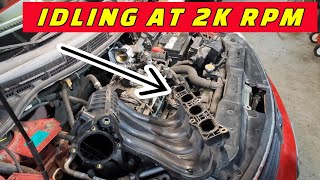
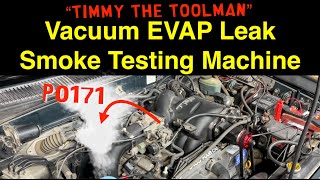
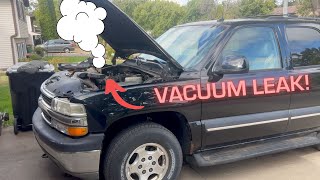
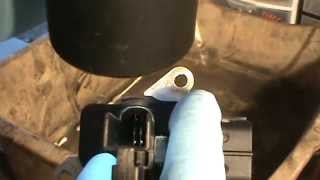
How to confirm: Perform a smoke test by injecting smoke into the intake system and watching for leaks, especially around the intake manifold 🎬 See how to find vacuum leaks using a smoke machine. where it meets the cylinder head and the flexible intake boot. Alternatively, with the engine running, carefully spray brake cleaner or unlit propane around the intake manifold gasket and vacuum lines; a noticeable change in engine idle RPM indicates a leak has been found.
Typical fix: Replace the faulty intake manifold gasket. This involves removing the throttle body and intake manifold. 🎬 Watch: Step-by-step guide to replacing the intake manifold gasket. While not overly complex, it requires careful cleaning of the mating surfaces. Also, inspect and replace any cracked or disconnected vacuum hoses, paying close attention to the PCV system and the main air duct.
Est. part cost: $15-$60 - Dirty or Faulty Mass Airflow (MAF) Sensor 🔴 High Probability → Shop Fuel Injection Air Flow Meter The MAF sensor can become contaminated with dirt, oil, and debris, causing it to send inaccurate (lower than actual) airflow readings to the engine. This leads the ECM to inject too little fuel. Aftermarket MAF sensors are notorious for causing persistent issues; using an OEM (Hitachi) sensor is strongly recommended if replacement is necessary.
How to confirm: Remove the MAF sensor and inspect the sensing elements. If they appear dirty, cleaning may resolve the issue. A scan tool can monitor MAF readings (g/s) at idle and under load to see if they are erratic or out of the expected range for the given RPM. A healthy 1.6L engine should read approximately 1.6-1.8 g/s at warm idle.
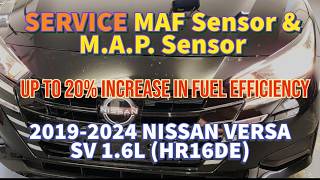
Typical fix: First, try cleaning the sensor with a dedicated MAF sensor cleaner spray. 🎬 Watch: How to troubleshoot and service your MAF sensor. Do not touch the sensor wires and do not use brake or carb cleaner. If cleaning doesn't work or the sensor is faulty, replace it with a high-quality OEM or brand-name part like Hitachi.
Est. part cost: $10 (cleaner) - $200 (new sensor) - Failing Front Oxygen Sensor (Air/Fuel Ratio Sensor) 🟡 Medium Probability → Shop Oxygen Sensor The A/F sensor is the primary input for fuel control. If it becomes slow, biased, or fails, it can incorrectly report a lean condition to the ECM. However, this part is often replaced unnecessarily when the real issue is a vacuum leak or MAF problem, which is why TSB NTB19-022 was issued to guide technicians.
How to confirm: Use a scan tool to graph the sensor's voltage or current. A healthy upstream sensor should fluctuate rapidly. A lazy or stuck sensor is likely faulty. Follow the specific diagnostic procedure in TSB NTB19-022 to avoid misdiagnosis.
Typical fix: Replace the front (upstream) oxygen sensor, also called the Air/Fuel Ratio sensor (OEM P/N 22693-1KT0A).
Est. part cost: $170-$280 - Low Fuel Pressure ⚪ Low Probability A weak fuel pump or clogged in-tank fuel filter can restrict fuel flow, leading to a lean condition across the entire engine.
How to confirm: Connect a fuel pressure gauge to the fuel system and check if the pressure is within the manufacturer's specifications (typically checked with key on/engine off and while the engine is running).
Typical fix: Replace the failing fuel pump module, which typically includes the in-tank filter.
Est. part cost: $150-$400
Rare But Worth Checking
- Faulty PCV Valve or Hose: → Shop PCV Valve The Positive Crankcase Ventilation (PCV) valve or its connecting hose can crack or stick open, creating a vacuum leak. This introduces unmetered air into the intake manifold, leading to a lean condition. A cracked PCV hose is a confirmed fix for P0171 on Nissan vehicles.
- Clogged Fuel Injectors: → Shop Fuel Injector If one or more injectors are partially clogged with deposits, they won't deliver the amount of fuel commanded by the ECM. This is less common but can cause a lean code, sometimes accompanied by a misfire code for a specific cylinder.
- Exhaust Leak: A leak in the exhaust manifold or pipe before the front oxygen sensor can allow outside air to be drawn into the exhaust stream. This makes the A/F sensor falsely detect a lean condition and command the ECM to add unnecessary fuel.
Diagnosis Steps
- Check for any other stored trouble codes to see if they provide more clues (e.g., misfire codes).
- Using a scan tool, check the long-term fuel trim (LTFT) values at idle and at 2500 RPM. A high positive value (e.g., >15-20%) confirms the lean condition. If the trim level decreases at higher RPM, a vacuum leak is highly likely.
- Visually inspect all vacuum hoses, the PCV hose, and the air intake tube (especially the accordion section) between the MAF sensor and throttle body for obvious cracks, disconnections, or damage.
- Perform a smoke test to definitively check for vacuum leaks. Pay extremely close attention to the intake manifold gasket area and the PCV system.
- If no vacuum leaks are found, remove and clean the Mass Airflow (MAF) sensor using dedicated MAF sensor cleaner. Let it dry completely before reinstalling. Re-test the vehicle.
- If the code returns, test the fuel pressure to ensure the fuel pump and filter are functioning correctly.
- If fuel pressure is normal, test the front oxygen (A/F) sensor's operation using a scan tool to check for proper response, following the guidance in TSB NTB19-022.
- If all else fails, consider less common causes like clogged fuel injectors or an exhaust leak before the A/F sensor.
Parts You'll Likely Need

- Intake Manifold Gasket
(OEM #14035-1HK0A)— This is a very common source of vacuum leaks on the HR16DE engine, causing unmetered air to enter the engine and trigger P0171.
Trusted brands: Nissan (OEM), Fel-Pro, Victor Reinz
OEM price range: $45-$65
Aftermarket price range: $15-$30 - Mass Airflow (MAF) Sensor
(OEM #22680-5RB0A)— Often gets dirty and provides incorrect air readings. Cleaning is a first step, but replacement is needed if it's faulty. Using OEM/Hitachi is highly recommended as aftermarket units can be unreliable. This part number supersedes the older 22680-BV80B.
Trusted brands: Nissan (OEM), Hitachi, Denso
OEM price range: $200-$350
Aftermarket price range: $80-$150 - Front Air/Fuel Ratio Sensor
(OEM #22693-1KT0A)— If the sensor itself fails, it will send incorrect lean readings to the ECM. It is the primary sensor for fuel control but should be tested thoroughly before replacement.
Trusted brands: Nissan (OEM), Denso, Bosch, NTK
OEM price range: $260-$390
Aftermarket price range: $150-$220
Related Codes That Often Appear With This One
- P0300-P0304 — A lean condition can cause incomplete combustion, leading to misfires. P0300 indicates random misfires, while P0301-P0304 would point to a specific cylinder that may have a clogged injector or localized vacuum leak.
- P0174 — This code is for 'System Too Lean (Bank 2)'. It is not applicable to the Versa Note's inline-four engine, which only has one bank.
Technical Service Bulletins (TSBs) & Recalls
- NTB19-022: 'NISSAN; P0171 AND P0174 SERVICE INFORMATION' - Published March 5, 2019, this TSB revises the diagnostic procedure for lean codes on the 2017-2019 Versa Note (and other models). It advises against immediate A/F sensor replacement and provides a flowchart for proper diagnosis.
Platform-Specific Known Issues
- Nissan TSB NTB19-022 provides a revised diagnostic procedure, highlighting that the Air/Fuel sensor should not be the first part replaced without following specific diagnostic steps.
Mechanic-Grade Diagnostic Values
- Mass Airflow (MAF) Sensor Reading at Idle — expected: Approximately 1.6 - 1.8 g/s (grams per second) on a fully warmed-up engine with accessories off.. Failure: A significantly lower reading may indicate a vacuum leak downstream of the sensor. A significantly higher or erratic reading may indicate a faulty sensor.
- Mass Airflow (MAF) Sensor Reading at 2500 RPM — expected: Approximately 5.7 g/s or higher, showing a smooth, linear increase with RPM.. Failure: A reading that does not rise smoothly with RPM or is significantly lower than expected can indicate a faulty sensor or a restriction.
- Long Term Fuel Trim (LTFT) at Idle — expected: Close to 0%, typically within +/- 10%.. Failure: A high positive value (e.g., +15% to +35%) indicates the ECM is adding a large amount of fuel to compensate for a lean condition.
- Long Term Fuel Trim (LTFT) Behavior (Idle vs. 2500 RPM) — expected: Values should remain relatively stable across the RPM range.. Failure: If LTFT is high at idle (e.g., +20%) but drops significantly toward 0% at a steady 2500 RPM, a vacuum leak is the most likely cause.
Real Owner Repair Stories
- Reddit user comment in /r/Nissan (2014 Nissan Versa (Same HR16DE engine)) — P0171 code, slow to start, rough idling.
❌ Tried (didn't work) Replaced O2 sensor, Replaced Mass Airflow sensor
✅ What actually fixed it The most common suggested fix from other users was a crack in the accordion-style air intake hose, specifically on the back or underside where it is difficult to see. This creates a vacuum leak after the MAF sensor. - YouTube video by 'Chris The dude nurse' (2008 Nissan Versa (Similar engine platform)) — P0171 code after replacing catalytic converter and O2 sensors.
❌ Tried (didn't work) Initial parts replacement (CAT, O2 sensors) did not resolve the lean code.
✅ What actually fixed it The final fix was replacing a cracked PCV-related hose, which was the source of the vacuum leak. The user also cleaned the throttle body and MAF sensor during the repair. After replacing the hose and clearing the code, the P0171 did not return.
"I Checked Everything" — The Actual Cause
- In some cases, a smoke test may not reveal the true root cause. A common scenario is a ruptured PCV diaphragm inside the valve cover, which causes a massive vacuum leak. However, this diaphragm may rupture because a separate, small check valve inside the plastic intake manifold has failed, causing the crankcase to become over-pressurized. Technicians might find the ruptured diaphragm and replace the valve cover, but if they don't diagnose the failed intake manifold check valve, the new diaphragm will rupture again, leading to a comeback. A shop reported a customer had a clean smoke test but was still advised to check the PCV system, suggesting it can be a tricky area to diagnose with smoke alone.
OEM Part Supersession History
22680-BV80B→22680-5RB0A— Standard part revision or manufacturer change.
Heads up: The new part number (22680-5RB0A) is the correct replacement for the original. Using the old part number may not be possible or advisable.
Model Year Variations Within This Range
- 2017-2019: There are no significant differences in the engine (1.6L HR16DE), fuel system, or emissions components that would affect the diagnosis or common causes of a P0171 code within this model year range.
Helpful Videos
We Have This Part in Stock


The information in this article is provided for general reference and educational purposes only. Vehicle specifications, procedures, and part compatibility can vary by production date, trim level, and region. Always consult your vehicle's factory service manual and verify part numbers before purchasing or performing repairs. Safety-critical components such as airbags, seat belts, and braking systems should be installed by a qualified professional.
- Nissan VERSA NOTE:
- 🧭 Diagnostic Flowchart
- 🎬 Helpful Videos
- 🛍️ Shop This Part
- What's Unique About the 2017-2019 Nissan VERSA NOTE
- Symptoms You May Notice
- Most Likely Causes
- Rare But Worth Checking
- Diagnosis Steps
- Parts You'll Likely Need
- Related Codes That Often Appear With This One
- Technical Service Bulletins (TSBs) & Recalls
- Platform-Specific Known Issues
- Mechanic-Grade Diagnostic Values
- Real Owner Repair Stories
- "I Checked Everything" — The Actual Cause
- OEM Part Supersession History
- Model Year Variations Within This Range
- 🎟️ Get 5% Off