

P0172 on 2014-2018 Chevrolet Silverado 1500: Rich Fuel Causes and Fixes
On a 2014-2018 Silverado with the 5.3L or 6.2L engine, code P0172 almost always points to a failing high-pressure fuel pump (HPFP) leaking fuel into the engine oil. The most definitive initial check is to smell the oil dipstick for a strong gasoline odor. The correct repair involves replacing the pump, its single-use high-pressure line, and performing an immediate oil and filter change to remove the contaminated oil.
- Before buying any parts, pull the oil dipstick and smell it. A strong gasoline odor makes the high-pressure fuel pump (HPFP) the number one suspect.
- If the oil smells normal, use a scan tool to check the 'Fuel Alcohol Content' reading. If it's high and you use regular gas, resetting this value may fix the issue for free.
- Inspect the MAF sensor for dirt and the air filter box for plastic obstructions near the sensor, as this is a known issue covered by a TSB.
- Do not replace the oxygen sensors; they are almost always doing their job correctly by reporting the rich condition.
What's Unique About the 2014-2018 Chevrolet Silverado 1500
These EcoTec3 direct-injected engines have a well-documented weakness in the high-pressure fuel pump (HPFP). Unlike many port-injected vehicles where a rich code points to a leaky injector or bad sensor, on these trucks, the HPFP is a primary suspect. It's a cam-driven pump located in the engine valley, and its internal seals can fail, dumping raw fuel directly into the crankcase. This fuel contaminates the oil, and the potent fuel vapors are then ingested by the engine through the Positive Crankcase Ventilation (PCV) system, creating a severe rich condition that the ECM cannot trace back to a specific sensor or injector.
Symptoms You May Notice
- Check Engine Light is on
- Strong smell of gasoline, especially when checking the engine oil
- Poor fuel economy
- Rough or unstable idle, especially after extended idling
- Black smoke from the exhaust
- Engine continues to run or sputter for a moment after being turned off ('dieseling')
- Noticeably hard or harsh shifting
- Reduced engine power or hesitation
- Long crank time to start the engine
- Replacing oxygen sensors. O2 sensors are usually correctly reporting the rich condition, they are not the cause of it. Replacing them will not fix the problem.
- Replacing the low-pressure fuel pump in the tank. This pump is rarely the cause of a rich condition; the high-pressure pump is the specific failure point on these direct-injected engines.
Most Likely Causes
- Leaking High-Pressure Fuel Pump (HPFP) 🔴 High Probability → Shop Fuel Pump The mechanical HPFP on the L83 and L86 engines is a known failure point, with some early models subject to a voluntary emissions recall. It is located in the engine valley, driven by the camshaft, and when its internal seals fail, it leaks fuel directly into the crankcase. A Reddit user described the diagnostic process: "The bushing on the cam pushrod wears out and sprays high pressure fuel into the crankcase which is then sucked into the intake by the PCV system."
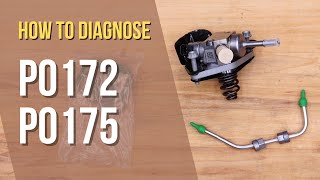
How to confirm: The most definitive sign is a strong smell of raw gasoline on the engine oil dipstick. A technician can confirm this by disconnecting the PCV hose from the intake, plugging the intake port, and watching the fuel trims on a scan tool. 🎬 See how to diagnose the fuel system and fix rich codes. If the trims rapidly improve towards zero, it confirms unmetered fuel vapors were entering from the crankcase. A visual comparison of a new vs. a failed pump often shows the failed pump's internal spring area washed clean by fuel.
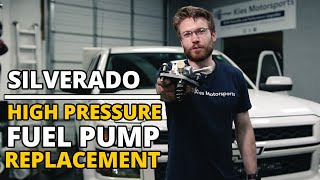
Typical fix: Replace the high-pressure fuel pump and the associated high-pressure fuel line 🎬 Watch: Step-by-step guide to replacing the high-pressure fuel pump. (which is single-use). An immediate oil and filter change is mandatory to remove the fuel-contaminated oil. Failing to change the oil will cause the rich code to return.
Est. part cost: $200-$500 - Incorrect Fuel Alcohol Content Reading 🟡 Medium Probability These trucks use a 'virtual' alcohol sensor; the ECM calculates the ethanol percentage based on readings from the oxygen sensors and fuel level changes after a fill-up. This calculation can drift over time, especially with short trips, causing the ECM to believe the fuel has a high ethanol content (like E85) and inject more fuel than necessary. A forum user noted their alcohol content reading was 23% while running regular 87 octane.
How to confirm: Use a scan tool to view the 'Fuel Alcohol Percentage' or similar PID. If you only use regular gasoline (E10/E15), the value should be low (typically under 15%). If the reading is high (e.g., 30%, 50%, or more), the ECM is commanding a rich mixture based on false data. Long-term fuel trims will be extremely negative, often maxed out at -30% or more.
Typical fix: Use a bi-directional scan tool to perform a 'Fuel Alcohol Content Reset' or 'Fuel Composition Reset'. This procedure resets the learned value back to a default (often around 3%), allowing the system to re-learn correctly. No parts are replaced. After the reset, the fuel trims should return to near zero.
Est. part cost: $0 - Dirty or Faulty Mass Air Flow (MAF) Sensor 🟡 Medium Probability → Shop Fuel Injection Air Flow Meter A dirty sensor can under-report airflow, causing the ECM to inject too much fuel. Additionally, TSB #PIP5446A notes that excess plastic 'flash' from the manufacturing process inside the air filter housing can disrupt airflow and cause erratic readings and rich/lean codes. Oiled aftermarket air filters are a common cause of MAF sensor contamination.
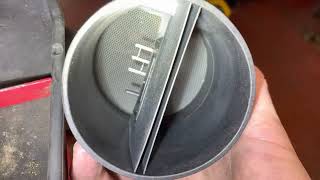
How to confirm: Inspect the MAF sensor wires for dirt or oil contamination. Inspect the inside of the air filter housing for any plastic obstructions near the sensor, as detailed in TSB PIP5446A. Clean the sensor with dedicated MAF sensor cleaner. A dirty MAF can also cause transmission shifting problems because it is a primary input for engine load calculation. 🎬 Watch: How a dirty MAF sensor causes these specific trouble codes.
Typical fix: Clean the MAF sensor with a dedicated cleaner. If the air filter housing has casting flash, the official GM fix is to replace the air filter housing lid (OEM Part #23383011, verify with VIN). If cleaning doesn't work, replace the MAF sensor.
Est. part cost: $60-$150 - Stuck Open EVAP Purge Valve ⚪ Low Probability → Shop Vapor Canister
How to confirm: With the engine running at idle, disconnect the purge line from the valve itself. There should be no vacuum present. You can also use a scan tool to command the valve closed and apply a vacuum pump to see if it holds. In one diagnostic video, a technician commanded the purge valve to 100% with a scan tool and felt no vacuum at the disconnected line, confirming the valve was stuck closed or failed electrically, though a stuck-open valve is more common for a rich code.
Typical fix: Replace the EVAP canister purge valve/solenoid. A common part number is ACDelco #214-2317 (GM #12690512), but always verify with VIN.
Est. part cost: $25-$50
Rare But Worth Checking
- Leaking Fuel Injector: → Shop Fuel Injector While less common than the HPFP failure, a direct injector can get stuck open, dumping fuel into a single cylinder. This might be accompanied by a misfire code for that specific cylinder (e.g., P0301-P0308). A scan tool with injector balance test capabilities can help identify a leaking injector without full disassembly.
Diagnosis Steps
- Read all diagnostic trouble codes with a scanner. Note if P0175 is also present, which indicates a problem affecting both banks.
- Perform the most critical check: Remove the engine oil dipstick and smell the oil. If it has a strong odor of raw gasoline, the high-pressure fuel pump is the most likely cause and should be addressed immediately to prevent engine damage.
- Connect a scan tool and observe Long-Term Fuel Trim (LTFT) for Bank 1. It will be significantly negative (e.g., -20% to -35%).
- On the scan tool, check the 'Fuel Alcohol Content' value. If it is abnormally high (over 15-20%) and you are not using E85 fuel, perform a 'Fuel Composition Reset'.
- Visually inspect the air filter and the air intake tube. Remove and inspect the MAF sensor for contamination. Check the air filter housing for casting flash per TSB PIP5446A.
- If the HPFP is suspected, confirm by temporarily disconnecting the PCV fresh air hose and plugging the intake port; if the fuel trims rapidly improve towards zero, it confirms unmetered fuel vapors were entering from the crankcase.
- Test the EVAP purge valve to ensure it is not stuck open and leaking fuel vapors into the intake at idle.
- As a final check, you can perform a fuel injector balance test or leak-down test to check for a faulty injector, though this is less common than the HPFP failure.
Parts You'll Likely Need
- High-Pressure Fuel Pump
(OEM #12677329 (Superseded by 12711662))— This is the most common failure point on the L83/L86 engines that causes a P0172 code due to internal leaking. A Reddit user found the GM Genuine part on RockAuto for $220.
Trusted brands: ACDelco, Bosch, GM Genuine
OEM price range: $220-$500
Aftermarket price range: $150-$300 - High-Pressure Fuel Pipe
(OEM #12655251)— This pipe connects the HPFP to the fuel rail and is a single-use, torque-to-yield part that must be replaced anytime it is disconnected. Re-using it can lead to dangerous fuel leaks.
Trusted brands: ACDelco
OEM price range: $30-$50
Related Codes That Often Appear With This One
- P0175 — System Too Rich (Bank 2). If both banks are running rich, it strongly points to a global issue affecting the entire engine, such as the HPFP, MAF sensor, or incorrect fuel alcohol content.
- P0101 — Mass Air Flow (MAF) Circuit Range/Performance. This code may appear if the MAF sensor is dirty, faulty, or if airflow is disrupted by the casting flash issue described in TSB PIP5446A.
- P0300 — Random/Multiple Cylinder Misfire. A severe rich condition can foul spark plugs with carbon and fuel, leading to incomplete combustion and misfires.
Technical Service Bulletins (TSBs) & Recalls
- PIP5446A: Addresses harsh shifting, rough idle, and rich/lean codes (P0172, P0175, P0101) caused by excessive casting flash in the air filter housing near the MAF sensor on 2014-2018 models. The fix is to inspect and, if flash is found, replace the air filter housing lid.
- PIP4792D: Pertains to slightly older models but the principle is relevant; discusses extended crank, rough running, and P0172/P0175 due to incorrectly learned fuel alcohol content on E85-compatible vehicles, requiring a scan tool reset.
- GM Voluntary Emission Recall 13370 / N140010: Affects some 2014 models with 4.3L and 5.3L engines for an incorrect fuel pump pressure regulator that could cause stalling or hard starts.
- GM Voluntary Emission Recall (Feb 2015): Affects certain 2014-2015 models with L83/L86 engines where the high pressure fuel pump may leak, causing fuel odor. Correction is to replace the fuel pump.
Platform-Specific Known Issues
- A leaking High-Pressure Fuel Pump (HPFP) is a widely documented problem that causes fuel to contaminate the engine oil, leading to rich codes P0172 and P0175.
- TSB #PIP5446A identifies an issue where excess plastic molding ('casting flash') in the air filter housing can disrupt airflow over the MAF sensor, causing inaccurate readings and rich codes.
Mechanic-Grade Diagnostic Values
- Long-Term Fuel Trim (LTFT) at idle — expected: -10% to +10%. Failure: Consistently more negative than -20% to -25%, indicating the ECM is removing fuel to compensate for a rich condition.
- Low-Side (In-Tank Pump) Fuel Pressure — expected: Around 72 PSI (500 kPa). A pressure relief valve should be set at 84 PSI (580 kPa).. Failure: Significantly lower pressure could indicate a weak in-tank pump, though this is not a common cause for a rich code.
- High-Pressure Fuel System Leak-Down Test — expected: After shutting off the engine, the high-side fuel pressure should remain stable or rise slightly as heat soaks the fuel rail.. Failure: A steady, continuous drop in pressure after shutdown indicates a leak, which could be a dripping injector.
- MAF Sensor Reading at Idle — expected: Approximately 4 grams/second for a 4-cylinder engine; a V8 like the 5.3L should be proportionally higher, likely in the 5-7 g/s range at a stable idle.. Failure: A reading that is significantly lower than expected for the engine's displacement can cause the ECM to command too much fuel.
- Injector Pulse Width (L83) — expected: Well below 6.0ms under normal operation.. Failure: Approaching or exceeding 6.0ms indicates the injectors are nearing their maximum duty cycle limit, often seen when trying to compensate for issues or under heavy load/high ethanol content.
Scan Tool Commands That Help
- GDS2 / Tech2Win or equivalent bi-directional scanner: Fuel Composition Reset — Use this when the 'Fuel Alcohol Percentage' PID shows a high value (e.g., >20%) but the vehicle has only been filled with standard E10/E15 gasoline. An incorrect high reading will cause the ECM to command more fuel, creating a rich condition. This function resets the value to a baseline, allowing it to re-learn correctly.
- GDS2 or equivalent bi-directional scanner: Injector Balance Test — This test can help identify a leaking or malfunctioning fuel injector. The tool pressurizes the fuel system and pulses each injector individually while monitoring the pressure drop on a fuel pressure gauge. An injector with an excessive pressure drop may be leaking.
- GDS2 or equivalent bi-directional scanner: EVAP Purge/Seal — This command allows the technician to command the EVAP purge valve open and closed to test its function. For a P0172, you would command it closed at idle and ensure no fuel vapors are being drawn into the intake, which would contribute to a rich condition.
Wiring & Ground Locations
- G102 — Located at the left rear of the engine, on the cylinder head.. This ground is for the 8 ignition coils. While not a direct cause of a rich code, a poor ground here can lead to weak spark, incomplete combustion, and misfires (P0300), which can accompany or be mistaken for a primary fuel issue.
- G103 / G104 — Located on the front of the passenger side (G103) and rear of the driver side (G104) cylinder heads.. These are primary engine ground points. The ECM and its sensors rely on solid ground paths. Corrosion or looseness at these points can introduce electrical noise and cause erratic sensor readings, potentially affecting fuel calculations.
- MAF Sensor Connector (8-pin) — On the air intake tube after the air filter housing.. A poor connection here can cause a P0101 but also contribute to P0172/P0175. Pin 5 should have 12V (ignition on), Pin 7 should be ground (<2 Ohms to chassis ground), and Pin 6 is the 5V reference signal. Verifying these voltages is crucial before replacing the sensor.
Real Owner Repair Stories
- YouTube channel 'Wrenching With Kenny' (2014+ Silverado/Sierra with 5.3L GDI engine) — P0172 and P0175 rich codes.
❌ Tried (didn't work) Not specified, but the video implies that basic checks were performed first.
✅ What actually fixed it The high-pressure fuel pump had failed and was leaking fuel into the crankcase. The fix was replacing the high-pressure fuel pump and performing an oil change. - YouTube channel 'Flat Rate Mechanic' (Chevy Suburban with 5.3L engine) — P0172 and P0175, with long-term fuel trims at -30%.
❌ Tried (didn't work) Checking for vacuum leaks., Blocking off the EVAP purge valve hose (no change in fuel trims).
✅ What actually fixed it The 'Fuel Alcohol Content' was reading 67%. Using a scan tool to perform a 'Fuel Compensation Reset' immediately brought the long-term fuel trims back to 0%. No parts were replaced.
OEM Part Supersession History
12677329→12691016, 12711662 (verify latest with VIN)— GM often updates parts to improve reliability or address known failure modes. The original HPFP is a known high-failure item.
Heads up: Part number 12691016 appears to supersede a long list of previous numbers including 12622475, 12633594, 12641740, and 12677329, indicating it may be a more robust, consolidated design.
Model Year Variations Within This Range
- 2015-2018: In 2015, Chevrolet began pairing the 6.2L L86 V8 with a new 8-speed (8L90) automatic transmission. While this doesn't directly affect the cause of P0172, the transmission control module relies heavily on accurate engine torque signals, which are derived from MAF and fuel calculations. A severe rich condition can sometimes manifest as harsh shifting, an issue noted in TSBs related to MAF problems.
Diagnostic Flowchart
Real Owner Stories
Aggregated from forums and TSBs cited above. Mileages and costs reflect what owners reported in those sources.
2014-2018 Chevrolet Silverado
Symptoms: P0172 and P0175 codes appeared after extended periods of idling, accompanied by noticeably hard shifting and the engine 'dieseling' (continuing to run or sputter) for a moment after being turned off.
What fixed it: Checking and resetting the incorrectly learned fuel alcohol content.
Source hint: https://www.chevroletforum.com/forum/2014-2018-gmt-k2-122/p0175-p0172-104993/
2015 Chevrolet Suburban LTZ
Symptoms: P0172 and P0175 codes triggered specifically at idle, with scan tool data showing long-term fuel trims maxed out at -35%.
What fixed it: Replacing the leaking High-Pressure Fuel Pump (HPFP).
Source hint: https://www.tahoeyukonforum.com/threads/p0172-p0175-2015-suburban-ltz.143719/
2015 Chevrolet Silverado 5.3L
Symptoms: Engine running rich with codes P0172 and P0175 present.
What fixed it: Diagnosed and replaced a failed HPFP after pulling the PCV hoses, plugging the intake boot holes, and watching the fuel trims return to normal.
Source hint: https://www.reddit.com/r/ChevyTrucks/comments/18m692l/2015_silverado_53_runs_rich/
Related OBD-II Codes
Frequently Asked Questions
Is there a recall for the high-pressure fuel pump on my 2014-2015 Silverado 5.3L?
Why is my Silverado shifting harshly along with the P0172 code?
How can I confirm if my Silverado's P0172 is caused by a leaking high-pressure fuel pump?
What is a 'Fuel Alcohol Content Reset' and why might my truck need it?
Does TSB PIP5446A apply to my 2014-2018 Silverado?
Do I need to change my oil if the high-pressure fuel pump fails?
Helpful Videos
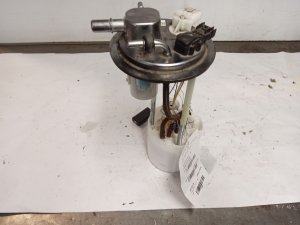
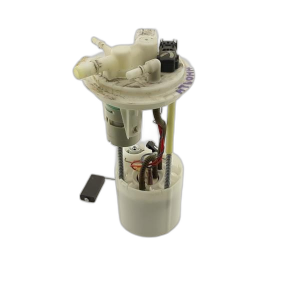
Used OEM Parts in Stock
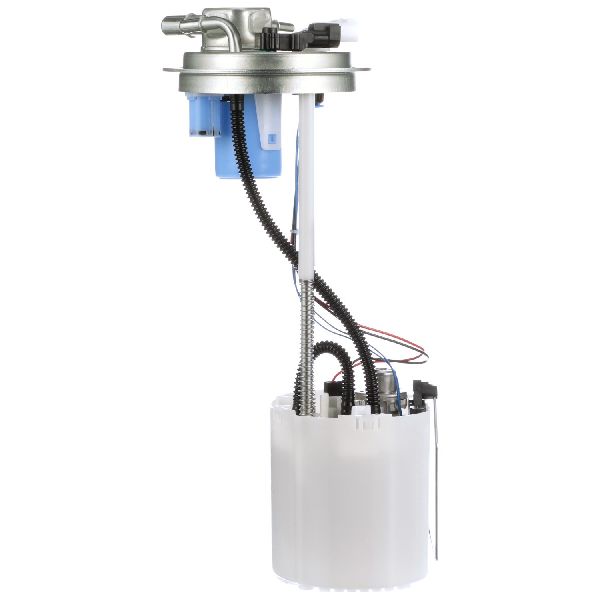
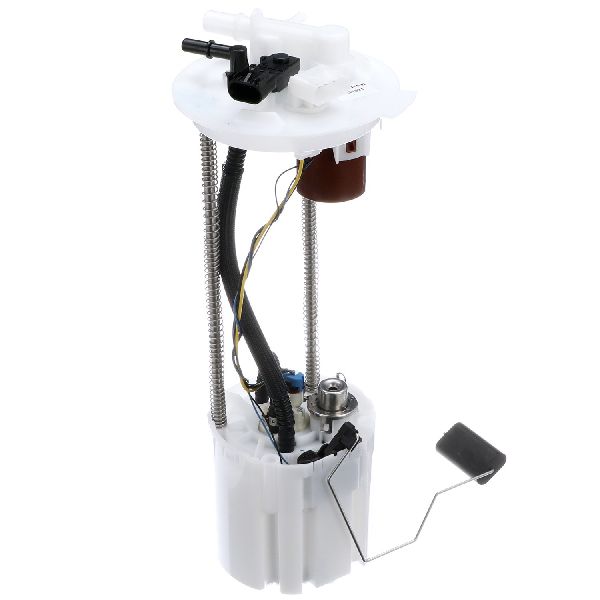
New Aftermarket Parts Available


The information in this article is provided for general reference and educational purposes only. Vehicle specifications, procedures, and part compatibility can vary by production date, trim level, and region. Always consult your vehicle's factory service manual and verify part numbers before purchasing or performing repairs. Safety-critical components such as airbags, seat belts, and braking systems should be installed by a qualified professional.
- Chevrolet Silverado 1500:
- 🧭 Diagnostic Flowchart
- 🎬 Helpful Videos
- 🛍️ Shop This Part
- What's Unique About the 2014-2018 Chevrolet Silverado 1500
- Symptoms You May Notice
- Most Likely Causes
- Rare But Worth Checking
- Diagnosis Steps
- Parts You'll Likely Need
- Related Codes That Often Appear With This One
- Technical Service Bulletins (TSBs) & Recalls
- Platform-Specific Known Issues
- Mechanic-Grade Diagnostic Values
- Scan Tool Commands That Help
- Wiring & Ground Locations
- Real Owner Repair Stories
- OEM Part Supersession History
- Model Year Variations Within This Range
- Real Owner Stories
- 2014-2018 Chevrolet Silverado
- 2015 Chevrolet Suburban LTZ
- 2015 Chevrolet Silverado 5.3L
- Related OBD-II Codes
- Frequently Asked Questions
- 🎟️ Get 5% Off