

P0174 on 2003-2006 BMW X3 M54: Causes for System Too Lean Bank 2
On a BMW X3 with the M54 engine, code P0174 is almost always caused by a vacuum leak. The most common culprits are cracked intake boots, a failed CCV system, or a leaking DISA valve O-ring. A smoke test is the best way to find the leak before buying parts. Less common causes include a leaking valve cover gasket or fuel injector O-rings.
- P0174 on an M54-powered X3 almost certainly means there is a vacuum leak.
- Do not replace oxygen sensors or the MAF sensor until you have definitively ruled out vacuum leaks.
- The most effective way to diagnose this code is with a smoke test to find the source of the unmetered air.
- The most common culprits are the intake boots, the CCV system, and the DISA valve O-ring.
- This guide applies specifically to 2003-2006 BMW X3 models with the M54 engine.
What's Unique About the 2003-2010 BMW X3
The BMW M54 engine, used in the X3 from 2003-2006, is legendary for its performance but also notorious for vacuum leaks as it ages. Unlike many other vehicles where a lean code might point to a sensor, on the M54, the cause is overwhelmingly a physical breach in the intake or crankcase ventilation system. The plastics and rubber used for components like the intake boots and CCV system become brittle over time from heat and oil exposure, leading to cracks that allow unmetered air to enter the engine after the Mass Airflow (MAF) sensor.
Generation note: The 2003-2010 BMW X3 model range covers the entire first generation (E83). However, this guide is specific to the M54 inline-6 engine, which was used in the 2003-2006 model years. Later models (2007-2010) used the N52 engine, which has different components and potential causes for lean codes.
Symptoms You May Notice
- Check Engine Light is on
- Rough or unstable idle, especially when cold
- Engine hesitation or stumbling during acceleration
- Reduced fuel economy
- A whistling or hissing sound from the engine bay
- Increased oil consumption if the CCV system has failed
- In severe cases, stalling when coming to a stop
- Loss of power, particularly at low RPM
- Replacing the oxygen (O2) sensors. While a faulty O2 sensor can cause lean codes, it is not a common failure point on the M54 compared to vacuum leaks. The O2 sensor is usually correctly reporting the lean condition, it is not the cause of it. Always perform a smoke test before replacing sensors.
Most Likely Causes
- Cracked Intake Boots 🔴 High Probability The rubber intake boots (upper and lower) between the MAF sensor and the throttle body are exposed to constant engine heat and vibration. They are famous for developing cracks in the accordion-like folds, which are often difficult to see without removing the part. The lower boot is especially prone to cracking where the idle air control valve branch connects.
How to confirm: Visually inspect the boots, bending them to reveal hidden cracks. The most definitive method is to perform a smoke test, which will show smoke leaking from any cracks. Spraying brake cleaner near the boots with the engine running may cause the idle to change, indicating a leak.
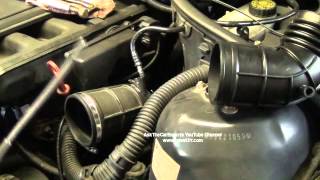
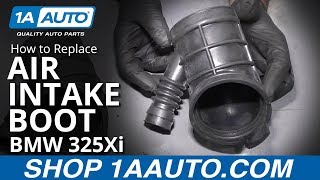
Typical fix: Replace both the upper and lower intake boots. 🎬 See this walkthrough for removing and installing new intake boots. It is recommended to replace them as a pair. Ensure hose clamps are properly seated and tightened.
Est. part cost: $40-$100 - Failed Crankcase Ventilation (CCV) System 🔴 High Probability The CCV system, also known as the oil separator, is made of plastic and rubber hoses that become extremely brittle with age. Failure of the valve diaphragm or cracks in the hoses create a significant vacuum leak, often causing both P0171 and P0174 codes. Cold climate versions exist with insulation to prevent freezing and clogging, a common issue.
How to confirm: A classic sign of a failed CCV diaphragm is a strong vacuum at the oil fill cap when the engine is running, making it very difficult to remove. Other symptoms include high oil consumption, blueish smoke from the exhaust, and oil in the intake boots. A smoke test will often show smoke exiting the oil dipstick tube or the valve cover if the CCV has failed.
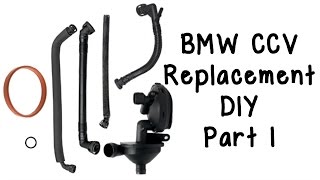
Typical fix: Replace the entire CCV system, including the oil separator valve and all four associated hoses. This is often sold as a complete kit. It is a labor-intensive job due to tight access under the intake manifold.
Est. part cost: $70-$200 - Leaking DISA Valve O-Ring 🟡 Medium Probability The DISA (Differentiated Intake System) valve adjusts the intake manifold runner length. Its seal against the intake manifold is a single O-ring that flattens and hardens over time, creating a vacuum leak. The original seal is molded into the housing and must be scraped out.
How to confirm: With the engine running, spray short bursts of brake cleaner or unlit propane near the DISA valve housing. If the engine idle changes, a leak is present. The valve can be removed (two T40 Torx bolts) to visually inspect the O-ring; if it's flat instead of round, it's bad. While removed, check the internal flap for excessive play and ensure the metal pin is secure, as it can fall into the engine causing catastrophic damage.
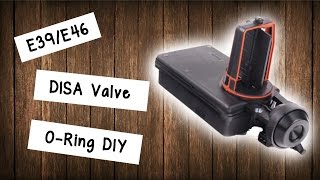
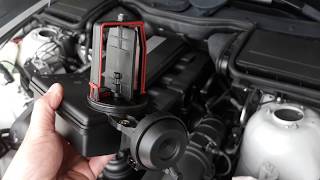
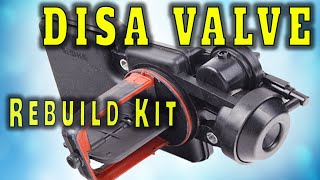
Typical fix: Replace the DISA valve O-ring. Many owners opt to install a DISA valve rebuild kit 🎬 Watch: How to fix and upgrade your DISA valve. which includes an upgraded seal (e.g., Viton or Fluorosilicone) and often reinforces the internal flap mechanism. An O-ring from a 91-94 Ford Probe water outlet is a known cross-fit part.
Est. part cost: $10-$60 - Leaking Valve Cover Gasket ⚪ Low Probability → Shop Engine Valve Cover The valve cover gasket hardens and leaks oil, which is a very common M54 issue. While primarily an oil leak, a significant breach, especially around the intake side or near the spark plug wells, can introduce unmetered air. A hairline crack in the plastic valve cover itself can also be a source of a vacuum leak.
How to confirm: Visual signs of oil leaking from the edges of the valve cover, particularly down the side of the engine block. A smoke test may show smoke seeping from the gasket edges. Oil found in the spark plug wells is another strong indicator.
Typical fix: Replace the valve cover gasket and the 15 associated grommets for the retaining nuts.
Est. part cost: $40-$100
Rare But Worth Checking
- Dirty or Failing Mass Airflow (MAF) Sensor: → Shop Fuel Injection Air Flow Meter A failing MAF sensor typically affects both banks and would throw P0171 and P0174 together. It's less likely if only P0174 is present but worth cleaning with a dedicated MAF cleaner as a maintenance step before replacement. Aftermarket cold air intakes can sometimes cause issues leading to these codes.
- Leaking Fuel Injector O-Rings: → Shop Fuel Injector The O-rings that seal the fuel injectors into the intake manifold can dry out and leak, causing a vacuum leak specific to one or more cylinders on Bank 2. This can sometimes be detected with a smoke test or by spraying carb cleaner near the injectors on Bank 2.
- Weak Fuel Pump or Clogged Fuel Filter: → Shop Fuel Pump Low fuel pressure can cause lean conditions, but this would typically affect both banks simultaneously. The fuel filter on these models also contains the fuel pressure regulator, and failure of either component can cause lean codes.
- Leaking Oil Dipstick O-Ring: The O-ring at the base of the oil dipstick tube where it enters the oil pan can become brittle and create a vacuum leak. This is often found during a smoke test, with smoke seen coming from the base of the dipstick tube.
- Brake Booster Hose Leak: A crack or loose connection in the vacuum hose leading to the brake booster can create a significant vacuum leak.
Diagnosis Steps
- Read the fault codes using an OBD-II scanner. Note any other codes present, especially P0171 or misfire codes.
- With a capable scanner, check the Long Term Fuel Trim (LTFT) and Short Term Fuel Trim (STFT) values at idle. High positive numbers (e.g., >+10%) on Bank 2 confirm the DME is adding fuel to correct a lean condition. Values that are high at idle but improve with RPM suggest a vacuum leak.
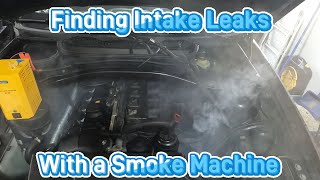
- The most effective diagnostic step: perform a smoke test. 🎬 Watch: How to perform a smoke test on your X3. Introduce smoke into the intake system via a vacuum line and look for smoke escaping. Common leak points are the intake boots, CCV hoses, DISA valve seal, dipstick tube O-ring, and valve cover gasket.
- Perform a thorough visual inspection of all vacuum hoses and the intake boots for obvious cracks or disconnections, especially in the accordion sections of the boots.
- Check for a failed CCV by trying to remove the oil cap with the engine running. Extreme suction indicates a likely failure.
- If no vacuum leaks are found, remove and inspect the DISA valve O-ring for flatness or damage and check the valve's internal flap for security.
- If no leaks are found after a thorough smoke test, investigate the fuel system. Check fuel pressure to rule out a weak pump or clogged filter/regulator. The M54 requires approximately 3.5 bar (50 psi).
- As a last resort, consider a faulty pre-catalyst oxygen sensor for Bank 2, but only after all potential vacuum and fuel delivery issues have been ruled out.
Parts You'll Likely Need
- Intake Boot Kit (Upper and Lower)
(OEM #13541438759 (Upper), 13541438761 (Lower))
Related Codes That Often Appear With This One
- P0171 — System Too Lean (Bank 1). This is the companion code for Bank 1 (cylinders 1-3). It often appears with P0174 because major vacuum leaks from the CCV system or intake boots affect the entire engine.
- P0304, P0305, P0306 — Cylinder Misfire (Cylinders 4, 5, or 6). A severe lean condition on Bank 2 can lead to misfires in the affected cylinders. Random misfire code P0300 is also possible.
- 2882, 2883 — These are the BMW-specific fault codes for fuel mixture control, corresponding to the generic P0171/P0174 codes. A BMW-specific scanner will read these.
Technical Service Bulletins (TSBs) & Recalls
- SI B13 01 07 - While not directly for P0174, this TSB addresses issues with the fuel tank vent valve on related engines, which can cause fuel trim faults. It's a reminder that other, less common evaporative emission system components can also cause lean conditions.
Mechanic-Grade Diagnostic Values
- Fuel Pressure (at fuel rail Schrader valve) — expected: Approx. 3.5 bar (50 psi) at idle.. Failure: Pressure significantly below 3.5 bar indicates a weak fuel pump or clogged filter/regulator. Pressure that bleeds off quickly after shutdown can indicate a leaking injector or faulty check valve.
- Mass Airflow (MAF) Sensor Reading at Idle — expected: Approximately 3.0-4.0 g/s for a 3.0L M54B30 engine at normal operating temperature. A general rule of thumb is that the g/s reading should roughly equal the engine displacement in liters.. Failure: Readings significantly lower or higher than the engine's displacement in liters at idle can suggest a faulty MAF sensor or a large vacuum leak downstream.
- Long Term Fuel Trims (LTFT) — expected: Between -5% and +5% on a healthy engine.. Failure: Sustained positive values above +10% to +12% will trigger the P0174 code. If trims are high at idle but normalize or decrease with increased RPM (e.g., at 2500 RPM), this strongly suggests a vacuum leak. If trims remain high across the RPM range, it may point more towards a fuel delivery or MAF sensor issue.
Hidden / Shadow Codes Worth Checking
- 2883: Mixture Control, Bank 2. This is the BMW-specific equivalent of P0174. (see via BMW-specific diagnostic software like INPA or ISTA, or high-end professional scan tools.)
- 2882: Mixture Control, Bank 1. This is the BMW-specific equivalent of P0171 and often appears with 2883. (see via BMW-specific diagnostic software like INPA or ISTA, or high-end professional scan tools.)
Scan Tool Commands That Help
- INPA/ISTA: Clear Adaptations / Reset Mixture Adaptations — This function should be performed after a repair that fixes a significant lean or rich condition, such as replacing a failed CCV system or fixing a large vacuum leak. It resets the long-term fuel trims to zero, allowing the DME to relearn the fuel map with the new, correct conditions. Failing to do this can cause the car to run poorly for a period after the repair as it relies on the old, incorrect learned values.
Wiring & Ground Locations
- Secondary Air System Vacuum Line — Runs from the secondary air valve near the exhaust manifold, around the perimeter of the valve cover, and connects to a port under the intake manifold.. This thin plastic line (PN 11727574490) becomes extremely brittle and almost always breaks or cracks when the valve cover is removed for a gasket replacement. This creates a vacuum leak that is often missed, causing lean codes (P0171/P0174) or secondary air codes (P0491/P0492) immediately after a valve cover service. It's a classic 'I just fixed one thing and now have a new code' scenario.
Real Owner Repair Stories
- Bimmerfest forum user (BMW E46 330i (M54)) — Persistent P0171 and P0174 codes with high LTFTs (+11% on both banks).
❌ Tried (didn't work) Smoke test performed, multiple vacuum leaks found and fixed, Both pre-catalyst O2 sensors replaced, MAF sensor replaced with new OEM Bosch unit
✅ What actually fixed it A fuel pressure test revealed the fuel pump was not holding pressure after the initial prime. Replacing the fuel pump resolved the lean codes. - Reddit r/e39 user (BMW 5 Series E39 with M54B25 engine) — Rough idle when at operating temperature, high lambda reading (2.0), indicating a severe lean condition.
❌ Tried (didn't work) CCV system replaced, Intake boots replaced, Vanos seals replaced, DISA valve and intake gaskets replaced, Cleaned Idle Control Valve
✅ What actually fixed it The user discovered a large, visible crack in the plastic valve cover itself, which was the source of the unmetered air. Replacing the entire valve cover was the fix.
"I Checked Everything" — The Actual Cause
- A weak fuel pump delivering low pressure (below the required ~50 psi) can cause lean codes on both banks even with a perfectly sealed intake system. A fuel pressure test is required to confirm this.
- A hairline crack in the exhaust manifold before the pre-catalyst O2 sensor can draw in fresh air, making the sensor read a false lean condition. This is difficult to find with a smoke test and may require close visual inspection of the manifold.
- Leaking fuel injector O-rings at the point where they seal into the intake manifold can be a small, localized vacuum leak that is sometimes missed by a smoke test but can be found by spraying brake cleaner directly at the base of each injector.
When the Usual Fixes Don't Work
- While the vast majority of P0174 codes on the M54 are caused by vacuum leaks, there are well-documented cases where the intake system is perfectly sealed, yet the code persists. In one such case, after replacing all common vacuum leak parts (intake boots, CCV, DISA O-ring) and even replacing sensors, the root cause was identified as a failing fuel pump that could not provide the required 3.5 bar of pressure under all conditions. This highlights the importance of not skipping a fuel pressure test when a thorough smoke test comes back clean.
OEM Part Supersession History
Varies→Cold Climate CCV Kit (e.g., 11617533400)— The standard CCV system was prone to freezing in cold climates, causing oil sludge and potential engine damage. BMW introduced an insulated version with foam jackets around the hoses and separator.
Heads up: The cold climate version is a direct, recommended upgrade for all M54 engines, regardless of the original climate the vehicle was sold in.
Model Year Variations Within This Range
- 2003-2006: The M54 engine itself did not receive a major technical update (TU) during its production run in the X3. The primary variations relate to optional equipment, such as the standard vs. cold-climate CCV system, but the core causes and fixes for P0174 remain consistent across these years.
Diagnostic Flowchart
Other Known Issues on This Vehicle
Issues unrelated to this code that are worth knowing about as an owner of this generation:
- VANOS Seal Failure 🔴 High — Extremely common. Seals degrade over time, typically noticeable after 70,000 miles. Symptoms include rough cold idle, loss of low-end torque, and rattling noises from the front of the engine.
- Cooling System Failure 🔴 High — Very common. The plastic components (expansion tank, radiator necks, water pump impeller) become brittle and fail, leading to coolant leaks and potential overheating. Preventative overhaul every 80,000-100,000 miles is recommended.
- Oil Filter Housing Gasket (OFHG) Leak 🟠 Medium — Extremely common oil leak. The gasket hardens and allows oil to leak down the driver's side of the engine block. If left unfixed, it can degrade the serpentine belts.
- Transfer Case Actuator Gear Failure 🟠 Medium — Common on all E83 X3 models. The plastic gear inside the transfer case actuator motor wears out, causing the 4x4, ABS, and Brake warning lights to illuminate. A metal replacement gear is a common, permanent fix.
- Panoramic Sunroof Malfunction 🟡 Low — Common issue where the sunroof mechanism fails due to broken plastic guide pieces, causing it to jam, rattle, or fail to close properly. Repair can be complex and costly.
Used vs. New Parts: Buying Guide for This Vehicle
When a used part is the smart pick: For certain electronic or robust mechanical components, a used part from a low-mileage donor can be a viable option. This includes items like the MAF sensor (if OEM Bosch/Siemens), throttle body, or even the DISA valve housing (if you plan to install a rebuild kit anyway).
Donor-vehicle mileage cap: roughly under 80000 miles for the part to have meaningful remaining life.
What to inspect on the donor part:
- For rubber/plastic parts, check for a recent date code stamped on the part.
- Squeeze any rubber hoses or boots; they should be pliable, not hard or crunchy.
- For electronic sensors, look for the original OEM branding (e.g., Bosch, Siemens/VDO). Avoid unbranded parts.
- Check for evidence of a front-end collision on the donor car, which could have damaged engine components.
OEM-only on this vehicle (don't cheap out):
- Crankcase Ventilation (CCV) System: Aftermarket CCV kits are notoriously unreliable and often fail within a year. The complex design and material requirements make OEM or OE-supplier (e.g., Febi, Vaico) the only sensible choice.
- Intake Boots: Cheap aftermarket intake boots often use inferior rubber that cracks prematurely. Stick with OEM or a reputable OE supplier like Rein.
Aftermarket brands forum-validated for this vehicle:
- DISA Valve Rebuild Kits: German Auto Solutions (GAS) and iA Performance offer well-regarded metal and upgraded-material rebuild kits that are considered superior to the original plastic components.
- Sensors (MAF, O2): Bosch, Siemens/VDO, NTK are the original equipment suppliers and are the most reliable choices.
Brands owners have reported issues with on this vehicle:
- URO Parts: While some of their products may be acceptable, URO has a widespread reputation in the BMW community for poor quality control on critical rubber and plastic components like intake boots and CCV hoses.
- Unbranded eBay/Amazon CCV Kits: These are almost universally cited as a cause of repeat failures and should be avoided at all costs.
Real Owner Stories
Aggregated from forums and TSBs cited above. Mileages and costs reflect what owners reported in those sources.
2003-2006 BMW 3-Series (E46) M54
Symptoms: Lean codes P0171 and P0174 along with misfires.
What fixed it: Identified and replaced cracked intake boots, VANOS seals, and the DISA O-ring.
Source hint: Reddit thread r/e46 titled 'p0171_and_p0174_codes'
2003-2010 BMW X3 M54
Symptoms: P0171 and P0174 codes; owner had to chase multiple small leaks.
What fixed it: Finding and repairing multiple small vacuum leaks throughout the intake system.
Source hint: PistonHeads forum topic '1743961'
2003-2006 BMW 3-Series (E46) M54
Symptoms: Lean codes P0171 and P0174.
What fixed it: Installation of a G.A.S. DISA rebuild kit to fix the DISA valve seal and internal flap.
Source hint: Reddit thread r/e46 titled 'p0171_and_p0174_codes'
Related OBD-II Codes
Frequently Asked Questions
I have a 2003-2010 BMW X3 with P0174; is there a TSB regarding fuel system faults for this engine?
Why is the lower intake boot on my M54 X3 so prone to causing this code?
My X3 has a P0174 and the oil cap is very hard to remove while running. What does this mean?
Can I just replace the O-ring on my X3's DISA valve to fix P0174?
Could my X3's valve cover gasket be the reason for a lean bank 2 code?
What should the fuel pressure be on my 2005 BMW X3 3.0i to rule out a P0174?
Helpful Videos

The information in this article is provided for general reference and educational purposes only. Vehicle specifications, procedures, and part compatibility can vary by production date, trim level, and region. Always consult your vehicle's factory service manual and verify part numbers before purchasing or performing repairs. Safety-critical components such as airbags, seat belts, and braking systems should be installed by a qualified professional.
- BMW X3:
- 🧭 Diagnostic Flowchart
- 🎬 Helpful Videos
- What's Unique About the 2003-2010 BMW X3
- Symptoms You May Notice
- Most Likely Causes
- Rare But Worth Checking
- Diagnosis Steps
- Parts You'll Likely Need
- Related Codes That Often Appear With This One
- Technical Service Bulletins (TSBs) & Recalls
- Mechanic-Grade Diagnostic Values
- Hidden / Shadow Codes Worth Checking
- Scan Tool Commands That Help
- Wiring & Ground Locations
- Real Owner Repair Stories
- "I Checked Everything" — The Actual Cause
- When the Usual Fixes Don't Work
- OEM Part Supersession History
- Model Year Variations Within This Range
- Other Known Issues on This Vehicle
- Used vs. New Parts: Buying Guide for This Vehicle
- Real Owner Stories
- 2003-2006 BMW 3-Series (E46) M54
- 2003-2010 BMW X3 M54
- 2003-2006 BMW 3-Series (E46) M54
- Related OBD-II Codes
- Frequently Asked Questions
- 🎟️ Get 5% Off