

P0174 on 2022 Chevrolet Colorado 3.6L V6: Lean Code Causes and Fixes
On a 2022 Colorado 3.6L, P0174 is most often caused by a software anomaly requiring a dealer update (TSB 21-NA-105) or a vacuum leak from a cracked air intake boot or disconnected PCV hose. Check for TSBs and simple leaks before buying parts.
- Before buying parts, contact a GM dealer with your VIN to check if TSB 21-NA-105 (ECM reprogram) or TSB 22-NA-171 (intake boot) apply.
- The most common physical faults are vacuum leaks. Thoroughly inspect the air intake boot for cracks and all PCV hoses for disconnections before suspecting other parts.
- Do not replace the oxygen sensor first. It is almost certainly working correctly by reporting the lean condition.
- If the code appeared right after an oil change, immediately check for a disconnected PCV hose under the engine cover.
- If both P0171 and P0174 are present, the cause is a problem affecting the whole engine, like the MAF sensor or a large vacuum leak.
What's Unique About the 2022-2022 Chevrolet Colorado
For the second-generation Colorado with the 3.6L LGZ V6, code P0174 is frequently not a simple part failure. GM has issued specific Technical Service Bulletins (TSBs) acknowledging that the ECM software can be overly sensitive, especially on low-mileage trucks, requiring a dealer re-flash to fix the problem. Additionally, common service work can easily lead to this code, as technicians often forget to reconnect a PCV hose hidden under the engine cover, creating a significant vacuum leak that is a widely reported issue on owner forums.
Symptoms You May Notice
- Check Engine Light is on
- Rough or unstable idle
- Hesitation or reduced power during acceleration
- Poor fuel economy
- Hissing or whistling noise from the engine bay
- Engine may enter a 'reduced power mode'.
- Replacing the oxygen (O2) sensor. The O2 sensor is almost always doing its job correctly by reporting the lean condition. The code means the sensor is working; the problem lies elsewhere in the air, fuel, or vacuum systems.
- Replacing the fuel injectors. While a clogged injector can cause a lean condition, it's much less common than a vacuum leak and is a more expensive and difficult repair. It would also more likely cause a single-cylinder misfire code rather than a bank-wide lean code.
Most Likely Causes
- Engine Control Module (ECM) Software Anomaly 🔴 High Probability GM issued TSB 21-NA-105 specifically for 2020-2021 models (and applicable to 2022) stating that P0171/P0174 can be set due to 'software anomalies,' especially on very low-mileage vehicles under 1,800 miles. TSB Bulletin #21NA105 provides specific repair information to correct this customer concern regarding the Engine Control Module calibration. A Reddit user with a 2021 model confirmed a dealer reprogram fixed their code under this TSB.
How to confirm: Contact a Chevrolet dealership and provide your VIN. They can check if TSB 21-NA-105 applies and if the updated calibration has been performed. This is a crucial first step before any parts are replaced.
Typical fix: Reprogramming the ECM with the latest GM-certified software. This must be done by a dealership or a qualified shop with a GM-authorized programming tool (e.g., GDS2).
Est. part cost: $0 (if covered under warranty/TSB) - Cracked or Disconnected Air Intake Duct/Boot 🔴 High Probability → Shop Engine Air Intake Resonator The large rubber air duct between the air filter box and the throttle body is a known failure point. GM issued TSB 22-NA-171 to address this specific issue, as cracks or weld failures in the boot create a significant unmetered air leak. TSB Bulletin #22-NA-171 provides service information to correct the Malfunction Indicator Lamp (MIL) illuminated on the Driver Information Center with DTCs P0171 and P0174 set.
How to confirm: Visually inspect the entire air duct, especially the flexible bellows sections, for cracks, splits, or loose connections. Flex the boot to reveal hidden splits. A smoke test is the most definitive way to find a leak. Per the TSB, the leak check should be done without removing the engine cover first. 🎬 Watch: How to remove the engine cover and intake tube.
Typical fix: Replace the cracked air intake duct assembly. The OEM part number is 84535596, which supersedes part number 84165133.
Est. part cost: $80-$150 - Disconnected or Leaking PCV Hose 🟡 Medium Probability → Shop PCV Valve Hose The PCV hoses, particularly a connection at the rear of the intake manifold hidden under the engine cover, are often not reconnected properly after service like an oil or air filter change. This is a very common story on forums like ColoradoFans.com and in YouTube repair videos for this exact engine. Manufacturer service bulletins, such as TSB Bulletin #PIE0413, have previously requested information from the field specifically regarding vehicles with the MIL illuminated and DTC P0171 and/or P0174.
How to confirm: With the engine cover removed, visually inspect all PCV hoses and their connections to the valve covers and intake manifold. Listen for a hissing sound at idle. A YouTube video by 'Homie Hektor' shows finding this exact disconnected hose on a 3.6L Colorado with P0171/P0174.
Typical fix: Reconnect the loose hose or replace the cracked hose/fitting. Ensure the locking clip is properly seated.
Est. part cost: $10-$50 - Failed PCV System (Integrated in Valve Cover) 🟡 Medium Probability The PCV system is integrated into the passenger-side (Bank 1) valve cover. When the internal, non-serviceable diaphragm fails or clogs, it creates a large, unmetered vacuum leak that affects the entire engine, often setting both P0171 and P0174 codes. TSB Bulletin #PIE0413A was issued to address field information regarding these specific lean conditions.
How to confirm: A loud whistling or sucking noise from the valve cover area is a strong indicator. A simple test is to try removing the oil filler cap with the engine running; if there is very strong suction holding it down, the PCV system has likely failed. A smoke test will often show smoke being drawn into the oil cap or dipstick tube.
Typical fix: Replace the entire valve cover assembly. The PCV system is not serviced separately. The OEM part number for the right (passenger) side is often cited as 12673290 or 12677999.
Est. part cost: $70-$150 - Dirty or Faulty Mass Airflow (MAF) Sensor ⚪ Low Probability → Shop Fuel Injection Air Flow Meter While less common than vacuum leaks, a MAF sensor contaminated with dirt or oil can under-report the amount of air entering the engine, causing the ECM to calculate an incorrect fuel mixture and trigger a lean code.
How to confirm: Remove the MAF sensor and inspect the sensitive wires for contamination. You can try cleaning it with a dedicated MAF sensor cleaner. If the problem persists, the sensor may need replacement. Do not touch the delicate sensor elements.
Typical fix: Clean the MAF sensor with a dedicated cleaner. If cleaning doesn't work, replace the sensor.
Est. part cost: $10 (cleaner) - $120 (sensor)
Rare But Worth Checking
- Leaking Intake Manifold Gaskets: → Shop Engine Intake Manifold The gaskets between the intake manifold and cylinder heads can degrade and fail, creating a vacuum leak. This is a known issue on the 3.6L engine family. A smoke test or cautiously spraying brake cleaner around the gasket area while monitoring engine RPM can help identify a leak.
- Weak Fuel Pump or Clogged Filter: → Shop Fuel Pump Insufficient fuel pressure can cause a lean condition. This would typically set codes for both banks (P0171 and P0174). A fuel pressure test is required for diagnosis.
- Loose Oil Filler Cap or Dipstick: A loose oil cap or an unseated dipstick can create a small vacuum leak through the PCV system, which is sometimes enough to trigger a lean code. This is mentioned as a specific visual check in TSB 21-NA-105. A Reddit user fixed their P0171/P0174 codes simply by tightening a loose oil cap.
- Stuck Open EVAP Purge Solenoid: → Shop Vapor Canister The EVAP purge solenoid can fail in an open position, creating a constant vacuum leak that allows unmetered fuel vapor into the intake manifold. This can trigger lean codes P0171/P0174 alongside EVAP codes like P0496.
Diagnosis Steps
- Check for Technical Service Bulletins (TSBs). Contact a GM dealer with your VIN to see if TSB 21-NA-105 (ECM software) or TSB 22-NA-171 (intake duct) apply to your vehicle. This should be the first step.
- Perform a thorough visual inspection. Check for a loose oil filler cap or dipstick. Remove the engine cover and inspect all vacuum and PCV hoses for cracks or disconnections, especially the one at the rear of the intake manifold that is often left off after service.
- Inspect the air intake duct. Carefully examine the large rubber boot (GM P/N 84535596) between the air filter housing and the throttle body for any cracks or tears. Flex the boot to reveal hidden splits, as this is a common failure point.
- Check Fuel Trims. Use an OBD-II scanner to monitor Short-Term (STFT) and Long-Term Fuel Trim (LTFT) values at idle and at 2500 RPM. High positive numbers (e.g., LTFT > 15-20%) confirm the ECM is adding fuel to combat a lean condition. If the trims decrease at higher RPM, 🎬 Watch: Understanding lean codes and how to diagnose them. it strongly suggests a vacuum leak.
- Perform a Smoke Test. If a visual inspection reveals no obvious leaks, a smoke test is the most effective way to find the source of an unmetered air leak in the intake manifold, PCV system, or intake ducting.
- Clean the Mass Airflow (MAF) Sensor. If no vacuum leaks are found, carefully remove and clean the MAF sensor using a dedicated MAF cleaner spray. Do not touch the sensor wires. Allow it to dry completely before reinstalling.
- Test Fuel Pressure. If vacuum leaks and the MAF sensor have been ruled out, test the fuel pressure to rule out a weak fuel pump or clogged filter.
Parts You'll Likely Need
- Air Cleaner Outlet Duct
(OEM #84535596)— This part is cited in GM TSB 22-NA-171 as a common failure point that cracks and causes a vacuum leak, triggering P0171 and P0174.
Trusted brands: ACDelco, GM Genuine
OEM price range: $100-$150
Aftermarket price range: $70-$120 - Valve Cover (Right/Passenger Side)
(OEM #12673290)— The PCV system is integrated into this valve cover. A failed internal PCV diaphragm creates a large vacuum leak, requiring replacement of the entire cover. This is a known issue on the 3.6L engine family.
Trusted brands: ACDelco, GM Genuine, Dorman
OEM price range: $100-$160
Aftermarket price range: $70-$120 - PCV Hose — The various PCV hoses can become brittle and crack, or may simply be left disconnected after service. The specific hose at the rear of the intake manifold is a common culprit.
Trusted brands: ACDelco, GM Genuine
OEM price range: $15-$40
Aftermarket price range: $10-$30
Related Codes That Often Appear With This One
- P0171 — System Too Lean (Bank 1). When both P0171 and P0174 are present, it strongly indicates a problem affecting the entire engine, such as a major vacuum leak (intake boot, PCV), a faulty MAF sensor, or a fuel delivery issue.
- P0300 — Random/Multiple Cylinder Misfire. A severe lean condition starves the cylinders of fuel, which can lead to misfires across multiple cylinders as combustion becomes unstable.
- P0496 — EVAP System High Purge Flow. This code often points to a purge solenoid valve that is stuck open. A stuck-open valve creates a vacuum leak, which can also cause P0171/P0174 to set.
Technical Service Bulletins (TSBs) & Recalls
- Engine Control Module Calibration for DTC P0171 and P0174 Set: Addresses 'software anomalies' causing lean codes on low-mileage (under 1800 miles) 2020-2021 Colorado/Canyon trucks. The fix is an ECM reprogram, not part replacement. TSB Bulletin #21NA105 provides specific repair information for this calibration concern.
- Malfunction Indicator Lamp (MIL) Illuminated - DTCs P0171 and/or P0174 Set: Identifies a cracked or failed rubber air intake boot as a cause for lean codes. Provides the part number (84535596) and diagnostic procedure. TSB Bulletin #22-NA-171 provides service information to correct this specific MIL illumination.
- Shake and/or Shudder During Light Throttle Acceleration Between 40 and 130 km/h (25 and 80 MPH): Addresses the common transmission shudder in 8-speed automatics. The prescribed fix is a transmission fluid exchange with a specific Mobil 1 synthetic fluid.
Platform-Specific Known Issues
- TSB 21-NA-105: GM acknowledges that on low-mileage 2020-2021+ models, P0171/P0174 can be set due to software sensitivity. The official fix is an ECM reprogram, not part replacement.
- TSB 22-NA-171: This bulletin specifically identifies the air intake duct (boot) as a common source of cracks and unmetered air leaks causing lean codes on 2017-2022 models with the 3.6L V6.
- Disconnected PCV Hose Post-Service: Many owners report this code appearing immediately after an oil change because a PCV hose under the engine cover was not reconnected by the technician.
Mechanic-Grade Diagnostic Values
- Mass Airflow (MAF) Sensor Reading at Idle — expected: Approximately 3.6 to 4.0 grams/second on a warm engine with no accessories on.. Failure: A reading significantly lower than 3.6 g/s suggests the sensor is under-reporting airflow, causing a lean condition.
- Low-Side Fuel Pressure (KOEO) — expected: 55-60 PSI.. Failure: Pressure significantly below 55 PSI indicates a weak in-tank fuel pump or a faulty fuel pressure regulator.
- High-Side Fuel Pressure (Direct Injection) — expected: 500-600 PSI at idle, rising to 2,000-2,800 PSI under load.. Failure: If the actual pressure on a scan tool does not track the desired pressure, it can indicate a failing High-Pressure Fuel Pump (HPFP), even if a specific pressure code is not yet present.
- EVAP Canister Purge Valve Solenoid Resistance — expected: 15 to 30 Ohms across the two pins.. Failure: A reading far outside this range, or an open circuit, indicates a failed solenoid coil. However, the most common failure is mechanical (stuck open), which this test will not catch.
- Upstream Oxygen Sensor (Bank 2, Sensor 1) Voltage — expected: Continuously fluctuating between approximately 0.1V (lean) and 0.9V (rich) on a warm, running engine.. Failure: A voltage that is steady or stuck below 0.2V indicates the sensor is correctly seeing a lean condition or is faulty/biased lean.
Hidden / Shadow Codes Worth Checking
- Mode 6 Data: While GM does not use widely publicized 'shadow codes' like some other manufacturers, technicians can use a scan tool to access Mode 6 data. This provides raw test results from the ECM's onboard diagnostic monitors, which can reveal borderline failures or intermittent issues that haven't yet set a hard fault code. (see via A professional scan tool with Mode 6 capabilities (e.g., GDS2, high-end Autel/Snap-on scanners).)
Scan Tool Commands That Help
- GDS2 / Professional Scan Tool: Fuel Trim Reset — This is a mandatory step after replacing any component that affects the air-fuel mixture, such as a MAF sensor, intake duct, or fixing a vacuum leak. It clears the long-term learned values, forcing the ECM to relearn the fuel strategy immediately and confirming the fix much faster.
- GDS2 / Professional Scan Tool: EVAP Purge/Seal — This bidirectional command allows the technician to manually open and close the EVAP purge solenoid. It's used to test if the valve is stuck open (creating a vacuum leak) or stuck closed, helping to rule out the EVAP system as the source of the lean code.
- GDS2 / Professional Scan Tool: Fuel Pump Duty Cycle Command — This function allows a technician to manually command the low-pressure in-tank fuel pump to a specific speed. By monitoring the fuel pressure sensor data simultaneously, they can verify if the pump is responsive and capable of building adequate pressure, helping to diagnose a weak low-side pump.
Wiring & Ground Locations
- G102 — Typically located at the left rear of the engine.. This ground point often serves the ignition coils. A poor ground here can cause weak spark and misfires, which can sometimes be misinterpreted by the ECM or accompany a lean condition.
- G103 — Located on the cowl in the engine compartment, often above the brake booster.. This is a critical ground point that often serves the Engine Control Module (ECM) and the Data Link Connector (DLC). A corroded or loose G103 can cause a host of erratic sensor readings and diagnostic headaches, including false lean codes.
Real Owner Repair Stories
- YouTube channel 'Lehew' (2017 Chevy Colorado V6) — Check Engine Light with P0171 and P0174 codes.
❌ Tried (didn't work) Initial diagnosis pointed towards common causes.
✅ What actually fixed it The large air intake duct was found completely disconnected from the airbox, causing a massive unmetered air leak. Reconnecting the duct and securing the clamp resolved both lean codes. - Reddit user in r/chevycolorado (2020 GMC Canyon 3.6L) — Check Engine Light with P0174 immediately after having the timing chain replaced at a dealership.
✅ What actually fixed it The user suspected a hose clamp was not properly tightened during reassembly after the major engine work. This is a common scenario where service-induced faults cause lean codes. - YouTube channel 'Homie Hektor' (2016 Chevy Colorado 3.6L) — P0171 and P0174 codes with very high fuel trims (39-40%) at idle.
❌ Tried (didn't work) Testing the EVAP purge valve, which was found to be working correctly.
✅ What actually fixed it A primary visual inspection found a disconnected vacuum hose causing a large leak. After reconnecting it, fuel trims improved but were still high (~15%). This led to removing the engine cover, where the actual root cause from a previous service was likely hidden, reinforcing that one obvious leak can hide another.
"I Checked Everything" — The Actual Cause
- A smoke test on the 3.6L LGZ engine may show no external leaks, yet a massive vacuum leak can still exist. This occurs when the internal diaphragm of the PCV system, which is integrated into the Bank 1 (passenger side) valve cover, fails. It creates a large, unmetered air path by pulling air directly from the crankcase. Because this is internal to the engine's closed system, smoke will not be visible externally. The key symptom is often a loud whistling noise from the valve cover or extremely strong suction when trying to remove the oil filler cap with the engine running.
OEM Part Supersession History
84165133, 84548065→84535596— Updated design to prevent cracking at the flexible bellows and weld seams.12644430→12673290— Design improvements for reliability and performance.
Heads up: While this part number is frequently associated with the 3.6L engine family, some vendor listings specify it for other GM vehicles like the Volt. Always verify fitment with VIN.12677999, 12673290 (conflicting data)→12673880— Consolidation of part numbers and potential design updates to the integrated PCV system.
Heads up: Part numbers for this component are frequently confused. 12673880 is cited as the correct passenger side (Bank 1) valve cover for the LGZ engine. Bank 2 (driver side) is 12714147.
Model Year Variations Within This Range
- 2017-2022: The 2022 model year falls at the end of the LGZ engine's use in the Colorado. No significant mid-year mechanical changes related to this code are documented for 2022. However, ECM software calibrations are continuously updated, making a TSB check for the latest software version a critical diagnostic step for any year model, including the 2022.
Diagnostic Flowchart
Other Known Issues on This Vehicle
Issues unrelated to this code that are worth knowing about as an owner of this generation:
- 8L45 Transmission Shudder/Harsh Shifting 🔴 High — Very common on 2017-2019 models with the 8-speed automatic. Often described as driving over rumble strips between 25-80 MPH. (Ref: TSB 18-NA-355 (Fluid Flush), TSB 16-NA-019 (Fast Learn Procedure))
- Timing Chain Stretch/Wear 🟠 Medium — A historical issue with the GM 3.6L engine family, though less common on the updated LGZ version than earlier LY7/LLT engines. Primarily caused by extended oil change intervals. Symptoms include startup rattle and codes like P0016/P0017.
- Torque Converter/Stator Support Issues 🟠 Medium — Related to the 8L45 transmission, can cause delayed engagement ('morning sickness') after sitting, or shuddering due to clutch glazing. (Ref: TSB 16-NA-014 (Stator Support), TSB 20-NA-142 (Torque Converter Replacement))
- Noisy Valve Train / Lifter Failure 🟡 Low — Some owners report ticking or noisy valve trains, which can sometimes be attributed to lifter issues, though it is not as widespread as transmission or timing chain concerns.
Used vs. New Parts: Buying Guide for This Vehicle
When a used part is the smart pick: For this code, used parts are generally not recommended due to the nature of the failures (aged rubber, worn diaphragms, sensitive electronics). However, a structural component like an intake manifold from a low-mileage, collision-damaged vehicle could be a cost-effective option if inspected carefully.
Donor-vehicle mileage cap: roughly under 50000 miles for the part to have meaningful remaining life.
What to inspect on the donor part:
- For a valve cover, check for any hairline cracks, especially around bolt holes, and ensure the integrated PCV orifice is free of heavy sludge.
- For an intake duct, avoid any part that feels brittle or has visible micro-cracks in the rubber bellows when flexed.
- For sensors, visually inspect the connector pins for corrosion or damage.
OEM-only on this vehicle (don't cheap out):
- Air Intake Duct: This is a high-failure part due to material degradation. An aftermarket or used part is likely to fail prematurely. Always buy the latest OEM part number (84535596).
- Mass Airflow (MAF) Sensor: Aftermarket MAF sensors are notorious for having slightly different calibrations that can cause persistent fuel trim issues. Stick with GM Genuine or ACDelco.
- Valve Cover Assembly: Given that the integrated PCV system is the primary failure point, and some aftermarket versions have been reported to have weak threaded inserts, OEM is the safest choice.
Aftermarket brands forum-validated for this vehicle:
- Fel-Pro: A well-regarded brand for intake manifold gaskets if that is determined to be the cause.
Brands owners have reported issues with on this vehicle:
- Unbranded/White-Box Valve Covers: Some owner experiences suggest issues with the quality of materials, such as thread inserts stripping out during installation, making them a risky choice.
Real Owner Stories
Aggregated from forums and TSBs cited above. Mileages and costs reflect what owners reported in those sources.
2021 Chevrolet Colorado 3.6L LGZ V6 — 14000 miles
Symptoms: The P0174 code appeared a few days after the vehicle was serviced.
What fixed it: The dealer resolved the issue by reprogramming the ECM as per TSB 21-NA-105.
Source hint: Reddit: r/chevycolorado - 2021 - code P0174 a few days after service
2016 Chevrolet Colorado 3.6L
Symptoms: Check Engine Light with codes P0171 and P0174.
What fixed it: Found a disconnected PCV hose at the rear of the intake manifold and reconnected it.
Source hint: YouTube: 2016 Chevy Colorado 3.6L P0171 P0174 - by Homie Hektor
2020 Chevrolet Colorado 3.6L LGZ V6 — ~1500 miles
Symptoms: Lean codes P0171/P0174 triggered on a very low-mileage truck.
What fixed it: ECM calibration update for software sensitivity.
Source hint: TSB 21-NA-105
Related OBD-II Codes
Frequently Asked Questions
Does TSB 21-NA-105 apply to my 2022 Chevrolet Colorado?
I just had my oil changed and now the Check Engine Light is on with P0174. What happened?
Is there a specific part number for the air intake boot if it's cracked?
My Colorado is whistling and the oil cap is hard to remove while running. Is this related to P0174?
Can I fix the P0174 software issue myself with a standard OBD-II scanner?
Should I remove the engine cover to check for air leaks first?
Helpful Videos
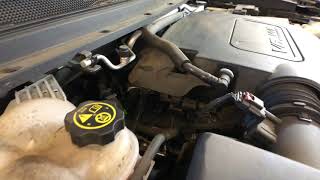
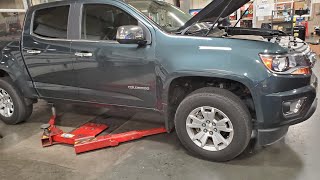
![[HOW TO] Remove the Engine Cover / Intake Tube on 2017-2022 Chevy Colorado 3.6L V6](https://img.youtube.com/vi/KXNf17izm6o/mqdefault.jpg)
Used OEM Parts in Stock
New Aftermarket Parts Available


The information in this article is provided for general reference and educational purposes only. Vehicle specifications, procedures, and part compatibility can vary by production date, trim level, and region. Always consult your vehicle's factory service manual and verify part numbers before purchasing or performing repairs. Safety-critical components such as airbags, seat belts, and braking systems should be installed by a qualified professional.
- Chevrolet Colorado:
- 🧭 Diagnostic Flowchart
- 🎬 Helpful Videos
- 🛍️ Shop This Part
- What's Unique About the 2022-2022 Chevrolet Colorado
- Symptoms You May Notice
- Most Likely Causes
- Rare But Worth Checking
- Diagnosis Steps
- Parts You'll Likely Need
- Related Codes That Often Appear With This One
- Technical Service Bulletins (TSBs) & Recalls
- Platform-Specific Known Issues
- Mechanic-Grade Diagnostic Values
- Hidden / Shadow Codes Worth Checking
- Scan Tool Commands That Help
- Wiring & Ground Locations
- Real Owner Repair Stories
- "I Checked Everything" — The Actual Cause
- OEM Part Supersession History
- Model Year Variations Within This Range
- Other Known Issues on This Vehicle
- Used vs. New Parts: Buying Guide for This Vehicle
- Real Owner Stories
- 2021 Chevrolet Colorado 3.6L LGZ V6 — 14000 miles
- 2016 Chevrolet Colorado 3.6L
- 2020 Chevrolet Colorado 3.6L LGZ V6 — ~1500 miles
- Related OBD-II Codes
- Frequently Asked Questions
- 🎟️ Get 5% Off