

P0174 on 2021-2025 Ram 1500: Causes for System Too Lean (Bank 2)
P0174 on a 2021-2024 Ram 1500 most often means you have a vacuum leak from a failed intake manifold gasket or a cracked exhaust manifold on the passenger side (Bank 2). The cracked exhaust manifold is a well-documented issue on the 5.7L HEMI, often identified by a cold-start ticking noise. Expect to pay $200-$600 for an intake gasket replacement or $800-$1500 for an exhaust manifold repair.
- P0174 on your Ram 1500 means the passenger side of the engine is running too lean (too much air, not enough fuel).
- The most likely cause is either a cracked passenger-side exhaust manifold or a leaking intake manifold gasket.
- Listen for a cold-engine 'ticking' noise for an exhaust leak, or a warm-engine 'hissing' for a vacuum leak.
- Do not immediately replace the O2 sensor; it is often just correctly reporting a problem caused by a leak.
- Driving with this code for too long can damage your catalytic converter, leading to a much more expensive repair.
What's Unique About the 2021-2024 Ram 1500
On the 5th Generation Ram 1500 (DT), the P0174 code is frequently linked to two well-documented issues. First, the intake manifold gaskets can fail, creating a significant vacuum leak—a problem hinted at in TSB #09-025-25 which mentions a "hissing noise from the engine". Second, the 5.7L HEMI engine is known for developing cracks in the exhaust manifolds. This allows outside air to be sucked into the exhaust stream before the O2 sensor, tricking it into reporting a false lean condition. TSB #09-019-23 directly addresses this issue, describing a "ticking noise from the exhaust manifold location(s) when cold" and recommending manifold replacement. While the code itself is generic, these two mechanical failures are the primary platform-specific culprits.
Diagnostic Flowchart
Tap your situation to follow the diagnostic path that matches what you're seeing on this vehicle.
Symptoms You May Notice
- Check Engine Light illuminated
- Reduced acceleration and power
- Engine running rough or misfiring, especially at idle
- Hissing noise from the engine bay, indicating a vacuum leak from the intake manifold
- Rough starting
- A distinct ticking noise from the passenger side wheel well, especially when the engine is cold, that may quiet down as the manifold heats up and the crack seals itself.
- Replacing the oxygen sensor without first checking for vacuum and exhaust leaks. An O2 sensor will accurately report a lean condition caused by a leak elsewhere; replacing it will not fix the root problem.
Most Likely Causes
- Cracked Exhaust Manifold (Bank 2) 🔴 High Probability → Shop Exhaust Manifold The 5.7L HEMI engine's stock cast iron manifolds are known to crack due to thermal stress and design flaws, often snapping the rearmost bolts. This is a very common issue on 5th Gen Rams, addressed by TSB #09-019-23. The leak allows oxygen into the exhaust, causing a false lean reading.
How to confirm: Visually inspect the passenger side exhaust manifold for cracks, often near the collector or bolt flanges. A key sign is a loose heat shield. Listen for a distinct ticking noise when the engine is cold that disappears as the engine warms up and the crack seals itself.
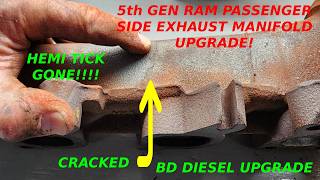
Typical fix: Replace the cracked exhaust manifold and broken bolts. The updated Mopar kit is recommended. Many owners opt for heavier-duty aftermarket manifolds or shorty headers to prevent a recurrence. 🎬 Watch: Step-by-step passenger side exhaust manifold replacement and upgrade.
Est. part cost: $150-$500 - Leaking Intake Manifold Gasket 🔴 High Probability → Shop Engine Intake Manifold The intake manifold gaskets can degrade, causing unmetered air to enter the engine. This is a common cause for lean codes on many vehicles, and a known issue on the Hemi, as documented in owner forums.
How to confirm: Perform a smoke test on the intake system. Smoke will be visibly escaping from the area of the leak. You may also hear a hissing sound near the top of the engine. Spraying a small amount of brake cleaner near the gasket with the engine running and listening for a change in engine RPM can also pinpoint a leak, but this should be done with extreme caution. 🎬 See this quick guide on diagnosing intake manifold gasket leaks.
Typical fix: Replace the intake manifold gaskets. This involves removing the intake manifold to access and replace the old gaskets. 🎬 Watch: Detailed tear down for replacing your intake manifold gaskets. It is recommended to use the updated Mopar gasket kit.
Est. part cost: $30-$100 - Faulty Upstream Oxygen (O2) Sensor 🟡 Medium Probability → Shop Oxygen Sensor O2 sensors wear out and can send slow or biased readings to the PCM. TSB #1814522 lists slow O2 sensor response codes alongside P0174, indicating it's a known related issue that can cause the code without a physical leak.
How to confirm: Use a scan tool with live data to monitor the Bank 2, Sensor 1 O2 sensor voltage. It should fluctuate rapidly between ~0.1 and 0.9 volts. A sensor that is slow, stuck, or biased (not switching correctly) is likely faulty.
Typical fix: Replace the Bank 2, Sensor 1 (upstream, passenger side, pre-catalytic converter) O2 sensor.
Est. part cost: $50-$150 - Vacuum Leak (PCV, Brake Booster, etc.) ⚪ Low Probability Rubber and plastic vacuum hoses can become brittle and crack, creating a source of unmetered air. The PCV valve hose connection at the intake is a potential spot for leaks.
How to confirm: Visually inspect all vacuum lines connected to the intake manifold for cracks or loose connections. A smoke test is the most effective method for finding small, hard-to-see leaks.
Typical fix: Replace the cracked or leaking vacuum hose.
Est. part cost: $10-$50
Rare But Worth Checking
- Clogged Fuel Injector on Bank 2: → Shop Fuel Injector If the lean condition is isolated to a single cylinder (identified by a corresponding misfire code like P0302, P0304, etc.), a clogged injector could be the cause. This is less common than a vacuum or exhaust leak affecting the entire bank.
- Weak Fuel Pump: → Shop Fuel Pump A failing fuel pump typically affects both engine banks, causing both P0171 and P0174 codes to appear together. If only P0174 is present, a fuel delivery issue is less likely but still possible if there's a restriction affecting only one side of the fuel rail.
Diagnosis Steps
- Connect an OBD-II scanner to confirm the P0174 code and check for any other related codes.
- Inspect the passenger side exhaust manifold for cracks or broken bolts. Listen for a ticking noise when the engine is cold. Check if the heat shield is loose.
- With the engine running, listen for a hissing sound around the intake manifold, which would indicate a vacuum leak.
- Perform a smoke test to definitively check for vacuum leaks at the intake manifold gaskets, PCV hoses, and brake booster line. This is the most reliable way to find air leaks.
- Using a scan tool, monitor long-term and short-term fuel trims for Bank 2 at idle and at 2500 RPM. High positive numbers (consistently above +10%, spiking to +25% or more) confirm a lean condition.
- Monitor the Bank 2, Sensor 1 oxygen sensor voltage. It should switch rapidly between approximately 0.1 and 0.9 volts. A lazy or stuck sensor is faulty.
- If no leaks are found and the O2 sensor is responsive, check fuel pressure to rule out a fuel delivery issue, though this is less likely if only P0174 is present.
Parts You'll Likely Need
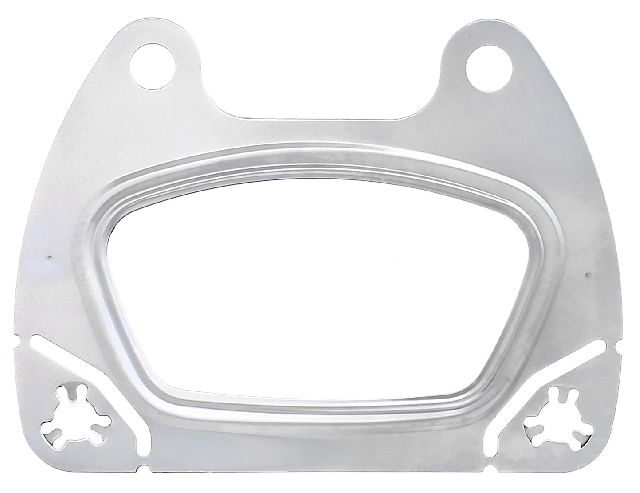
- Exhaust Manifold Kit (Bank 2 / Passenger Side)
(OEM #68591572AB (supersedes 68591572AA))— A cracked exhaust manifold is a highly common cause of P0174 on the 5.7L HEMI engine in this truck. The kit typically includes the manifold, gasket, and new hardware.
Trusted brands: Mopar, Dorman, BD Diesel
OEM price range: $90-$150
Aftermarket price range: $150-$500 - Intake Manifold Gasket Set
(OEM #68545089AA (Kit) or 53022143AB (Individual))— Failed intake gaskets are a frequent source of vacuum leaks that cause this code. It is recommended to replace all gaskets at once.
Trusted brands: Mopar, Fel-Pro, Mahle
OEM price range: $25-$40
Aftermarket price range: $20-$60 - Upstream Oxygen Sensor (Bank 2, Sensor 1)
(OEM #Check with dealer by VIN; Mopar/NTK is OEM supplier)— A failing O2 sensor can send incorrect lean readings. TSB #1814522 links slow sensor response to this code.
Trusted brands: Denso, NTK, Bosch
OEM price range: $80-$150
Aftermarket price range: $50-$100
Related Codes That Often Appear With This One
- P0171 — System Too Lean (Bank 1). If both codes are present, it points to a problem affecting the entire engine, like a large vacuum leak at the intake manifold/throttle body or low fuel pressure from a weak fuel pump.
- P0300 — Multiple Cylinder Misfire. A severe lean condition starves the cylinders of fuel, leading to incomplete combustion and misfires. This is noted in TSB #09-025-25 and TSB #1814522.
- P0153 — O2 Sensor Circuit Slow Response (Bank 2, Sensor 1). This code often appears with P0174, as a failing or slow O2 sensor can be the cause of the lean code, as seen in TSB #1814522.
Technical Service Bulletins (TSBs) & Recalls
- Bulletin #09-025-25: Notes P0174 may be set with symptoms like a rough running engine and a hissing noise.
- Bulletin #1814522: Links P0174 with slow O2 sensor response codes (P0153) and misfire codes (P0300).
- Bulletin #1400521: Connects P0174 with customer complaints of reduced acceleration and rough starting.
Platform-Specific Known Issues
- TSB #09-019-23 addresses ticking noises from cracked exhaust manifolds on 2019-2022 Ram 1500s with the 5.7L HEMI, a primary cause for P0174. The repair involves replacing the manifold with an updated kit.
- Owners and technicians on forums like 5thGenRams.com frequently report that the rearmost exhaust manifold bolts on the passenger side are the first to break, causing a leak that is most audible on a cold start.
- While the 'Hemi Tick' can sometimes be related to lifters, the version that disappears after the engine warms up is almost always an exhaust leak from a cracked manifold or broken bolt.
Mechanic-Grade Diagnostic Values
- Fuel Pressure (at fuel rail) — expected: 407 kPa +/- 34 kPa (59 psi +/- 5 psi). Failure: Pressure below this specification indicates a weak fuel pump, clogged filter, or faulty regulator.
- 2/1 O2 Sensor Voltage (disconnected, ignition on, engine off) — expected: 4.1 - 5.0 Volts. Failure: A reading outside this range suggests a problem with the PCM or the wiring, not the sensor itself.
- O2 Sensor Heater Circuit Resistance — expected: ~5 to 6 Ohms. Failure: Significantly higher resistance or an open circuit (infinite resistance) indicates a failed heater element within the sensor.
Scan Tool Commands That Help
- wiTECH / Professional Scan Tool: ASD Fuel System Test — To command the fuel pump to run without the engine running, allowing for an accurate fuel pressure reading at the rail to diagnose fuel delivery issues.
- wiTECH / Professional Scan Tool: 2/1 O2 Heater Test — To specifically command the heater element in the Bank 2 Sensor 1 O2 sensor to activate. Monitoring the sensor's voltage during this test can confirm if the heater is working and if the PCM is sending the command.
Wiring & Ground Locations
- Bank 2, Sensor 1 Heater Circuit — Pin 17 on Connector C2 of the Powertrain Control Module (PCM).. This is the specific wire that sends power to the O2 sensor's heater. A break or short in this wire can cause O2 sensor codes and incorrect readings that lead to a P0174.
- Main Engine Grounds — On the rear of the cylinder heads (both left and right heads), with a ground strap to the vehicle's cab.. A poor ground connection at the cylinder head can cause a variety of sensor reading errors and electrical issues, including erratic O2 sensor behavior that could trigger lean codes.
- Circuit 'Z' Wires — Various locations throughout the engine harness.. In Mopar wiring diagrams, any wire with a circuit code starting with 'Z' is a ground circuit. The O2 sensor has a dedicated ground wire that must have good continuity for the sensor to report accurate voltage.
Real Owner Repair Stories
- RamForum.com user (Ram 1500 with 5.7L HEMI) — Check Engine Light with code P0052 (HO2S Heater Circuit High Bank 2, Sensor 1), which is often related to P0174 issues.
❌ Tried (didn't work) Replacing both Bank 2 O2 sensors with new NGK parts., Swapping the Bank 1 and Bank 2 upstream sensors to see if the code followed the sensor (it did not)., Cleaning all visible grounds under the hood., Confirming continuity of the heater circuit wire from the sensor plug to the PCM.
✅ What actually fixed it The diagnostic process pointed to an issue with the PCM or wiring, not the sensor. The user created a test light from an old sensor plug and confirmed the PCM was not sending power to the Bank 2 Sensor 1 heater circuit, while it was sending power to the Bank 2 Sensor 2 heater. This advanced diagnosis correctly identified the problem was upstream of the sensor itself, likely a faulty PCM driver for that circuit.
OEM Part Supersession History
68365738AA, 68591572AA→68591572AB— Part revision and update by the manufacturer, likely to improve durability and prevent the cracking issues seen in earlier versions.68433348AA→68757763AA— Part revision for the fuel pump module assembly.
Heads up: Applies to 2021-2025 models.
Model Year Variations Within This Range
- 2025: The 5.7L HEMI V8 engine was discontinued for the Ram 1500 after the 2024 model year. The 2025 model introduced the new 3.0L Hurricane twin-turbo inline-six engine. Therefore, this P0174 guide for the 5.7L HEMI only applies to model years 2021-2024.
Helpful Videos
We Have This Part in Stock

The information in this article is provided for general reference and educational purposes only. Vehicle specifications, procedures, and part compatibility can vary by production date, trim level, and region. Always consult your vehicle's factory service manual and verify part numbers before purchasing or performing repairs. Safety-critical components such as airbags, seat belts, and braking systems should be installed by a qualified professional.
- Ram 1500:
- 🧭 Diagnostic Flowchart
- 🎬 Helpful Videos
- 🛍️ Shop This Part
- What's Unique About the 2021-2024 Ram 1500
- Symptoms You May Notice
- Most Likely Causes
- Rare But Worth Checking
- Diagnosis Steps
- Parts You'll Likely Need
- Related Codes That Often Appear With This One
- Technical Service Bulletins (TSBs) & Recalls
- Platform-Specific Known Issues
- Mechanic-Grade Diagnostic Values
- Scan Tool Commands That Help
- Wiring & Ground Locations
- Real Owner Repair Stories
- OEM Part Supersession History
- Model Year Variations Within This Range
- 🎟️ Get 5% Off