

P0174 on 2017-2020 Toyota Sequoia: System Too Lean Bank 2 Causes and Fixes
On a 2017-2020 Toyota Sequoia, P0174 is most often caused by a dirty Mass Airflow (MAF) sensor or a vacuum leak from failed intake manifold gaskets. Cleaning the MAF sensor is an easy first step, but if the issue persists, a smoke test to find vacuum leaks is the next logical step. For Flex Fuel models, an ECM software update may be required per a Toyota TSB.
- P0174 means the driver's side of the engine is running lean (too much air/not enough fuel).
- Start your diagnosis by cleaning the Mass Airflow (MAF) sensor with a dedicated cleaner, as this is a common, inexpensive fix.
- The next most likely cause is a vacuum leak, often from the intake manifold gaskets. A smoke test is the best way to find it.
- If you have a Flex Fuel (3UR-FBE) model and also have a hard start problem, consult a dealer about TSB T-SB-0166-19_Rev, as you may need a software update.
- Only replace the Air/Fuel Ratio (oxygen) sensor after ruling out MAF issues and vacuum leaks.
What's Unique About the 2017-2020 Toyota SEQUOIA
The Toyota Sequoia's 5.7L 3UR-FE V8 is generally very reliable, but its plastic and rubber intake components can become brittle over time, making vacuum leaks from intake manifold gaskets a very common cause for P0174. Furthermore, Toyota has issued specific Technical Service Bulletins for this platform. For Flex Fuel (3UR-FBE) models, TSB T-SB-0166-19_Rev indicates that P0174 can be accompanied by a hard start (P1604) and may be caused by an ECM software issue where the computer incorrectly estimates the fuel's alcohol content. The fix often involves an ECM reflash and sometimes a fuel pump replacement, which may be covered under the Federal Emission Warranty (96 months/80,000 miles). Another bulletin, TSB000923, links lean codes P0171/P0174 with low fuel system pressure code P0087, pointing directly to a fuel delivery issue.
🎬 Watch this walkthrough for troubleshooting P0171 and P0174 lean codes.Diagnostic Flowchart
Tap your situation to follow the diagnostic path that matches what you're seeing on this vehicle.
Symptoms You May Notice
- Check Engine Light is on
- Rough or unstable idle, especially at a stop
- Hesitation or stumbling during acceleration
- Reduced fuel economy
- Hard start condition (engine cranks longer than usual before starting) [Bulletin #TSB000923, Bulletin #T-SB-0166-19_Rev, 24]
- A whistling or sucking sound from the engine bay at idle, indicating a vacuum leak
- Replacing the downstream (post-catalyst) oxygen sensor instead of the upstream (pre-catalyst) Air/Fuel Ratio sensor. The downstream sensor only monitors catalyst efficiency and does not affect fuel trim.
- Replacing the Air/Fuel Ratio sensor before confirming there are no vacuum leaks or MAF sensor issues, which are more common and less expensive causes.
Most Likely Causes
- Dirty or Faulty Mass Airflow (MAF) Sensor 🔴 High Probability → Shop Fuel Injection Air Flow Meter The MAF sensor wire is delicate and can become contaminated by dust or oil (especially from aftermarket oiled air filters), causing it to under-report airflow to the ECM. This is a very common issue on Toyota V8s and a frequent first-step fix discussed in owner forums.
How to confirm: Inspect the sensor wires for contamination. A more definitive test is to monitor MAF readings with a scan tool; a healthy 5.7L engine should read around 5-7 g/s at a stable idle (around 700 RPM). If readings are significantly lower, the sensor is likely dirty or faulty. Unplugging the sensor may cause the idle to smooth out, temporarily confirming it's the issue.
Typical fix: Clean the sensor using only dedicated MAF sensor cleaner spray. Do not touch the wires. If cleaning does not resolve the issue, replace the sensor. Denso is the OEM supplier and highly recommended.
Est. part cost: $10-$20 (cleaner), $70-$150 (replacement sensor) - Vacuum Leak (Intake Manifold Gaskets) 🔴 High Probability The intake manifold gaskets on the 5.7L V8 are made of materials that can become hard and brittle after many heat cycles, causing unmetered air to leak into the intake, a well-documented failure.
How to confirm: The most effective method is to perform a smoke test, which will force low-pressure smoke into the intake system and reveal leaks visually around the manifold edges. A less precise method is to carefully spray brake cleaner or a propane torch (unlit) around the gasket area and listen for a change in engine idle RPM.
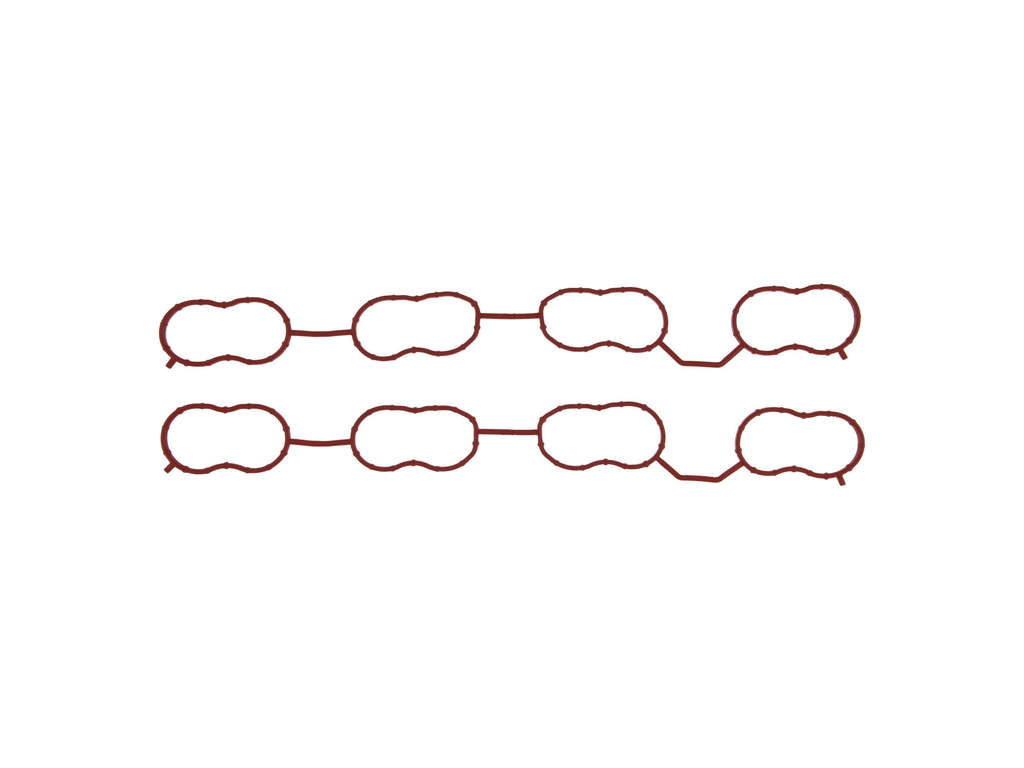
Typical fix: Replace the intake manifold gaskets. It is recommended to replace gaskets for both banks at the same time. The OEM part number is 17171-0S030.
Est. part cost: $30-$70 - Faulty Air/Fuel Ratio Sensor (Bank 2, Sensor 1) 🟡 Medium Probability → Shop Oxygen Sensor This sensor, also known as an upstream oxygen sensor, operates in a high-temperature environment and degrades over time. After 80,000-100,000 miles, failure is common, but it is often misdiagnosed when the real issue is a vacuum leak.
How to confirm: Use a scan tool to graph the sensor's voltage or current. A healthy sensor will fluctuate rapidly. A lazy or flat-lined sensor is faulty. Always rule out vacuum leaks and MAF issues first, as they can mimic a bad sensor and cause it to report a lean condition that is real.
Typical fix: Replace the Bank 2, Sensor 1 Air/Fuel Ratio sensor. Bank 2 is the driver's side. Denso is the OEM supplier.
Est. part cost: $120-$200 - Low Fuel Pressure ⚪ Low Probability A weak fuel pump or clogged fuel filter can starve the engine for fuel. Toyota TSB TSB000923 directly links P0174 with a low fuel pressure code (P0087). TSB T-SB-0166-19_Rev also lists fuel pump replacement as part of the repair procedure for some Flex Fuel vehicles with this code.
How to confirm: Connect a fuel pressure gauge to the fuel system. Toyota's 3UR-FE engine does not have a simple test port, so special adapters are needed to tap into the fuel line. Compare the readings at idle and under load to the manufacturer's specifications.
Typical fix: If pressure is low, the cause must be diagnosed further. This typically involves replacing the fuel pump assembly or the in-tank fuel filter.
Est. part cost: $200-$500 (fuel pump assembly)
Rare But Worth Checking
- Cracked PCV hose: → Shop PCV Valve Hose The PCV hose can become brittle and crack, creating a small but persistent vacuum leak that is sometimes hard to spot. It should be inspected carefully during a vacuum leak diagnosis.
- Exhaust leak before the A/F sensor: A crack in the exhaust manifold or a leaking gasket can allow oxygen to be pulled into the exhaust stream, making the A/F sensor report a false lean condition.
- Clogged Fuel Injector on Bank 2: → Shop Fuel Injector A single fuel injector on one of the Bank 2 cylinders can become clogged, causing that cylinder to run lean and contributing to the overall lean condition for the bank. This is less common than a vacuum leak affecting all cylinders.
Diagnosis Steps
- Check for other DTCs. Codes like P0171, P0087, or P1604 provide critical diagnostic clues.
- Use a scan tool to observe Long Term Fuel Trim (LTFT) and Short Term Fuel Trim (STFT) for Bank 2. A combined value consistently above +25% at idle confirms a significant lean condition. Note if the trims decrease and normalize at higher RPMs, which strongly suggests a vacuum leak.
- Visually inspect the air intake tube between the air filter box and the throttle body for any cracks or loose connections. Check all accessible vacuum and PCV hoses for cracks.
- Clean the Mass Airflow (MAF) sensor with dedicated MAF cleaner spray. Allow it to dry completely before reinstalling. Clear codes and test drive to see if the code returns.
- If the code returns, perform a smoke test to check the entire intake system for vacuum leaks. Pay close attention to the intake manifold gaskets and all vacuum hoses. This is the most reliable way to find a leak.
- If no vacuum leaks are found, test the fuel pressure to ensure it is within Toyota's specifications. This is more involved on the 3UR-FE as it lacks a test port.
- If fuel pressure is normal, use a scan tool to graph the Bank 2, Sensor 1 (A/F sensor) output. If it is slow to respond or has a fixed low voltage, it has likely failed and should be replaced.
- If the vehicle is a Flex Fuel (3UR-FBE) model and exhibits hard starting, consult a Toyota dealer about TSB T-SB-0166-19_Rev for a potential ECM software update.
Parts You'll Likely Need
- Mass Airflow (MAF) Sensor Cleaner — This is the cheapest and easiest first step, as a dirty MAF sensor is a very common cause of P0174 on this vehicle.
Trusted brands: CRC, Liqui Moly
Aftermarket price range: $10-$20 - Mass Airflow (MAF) Sensor
(OEM #22204-0V010 (Cross-references to Denso 197-6160))— If cleaning the original sensor doesn't work, replacement is the next step. Using the OEM Denso brand is highly recommended for accuracy and longevity.
Trusted brands: Denso (OEM)
OEM price range: $100-$160
Aftermarket price range: $70-$120 - Intake Manifold Gasket
(OEM #17171-0S030)— These gaskets are a known failure point on the 5.7L V8, leading to vacuum leaks that cause lean codes. They become hard and brittle with age.
Trusted brands: Toyota Genuine, Fel-Pro, Mahle
Related Codes That Often Appear With This One
- P0171 — System Too Lean Bank 1. This code is very common with P0174 because issues like a dirty MAF sensor or a large vacuum leak from the intake manifold affect both engine banks.
- P0087 — Fuel Rail / System Pressure – Too Low. A Toyota TSB directly links this code with P0174, indicating a potential fuel delivery problem from a weak fuel pump or clogged filter.
- P1604 — Startability Malfunction. A Toyota TSB links this code with P0174 on Flex Fuel (3UR-FBE) models, pointing to a potential ECM software issue related to incorrect fuel alcohol content calculations.
Technical Service Bulletins (TSBs) & Recalls
- TSB000923: Notes that some vehicles may exhibit a hard start and/or MIL ON with DTCs P0171/P0174 and P0087 (Fuel Rail / System Pressure – Too Low).
- T-SB-0166-19_Rev: Pertains to 3UR-FBE engines that may have a hard start and/or MIL ON with P0171/P0174, P0172/P0175, or P1604, potentially requiring an ECM update.
Platform-Specific Known Issues
- TSB T-SB-0166-19_Rev notes that 3UR-FBE (Flex Fuel) models may exhibit P0174 along with a hard start (P1604). The fix may be an ECM software update performed by a dealer, not a parts replacement.
- TSB TSB000923 indicates that P0174 may be set in conjunction with P0087 (Fuel Rail / System Pressure – Too Low), pointing towards a potential fuel pump or fuel delivery issue.
Mechanic-Grade Diagnostic Values
- A/F Sensor Heater Resistance — expected: 0.8 - 1.4 Ω at 20°C (68°F). Failure: Resistance outside of this range indicates a faulty sensor heater.
- Fuel Pressure (at fuel pump outlet) — expected: 53.6 PSI to 59.5 PSI. Failure: Pressure below the minimum specification indicates a weak fuel pump or clogged filter.
- Mass Airflow (MAF) Sensor Reading at Idle — expected: Approximately 4.0 - 5.0 g/s at 700 RPM. Failure: A significantly higher reading (e.g., over 6.5 g/s) or lower reading at idle can indicate a contaminated sensor or a vacuum leak.
Scan Tool Commands That Help
- Toyota Techstream: Active Test: Control the Injection Volume for A/F sensor — To verify A/F sensor functionality. This test allows the technician to command a 12.5% leaner or 25% richer mixture and observe if the sensor responds correctly, confirming if the sensor is lazy or biased.
- Toyota Techstream (or compatible bidirectional scanner): Special Function: Fuel Density Learning Value Reset — On Flex Fuel (3UR-FBE) models, especially when P0174 is accompanied by P1604 (Startability Malfunction). This resets the ECM's learned fuel alcohol content to zero and also resets fuel trims, directly addressing the software-related issue described in TSB T-SB-0166-19_Rev.
Wiring & Ground Locations
- D1 — Rear side of the left (driver's side) cylinder head.. This is a primary engine ground point for Bank 2. A loose or corroded connection here can cause erratic voltage and incorrect readings from the Bank 2 A/F sensor and other components, leading to a false P0174 code.
- A/F Fuse — In the engine compartment fuse box (multi fuse block).. A dedicated 15A fuse labeled 'A/F' provides power for the engine control system, including the A/F sensor heaters. Although a blown fuse would likely cause a heater circuit code, a poor connection at this fuse could cause intermittent issues.
Real Owner Repair Stories
- Reddit user Top-Guitar-7096 (Toyota Sequoia (year not specified, but with 5.7L V8)) — Getting lean codes P0171 & P0174 at idle. Check engine light only comes on at a stop.
❌ Tried (didn't work) Cleaning the MAF sensor, Visual search for vacuum leaks
✅ What actually fixed it Used a smoke machine, which revealed a leak from the intake manifold. The implied fix was replacing the intake manifold gaskets. - Toyota Tundra Forum user poormxdad (2007 Sequoia (same 3UR engine family)) — Persistent P0174 code.
❌ Tried (didn't work) Replacing spark plugs, Cleaning MAF sensor, Cleaning throttle body, Replacing PCV valve and hose
✅ What actually fixed it Replaced a deteriorated vacuum hose for the power steering air control valve. This valve uses manifold vacuum, and the hose connected to the Bank 2 side of the intake had become a vacuum leak.
"I Checked Everything" — The Actual Cause
- A cracked exhaust manifold or a leaking exhaust manifold gasket located before the Bank 2 Air/Fuel ratio sensor. This allows outside oxygen to be drawn into the exhaust stream, which makes the sensor incorrectly report a lean condition to the ECM. This type of leak will not be found with a standard intake smoke test.
When the Usual Fixes Don't Work
- While common causes like MAF sensors and intake gaskets should be checked first, they are not always the root cause. In one documented case for a similar Toyota V8, a persistent P0174 was resolved only after replacing a deteriorated vacuum hose connected to the power steering air control valve, a part not typically associated with fuel trim issues. This highlights the need to check all vacuum lines connected to the intake manifold, regardless of the system they appear to belong to. Furthermore, if an intake smoke test reveals no leaks, the issue could be on the exhaust side, such as a cracked exhaust manifold allowing oxygen to enter the exhaust stream before the A/F sensor.
OEM Part Supersession History
17171-0S010, 17171-38010, 17171-38030→17171-0S030— Standard part revision and consolidation by the manufacturer.
Model Year Variations Within This Range
- 2017-2020: The most significant variation affecting this code is the presence of the Flex Fuel (3UR-FBE) vs. the standard gasoline (3UR-FE) engine. The 3UR-FBE is susceptible to an ECM logic issue where it incorrectly calculates fuel alcohol content, leading to lean codes (P0171/P0174) and hard starting (P1604), as addressed in TSB T-SB-0166-19_Rev.
Helpful Videos
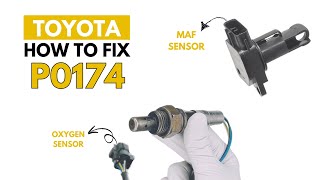
![How to Fix TOYOTA P0174 Engine Code in 3 Minutes [2 DIY Methods / Only $8.99]](https://img.youtube.com/vi/3CU1DVre8JU/mqdefault.jpg)

We Have This Part in Stock



The information in this article is provided for general reference and educational purposes only. Vehicle specifications, procedures, and part compatibility can vary by production date, trim level, and region. Always consult your vehicle's factory service manual and verify part numbers before purchasing or performing repairs. Safety-critical components such as airbags, seat belts, and braking systems should be installed by a qualified professional.
- Toyota SEQUOIA:
- 🧭 Diagnostic Flowchart
- 🎬 Helpful Videos
- 🛍️ Shop This Part
- What's Unique About the 2017-2020 Toyota SEQUOIA
- Symptoms You May Notice
- Most Likely Causes
- Rare But Worth Checking
- Diagnosis Steps
- Parts You'll Likely Need
- Related Codes That Often Appear With This One
- Technical Service Bulletins (TSBs) & Recalls
- Platform-Specific Known Issues
- Mechanic-Grade Diagnostic Values
- Scan Tool Commands That Help
- Wiring & Ground Locations
- Real Owner Repair Stories
- "I Checked Everything" — The Actual Cause
- When the Usual Fixes Don't Work
- OEM Part Supersession History
- Model Year Variations Within This Range
- 🎟️ Get 5% Off