

P0175 on 2006-2008 Audi RS4 4.2L V8: Causes and Fixes for Rich Fuel Mixture
P0175 on the Audi RS4 4.2L V8 means the engine is running too rich on Bank 2 (driver's side). The most common causes are a failing upstream oxygen sensor, a faulty mass airflow (MAF) sensor, or a leaking high-pressure fuel pump. Severe carbon buildup on the intake valves is also a very frequent underlying issue, often requiring professional cleaning.
- P0175 on a 2006-2008 Audi RS4 indicates a rich fuel condition on the driver's side (Bank 2).
- Do not ignore this code. It can cause damage to expensive catalytic converters and indicates a significant engine performance issue.
- The most common causes are specific to the 4.2L FSI engine: severe intake valve carbon buildup and/or a failing high-pressure fuel pump leaking fuel into the oil.
- Always check the engine oil for the smell of fuel before replacing any parts. This is a key indicator of a failed HPFP.
- If the engine has over 60,000 miles and has never had a carbon cleaning service, it is highly likely to be a contributing factor.
What's Unique About the 2006-2008 Audi RS4
The B7 RS4's 4.2L FSI (Fuel Stratified Injection) V8 is a high-revving, direct-injection engine. Unlike traditional port injection, fuel is sprayed directly into the cylinder, meaning it never washes over the intake valves. This design makes the engine highly susceptible to severe carbon buildup on the valves, which can disrupt airflow, cause rough idling, and contribute to fuel mixture codes like P0175. Additionally, this engine uses two cam-driven high-pressure fuel pumps (HPFPs), one for each bank. A common failure involves the pump's internal seals degrading, causing fuel to leak directly into the engine oil, contaminating the PCV system and creating a rich condition. The engine management also uses two separate ECUs (master and slave), meaning diagnostic codes must be checked for both modules, as a generic scanner may miss codes on the second ECU.
Symptoms You May Notice
- Check Engine Light is on
- Poor fuel economy
- Rough or unstable idle, sometimes with hesitation when warm.
- Hesitation or lack of power during acceleration, especially between 2000-4000 RPM.
- Strong smell of fuel from the exhaust.
- Black smoke from the exhaust, especially at idle or under load.
- Engine oil level appears to be rising or is overfull
- Noticeable smell of gasoline in the engine oil when checking the dipstick.
- Replacing the O2 sensor when the actual cause is a leaking high-pressure fuel pump or severe carbon buildup. The O2 sensor correctly reports the rich condition but is not the source of it.
- Assuming a vacuum leak, which typically causes a lean code (P0171/P0174), not a rich code.
- Replacing fuel injectors when the issue is fuel pressure related or carbon buildup.
Most Likely Causes
- Severe Carbon Buildup on Intake Valves 🔴 High Probability The FSI direct-injection design does not clean the intake valves with fuel, leading to inevitable carbon accumulation that disrupts airflow and tricks the ECU into adding too much fuel. This is a widely documented issue requiring cleaning, often between 40,000 and 60,000 miles.
How to confirm: Visually inspect the intake valves using a borescope after removing the intake manifold. Symptoms like rough cold starts, misfires under load, and a history of fuel trim codes are strong indicators. A professional diagnosis is often required.
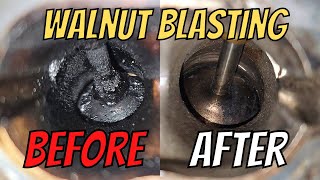
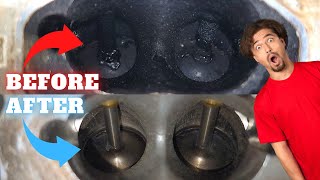
Typical fix: Professional carbon cleaning is required. The most effective method is walnut shell blasting the intake ports and valves. 🎬 Watch: Step-by-step DIY walnut blasting instructions for the 4.2L V8. Chemical treatments (like Seafoam) are generally considered ineffective for the heavy deposits found on these engines.
Est. part cost: $20-$50 for intake gaskets - Failing High-Pressure Fuel Pump (HPFP) 🟡 Medium Probability → Shop Fuel Pump The diaphragm in the cam-driven HPFP can fail, allowing raw fuel to leak directly into the crankcase. This contaminates the oil, and the PCV system pulls the fuel vapors into the intake, creating a rich mixture across both banks, often triggering P0172 and P0175.
How to confirm: Check the engine oil for a strong smell of gasoline. An oil level that is rising or overfull is a definitive sign. In some cases, a rattling or ticking noise may be heard from the pump area.
Typical fix: Replace the high-pressure fuel pump for Bank 2 (driver's side). It is often recommended to replace both pumps at the same time. An engine oil and filter change is mandatory to remove the contaminated oil.
Est. part cost: $300-$500 - Faulty Upstream Oxygen (O2) Sensor 🟡 Medium Probability → Shop Oxygen Sensor The O2 sensor is a primary input for fuel trim. A lazy or failing sensor can send incorrect (falsely lean) signals to the ECM, causing it to add too much fuel. Contamination from a persistent rich condition or age can cause failure.
How to confirm: Use a scan tool to monitor the O2 sensor voltage for Bank 2, Sensor 1. It should fluctuate rapidly between approximately 0.1V and 0.9V. A slow or stuck reading (especially stuck high) indicates a problem.
Typical fix: Replace the Bank 2 (driver's side) upstream O2 sensor. It is often wise to replace them in pairs (Bank 1 and Bank 2).
Est. part cost: $80-$200 - Faulty Mass Airflow (MAF) Sensor ⚪ Low Probability → Shop Fuel Injection Air Flow Meter The B7 RS4 uses a single MAF sensor, but its reading is split between two ECUs. A dirty or failing MAF can under-report airflow, causing both ECUs to command an overly rich mixture. While this typically sets codes on both banks (P0172 & P0175), it can sometimes manifest on a single bank first.
How to confirm: Try cleaning the MAF sensor with a dedicated MAF sensor cleaner first. If the problem persists, monitor MAF readings with a scan tool to see if they are within the expected range for the given RPM and increase smoothly. A healthy engine should read approximately 4-8 g/s at idle.
Typical fix: Clean or replace the MAF sensor.
Est. part cost: $150-$300 - Leaking Fuel Injector(s) ⚪ Low Probability → Shop Fuel Injector An injector can become stuck open or leak fuel into the cylinder after the engine is off, leading to a rich condition on startup and during operation. This can be caused by internal wear or deposits.
How to confirm: This is difficult to confirm without professional tools. A fuel pressure leak-down test can indicate a leak in the system; if pressure drops quickly after shutdown, an injector could be the cause. Another method is to pull the spark plugs on Bank 2 and check for one that is significantly more fouled (black, sooty) than the others. 🎬 Watch: 3 signs your Audi fuel injectors are stuck open.
Typical fix: Replace the leaking fuel injector(s) on Bank 2. It's recommended to replace the seals on all injectors if they are removed.
Est. part cost: $100-$250 per injector
Rare But Worth Checking
- Faulty Fuel Pressure Regulator: → Shop Fuel Injection Pressure Regulator A failing regulator can cause excessive fuel pressure across the entire system, leading to rich conditions on both banks, often triggering P0172 and P0175 together.
- Faulty Engine Coolant Temperature (ECT) Sensor: If the ECT sensor incorrectly reports a cold engine, the ECM will command a richer fuel mixture, similar to a cold-start enrichment, which can trigger the code.
- Exhaust Leak Before O2 Sensor: → Shop Oxygen Sensor An exhaust leak before the upstream O2 sensor can draw in fresh air. The sensor interprets this as a lean condition and commands the ECM to add more fuel, ironically causing a rich condition. This is less common than a vacuum leak causing a lean code.
Diagnosis Steps
- Use an OBD-II scanner (preferably VCDS or equivalent) to confirm P0175 and check for any other codes in *both* engine control modules. Note the freeze frame data.
- Check the engine oil level and smell. If it smells strongly of gasoline and/or the level is high or rising, immediately suspect a failing high-pressure fuel pump. This is a critical check on this engine.
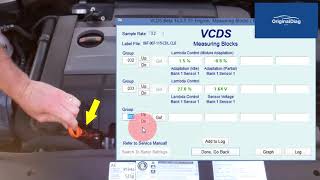
- Use a scan tool to monitor live data. Observe the short-term (STFT) and long-term (LTFT) fuel trims for Bank 2 (VCDS Group 032 & 0 🎬 See this guide to understanding fuel trim data using VCDS.33). A strong negative number (e.g., -15% or more) confirms the ECM is trying to correct a rich condition.
- Monitor the Bank 2, Sensor 1 (upstream) O2 sensor voltage. It should switch rapidly between high (~0.9V) and low (~0.1V) values. If it's stuck high or slow to respond, the sensor may be faulty or fouled.
- Inspect the air filter and intake tract for any blockages or restrictions.
- Clean the MAF sensor(s) with dedicated cleaner. Observe the MAF reading (g/s) on the scan tool to ensure it increases smoothly with RPM. A healthy 4.2L FSI should show approx. 4-8 g/s at idle.
- If other causes are ruled out, perform a visual inspection of the intake valves for carbon buildup using a borescope. This is a very common issue on the 4.2L FSI engine and a likely culprit if other tests are inconclusive.
- If a leaking injector is suspected, a professional fuel pressure leak-down test is the next step.
Parts You'll Likely Need
- Intake Valve Carbon Cleaning Service — This is the most common underlying problem for fuel mixture issues on the 4.2L FSI engine.
OEM price range: $800-$1500 (Shop Service) - High-Pressure Fuel Pump (HPFP)
(OEM #079127025J, superseded by 079127025AC)— A common failure point that leaks fuel into the crankcase, causing a rich condition. Bank 2 is the driver's side pump.
Trusted brands: Hitachi (OEM)
OEM price range: $300-$500
Aftermarket price range: $200-$400 - Upstream Oxygen Sensor (Bank 2, Sensor 1) — A lazy or failed sensor can send incorrect signals, causing the ECM to enrich the mixture unnecessarily.
Trusted brands: Bosch, NTK, Denso
OEM price range: $150-$250
Aftermarket price range: $80-$200
Related Codes That Often Appear With This One
- P0172 — System Too Rich, Bank 1. If both P0172 and P0175 are present, it points to a problem affecting the entire engine, such as a faulty MAF sensor, fuel pressure issue, or both high-pressure fuel pumps failing.
- P0300, P0305, P0306, P0307, P0308 — Misfire codes for Bank 2 cylinders (5, 6, 7, 8). An excessively rich mixture can foul spark plugs and cause incomplete combustion, leading to misfires on the affected bank.
- P0087 — Fuel Rail/System Pressure - Too Low. While counterintuitive for a rich code, a failing HPFP can sometimes trigger pressure codes as its performance becomes erratic before a complete failure that causes leaks.
- P1923 — Please Check DTC Memory of ECU Number 2. This is an informational code from the master ECU telling the technician to also scan the slave ECU, where the actual fault (like P0175) may be stored.
Technical Service Bulletins (TSBs) & Recalls
- While no TSB is specific to P0175 on the RS4, TSB 2020048/11 (related to other FSI engines) discusses issues with fuel quality causing deposits in injectors, leading to rich conditions after shutdown. It recommends using TOP TIER gasoline and a specific fuel additive (G 001770A2) to clean injectors. This highlights Audi's awareness of fuel-related deposit issues.
Platform-Specific Known Issues
- The 4.2L FSI V8 is notorious for heavy carbon deposits on the intake valves, often requiring cleaning every 40,000-60,000 miles to maintain performance and prevent fuel trim issues.
- Failure of the cam-follower for the high-pressure fuel pump is a known issue, which can lead to pump failure and subsequent fuel-in-oil contamination. It's considered a mandatory replacement part when servicing the HPFP.
- A user on MHH Auto forum with a 2008 RS4 experienced persistent P0172 and P0175 codes even after replacing HPFPs, PCV, sensors, and performing a carbon clean, highlighting the diagnostic difficulty. The issue pointed towards injectors after unplugging the HPFPs showed a change in fuel trims.
Mechanic-Grade Diagnostic Values
- High-Pressure Fuel Rail Pressure — expected: Up to 136 bar (1,973 psi) under load. A forum user noted 20 bar at the rail during their diagnosis.. Failure: Significantly lower than specified pressure under load, or erratic readings. May set a P0087 code.
- Low-Pressure Fuel System Pressure — expected: 5 to 6 bar (72 to 87 psi) feeding the HPFPs.. Failure: Pressure below this range indicates a failing in-tank pump or controller, which can starve the HPFPs.
- Mass Air Flow (MAF) Sensor Reading at Idle — expected: Approximately 4-8 g/s at normal idle with no load. The rule of thumb is ~1.8 g/s per liter of displacement, so a 4.2L should be around 7.5 g/s.. Failure: A significantly lower value may indicate a vacuum leak after the MAF. A significantly higher value could indicate a contaminated sensor.
- Mass Air Flow (MAF) Sensor Reading at Peak Power — expected: A healthy engine should show a total of 330-340 g/s. Note: VCDS may log this value per-ECU, so the logged value must be doubled.. Failure: Readings significantly below 300 g/s (total) suggest an airflow restriction (like carbon buildup) or a failing MAF sensor.
- Long-Term Fuel Trim (Bank 2) — expected: Close to 0%, within +/- 10%. Monitored in VCDS Engine -> Measuring Blocks -> Group 032.. Failure: A large negative value (e.g., -15% to -25%) confirms the ECU is compensating for a rich condition.
Hidden / Shadow Codes Worth Checking
- P1923: Please Check DTC Memory of ECU Number 2. This is not a fault code itself, but an instruction from the master ECU (Engine) to the technician that the slave ECU (Engine II) has stored fault codes that need to be read separately. (see via A VAG-specific scan tool like VCDS or ODIS is required. A generic OBD-II reader may only communicate with the master ECU and miss this, leading to a misdiagnosis.)
Scan Tool Commands That Help
- VCDS (VAG-COM): Reset Learned Values (Fuel Trim Reset) — After a repair like replacing an O2 sensor, cleaning the MAF, or performing a carbon clean, to force the ECU to relearn fuel strategy from a baseline of zero. Found in [01-Engine] -> [Adaptation - 10] -> Channel 'IDE00433'. Alternatively, clearing all fault codes will also reset long-term trims.
- VCDS (VAG-COM): Throttle Body Adaptation — After cleaning the throttle body or removing the intake manifold. This calibrates the closed and open positions of the throttle plate. Found in [01-Engine] -> [Basic Settings - 04] -> Group 060.
- VCDS (VAG-COM): Monitor Fuel Trims (Groups 032 & 033) — This is the primary live data to watch during diagnosis. Group 032 shows long-term additive (idle) and multiplicative (partial load) trims. Group 033 shows real-time short-term trims.
Wiring & Ground Locations
- G410 - Low Pressure Fuel Sensor — Located on a fuel line in the engine bay, making it relatively easy to access for testing or replacement.. A faulty G410 can provide incorrect data to the fuel pump control module, potentially affecting the entire fuel delivery strategy, though it more commonly causes low-pressure codes like P310B.
- G247 - High Pressure Fuel Sensor — Located on the fuel rail, underneath the intake manifold. Access is extremely difficult and typically requires removal of the intake manifold.. This sensor directly measures the rail pressure that feeds the injectors. A failure can cause the ECU to miscalculate fuel delivery, but it's more likely to set a pressure-related code (P0087) than a mixture code.
- N145 - Right Engine Mount Solenoid Valve — The right-side (Bank 1) engine mount.. While not a direct cause, a fault code for this component (P1577) was seen alongside P0172/P0175 in a detailed diagnostic case, indicating that multiple, seemingly unrelated electronic faults can occur simultaneously. It highlights the need to address all codes, not just the primary mixture code.
Real Owner Repair Stories
- Reddit user @MattMBerkshire (Audi RS4, 55,000 miles) — Extremely poor fuel economy.
❌ Tried (didn't work) Not specified, but the implication is the problem was persistent.
✅ What actually fixed it A professional walnut blast carbon cleaning of the intake valves. The user noted the car 'starts and sounded incredibly grateful for it' and that fuel economy was saved. They state 50k miles seems to be the limit before these engines 'struggle badly' from carbon. - MHH Auto forum user ngv1515 (2008 Audi RS4, 145,422 km) — P0172 and P0175 (System Too Rich, Banks 1 & 2).
❌ Tried (didn't work) Carbon cleaning ('De-carbon all valves'), New PCV valve (replaced twice), New low-pressure fuel sensor, New high-pressure fuel sensor, Replaced both high-pressure fuel pumps (HPFPs), New fuel filter, Cleaned MAF sensor, Updated both ECUs, Smoke tested intake manifold (no leaks found)
✅ What actually fixed it The thread ends without a definitive fix, with the owner noting even the Audi dealer gave up. However, the diagnostic process is extremely valuable, showing a case where all common fixes failed. The user isolated the issue to the high-pressure fuel side by unplugging the HPFPs and watching the fuel trims change, confirming the rich condition was from fuel delivery, not a sensor error.
"I Checked Everything" — The Actual Cause
- A rich code like P0175 is rarely caused by a vacuum leak that a smoke test would find; those typically cause lean codes (P0171/P0174). In one documented case, a technician performed a smoke test on the intake manifold and found no leaks, yet the P0172/P0175 codes persisted. This correctly ruled out unmetered air and pointed the diagnosis toward an over-fueling problem, such as a leaking HPFP or faulty fuel pressure regulation, which are common on the RS4.
When the Usual Fixes Don't Work
- While carbon buildup and HPFP failure are the most cited causes, there are documented cases where extensive parts replacement did not solve the issue. In one instance, an owner replaced both HPFPs, multiple sensors, and performed a carbon clean without fixing P0172/P0175. This suggests that in some scenarios, the root cause could be more obscure, such as a wiring harness issue, a fault within an ECU, or a mechanical timing problem, and that simply replacing the 'usual suspect' parts is not a guaranteed fix.
OEM Part Supersession History
079127025J→079127025AC— Revision and improvement of the part by the manufacturer.
Heads up: These parts are for the left side (Bank 2). The right side (Bank 1) pump is a different part number (e.g., 079127026AB).
Diagnostic Flowchart
Used vs. New Parts: Buying Guide for This Vehicle
When a used part is the smart pick: For this specific vehicle and code, buying used parts for the primary failure components is generally not advisable. The only exception might be major structural components if required for a related repair, but not the sensors or pumps that cause the code.
Donor-vehicle mileage cap: roughly under 80000 miles for the part to have meaningful remaining life.
What to inspect on the donor part:
- For injectors: must be sent for professional cleaning, flow-testing, and seal replacement before installation.
- Verify part numbers meticulously, as many similar-looking parts from other Audi V8s will not work correctly.
OEM-only on this vehicle (don't cheap out):
- High-Pressure Fuel Pump (HPFP): The OEM Hitachi pumps are the only proven reliable option for a stock vehicle. Cheap aftermarket HPFPs are a significant risk of premature failure or incorrect fuel pressure delivery.
- Fuel Pressure Sensors (G247/G410): Given the criticality of fuel pressure data for the FSI system and the labor to replace the high-pressure sensor, using OEM (Bosch) or equivalent quality is strongly recommended to avoid repeat repairs.
Aftermarket brands forum-validated for this vehicle:
- O2 Sensors: Bosch, NTK, Denso.
- Upgraded HPFPs (for modified cars): APR is a known tuner that provides rebuilt and upgraded pumps.
Brands owners have reported issues with on this vehicle:
- Unbranded, 'white box' electronic sensors (MAF, O2, Fuel Pressure) from online marketplaces.
- Low-cost aftermarket high-pressure fuel pumps that are not from a reputable performance brand.
Real Owner Stories
Aggregated from forums and TSBs cited above. Mileages and costs reflect what owners reported in those sources.
2008 Audi RS4
Symptoms: Persistent P0172 and P0175 codes that remained even after replacing HPFPs, PCV, sensors, and performing a carbon clean.
What fixed it: After extensive troubleshooting, diagnostics pointed towards faulty fuel injectors as the root cause.
Source hint: https://mhhauto.com/Thread-Audi-RS4-System-Too-Reach-P0172-P0175-HELP
2013 Audi S8
Symptoms: P0172 and P0175 codes with fuel detected in the engine oil.
What fixed it: The cause was failing High-Pressure Fuel Pumps (HPFPs).
Source hint: https://www.audiworld.com/forums/a8-s8-d4-platform-discussion-190/p0175-p0172-system-too-rich-3006198/
Audi A8 4.2L
Symptoms: P0172 and P0175 codes with severe fuel contamination of the engine oil.
What fixed it: The issue was resolved by replacing both HPFPs and performing a mandatory engine oil change.
Source hint: https://www.youtube.com/watch?v=sB4a-4vX-sE
Audi A6 2.7T
Symptoms: A single-bank P0175 'System Too Rich' code.
What fixed it: The owner resolved the code by cleaning the Mass Airflow (MAF) sensor.
Source hint: https://www.audiforums.com/forum/audi-a6-56/p0175-system-too-rich-bank-2-a-182279/
Related OBD-II Codes
Frequently Asked Questions
My RS4's engine oil smells strongly of gasoline and the level is rising. What's the most likely cause for the P0175 code?
How often should I expect to perform a carbon cleaning on my 2006-2008 RS4 to prevent codes like P0175?
Are chemical cleaners like Seafoam effective for the carbon buildup on the 4.2L FSI engine?
If I need to replace the High-Pressure Fuel Pump, is there anything else I should replace at the same time?
My mechanic thinks the upstream O2 sensor is causing P0175. Should I just replace the one for Bank 2?
Is there a specific Audi TSB that addresses the P0175 code on the B7 RS4?
Helpful Videos

The information in this article is provided for general reference and educational purposes only. Vehicle specifications, procedures, and part compatibility can vary by production date, trim level, and region. Always consult your vehicle's factory service manual and verify part numbers before purchasing or performing repairs. Safety-critical components such as airbags, seat belts, and braking systems should be installed by a qualified professional.
- Audi RS4:
- 🧭 Diagnostic Flowchart
- 🎬 Helpful Videos
- What's Unique About the 2006-2008 Audi RS4
- Symptoms You May Notice
- Most Likely Causes
- Rare But Worth Checking
- Diagnosis Steps
- Parts You'll Likely Need
- Related Codes That Often Appear With This One
- Technical Service Bulletins (TSBs) & Recalls
- Platform-Specific Known Issues
- Mechanic-Grade Diagnostic Values
- Hidden / Shadow Codes Worth Checking
- Scan Tool Commands That Help
- Wiring & Ground Locations
- Real Owner Repair Stories
- "I Checked Everything" — The Actual Cause
- When the Usual Fixes Don't Work
- OEM Part Supersession History
- Used vs. New Parts: Buying Guide for This Vehicle
- Real Owner Stories
- 2008 Audi RS4
- 2013 Audi S8
- Audi A8 4.2L
- Audi A6 2.7T
- Related OBD-II Codes
- Frequently Asked Questions
- 🎟️ Get 5% Off