

OBD-II Code P0179: Fuel Composition Sensor Circuit High
The Ultimate Guide to Diagnosing and Fixing P0179
- P0179 points directly to a failed Fuel Composition Sensor or damaged wiring in 90% of cases, particularly on American Flex-Fuel trucks.
- Driving with an active P0179 causes a 5-10% drop in fuel economy and destroys the catalytic converter within 3 to 6 months.
- Unplug the sensor with the key on; if the code flips from P0179 to P0178 (Circuit Low), the wiring is intact and the sensor itself requires replacement.
- Inspect the sensor's wiring harness for melted insulation or road salt corrosion before buying parts, as repairing a $10 wire often clears the code.
What Does P0179 Mean?
P0179 means the Powertrain Control Module (PCM) detects a voltage signal from the fuel composition sensor circuit that is too high. This sensor, found primarily in Flex-Fuel (E85) vehicles, measures the fuel's ethanol percentage. A high voltage signal incorrectly tells the computer the ethanol percentage is extremely high or indicates a short-to-voltage in the circuit. The PCM relies on this data to adjust fuel injection and ignition timing; without it, the engine runs excessively rich.
Technical definition: The SAE/OBD-II definition for P0179 is "Fuel Composition Sensor Circuit High Input". The PCM has registered a voltage from the fuel composition sensor above the specified range (typically over 5 volts). The sensor normally sends a frequency-modulated square wave signal between 50 Hz (0% ethanol) and 150 Hz (100% ethanol). A frequency outside this range or a static high voltage triggers the code.
Can I Drive With P0179?
Yes, But With Caution. You can drive for short, essential trips, but avoid long distances, high speeds, and heavy loads. Ignoring the code causes a 5-10% drop in fuel economy and destroys the catalytic converter over time, resulting in an $800 to $2,500 repair. Stop driving immediately if the check engine light flashes or you experience significant power loss.
Common Causes
- Faulty Fuel Composition Sensor (FCS) (Very Common) — The sensor's internal electronics fail, causing it to send a constant high-voltage signal to the computer, incorrectly reporting a maximum ethanol content.
- Wiring or Connector Issues (Common) — The wiring harness or connector shorts to a voltage source. This is caused by heat exposure from the exhaust, improper routing causing chafing, or road salt corrosion in colder climates.
- Outdated or Corrupt PCM Software (Less Common) — The PCM's software contains a glitch or outdated calibration that misinterprets a normal sensor signal. Manufacturers release technical service bulletins (TSBs) with software updates to resolve this.
- Contaminated Fuel (Less Common) — Significant water or debris in the fuel interferes with the sensor's reading. Some sensors output a specific high frequency (like 180-190 Hz) to indicate contamination.
- Loose or Corroded Ground Straps (Uncommon) — A bad engine or chassis ground creates a voltage offset in the sensor's circuit, forcing the PCM to read a falsely high voltage even if the sensor works correctly.
- High System Voltage (Uncommon) — A failing alternator overcharging the electrical system causes abnormally high voltage across all circuits, skewing the fuel composition sensor's output.
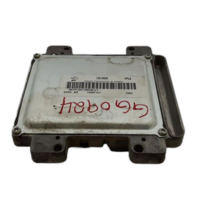
- Powertrain Control Module (PCM) Failure (Rare) — The vehicle's main computer suffers an internal fault, such as a failed analog-to-digital converter, preventing it from processing the sensor signal. Consider this only after ruling out all other causes.
Symptoms
- Check Engine Light On — The Malfunction Indicator Lamp illuminates steadily on the dashboard.
- Decreased Fuel Economy — The vehicle uses significantly more fuel because the computer enriches the mixture for a high ethanol content that isn't present. Expect a 5-10% drop in MPG.
- Poor Engine Performance — You will experience engine hesitation, a rough idle, stumbling on acceleration, or stalling, particularly during cold starts.
- Smell of Fuel from Exhaust — The PCM commands too much fuel, causing the engine to run rich. Unburnt fuel exits through the exhaust, creating a strong gasoline odor.
- Difficulty Starting — The engine becomes hard to start or fails to start due to the incorrect air/fuel mixture, a problem exacerbated by cold weather.
- Incorrect Fuel Composition Reading (scan-tool only — no driver-felt sign) — The live data PID for 'Fuel Composition' or 'Ethanol %' shows an abnormally high value (e.g., 85-100%) even when the tank contains regular E10 gasoline.
Diagnostic Flowchart
Tap your situation to follow the diagnostic path that matches what you're seeing on this code.
Common Fixes & Costs
- Replace Fuel Composition Sensor — Parts: $100-$350, Labor: $100-$200, ~1.5 hr book time (Intermediate)
- Repair Wiring or Connector — Parts: $10-$50, Labor: $100-$150, ~1.5 hr book time (Advanced)
- Reflash or Reprogram PCM — Parts: $0, Labor: $100-$180, ~1.0 hr book time (Professional)
- Repair Engine/Chassis Ground Connection — Parts: $5-$20, Labor: $50-$100, ~0.8 hr book time (DIY)
- Replace Powertrain Control Module (PCM) — Parts: $600-$900, Labor: $200-$300, ~2.0 hr book time (Professional)
DIY vs Professional
- Replace Fuel Composition Sensor — Beginner:
- Repair Wiring or Connector — Beginner:
- Reflash or Reprogram PCM — Beginner:
- Repair Engine/Chassis Ground Connection — Beginner:
Used vs. New Parts: Buying Guide
When a used part is worth it: Never. A used fuel composition sensor is a high-risk purchase. The primary failure mode is internal electronic degradation, meaning a salvage yard part will likely fail shortly after installation.
Donor-vehicle mileage cap: roughly under 40000 miles for the part to have meaningful remaining life.
Donor quality checklist:
- Avoid parts from regions with heavy road salt usage (rust belt) as connectors are compromised.
- Ensure the OEM part number matches exactly.
Decision logic:
- If The cost of a new OEM or reputable aftermarket sensor is under $400. → Always buy new. The warranty coverage outweighs the minimal savings of a used part.
- If The vehicle is very old and has low residual value. → Consider a used part only as a last resort, and only if performing the labor DIY to avoid paying twice.
Warranty tradeoff: Used parts carry a 30-day warranty, which is insufficient for latent defects. New aftermarket parts offer a 1-year to lifetime warranty.
Worst-case if a used part fails: $350. This represents the cost of a second replacement sensor plus the shop labor to install it again.
What Happens If You Wait — Timeline
- 0-1 month: Check Engine Light illuminates. A 5-10% drop in fuel economy occurs. The engine experiences occasional hard starting or a rough idle when cold. (MPG impact: 5-10%% · Added cost: $20-$60 in wasted fuel)
- 1-3 months: Engine performance issues become consistent. The constant rich fuel mixture overheats the catalytic converter and fouls the spark plugs. (MPG impact: 10-15%% · Added cost: $100-$300 in wasted fuel and spark plug replacement)
- 3-6 months: Catalytic converter substrate suffers permanent damage (sintering or cracking) from sustained high temperatures. The smell of raw fuel from the exhaust is obvious. (MPG impact: 15-20%% · Added cost: $800-$1500 as catalytic converter damage becomes irreversible)
- 6+ months: Catastrophic failure of the catalytic converter. The internal monolith melts and breaks apart, creating a severe exhaust blockage, drastic power loss, and stalling. (MPG impact: 20-30%+% · Added cost: $1500-$3000 for catalytic converter and O2 sensor replacement)
Cost of Not Fixing It
- 0-1 Month: Noticeable decrease in fuel economy by 5-10%, resulting in higher fuel costs. Hard starting or rough idle occurs in cold weather. (Added cost: $20-$60 in wasted fuel.)
- 1-6 Months: The continuous rich fuel mixture overheats the catalytic converter, reducing its lifespan. Spark plugs become fouled with carbon. (Added cost: $100-$300 for spark plug replacement and wasted fuel.)
- 6+ Months: Catastrophic failure of the catalytic converter. The internal substrate melts, causing a severe exhaust restriction and major power loss. (Added cost: $1200-$2800 for catalytic converter replacement.)
Diagnosis Steps
- Verify the Code and Review Freeze Frame Data
Use an OBD-II scanner to confirm P0179 is active. Document the freeze frame data to capture the vehicle's sensor readings at the exact moment the fault triggered.
Tools: OBD-II Scanner (Beginner) - Pro Tip: Induce the Opposite Code
With the key on and engine off, disconnect the fuel composition sensor's electrical connector. Re-scan for codes. If P0179 disappears and is replaced by P0178 (Circuit Low), the wiring and PCM are good, and the sensor itself has failed internally.
Tools: OBD-II Scanner (Intermediate) - Analyze Live Sensor Data
Observe the 'Fuel Composition' or 'Ethanol %' PID on a live data scanner. On a vehicle with regular gasoline, the reading sits between 5-15%. A value stuck at 85% or higher confirms a sensor or circuit fault.
Tools: OBD-II Scanner with Live Data (Intermediate) - Thorough Visual Inspection
Inspect the wiring harness from the sensor connector to the PCM. Look for burnt insulation near exhaust components, chafed wires, and green/white corrosion inside the connector.
Tools: Flashlight, Inspection mirror (Beginner) - Test the Circuit with a Multimeter
With the sensor disconnected and key on, check the power supply wire (typically 5V). Check the ground wire for continuity to the chassis (resistance < 1.0 ohm). Check the signal wire for voltage; any reading > 5V indicates a short-to-voltage in the harness.
Tools: Digital Multimeter, Vehicle-specific wiring diagram (Advanced) - Analyze the Sensor's Frequency Signal
Back-probe the signal wire with the engine running. A healthy sensor produces a square wave between 50 Hz (0% ethanol) and 150 Hz (100% ethanol). A flat line at high voltage or a frequency stuck above 150 Hz confirms a failed sensor.
Tools: Oscilloscope or Multimeter with Hz function, Wiring diagram (Advanced) - Check for TSBs and Software Updates
Check a professional repair database for Technical Service Bulletins (TSBs) related to P0179. Manufacturers occasionally release PCM software updates to correct logic errors that falsely trigger this code.
Tools: Online repair database or dealer contact (Intermediate)
When This Code Triggers (Freeze-Frame Conditions)
- Engine Coolant Temp: 185-205°F (The fault registers when the engine is fully warmed up and in closed-loop fuel control.)
- RPM: 1200-2800 RPM (The code sets during steady-state driving or light acceleration, rarely at idle.)
- Engine Load: 25-60% (Corresponds to a part-throttle, cruising condition where the PCM actively monitors fuel composition.)
- Vehicle Speed: 30-60 mph (Consistent with city or highway cruising speeds where the system expects stable sensor readings.)
Related Codes
- P0178 — 'Fuel Composition Sensor Circuit Low Input' is the direct opposite of P0179. If disconnecting the sensor causes P0179 to flip to P0178, the sensor itself is the culprit.
- P0176 — 'Fuel Composition Sensor Circuit Malfunction' indicates an erratic or lost signal, whereas P0179 is set specifically when the signal is stuck high.
- P0177 — 'Fuel Composition Sensor Circuit Range/Performance' suggests illogical sensor readings caused by contamination or an intermittent electrical fault.
- P0172 — 'System Too Rich (Bank 1)' is a direct consequence of P0179. The PCM thinks there is high ethanol (P0179) and adds excessive fuel, triggering the rich code (P0172). Fixing P0179 resolves P0172.
Climate & Environmental Factors
- Road Salt & Corrosion: In winter climates, road salt is the primary cause of P0179. Salty spray corrodes the sensor's connector pins and wiring, leading to shorts. GM issued special coverage program 14289 specifically for this failure.
- Cold Temperatures: Cold weather exacerbates symptoms like hard starting and rough idle. The PCM's incorrect fuel enrichment is highly disruptive during a cold start when a precise mixture is critical.
How to Talk to a Mechanic About This Code
Say this: "I have a check engine light and my scanner shows a P0179 code, 'Fuel Composition Sensor Circuit High'. I know this is often a bad sensor, a wiring issue, or a software problem. Can you test the circuit and check for TSBs before recommending a sensor replacement?"
This signals you understand the common causes. It directs the technician to perform a proper diagnosis (testing the circuit) rather than just replacing the most likely part, saving you money if the problem is a corroded wire.
Avoid saying:
- 'My check engine light is on, can you just fix it?' (Invites unnecessary diagnostic time.)
- 'I think I need a new fuel composition sensor.' (Don't diagnose it for them; you might pay for a part you don't need.)
- 'Just do whatever it takes.' (Removes your control over the cost.)
Questions to ask before authorizing the repair:
- Did you test the sensor's wiring and check for a short to voltage? What were the results?
- Did you check for any Technical Service Bulletins (TSBs) or software updates for my vehicle?
- If the sensor needs replacement, what is the warranty on the new part and your labor?
- Can you provide a printout of the freeze-frame data and the final code readings?
Where to Take It: Dealer vs Independent vs Chain
- Dealer:
Best for: Vehicles still under a powertrain or emissions warranty., If the diagnosis requires a PCM software update (reflash) using factory tools., Complex electrical issues or manufacturer-specific quirks involving TSBs.
Downsides: Highest labor rates (1.5-2x vs. independent)., Quicker to replace a whole assembly rather than perform a cheaper wiring repair. (Typical cost: +50% vs. baseline) - Independent Shop:
Best fit for most scenarios. An experienced independent shop easily handles the common causes of P0179 (bad sensor, wiring) at a lower labor rate. Go to a dealer only if a PCM reflash is required.
Best for: Out-of-warranty vehicles where cost is a major factor., Diagnosing and replacing the fuel composition sensor or repairing damaged wiring.
Downsides: Shop quality varies widely; look for ASE certifications., May lack manufacturer-specific tools to perform a PCM reflash. (Typical cost: +0% vs. baseline) - Chain Shop:
Avoid for initial diagnosis. They often miss wiring issues and push unnecessary sensor replacements.
Best for: Simple, routine maintenance like oil changes or tires.
Downsides: Technician skill varies dramatically., High pressure to upsell services and recommend unnecessary part replacements., Less likely to perform detailed electrical diagnostics. (Typical cost: -10% vs. baseline)
When to Walk Away From the Repair
If the estimated repair cost for the P0179 code and any other immediate needs exceeds 40-50% of your car's private-party value, consider selling the car instead of repairing it.
- Car worth $5000, fix is $800: Fix it. The repair cost is well below the 50% threshold and prevents expensive catalytic converter damage.
- Car worth $3000, fix is $1600: Borderline. This repair is over 50% of the car's value. Get a second opinion. If the car has other pending issues, walk away.
- Car worth $2000, fix is $2500: Walk away. The repair cost exceeds the vehicle's value. Do not invest this money.
What Scan Tool You Need for This Code
Minimum: A basic OBD-II reader that shows live data for the 'Fuel Composition' PID.
A $20 code reader won't show the live ethanol percentage reading, which is crucial for diagnosis. Furthermore, the ultimate fix on many GM vehicles is a 'Fuel Composition Reset,' which requires a bidirectional scanner.
Budget: BlueDriver Pro (~$100) — Reads the code and lets you view live data, including the fuel composition percentage, to see if the reading is stuck high. It cannot perform the fuel composition reset.
Mid-range: Foxwell NT510 Elite (~$180) — Offers full system diagnostics and includes the bidirectional 'Fuel Composition Reset' function for makes like GM and Ford. This fixes the problem without replacing parts if the issue is a learned incorrect value.
Professional: Autel MaxiCOM MK808S / Launch X431 CRP919E (~$400-550) — Full-featured bidirectional scan tools. They easily perform the 'Fuel Composition Reset', actuate components to test them, and provide dealership-level diagnostics.
Rent vs buy: AutoZone offers a Loan-A-Tool program to borrow a basic OBD-II scanner for free. However, if the fix requires a 'Fuel Composition Reset,' you must buy a bidirectional tool, as these are not available for rent.
How to Clear the Code After You Fix It
- Use a bi-directional OBD-II scan tool to clear the P0179 fault code.
- For GM vehicles, perform a 'Fuel Composition Reset' using the scan tool to relearn the baseline gasoline value.
- Ensure the fuel tank is at least 1/4 full with regular gasoline (not E85) before driving.
- Perform a complete OBD-II drive cycle to set readiness monitors.
Drive cycle (~30 minutes): Start the engine cold and idle for 3 minutes. Drive in stop-and-go city traffic for 15 minutes. Drive at a steady highway speed (55 mph) for 10 minutes. Allow the vehicle to cool down completely.
Readiness monitors affected: Comprehensive Component Monitor, Catalyst Monitor, Oxygen (O2) Sensor Monitor
Before emissions retest: drive at least 100 miles to fully set monitors.
Watch out for:
- Disconnecting the battery does not reliably clear the code and resets all readiness monitors to 'Not Ready', guaranteeing an emissions failure.
- Failing to perform the 'Fuel Composition Reset' on applicable vehicles causes persistent fuel trim issues even after replacing the sensor.
Will This Fail Emissions / State Inspection?
Yes — this code typically fails an OBD-II emissions inspection.
- California: A P0179 code is an automatic failure. All OBD-II readiness monitors must be set to 'Ready' (except EVAP, depending on the vehicle) before passing. Expect to drive 50-100 miles after the repair.
- New York: The NYS DMV inspection includes an OBD-II scan. P0179 causes an immediate failure. The Check Engine Light must be off and monitors set.
- Texas: In emissions-testing counties, an active P0179 results in failure. After clearing the code, you can typically have one monitor 'Not Ready' and still pass.
Most Commonly Affected Vehicles
- Ford F-150 (2004-2024) — Extremely common on Flex-Fuel models. Always inspect the wiring harness for chafing or heat damage before replacing the sensor.
- Chevrolet Silverado / Tahoe (2007-2024) — These models frequently experience P0179 due to a failing fuel composition sensor located in the fuel line beneath the vehicle.
- Dodge Ram 1500 (2009-2024) — The fuel composition sensor is a known failure item on Flex-Fuel Rams. The connector and wiring are highly susceptible to corrosion.
- GMC Yukon / Sierra (2004-2014) — Owners frequently report this code pointing to a failed sensor. Check for GM Special Coverage Adjustment #14289 before paying out of pocket.
- Chevrolet Suburban (2003-2014) — Flex-fuel Suburbans are highly susceptible. Diagnosis is straightforward, usually leading to sensor replacement.
- Nissan NV200 (2013-2021) — TSB NTB15-003 addresses an incorrectly installed sensor harness that rubs against a bracket, causing a short circuit and triggering P0179.
- Toyota Tundra / Sequoia (2018-2019) — These models were part of a major recall for faulty low-pressure fuel pumps, which can cause stalling and trigger various fuel system codes including P0179.
Manufacturer-Specific Notes
- General Motors (Chevrolet, GMC): GM issued Special Coverage Adjustment #14289 for certain 2013-14 models, extending the sensor warranty to 10 years/150,000 miles due to road salt corrosion failures. Always check for warranty coverage first.
- Ford: Thoroughly check the wiring harness for chafing and melting, as it is often routed near hot exhaust components. The sensor may be covered under the 5-year/60,000-mile Powertrain Warranty.
- Nissan: On models like the NV200, check TSB NTB15-003 first. It addresses incorrect routing of the sensor's wiring harness causing it to rub and short circuit.
- Non-Flex Fuel Vehicles: Triggering this code on a non-flex-fuel vehicle is extremely rare and points directly to a wiring short to a power source, a major ground issue, or an internal PCM fault.
Real Owner Stories
2012 Chevy Suburban 1500 with 100K miles
Vehicle had a hard start issue that progressed to a no-start condition. The engine was flooding with fuel.
What they tried:
- Owner discovered the fuel system incorrectly believed it was running a 50% ethanol mix.
Outcome: Using a Foxwell NT510 Elite scan tool, the owner performed a 'Fuel Composition Reset'. This reset the alcohol percentage back to 3% for regular gasoline, instantly resolving the starting issues without replacing parts.
Lesson: On GM flex-fuel vehicles, an incorrect fuel alcohol reading is often fixed with a bi-directional scan tool reset. This is a cheaper first step than replacing parts.
2013 Chevy Silverado 2500HD Flex-Fuel
Check engine light on with rich codes (P0172/P0175) and stumbling on startup. Scan tool showed fuel alcohol content at 60% despite using 100% gasoline.
What they tried:
- Owner considered buying a scan tool to perform a fuel composition reset.
Outcome: A forum member advised that failed upstream O2 sensors were the actual cause. Replacing both upstream O2 sensors resolved the rich codes and corrected the alcohol calculation.
Lesson: An incorrect fuel alcohol percentage is often a symptom, not the root cause. When O2 sensors fail and cause a rich condition, the PCM misinterprets this as high ethanol content.
2000 Mitsubishi Pajero GDI with intermittent P0179
Check engine light came on intermittently. The previous owner replaced an O2 sensor, but the code returned.
What they tried:
- The owner asked a forum if it was safe to drive 700km with the light on.
Outcome: The community advised against the drive. An intermittent electrical fault on a non-flex-fuel vehicle is unpredictable and leads to breakdowns.
Lesson: For non-flex-fuel vehicles, P0179 points to a fundamental electrical problem (wiring short, PCM issue). Intermittent codes become permanent and leave you stranded.
How to Prevent This Code From Triggering
- Apply Dielectric Grease to Connectors (During any under-vehicle service) — Applying non-conductive dielectric grease to the sensor's connector creates a seal that prevents moisture and road salt from reaching the pins, stopping corrosion.
- Perform Regular Undercarriage Washes (Monthly, especially in winter) — Washing the undercarriage removes corrosive road salt and grime, protecting the fuel composition sensor, wiring, and brake lines.
- Inspect and Secure Wiring Harnesses (During every oil change) — Ensure the wiring harness is secured in its clips and not routed near hot exhaust pipes. A loose harness is prone to damage that causes a short circuit.
- Annual Rust Proofing Application (Once per year (especially in salt regions)) — An oil-based rust proofing spray applied to the underbody creates a barrier that displaces moisture and protects electrical components from road salt.
Frequently Asked Questions
What is a Fuel Composition Sensor and where is it located?
It measures the ethanol percentage in your fuel so the engine computer can adjust performance. It is typically located in the fuel line between the fuel tank and the engine's fuel rail on Flex-Fuel vehicles.
What are the most common mistakes when diagnosing P0179?
The biggest mistake is replacing the sensor without testing the circuit for a short-to-voltage first. Always check the wiring harness and verify if any Technical Service Bulletins (TSBs) offer a simple software fix.
Can I fix P0179 myself?
Replacing the sensor is a straightforward DIY repair for intermediate mechanics since it sits in an accessible part of the fuel line. However, diagnosing wiring shorts or reprogramming a PCM requires professional tools.
Why did my P0179 code come back after a repair?
A returning code means the root cause was missed, such as an intermittent wiring short or a failed replacement part. It also occurs if you fail to perform a 'Fuel Composition Reset' with a scan tool after installation.
Can a bad battery or alternator cause P0179?
Yes. A failing alternator overcharging the system produces excessive voltage, triggering a high input signal from the sensor.
What happens if I ignore P0179?
Ignoring P0179 forces the engine to run rich, wasting fuel and eventually melting the catalytic converter. This turns a minor sensor replacement into a multi-thousand-dollar exhaust repair.
Can a bad gas cap cause P0179?
No. A loose gas cap causes EVAP system codes like P0442, whereas P0179 is a specific electrical circuit fault unrelated to fuel tank pressure.
Key Takeaways
- P0179 points directly to a failed Fuel Composition Sensor or damaged wiring in 90% of cases, particularly on American Flex-Fuel trucks.
- Driving with an active P0179 causes a 5-10% drop in fuel economy and destroys the catalytic converter within 3 to 6 months.
- Unplug the sensor with the key on; if the code flips from P0179 to P0178 (Circuit Low), the wiring is intact and the sensor itself requires replacement.
- Inspect the sensor's wiring harness for melted insulation or road salt corrosion before buying parts, as repairing a $10 wire often clears the code.
Shop the Parts Behind P0179
Below are the parts most often responsible for code P0179, ranked by how frequently each one is the actual culprit (per the diagnosis above). Tap any to see what we have for your vehicle.

The information in this article is provided for general reference and educational purposes only. Vehicle specifications, procedures, and part compatibility can vary by production date, trim level, and region. Always consult your vehicle's factory service manual and verify part numbers before purchasing or performing repairs. Safety-critical components such as airbags, seat belts, and braking systems should be installed by a qualified professional.
- 🧭 Diagnostic Flowchart
- 🛍️ Shop This Part
- What Does P0179 Mean?
- Can I Drive With P0179?
- Common Causes
- Symptoms
- Common Fixes & Costs
- DIY vs Professional
- Used vs. New Parts: Buying Guide
- What Happens If You Wait — Timeline
- Cost of Not Fixing It
- Diagnosis Steps
- When This Code Triggers (Freeze-Frame Conditions)
- Related Codes
- Climate & Environmental Factors
- How to Talk to a Mechanic About This Code
- Where to Take It: Dealer vs Independent vs Chain
- When to Walk Away From the Repair
- What Scan Tool You Need for This Code
- How to Clear the Code After You Fix It
- Will This Fail Emissions / State Inspection?
- Most Commonly Affected Vehicles
- Manufacturer-Specific Notes
- Real Owner Stories
- 2012 Chevy Suburban 1500 with 100K miles
- 2013 Chevy Silverado 2500HD Flex-Fuel
- 2000 Mitsubishi Pajero GDI with intermittent P0179
- How to Prevent This Code From Triggering
- Frequently Asked Questions
- What is a Fuel Composition Sensor and where is it located?
- What are the most common mistakes when diagnosing P0179?
- Can I fix P0179 myself?
- Why did my P0179 code come back after a repair?
- Can a bad battery or alternator cause P0179?
- What happens if I ignore P0179?
- Can a bad gas cap cause P0179?
- Key Takeaways
- 🎟️ Get 5% Off