

P0191 on 2015-2018 Ford Edge 2.7L EcoBoost: Causes, Symptoms, and Fixes
This code usually points to a failing Fuel Rail Pressure (FRP) sensor on the 2.7L EcoBoost engine. The sensor gives incorrect readings to the computer, causing drivability issues. Replacing the sensor is the most common fix, but wiring issues should also be investigated.
- P0191 on your 2.7L EcoBoost Edge means there's a problem with the high-pressure fuel system, most often a faulty Fuel Rail Pressure (FRP) sensor.
- Symptoms are serious and include hesitation, stalling, and loss of power.
- Diagnosis should start by monitoring the fuel rail pressure with a scan tool to see if it's behaving erratically.
- While you can replace the sensor yourself, working on the high-pressure fuel system is risky; professional service is recommended.
- Always use a high-quality replacement sensor, preferably from an OEM supplier like Motorcraft or Bosch, to ensure an accurate and lasting repair.
What's Unique About the 2015-2018 Ford Edge
The 2.7L EcoBoost is a Gasoline Turbocharged Direct Injection (GTDI) engine. This design uses two fuel pumps: a low-pressure pump in the tank and a high-pressure, cam-driven pump on the engine to achieve pressures over 2000 PSI. The P0191 code specifically relates to the high-pressure side of the system. While the causes can be complex, the Fuel Rail Pressure (FRP) sensor itself is a frequent point of failure on these engines, sometimes more so than the pumps or wiring.
Symptoms You May Notice
- Check Engine Light is on
- Engine hesitation or stumbling during acceleration
- Rough or erratic idle
- Loss of engine power
- Difficulty starting the engine, requiring long cranks
- Engine stalling, especially at low RPM or when coming to a stop
- Decreased fuel economy
- Replacing the fuel injectors when the issue is actually inconsistent fuel pressure.
- Replacing the in-tank fuel pump without first verifying if the fault lies with the high-pressure system or the FRP sensor.
- Replacing the FRP sensor without thoroughly inspecting the wiring harness for chafing or damage, leading to a recurrence of the code.
Most Likely Causes
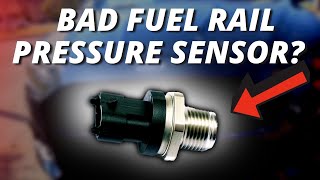
- Faulty Fuel Rail Pressure (FRP) Sensor 🔴 High Probability → Shop Fuel Pressure Sensor The FRP sensor is a sensitive electronic component that operates in a high-heat, high-vibration environment and is a known failure point on many modern Ford engines. It can fail intermittently, especially when cold, before failing completely.
How to confirm: Use an OBD-II scanner to monitor the 'FRP' PID (Parameter ID). If the pressure reading is erratic, doesn't change with engine RPM, is stuck at a high value, or is clearly illogical (e.g., reading high pressure with the engine off), the sensor is likely bad.
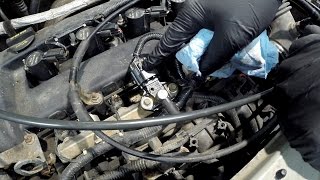
Typical fix: Replace the Fuel Rail Pressure sensor. It is typically located on the high-pressure fuel rail on top of the engine, often near the back. 🎬 See this walkthrough on replacing the fuel rail pressure sensor
Est. part cost: $80-$150 - Damaged Wiring or Connector 🟡 Medium Probability The engine harness wiring can become brittle or damaged from heat and vibration, leading to poor electrical connections to the FRP sensor. Chafing against engine components or brackets is a known cause of this code.
How to confirm: Visually inspect the wiring harness and connector for the FRP sensor. Look for any signs of chafing, melting, corrosion on the pins, or loose connections. Perform a continuity and voltage test on the sensor's circuit. A real-world example from a 2CarPros forum user involved replacing the sensor and pump, only to find the issue was a wiring fault.
Typical fix: Repair the damaged section of the wiring harness or replace the connector pigtail. Protect the repaired area with loom or re-route to prevent future chafing.
Est. part cost: $20-$50 - Failing High-Pressure Fuel Pump (HPFP) ⚪ Low Probability → Shop Fuel Pump While less common than the sensor, the mechanical high-pressure pump can wear out, failing to deliver the pressure commanded by the PCM, especially under high load.
How to confirm: Monitor fuel rail pressure with a scan tool. If the actual pressure consistently fails to meet the desired pressure under load, and the low-pressure system is confirmed to be working correctly, the HPFP is suspect. This diagnosis should only be made after ruling out the sensor and wiring. 🎬 Watch: Diagnosing a high pressure fuel pump on the 2.7L
Typical fix: Replacement of the high-pressure fuel pump. This is a more involved and expensive repair.
Est. part cost: $400-$800 - Failing Low-Pressure Fuel Pump or Driver Module ⚪ Low Probability → Shop Fuel Pump The high-pressure pump cannot function correctly if it isn't being fed with adequate pressure from the in-tank low-pressure pump. The Fuel Pump Driver Module (FPDM) that controls this pump can also fail.
How to confirm: Check the low-pressure fuel system pressure. If it is below specification (typically 40-65 PSI), the in-tank pump, fuel filter, or FPDM could be at fault.
Typical fix: Replace the in-tank fuel pump assembly or the Fuel Pump Driver Module.
Est. part cost: $250-$500
Rare But Worth Checking
- Powertrain Control Module (PCM) Issue: → Shop Engine Control Module (ECM) In very rare cases, the PCM itself can have an internal fault, causing it to misinterpret a good sensor signal. This should only be considered after all other possibilities have been exhaustively ruled out.
Diagnosis Steps
- Connect an OBD-II scanner and check for any other stored trouble codes.
- Access live data and monitor the Fuel Rail Pressure (FRP) PID. Note the pressure with the key on/engine off, at idle, and while driving under load.
- Compare the actual FRP reading to the desired FRP reading on the scanner. Large, persistent discrepancies point to a problem.
- Thoroughly inspect the FRP sensor's connector and the surrounding wiring harness for any obvious damage, corrosion, or loose connections. Pay close attention to areas where the harness may rub against engine brackets or other components.
- If the sensor reading is erratic or stuck, and the wiring appears intact, the sensor itself is the most likely culprit.
- If the sensor and wiring test good, the next step is to diagnose the fuel delivery system. This involves checking the performance of both the low-pressure in-tank pump and the high-pressure engine-mounted pump.
- Test the Fuel Pump Driver Module (FPDM) to ensure it is sending the correct voltage to the low-pressure pump.
Parts You'll Likely Need
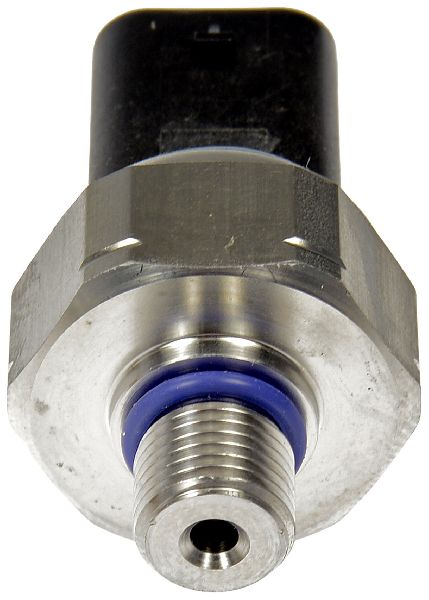
- Fuel Rail Pressure Sensor
(OEM #BU5Z-9F972-B (also listed as BU5A-9F972-CA))— This sensor is the most frequent failure point for code P0191 on this engine. It directly measures the pressure in the fuel rail and sends this critical information to the PCM.
Trusted brands: Motorcraft, Bosch, Standard Motor Products
OEM price range: $120-$180
Aftermarket price range: $70-$120
Related Codes That Often Appear With This One
- P0192 — This code indicates 'Fuel Rail Pressure Sensor Circuit Low Input', which is a more specific version of the P0191 performance issue.
- P0193 — This code indicates 'Fuel Rail Pressure Sensor Circuit High Input', another specific fault related to the same sensor and circuit.
- P0087 — This code means 'Fuel Rail/System Pressure - Too Low', which can be a direct mechanical cause (like a failing pump) for the P0191 range/performance code.
Technical Service Bulletins (TSBs) & Recalls
- TSB 19-2219: Documents the common oil pan leak on 2015-2017 models due to RTV sealant failure.
- TSB 23-2338: A later TSB updating the repair procedure for the oil pan leak, sometimes involving valve cover replacement to ensure PCV system compatibility.
Platform-Specific Known Issues
- While no specific TSB for P0191 on the 2015-2018 Edge 2.7L was found, a GM service bulletin (21-NA-259) for its own 2.7L engine lists P0191 as a potential DTC caused by the engine wiring harness chafing on engine components. This cross-platform validation strongly suggests inspecting the harness is a critical diagnostic step for this code on the Ford 2.7L as well.
- Some owners have reported intermittent hesitation and power loss for weeks before the P0191 code finally appears, suggesting the sensor can fail gradually.
Mechanic-Grade Diagnostic Values
- FRP Sensor Signal Voltage (KOEO - Key On, Engine Off) — expected: 2.0V - 3.0V. Failure: Voltage significantly outside this range, or at 0V or 5V, indicates a sensor or wiring fault.
- FRP Sensor Signal Voltage (At Idle) — expected: 2.0V - 2.5V. Failure: A reading that is stuck, erratic, or does not respond to changes in engine RPM suggests a faulty sensor.
- Low-Pressure Fuel System Pressure — expected: 345-827 kPa (50-120 PSI). Failure: Pressure below this range indicates a problem with the in-tank fuel pump, fuel filter, or Fuel Pump Driver Module (FPDM).
- High-Pressure Fuel System Voltage Correlation — expected: Approx. 3.5V corresponds to maximum pressure of ~2,900 PSI.. Failure: If the scan tool shows a voltage that is illogical for the commanded pressure (e.g., high voltage at low pressure), it points to a sensor or wiring issue.
Hidden / Shadow Codes Worth Checking
- P0191:XX-YY: Ford's diagnostic system often appends a two-digit failure type code (XX) and an occurrence counter (YY) visible on dealer-level scan tools like IDS. For example, a code might appear as P0191:00-2F. While the specific subtype for this DTC isn't documented here, its presence can offer more granular detail about the nature of the fault (e.g., circuit high, low, intermittent). (see via Ford IDS (Integrated Diagnostic System) or equivalent high-level aftermarket scan tool.)
Scan Tool Commands That Help
- Ford IDS (or equivalent): FP (MODE) - Fuel Pump Duty Cycle Control — This bidirectional control allows a technician to command the low-pressure fuel pump on or off to verify its operation and check for pressure stability and leak-down, which is a key step in Ford's pinpoint tests.
- Ford IDS (or equivalent): FLP_V (VOLT) PID Monitoring — This is used during a 'wiggle test'. A technician monitors this live voltage PID while physically manipulating the sensor connector and wiring harness to identify intermittent shorts or opens that may not be present when the vehicle is stationary.
Wiring & Ground Locations
- G104 / G106 — Main engine compartment ground points. G104 is often on the left (driver's side) front of the engine compartment, while G106 is on the right (passenger's side) front.. The FRP sensor circuit relies on a clean ground reference. A corroded or loose main engine ground can introduce electrical noise or voltage offsets, causing the PCM to receive an incorrect signal from the sensor.
- PCM Grounds (Firewall) — On the firewall of the engine bay. The exact location can vary slightly by model year, but they are the primary ground points for the Powertrain Control Module.. This is the ultimate ground reference for the PCM's interpretation of all sensor data. Verifying this ground is tight and clean is a crucial step when diagnosing any sensor performance code, especially after checking the sensor-side connector and harness.
- Pinpoint Test DD — This is a document, not a physical part. It is the official Ford diagnostic procedure for the FRP sensor.. Knowing this test procedure exists and can be found on enthusiast forums (like fordedgeforum.com) provides a direct path to dealer-level diagnostic steps, including connector pinouts and expected values.
OEM Part Supersession History
BU5Z-9F972-A (also CM5226)→BU5Z-9F972-B (also CM5250)— Standard part revision and improvement. Engineering updates are often incorporated into newer part numbers to improve reliability or performance.
Heads up: The newer BU5Z-9F972-B is backward compatible and is the correct service part for the entire 2015-2018 range.
Diagnostic Flowchart
Other Known Issues on This Vehicle
Issues unrelated to this code that are worth knowing about as an owner of this generation:
- Engine Oil Pan Leak 🟠 Medium — Very common on 2015-2017 models due to failure of the RTV sealant. Less common on 2018+ models which received an updated pan design. (Ref: TSB 19-2219, TSB 23-2338)
- Coolant Intrusion / Cracked Cylinder Head 🔴 High — Reported by some owners, leading to coolant loss, white exhaust smoke, and potential engine failure. Less common than oil leaks but catastrophic when it occurs.
- Front Brake Hose Rupture 🔴 High — Affects all 2015-2018 Edge models. A safety recall was issued because the hoses can rupture, leading to a loss of braking. (Ref: NHTSA Recall 20V435000)
- Carbon Buildup on Intake Valves 🟡 Low — An inherent issue with all direct-injection (GDI/GTDI) engines over time. Typically becomes noticeable after 60,000-100,000 miles, causing rough idle or hesitation.
Used vs. New Parts: Buying Guide for This Vehicle
When a used part is the smart pick: For this repair, using used parts is generally not recommended. The most common failure, the FRP sensor, is an electronic part prone to wear and is relatively inexpensive new. A used High-Pressure Fuel Pump (HPFP) might be considered only if it comes from a very low-mileage donor and offers substantial savings over a new unit, but it carries significant risk.
Donor-vehicle mileage cap: roughly under 30000 miles for the part to have meaningful remaining life.
What to inspect on the donor part:
- For a used HPFP, verify the donor vehicle's mileage and history if possible.
- There are no reliable visual cues to determine the health of a used HPFP or FRP sensor.
- Avoid parts from vehicles with known flood or fire damage.
OEM-only on this vehicle (don't cheap out):
- High-Pressure Fuel Pump (HPFP)
- Fuel Rail Pressure (FRP) Sensor
Aftermarket brands forum-validated for this vehicle:
- Bosch (often an OEM supplier)
- Standard Motor Products (SMP)
Brands owners have reported issues with on this vehicle:
- Unbranded, 'white-box' sensors from online marketplaces are frequently cited on forums as being unreliable, failing quickly, or being out-of-spec from the start, leading to wasted time and money.
Real Owner Stories
Aggregated from forums and TSBs cited above. Mileages and costs reflect what owners reported in those sources.
2016 Ford Edge 2.7L EcoBoost — 98000 miles
Symptoms: The owner noticed intermittent hesitation and power loss for weeks before the code appeared; the engine eventually stalled while driving.
What fixed it: After replacing the sensor and the fuel pump without success, the root cause was discovered to be a wiring fault in the sensor circuit.
Source hint: 2carpros.com - 'Code P0191: About a Month Ago, Was Driving and Engine Stalled'
Related OBD-II Codes
Frequently Asked Questions
Does TSB 19-2219 or TSB 23-2338 for the 2.7L EcoBoost relate to my P0191 fuel pressure code?
I have a 2016 Lincoln MKX with the 2.7L engine; is it prone to the same P0191 issues as the Ford Edge?
Could a safety recall be causing my engine to stall and throw a P0191 code?
Where is the Fuel Rail Pressure (FRP) sensor located on my 2.7L EcoBoost V6?
Is there a specific wiring issue I should look for on my Ford Edge 2.7L?
What should the low-pressure fuel system read on a scan tool for this vehicle?
Helpful Videos
We Have This Part in Stock


The information in this article is provided for general reference and educational purposes only. Vehicle specifications, procedures, and part compatibility can vary by production date, trim level, and region. Always consult your vehicle's factory service manual and verify part numbers before purchasing or performing repairs. Safety-critical components such as airbags, seat belts, and braking systems should be installed by a qualified professional.
- Ford Edge:
- 🧭 Diagnostic Flowchart
- 🎬 Helpful Videos
- 🛍️ Shop This Part
- What's Unique About the 2015-2018 Ford Edge
- Symptoms You May Notice
- Most Likely Causes
- Rare But Worth Checking
- Diagnosis Steps
- Parts You'll Likely Need
- Related Codes That Often Appear With This One
- Technical Service Bulletins (TSBs) & Recalls
- Platform-Specific Known Issues
- Mechanic-Grade Diagnostic Values
- Hidden / Shadow Codes Worth Checking
- Scan Tool Commands That Help
- Wiring & Ground Locations
- OEM Part Supersession History
- Other Known Issues on This Vehicle
- Used vs. New Parts: Buying Guide for This Vehicle
- Real Owner Stories
- 2016 Ford Edge 2.7L EcoBoost — 98000 miles
- Related OBD-II Codes
- Frequently Asked Questions
- 🎟️ Get 5% Off