

P0191 on 2015-2018 GMC Savana: Fuel Rail Pressure Sensor Causes and Fixes
Code P0191 on a 2015-2018 GMC Savana indicates a problem with the Fuel Rail Pressure (FRP) sensor's signal. While the sensor itself can fail, GM Technical Service Bulletins strongly suggest checking for fuel system contamination, which is a common underlying cause for this code on these vans. This issue is well-documented for both gasoline and Duramax diesel engines on this platform.
- P0191 on a 2015-2018 Savana means there's a problem with the fuel rail pressure sensor's signal.
- Before replacing any parts, check for fuel contamination. GM has issued multiple service bulletins indicating this is a common problem for these vans.
- Symptoms typically include hard starting, stalling, rough running, and a lit Check Engine Light.
- If the fuel is clean, the most likely causes are a faulty Fuel Rail Pressure sensor or a failing fuel pump.
- This code is often seen with P0087 (pressure too low) and P0088 (pressure too high).
What's Unique About the 2015-2018 Gmc SAVANA
For this generation of GMC Savana and its platform-mate, the Chevrolet Express, multiple official GM Technical Service Bulletins (TSBs) link the P0191 code directly to fuel system contamination. This is a known issue across both gasoline and diesel engines, where debris can cause erratic fuel pressure readings. For Duramax diesel models specifically, contamination from water (causing rust) or even Diesel Exhaust Fluid (DEF) has been identified as a cause. Before assuming a sensor or pump has failed, it is critical to investigate the possibility of debris in the fuel system, as this is a well-documented issue that can cause erratic fuel pressure readings and trigger this specific code.
Diagnostic Flowchart
Tap your situation to follow the diagnostic path that matches what you're seeing on this vehicle.
Symptoms You May Notice
- Check Engine Light is on
- Hard starting or no-start condition.
- Engine runs rough or stalls, especially at idle or under load.
- Reduced engine power and sluggish acceleration.
- Poor fuel economy.
- Engine hesitation or surging.
- Immediately replacing the Fuel Rail Pressure sensor without checking for fuel contamination or testing the fuel pump's actual output. The sensor is often reporting a real pressure problem, rather than being the cause of it.
- On Duramax models, replacing the high-pressure fuel pump without first confirming fuel contamination, which could be the root cause of the pump's failure.
Most Likely Causes
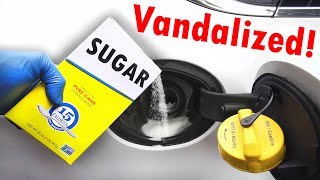
- Fuel System Contamination 🔴 High Probability This is a documented issue cited in multiple GM Technical Service Bulletins (PIP5151F, 16-NA-102) for this vehicle platform, affecting both gasoline and diesel models. Debris in the tank can clog the fuel pump pickup or interfere with pressure regulation. For Duramax diesels, TSBs specifically show examples of rust from water in the fuel or contamination from DEF.
How to confirm: Take a fuel sample from the fuel rail's Schrader valve or by disconnecting the fuel line. Inspect the sample in a clear container for visible debris, dirt, water, or fuel separation. For diesel models, TSB 16-NA-102 outlines inspecting the Fuel Pressure Regulator 1 for magnetic metal debris as a key diagnostic step.
Typical fix: If contamination is found, the entire fuel system must be cleaned. This involves dropping and cleaning the fuel tank, flushing the fuel lines, and replacing the fuel filter(s). 🎬 See how to properly flush and clean your fuel system. Depending on the severity and type of contamination, the fuel pump and/or fuel injectors may also require replacement.
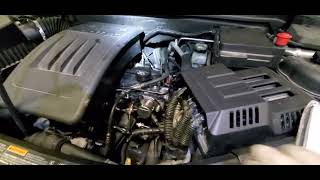
Est. part cost: $20-$100 for filters and cleaning supplies, potentially more if the pump is damaged. - Faulty Fuel Rail Pressure (FRP) Sensor 🟡 Medium Probability → Shop Fuel Pressure Sensor The sensor is located on the engine's fuel rail, which on these vans is accessed by removing the 'doghouse' engine cover inside the cab. Its location can expose its connector to dirt and moisture over time.
How to confirm: Use a scan tool to monitor the fuel rail pressure reading (FRP PID). If the reading is erratic, stuck at one value, or clearly incorrect for the engine's state (e.g., reading high pressure with the engine off), the sensor is likely faulty. Compare the scan tool reading to a mechanical fuel pressure gauge; if they differ significantly, the sensor is bad.
Typical fix: Replace the fuel rail pressure sensor. It is mounted on the fuel rail at the rear of the driver's side of the engine.
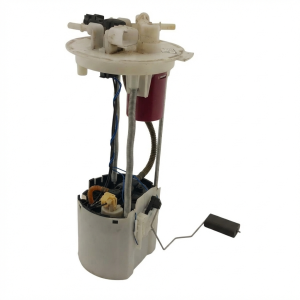
Est. part cost: $40-$120 - Failing Fuel Pump 🟡 Medium Probability → Shop Fuel Pump A weak lift pump (in-tank) or high-pressure pump (on diesel engines) can fail to provide the pressure commanded by the ECM, especially under load like towing.
How to confirm: Connect a mechanical fuel pressure gauge to the fuel system. If the mechanical gauge shows low or fluctuating pressure that matches the scan tool data, 🎬 Watch this walkthrough on testing for a weak fuel pump. the pump is likely weak or failing. For diesel models, a weak high-pressure pump (CP4) can be a cause, often diagnosed by seeing actual rail pressure fall below desired pressure under acceleration.
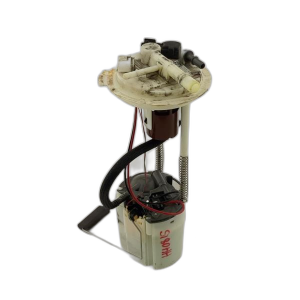
Typical fix: Replace the in-tank fuel pump module assembly or the high-pressure fuel pump on diesel models.
Est. part cost: $200-$400 for in-tank pump, significantly more for diesel high-pressure pump. - Damaged Wiring or Connector ⚪ Low Probability GM issued TSB 20-NA-197 for some models, which includes the Express/Savana, noting that corrosion or damage at the fuel pressure sensor's electrical connector can cause a P0191 code.
How to confirm: Visually inspect the wiring harness and connector for the FRP sensor for any signs of damage, corrosion, or loose pins. Perform a continuity and voltage drop test on the power (often a 5V reference), ground, and signal wires.
Typical fix: Repair the damaged section of the wiring harness or replace the connector pigtail. Applying dielectric grease during reassembly is recommended to prevent future corrosion.
Est. part cost: $15-$50
Rare But Worth Checking
- Clogged Fuel Filter: → Shop Fuel Filter While often replaced as part of routine maintenance, a severely clogged fuel filter can restrict flow enough to cause pressure issues and trigger a P0191 code. This should always be checked before replacing more expensive components.
- Faulty Powertrain Control Module (PCM): → Shop Engine Control Module (ECM) This is extremely rare, but a malfunctioning PCM can misinterpret sensor data or fail to properly command the fuel system. This should only be considered after all other possibilities have been exhaustively ruled out.
Diagnosis Steps
- Connect an OBD-II scanner and check for any other stored codes, paying close attention to P0087, P0088, or P128E. 🎬 Watch: A step-by-step guide to diagnosing the P0191 code.
- Observe live data from the Fuel Rail Pressure sensor on the scanner. Note the pressure reading with the key on, engine off, and then while idling and driving. Compare the actual pressure to the desired pressure PID.
- Following the guidance in GM TSBs, carefully take a fuel sample. Check for any debris, water, or other contaminants. If contamination is found, this is the primary issue to address.
- Visually inspect the FRP sensor's electrical connector and wiring for any obvious damage, corrosion, or looseness, as noted in TSB 20-NA-197.
- If the fuel is clean, connect a mechanical fuel pressure gauge to verify the readings from the electronic sensor. If the readings don't match, the sensor is likely bad.
- If the mechanical gauge confirms low or erratic pressure that matches the scan tool, the problem lies with the fuel delivery system (fuel pump, fuel filter).
- If the sensor and fuel pressure test good, perform a voltage and continuity test on the sensor's wiring circuit to rule out an electrical issue.
- Based on the findings, replace the faulty component (sensor, fuel pump) or perform a full fuel system cleaning as required by TSB 16-NA-102.
Parts You'll Likely Need
- Fuel Rail Pressure Sensor
(OEM #12673299 (example for 6.0L V8, verify by VIN))— This sensor can fail, sending incorrect or erratic signals to the PCM. It's a common fix if fuel delivery and wiring are confirmed to be good.
Trusted brands: ACDelco, Bosch, Standard Motor Products
OEM price range: $70-$150
Aftermarket price range: $40-$120 - Fuel Pump Module Assembly
(OEM #M10235 (This is a Delphi aftermarket part number, not an OEM GM part number. Verify specific GM part number by VIN))— A weak or failing fuel pump cannot supply adequate pressure, which is a direct cause of P0191 and related codes. Contamination found in the tank often requires pump replacement.
Trusted brands: ACDelco, Delphi
OEM price range: $250-$400
Aftermarket price range: $200-$300 - Fuel Filter — A clogged fuel filter will restrict fuel flow, causing a pressure drop and potentially triggering P0191. It is a critical maintenance item and a common cause of fuel pressure issues.
Related Codes That Often Appear With This One
- P0087 — This code means "Fuel Rail/System Pressure - Too Low" and often appears with P0191 when the underlying cause is a weak fuel pump, clogged filter, or fuel contamination.
- P0088 — This code means "Fuel Rail/System Pressure - Too High" and can be set alongside P0191 if there is a blockage or a regulator issue causing excessive pressure.
- P128E — This is a GM-specific code that is also related to fuel rail pressure and is cited in the same TSBs as P0191, indicating they share common causes on this platform.
- P0192 / P0193 — These codes indicate a circuit low or high input for the FRP sensor, respectively. They point more specifically to an electrical issue with the sensor or its wiring, but can accompany P0191.
Technical Service Bulletins (TSBs) & Recalls
- PIP5151F: Discusses hard/no start, rough running, and low fuel pressure with codes P0087, P0088, P0191, P128E, pointing to fuel system contamination (including water, DEF, and other fluids) in Duramax engines.
- 16-NA-102: Provides a detailed procedure to inspect for metallic debris and, if found, clean the entire fuel system (tank, lines, filter housing) and replace necessary components to fix hard/no start issues and DTCs P0087, P0088, P0191, or P128E.
- PIP4949E: Mentions hard start or no start with DTCs P0087, P0088, P0191, or P128E and advises following standard diagnostic procedures, often as a precursor to the more detailed steps in other TSBs.
- 20-NA-197: Addresses corrosion at the fuel pressure sensor connector as a potential cause for P0191 on various GM trucks, including the Savana/Express.
Platform-Specific Known Issues
- A high likelihood of fuel system contamination causing P0191, as documented in GM TSBs #PIP5151F and #16-NA-102. This can lead to hard start, no start, and rough running conditions.
- For Duramax diesel models, contamination can be from metallic debris from a failing high-pressure fuel pump, water causing rust, or even accidental contamination with Diesel Exhaust Fluid (DEF).
- Corrosion at the fuel pressure sensor electrical connector is also a known issue addressed by GM TSB 20-NA-197.
Mechanic-Grade Diagnostic Values
- FRP Sensor Connector Voltage Test (Key On, Connector Disconnected) — expected: 5V on the reference wire, 0V (continuity to ground) on the ground wire, and 5V on the signal wire (bias voltage from ECM).. Failure: Missing 5V reference or ground indicates a wiring or ECM issue. Incorrect signal voltage points towards a circuit problem.
- Duramax Fuel Rail Pressure (Key On, Engine Off) — expected: 1-1.8 MPa (145-261 PSI) on a scan tool.. Failure: A reading of 0 or one significantly outside this range suggests a faulty sensor or a complete lack of pressure.
- Gasoline Engine Fuel Pressure (Typical, at rail) — expected: Approximately 400-440 kPa (58-64 PSI) at idle.. Failure: Pressure that is significantly lower, higher, or fluctuates wildly indicates a problem with the pump, regulator, or a leak/restriction.
- Voltage Drop on Fuel Pump Driver Module Power/Ground — expected: Less than 0.1V (e.g., 0.05V).. Failure: An excessive voltage drop indicates high resistance in the power or ground circuit supplying the module, which can cause erratic pump behavior.
Hidden / Shadow Codes Worth Checking
- P0087, P0089, P026C, P026D, P1089, P163A, P163B, P2293, P228A, P228B, P228C, P228D: Per TSB 20-NA-197 for L5P Duramax engines, these codes may set along with P0191 due to a common cause: corrosion or damage at the fuel pressure sensor electrical connector. (see via Standard OBD-II scanner.)
Wiring & Ground Locations
- ECM Connector X1 — In the engine compartment, on the left inner fender. It is the ECM connector with the blue-colored face.. This is where the FRP sensor wiring terminates. Pin 2 is the fuel signal, Pin 8 is the low reference (ground), and Pin 10 is the 5-volt reference. These are the specific pins to test for continuity back from the sensor.
- G104 / G108 — G104 is on the back of the left (driver's side) cylinder head. G108 is the other end of that same ground strap, attached to the firewall in the engine compartment.. These are primary engine-to-chassis grounds. A poor connection here can cause erratic sensor readings and module behavior throughout the engine management system.
- G303 — Behind the left (driver's side) kick panel inside the cab.. This is a major body/chassis ground point. While not directly for the engine sensors, modules inside the cab rely on these grounds, and a poor connection can cause a wide range of electrical issues.
Real Owner Repair Stories
- Reddit user on r/Duramax (2018 GM Truck with L5P Duramax engine) — P0191 code
❌ Tried (didn't work) Not specified, user was asking for help.
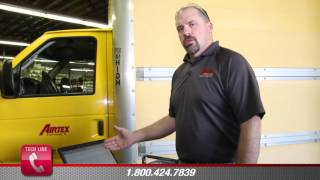
✅ What actually fixed it The confirmed fix from another user was repairing the wiring at the fuel rail pressure sensor connector. The connector is located at the front of the engine on the passenger side, at the end of the fuel rail behind the throttle body. - Airtex Tech Video (on a Ford E350) (2005 Ford E350 (Note: Different vehicle, but a pulse-width modulated returnless fuel system with similar failure modes)) — P0191, fuel pump running continuously with key on, excessively high fuel pressure (74 PSI).
❌ Tried (didn't work) Initial diagnosis confirmed the FRP sensor was working correctly by reporting the high pressure, and the Fuel Pump Driver Module had good power and ground.
✅ What actually fixed it The root cause was the fuel pump's rubber isolator boot inside the fuel tank had deteriorated due to fuel contamination. This allowed the metal case of the pump to contact the metal hanger assembly, creating a direct short to ground. This short caused the pump to run continuously at full power, creating excessive pressure. The fix was to replace the entire fuel pump hanger assembly and clean the tank.
"I Checked Everything" — The Actual Cause
- A P0191 code with excessively high pressure was traced to a short circuit inside the fuel tank. The fuel pump's rubber isolator had degraded, allowing the pump's metal body to touch the grounded hanger assembly. This bypassed the fuel pump driver module's control, causing the pump to run constantly at maximum speed. Standard external wiring and pressure tests would not immediately pinpoint a fault inside the sealed tank assembly.
OEM Part Supersession History
4-wire Fuel Rail Pressure/Temperature Sensor→3-wire Fuel Rail Pressure Sensor— GM discontinued the integrated temperature sensing function in the rail pressure sensor for some Gen V engines.
Heads up: The harness connector may physically fit both sensor types, but they are not interchangeable. The ECU programming is specific to either a 3-wire or 4-wire sensor. Using the wrong sensor for your vehicle's calibration will result in incorrect readings and codes. Always verify the correct part by VIN.
Model Year Variations Within This Range
- 2015-2017 vs 2017-2018: Around the 2017 model year, some Gen V engines transitioned from a 4-wire fuel rail pressure sensor (which included a temperature sensor) to a simpler 3-wire sensor. While the function for P0191 is the same, the physical part and wiring are different and must match the vehicle's original build and ECU calibration.
Helpful Videos
Used OEM Parts in Stock
New Aftermarket Parts Available


The information in this article is provided for general reference and educational purposes only. Vehicle specifications, procedures, and part compatibility can vary by production date, trim level, and region. Always consult your vehicle's factory service manual and verify part numbers before purchasing or performing repairs. Safety-critical components such as airbags, seat belts, and braking systems should be installed by a qualified professional.
- Gmc SAVANA:
- 🧭 Diagnostic Flowchart
- 🎬 Helpful Videos
- 🛍️ Shop This Part
- What's Unique About the 2015-2018 Gmc SAVANA
- Symptoms You May Notice
- Most Likely Causes
- Rare But Worth Checking
- Diagnosis Steps
- Parts You'll Likely Need
- Related Codes That Often Appear With This One
- Technical Service Bulletins (TSBs) & Recalls
- Platform-Specific Known Issues
- Mechanic-Grade Diagnostic Values
- Hidden / Shadow Codes Worth Checking
- Wiring & Ground Locations
- Real Owner Repair Stories
- "I Checked Everything" — The Actual Cause
- OEM Part Supersession History
- Model Year Variations Within This Range
- 🎟️ Get 5% Off