

P0191 on 2022 Kia Carnival: Fuel Rail Pressure Sensor Causes and Fixes
This code indicates a problem with the fuel rail pressure sensor's signal. The most common cause is a faulty Fuel Rail Pressure Sensor (FRPS) itself. Other possibilities include wiring issues, a failing high-pressure fuel pump, leaking fuel injectors, or a problem with the engine computer (PCM).
- P0191 on a 2022 Kia Carnival points to a problem with the high-pressure fuel system, specifically an irrational signal from the fuel rail pressure sensor.
- The most likely cause is a faulty fuel rail pressure sensor, but wiring issues and a failing high-pressure fuel pump are also possibilities.
- Due to the extremely high pressures involved in the GDI fuel system, diagnosis and repair are best left to a qualified professional.
- Do not ignore this code. It can lead to stalling, significant power loss, and potential further engine damage.
- Check for related codes like P0087, which would strongly suggest a failing high-pressure fuel pump.
What's Unique About the 2022-2022 Kia Carnival
The Kia Carnival with the Lambda III 3.5L GDI (Gasoline Direct Injection) engine utilizes a high-pressure fuel system to inject fuel directly into the cylinders. This system is more complex than older multi-port injection (MPI) systems and relies on both a low-pressure in-tank pump and a high-pressure fuel pump (HPFP) on the engine. Code P0191 on this platform points to a potential issue within this high-pressure side, making the sensor, HPFP, and high-pressure injectors primary areas of investigation. A TSB (FUE060) specifically for the 2022 Carnival confirms that faulty high-pressure injectors can be a cause of fuel system issues on this engine. Furthermore, NHTSA ODI #11682506 notes an instance where the Check Engine Light displayed this specific DTC, even when the dealer suggested certain fuel-related recalls did not apply to that specific VIN.
Symptoms You May Notice
- Check Engine Light is on
- Engine hesitation or sputtering, especially during acceleration
- Significant loss of engine power or entering 'limp mode'
- Engine may stall or run rough
- Poor fuel economy
- Engine may crank but not start
- Abnormal smell in tailpipe emissions, often rich or lean.
- Replacing the fuel pump without confirming it's the high-pressure pump (HPFP) and not the low-pressure in-tank pump.
- Replacing the fuel rail pressure sensor without first checking the wiring and connectors for damage or corrosion.
- Replacing spark plugs to fix hesitation without first addressing the fuel pressure fault code, as reported by an owner of a similar Kia GDI vehicle.
Most Likely Causes
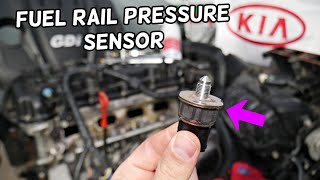
- Faulty Fuel Rail Pressure Sensor (FRPS) 🔴 High Probability → Shop Fuel Pressure Sensor Sensors are common failure points in modern high-pressure fuel systems due to the harsh conditions they operate in. It is the component directly responsible for the signal reported in the fault. 🎬 Watch: Understanding the P0191 code and how the sensor works.
How to confirm: Using a scan tool, compare the live data from the FRPS with the desired fuel rail pressure specified by the PCM. A significant, erratic, or unchanging reading suggests a faulty sensor. A mechanical pressure gauge can also be used to verify actual pressure against the sensor's reading; the two values should be within 5 PSI of each other. This is a job for a professional on a GDI system.
Typical fix: Replace the fuel rail pressure sensor.
Est. part cost: $70-$200 - Wiring or Connector Issue 🟡 Medium Probability
How to confirm: Visually inspect the wiring harness and connector for the FRPS for any signs of damage, corrosion, or loose connections. Use a multimeter to check for proper 5V reference voltage, good ground, and a clear signal wire between the sensor and the PCM.
Typical fix: Repair or replace the damaged wiring or connector. Clean corroded terminals and apply dielectric grease. 🎬 See this walkthrough for locating and replacing the pressure sensor.
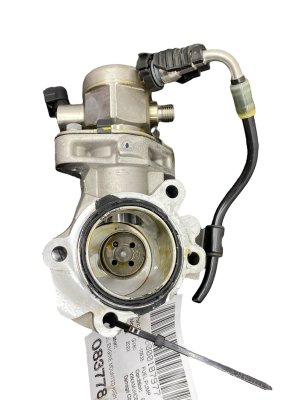
Est. part cost: $5-$50 - Failing High-Pressure Fuel Pump (HPFP) ⚪ Low Probability → Shop Fuel Pump The HPFP is a mechanical component that can wear out over time, leading to inconsistent or low fuel pressure.
How to confirm: Monitor fuel pressure with a scan tool. If the actual pressure consistently fails to meet the desired pressure, especially under load, and the sensor is known to be good, the HPFP is a likely culprit. This is often accompanied by code P0087 (Fuel Rail/System Pressure - Too Low).
Typical fix: Replace the high-pressure fuel pump.
Est. part cost: $400-$800
Rare But Worth Checking
- Faulty Powertrain Control Module (PCM): → Shop Engine Control Module (ECM) This is very rare. All other possibilities, including wiring, sensors, and mechanical fuel system components, should be exhaustively ruled out before considering PCM failure.
- Leaking High-Pressure Fuel Injectors: → Shop Fuel Injector A leaking high-pressure fuel injector can cause a drop in rail pressure. TSB FUE060 for the 2022 Carnival (produced Jan-Nov 2021) specifically addresses replacing faulty injectors for air-fuel ratio imbalance codes, which can be related to pressure deviations that trigger P0191.
- Clogged Fuel Filter: → Shop Fuel Filter A clogged main fuel filter can starve the high-pressure system of fuel, leading to low pressure readings.
Diagnosis Steps
- Connect a professional-grade OBD-II scanner and check for any other stored codes, paying close attention to P0087 or P219C-P21A1.
- Monitor the live data stream for 'Fuel Rail Pressure' and 'Desired Fuel Rail Pressure'. Note if the actual pressure is erratic, stuck, or significantly different from the desired pressure.
- Perform a visual inspection of the Fuel Rail Pressure Sensor (FRPS) and its electrical connector. Look for any signs of damage, corrosion, or loose wires.
- Inspect the wiring harness between the FRPS and the PCM for any chafing, breaks, or shorts.
- With the key on and engine off, use a multimeter to test the sensor's circuit. Verify a 5V reference signal, a solid ground, and check the signal wire voltage.
- If possible and safe, connect a mechanical fuel pressure gauge to the high-pressure system. Compare the mechanical reading to the scan tool's live data. The readings should be within 5 PSI of each other. A discrepancy points to a bad sensor.
- If the sensor and wiring are confirmed to be good, but pressure is low or erratic, the focus should shift to mechanical fuel delivery. Investigate the high-pressure fuel pump (HPFP) and for potential fuel injector leaks, especially if cylinder imbalance codes are present.
Parts You'll Likely Need
- Fuel Rail Pressure Sensor
(OEM #35342-2S000)— This sensor is the most common failure point for code P0191 as it directly measures the value that is being reported as out of range. Part number confirmed to fit 2022-2024 Carnival 3.5L models.
Trusted brands: Kia (OEM), Bosch
OEM price range: $120-$200
Aftermarket price range: $70-$150 - High-Pressure Fuel Pump (HPFP) — If the sensor is good, the next most likely cause is the pump's inability to generate the pressure commanded by the PCM, especially if code P0087 is also present. 🎬 Watch: How to diagnose and repair common Kia GDI fuel pressure issues.
Trusted brands: Kia (OEM)
OEM price range: $600-$800
Aftermarket price range: $400-$600 - High-Pressure Fuel Injector
(OEM #35310-3NGA0)— A potential cause, especially on vehicles built between Jan-Nov 2021, as identified in TSB FUE060. A leaking injector can cause a loss of rail pressure.
Trusted brands: Kia (OEM)
OEM price range: $150-$250 per injector
Related Codes That Often Appear With This One
- P0087 — This code for 'Fuel Rail/System Pressure - Too Low' often appears with P0191 when the high-pressure fuel pump is failing and cannot build enough pressure.
- P0193 — This code for 'Fuel Rail Pressure Sensor Circuit High Input' can indicate an electrical fault, such as a short in the wiring or a failing sensor sending an erroneously high voltage signal.
- P219C - P21A1 — These codes indicate cylinder-specific air-fuel ratio imbalances. TSB FUE060 for the 2022 Carnival directly links these codes to faulty high-pressure injectors, which can also cause the fuel rail pressure irregularities that trigger P0191.
Technical Service Bulletins (TSBs) & Recalls
- FUE060: Cylinder Imbalance Inspection & Injector Replacement for some 2022MY Carnival (KA4) vehicles produced Jan 26, 2021 - Nov 10, 2021. Instructs replacement of injectors and fuel pipes for codes P219C-P21A1.
Platform-Specific Known Issues
- There is a Technical Service Bulletin (TSB FUE060) for 2022 Kia Carnival vehicles with the 3.5L GDI engine, produced from January 26, 2021, through November 10, 2021. It addresses MIL illumination and reduced power associated with air-fuel ratio imbalance codes (P219C-P21A1). The prescribed fix is to replace the high-pressure fuel injector(s) for the affected cylinder(s), along with the high-pressure fuel pipe and cross-over pipe. A leaking injector as described in this TSB is a direct cause for fuel pressure deviation and can be a root cause for a P0191 code.
Mechanic-Grade Diagnostic Values
- Fuel Rail Pressure Sensor (FRPS) Reference Voltage — expected: 5.0V with key on, engine off.. Failure: No voltage or significantly lower voltage points to a PCM or wiring issue.
- Fuel Rail Pressure Sensor (FRPS) Signal Voltage — expected: ~0.5V at zero pressure (KOEO), 1.2V - 1.5V at idle, jumping to ~3.8V on snap acceleration.. Failure: Voltage is stuck at 0V or 5V, or does not respond to changes in engine speed/load.
- Fuel Rail Pressure Sensor (FRPS) Ground Circuit Resistance — expected: < 0.5 Ω. Failure: High resistance indicates a corroded or broken ground wire.
- High-Pressure Fuel System Pressure (at warm idle) — expected: Approx. 40 bar (~580 PSI). Failure: Actual pressure reading on a scan tool is significantly lower than the desired pressure, or is stuck at the low-pressure system's value (~50-70 PSI).
- Low-Pressure Fuel Pump (in-tank) pressure — expected: 45-70 PSI. Failure: Pressure is significantly below specification, which can starve the High-Pressure Fuel Pump (HPFP).
Scan Tool Commands That Help
- Kia GDS (Global Diagnostic System): Actuation Test for Fuel System — To command changes in fuel mixture (rich/lean) and observe the O2 sensor and fuel pressure sensor response, helping to isolate a non-responsive component.
- Kia GDS (Global Diagnostic System): Idle RPM Control Test — To diagnose issues like engine vibration or load compensation problems that may be caused by inconsistent fuel pressure. The tool can force RPM changes to see if the fuel system can keep up.
- Professional Bidirectional Scanners (e.g., ANCEL DS160): Fuel Trim Reset / Fuel Injector Pump Test — After replacing a component like an injector or pump, these functions reset adaptive values and can be used to test the new component's operation under controlled conditions.
- Kia GDS (Global Diagnostic System): ECU Programming / Injector Calibration — Required after replacing major components like the ECU or fuel injectors to ensure the new parts are correctly calibrated and recognized by the vehicle's computer.
Wiring & Ground Locations
- FRPS Connector — On the high-pressure fuel rail, which is located under the intake manifold on the Lambda III 3.5L GDI engine.. This is the primary connection point to check for corrosion, damage, or a loose fit, which are common causes of electrical faults for the sensor.
- Engine/Chassis Ground — A common grounding point for interior electronics on many Kia models is a grounding bolt located to the right of the interior fuse panel, behind the dash/kick panel. Other main engine grounds should also be inspected for tightness and corrosion.. A poor ground for the sensor circuit or the PCM can cause erratic voltage readings, leading to a P0191 code even if the sensor itself is good.
OEM Part Supersession History
Not applicable→35342-2S000— This is the current, specified part number for the 2022-2024 Kia Carnival 3.5L.
Heads up: While other Kia/Hyundai sensors may physically fit, using the exact specified part number is critical for GDI systems due to precise calibration requirements.
Model Year Variations Within This Range
- 2022 (Jan 26, 2021 - Nov 10, 2021 production): Vehicles produced in this date range are subject to TSB FUE060, which identifies potentially faulty high-pressure fuel injectors as a cause for fuel system-related codes. This makes injector failure a higher probability on these specific vehicles compared to later production models.
Diagnostic Flowchart
Other Known Issues on This Vehicle
Issues unrelated to this code that are worth knowing about as an owner of this generation:
- Power Sliding Door Malfunction 🔴 High — Common enough to trigger multiple recalls (SC221, SC266) and numerous owner complaints. Affects 2022-2023 models. (Ref: Recall SC221 (door may not latch securely) and Recall SC266 / NHTSA #23V-236 (anti-reverse safety feature fails).)
- Fuel Pipe / Fuel Rail Leaks 🔴 High — Subject of at least two recalls, indicating a manufacturing or material defect. (Ref: Recall SC211 (damaged plastic MPI fuel rail tube) and Recall SC368 (leak at pipe connection between fuel pipe and fuel rail).)
- Sudden Loss of Power / Electrical Faults 🟠 Medium — Multiple owner complaints filed with the NHTSA describe engine hesitation, sudden power loss, and electrical system malfunctions.
- Intake Valve Carbon Buildup 🟠 Medium — A common long-term issue for all Gasoline Direct Injection (GDI) engines, including the Lambda family. Buildup typically becomes noticeable after 60,000-90,000 miles. (Ref: No recall, but a known characteristic of GDI technology that requires periodic cleaning.)
Used vs. New Parts: Buying Guide for This Vehicle
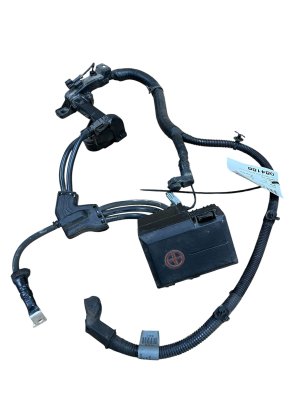
When a used part is the smart pick: For this repair, using used parts is generally not recommended due to the high-stress nature of the GDI fuel system. However, if cost is a major factor, a used wiring harness or connector pigtail from a low-mileage donor vehicle could be a viable option if the original is damaged.
Donor-vehicle mileage cap: roughly under 50000 miles for the part to have meaningful remaining life.
What to inspect on the donor part:
- For wiring: Check for any signs of brittleness, cracking, or previous repairs.
- For connectors: Ensure locking tabs are intact and terminals are free of corrosion.
- Verify the donor vehicle was not involved in a front-end collision that could have stressed the engine components.
OEM-only on this vehicle (don't cheap out):
- Fuel Rail Pressure Sensor (FRPS)
- High-Pressure Fuel Pump (HPFP)
- High-Pressure Fuel Injectors
Aftermarket brands forum-validated for this vehicle:
- Bosch (for sensors, if available as an OEM supplier)
Brands owners have reported issues with on this vehicle:
- Unbranded, no-name sensors and pumps from online marketplaces. GDI systems are highly sensitive to component quality and calibration, and using cheap, unverified parts often leads to repeat failures or new problems.
Real Owner Stories
Aggregated from forums and TSBs cited above. Mileages and costs reflect what owners reported in those sources.
2022 Kia Carnival 3.5L GDI
Symptoms: MIL illumination and reduced power associated with air-fuel ratio imbalance.
What fixed it: Replacement of the high-pressure fuel injector(s) for the affected cylinder(s), along with the high-pressure fuel pipe and cross-over pipe.
Source hint: TSB FUE060: Cylinder Imbalance Inspection & Injector Replacement
2022 Kia Carnival
Symptoms: The Check Engine Light displayed DTC P0191 (Fuel Rail Pressure Sensor Range/Performance). The owner noted that while the dealer claimed recall SC211 did not apply to the vehicle, the CEL continued to display with no resolution from minimal diagnosis.
Source hint: NHTSA ODI #11682506
2014 Kia Soul
Symptoms: Vehicle entered limp mode and was unable to accelerate past 40 mph following a battery issue.
What fixed it: P0191 code was triggered; primary symptom was limp mode.
Source hint: Reddit r/KiaSoulClub
2022 Kia K5 1.6L Turbo GDI
Symptoms: Rough idle and stalling.
What fixed it: The dealership suggested replacing spark plugs for $600, though this was noted as a potential misdiagnosis for the P0191-00 code.
Cost: $600-$600
Source hint: Reddit r/kia
Related OBD-II Codes
Frequently Asked Questions
Does TSB FUE060 apply to my 2022 Kia Carnival with the 3.5L GDI engine?
Could a fuel leak be causing my P0191 code on my Carnival?
My Carnival is losing power and stalling; could this be related to the sliding doors?
Can I use an aftermarket fuel rail pressure sensor to fix this?
Is there a software update for the fuel system on this engine family?
Should I replace my spark plugs to fix a P0191 code?
Helpful Videos
Used OEM Parts in Stock
New Aftermarket Parts Available


The information in this article is provided for general reference and educational purposes only. Vehicle specifications, procedures, and part compatibility can vary by production date, trim level, and region. Always consult your vehicle's factory service manual and verify part numbers before purchasing or performing repairs. Safety-critical components such as airbags, seat belts, and braking systems should be installed by a qualified professional.
- Kia Carnival:
- 🧭 Diagnostic Flowchart
- 🎬 Helpful Videos
- 🛍️ Shop This Part
- What's Unique About the 2022-2022 Kia Carnival
- Symptoms You May Notice
- Most Likely Causes
- Rare But Worth Checking
- Diagnosis Steps
- Parts You'll Likely Need
- Related Codes That Often Appear With This One
- Technical Service Bulletins (TSBs) & Recalls
- Platform-Specific Known Issues
- Mechanic-Grade Diagnostic Values
- Scan Tool Commands That Help
- Wiring & Ground Locations
- OEM Part Supersession History
- Model Year Variations Within This Range
- Other Known Issues on This Vehicle
- Used vs. New Parts: Buying Guide for This Vehicle
- Real Owner Stories
- 2022 Kia Carnival 3.5L GDI
- 2022 Kia Carnival
- 2014 Kia Soul
- 2022 Kia K5 1.6L Turbo GDI
- Related OBD-II Codes
- Frequently Asked Questions
- 🎟️ Get 5% Off