

P0191 on 2014-2020 Ram 3500 6.7L Cummins: Causes and Fixes
On a 2014-2020 Ram 3500 with the 6.7L Cummins, code P0191 is most often caused by clogged fuel filters or a failing fuel rail pressure sensor. Always replace both fuel filters first as the cheapest and most common initial step. If the code persists, the sensor is the next likely culprit, identifiable by a Key On, Engine Off (KOEO) pressure reading over 100 PSI on a scan tool.
- Always start diagnosis by replacing both fuel filters, as this is the most common and least expensive fix.
- A faulty fuel rail pressure sensor is the next most likely cause. Check it with a scan tool with the Key On, Engine Off; a reading over 100 PSI indicates it's bad.
- On higher mileage trucks, a persistent P0191 that occurs at a hot idle can be the first sign of failing/leaking fuel injectors, which requires an advanced return flow test to confirm.
- Be aware of generation-specific issues: 2014 models may have a cold-weather software bug (TSB 14-001-14 REV. B), and 2019-2020 models have the failure-prone CP4 fuel pump (Recall Y78).
What's Unique About the 2014-2020 Ram 3500
The high-pressure common rail (HPCR) fuel system on the 6.7L Cummins operates at extremely high pressures, making it very sensitive to fuel quality and pressure fluctuations. The diagnostic monitor for P0191 on these trucks is known to be sensitive, often running at a hot idle (like at a stoplight after highway driving), which can make the problem seem intermittent. The 2014-2020 model years also span a critical change in the high-pressure fuel pump, from the robust CP3 (2014-2018) to the failure-prone Bosch CP4 (2019-2020), which can influence diagnosis. Additionally, a specific software issue documented in TSB #14-001-14 REV. B can cause this code on 2013-2014 models in cold weather (below 20°F) due to the fuel heater being disabled, leading to fuel gelling.
Diagnostic Flowchart
Tap your situation to follow the diagnostic path that matches what you're seeing on this vehicle.
Generation note: The 2014-2020 range covers the end of the Fourth Generation (2014-2018) and the start of the Fifth Generation (2019-2020). Key differences include: 2014-2018 models use a CP3 high-pressure fuel pump. 2019-2020 models used a Bosch CP4 high-pressure fuel pump, which is subject to a recall (Y78 / NHTSA 21V880) for failure. The frame-mounted fuel filter also changed from a spin-on to a cartridge style in 2019. Additionally, 2018 and newer models have a security gateway module that can complicate diagnostics for DIYers.
Symptoms You May Notice
- Check Engine Light is on
- Engine stalling, especially when coming to a stop or at idle
- Hard to start or no-start condition
- Reduced engine power (limp mode)
- Engine hesitation or surging
- Rough idle
- Engine stumble during warm-up
- Replacing the fuel rail pressure sensor without first replacing the fuel filters.
- Replacing the expensive high-pressure fuel pump when the fault is a much cheaper sensor, clogged filter, or leaking injector.
- Assuming 'Circuit Performance' means the fault must be electrical, when it is frequently a mechanical fuel delivery issue like clogged filters or leaking injectors.
Most Likely Causes
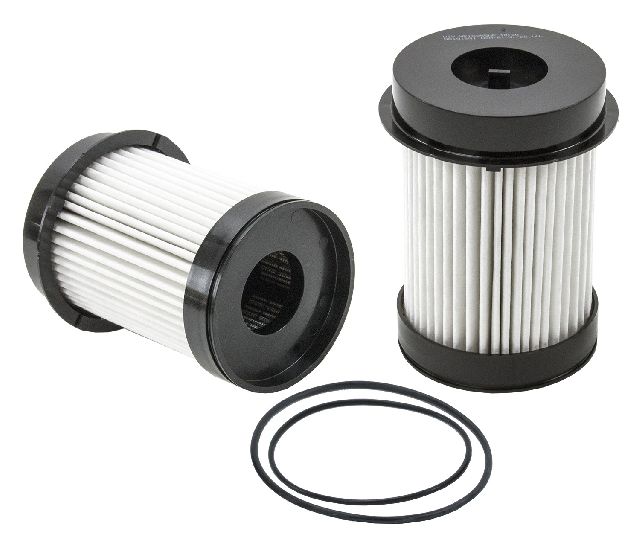
- Clogged Fuel Filters 🔴 High Probability → Shop Fuel Water Separator Filter The 6.7L Cummins has two fuel filters (one engine-mounted, one frame-mounted) that must be changed every 15,000 miles. Restricted flow from dirty filters is a primary cause of pressure deviation and the most common first step in any P0191 diagnosis.
How to confirm: Check service history or the filter life monitor. If the filters are near or past their service interval, they are the prime suspect. This should always be the first diagnostic step.
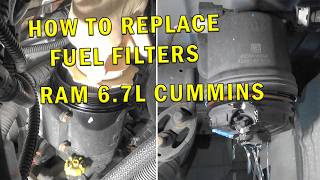
Typical fix: Replace both the engine-mounted and frame-mounted fuel filters. 🎬 Watch: Step-by-step guide to replacing both fuel filters. Use high-quality Mopar or Fleetguard filters. For 2014-2018 models, the kit is often Mopar #68157291AA & #68197867AB. For 2019-2020 models, the kit is Mopar #68157291AA & #68436631AA.
Est. part cost: $80-$150 - Faulty Fuel Rail Pressure Sensor 🔴 High Probability → Shop Fuel Pressure Sensor The sensor is a common failure point. It can become biased with heat and age, sending incorrect voltage readings to the ECM even if it hasn't failed completely. This is a very common fix reported in owner forums.
How to confirm: Use a scan tool to check the fuel rail pressure with the Key On, Engine Off (KOEO). A reading significantly above 0 PSI indicates a biased, faulty sensor. While official specs may allow up to 870 PSI, experienced technicians and forum users agree that any reading over 100-200 PSI confirms a bad sensor. The voltage on the signal wire should be 0.5V at KOEO.
Typical fix: Replace the fuel rail pressure sensor. It is located on the fuel rail on the driver's side of the engine. The common OEM part is a Bosch sensor, sold under Mopar part number 68214374AA or Bosch part number 0281006327.
Est. part cost: $65-$300 - Leaking Fuel Injector(s) or Connector Tubes 🟡 Medium Probability → Shop Fuel Injector At higher mileage, injectors can wear and leak fuel back into the return system instead of into the cylinder. This causes a drop in rail pressure that the high-pressure pump struggles to overcome, especially at a hot idle when fuel is thinner. Loose injector connector tubes can also cause a leak.
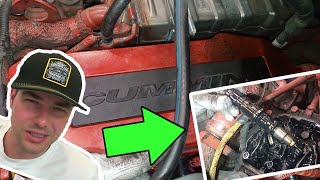
How to confirm: This is an advanced diagnosis requiring an injector return flow test. 🎬 Watch a pro mechanic troubleshoot common 6.7L Cummins fuel issues. Total return flow should be less than 40 mL in 10 seconds of cranking or 210 mL in 30 seconds at idle during a fuel pressure override test. Before replacing injectors, re-torquing the connector tube nuts to 37-41 ft-lbs and re-testing is recommended.
Typical fix: Re-torquing the injector connector tubes may resolve small leaks. If the test fails, the leaking injector(s) and their corresponding connector tubes must be replaced. It is best practice to replace them as a set.
Est. part cost: $400-$3000+ - Faulty Fuel Control Actuator (FCA) ⚪ Low Probability → Shop Fuel System Controller The FCA (also called the MPROP or fuel pressure regulator) is mounted on the high-pressure fuel pump and regulates the volume of fuel entering the pump. It is a known wear item and can stick or respond slowly, causing erratic fuel pressure at idle.
How to confirm: This is often a process-of-elimination diagnosis after filters, sensor, and injectors have been ruled out. A scan tool may show a large discrepancy or oscillation between desired and actual fuel pressure at idle that isn't explained by other causes. On CP3-equipped trucks (2014-2018), unplugging the FCA with the engine idling should cause rail pressure to jump to its maximum (~26,000 PSI), confirming the pump's ability to generate pressure.
Typical fix: Replace the Fuel Control Actuator on the high-pressure pump. It is typically held on by three T25 Torx bolts.
Est. part cost: $100-$250
Rare But Worth Checking
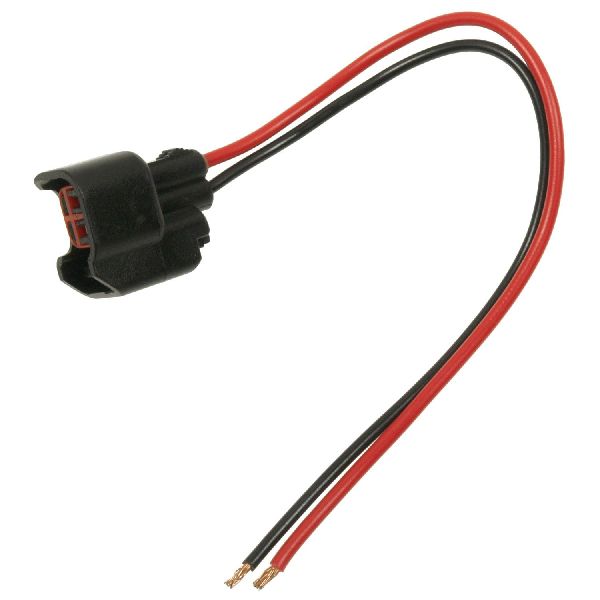
- Damaged Wiring or Connector: The wiring harness to the fuel rail pressure sensor can be damaged by heat, vibration, or chafing. A wiggle test on the harness while monitoring live data can help identify intermittent connection issues.
- Failing High-Pressure Fuel Pump (CP4): → Shop Fuel Pump On 2019-2020 models, a failing CP4 pump can cause erratic fuel pressure and trigger P0191, often along with P0087. This is a critical failure that can send metal debris through the entire fuel system. Check for a related recall (Y78 / NHTSA 21V880) and inspect the fuel filter housing for metallic 'glitter'.
- Powertrain Control Module (PCM) Issue / Software Update: → Shop Engine Control Module (ECM) In some cases, the PCM software logic is too sensitive. Multiple TSBs (e.g., 18-102-22 REV A, 18-008-24) have been issued for 2019-2022 models that include a fix for P0191 as part of a larger software update. These updates often require the Y78 CP4 pump recall to be completed first.
- Leaking Fuel Pressure Relief Valve: This valve on the fuel rail can stick partially open, causing a constant loss of pressure. It can be tested by checking for any fuel flow from its return port at idle; there should be none. The common Bosch part number is 1110010013.
Diagnosis Steps
- Check for and record any other stored trouble codes, paying special attention to P0087 or P2BAC.
- Replace both the engine-mounted and frame-mounted fuel filters. This is the most common and cheapest fix and should always be done first.
- Using a scan tool, check the fuel rail pressure with the Key On, Engine Off (KOEO). If the pressure reads above 100 PSI, the fuel rail pressure sensor is faulty and needs replacement.
- If the KOEO pressure is normal, start the engine and monitor the actual vs. desired fuel rail pressure at idle and under load. Large deviations or oscillations at a hot idle can point to a mechanical issue.
- Visually inspect the wiring harness and connector for the fuel rail pressure sensor for any signs of damage, corrosion, or loose pins. Perform a 'wiggle test' while watching live data.
- If the code persists and is most common at a hot idle, suspect a mechanical issue like leaking injectors. Perform an injector return flow test to confirm. Maximum allowable return is 40 mL in 10 seconds (cranking) or 210 mL in 30 seconds (running).
- For 2019-2020 models, check the fuel filter housing for metallic debris, which would indicate a catastrophic CP4 high-pressure pump failure. Verify if recall Y78 has been performed.
- If all other components test good, the Fuel Control Actuator (FCA) or a leaking pressure relief valve are the next items to investigate.
Parts You'll Likely Need
- Fuel Filter Kit (Engine and Frame)
(OEM #68157291AA & 68197867AB (2014-18) / 68157291AA & 68436631AA (2019-20)) - Fuel Rail Pressure Sensor
(OEM #68214374AA (Mopar) / 0281006327 (Bosch)) - Fuel Injector Connector Tube
- Fuel Control Actuator (FCA/MPROP)
Related Codes That Often Appear With This One
- P0087 — This code for 'Fuel Rail/System Pressure - Too Low' often appears with P0191 when the root cause is a mechanical issue like clogged filters, a weak lift pump, or a failing CP4 pump.
- P2BAC — This is an informational code indicating the ECM has disabled the EGR system due to another fault (like P0191). It does not require a separate repair and will clear once the primary fuel pressure issue is fixed.
- P2002 — Listed in manufacturer TSBs (18-102-22 REV A, 18-008-24) alongside P0191, indicating a potential software update may address both. It means 'Diesel Particulate Filter Efficiency Below Threshold'.
- P0401 — Listed in manufacturer TSBs (18-102-22 REV A, 18-008-24) alongside P0191. It means 'EGR System Performance' and is often addressed by the same PCM software updates.
Technical Service Bulletins (TSBs) & Recalls
- Addresses a no-start or P0191/P0087 code in cold weather (below 20°F) on 2013-2014 models. A software issue prevents the fuel heater from activating, causing fuel gelling. The fix is a PCM reflash.
- A series of broad PCM software updates for 2019-2022 models that address a long list of potential fault codes, including P0191. These are general software improvements and often require the Y78 CP4 pump recall to be completed first.
- A critical safety recall for 2019-2020 Ram HD trucks to replace the failure-prone Bosch CP4.2 high-pressure fuel pump with a more robust CP3 pump. A failing CP4 can trigger P0191.
Platform-Specific Known Issues
- TSB #14-001-14 REV. B was issued for 2013-2014 models where a software glitch prevents the fuel heater from activating in cold weather (below 20°F), causing fuel gelling and triggering P0191 and P0087. The fix is a PCM reflash at a dealership.
- Recall Y78 / NHTSA 21V880 was issued for 2019-2020 models to address the failure-prone Bosch CP4.2 high-pressure fuel pump. A failing CP4 can cause P0191.
- The diagnostic monitor for P0191 often runs at a hot idle, making the code appear intermittently, such as when stopping at a traffic light after exiting the freeway.
Mechanic-Grade Diagnostic Values
- Fuel Rail Pressure Sensor (FRPS) Signal Voltage (KOEO) — expected: ~0.5 Volts. Failure: A significant deviation from 0.5V, or a reading over 1.5V, indicates a sensor or wiring fault.
- FRPS 5V Reference Voltage at Connector — expected: 4.90 to 5.10 Volts. Failure: Lack of 5V points to a wiring or ECM problem.
- FRPS Ground Circuit Voltage Drop — expected: < 50 mV. Failure: Voltage higher than 50 mV indicates high resistance in the ground circuit.
- New Bosch FRPS Resistance (Part #0281006327) — expected: Pin 1-3: ~24 kOhms; Pin 2-3: ~2.3 MOhms; Pin 1-2: Open/Infinity. Failure: Significant deviation from these values on a new or suspect sensor.
- Injector Return Flow (Cranking, No-Start) — expected: < 40 mL in 10 seconds. Failure: Flow greater than 40 mL indicates a severe leak from one or more injectors or connector tubes.
- Injector Return Flow (Running, Fuel Pressure Override Test) — expected: < 210 mL in 30 seconds at 1200 RPM. Failure: Total flow greater than 210 mL indicates excessive leakage from one or more injectors.
- Low-Pressure Lift Pump Pressure (at idle) — expected: ~10 PSI. Failure: Pressure dropping near zero under load or consistently low at idle suggests a failing lift pump or clogged filters.
- Injector Connector Tube Nut Torque — expected: 37-41 ft-lbs (50-56 Nm). Failure: Incorrect torque can cause fuel leaks at the injector, leading to low rail pressure.
Scan Tool Commands That Help
- wiTECH or equivalent professional scanner: Fuel Pressure Override Test — This function commands the high-pressure pump to its maximum output (approx. 26,000 PSI) while the engine runs at a set RPM (e.g., 1200). It is the required condition for performing an accurate, by-the-book running injector return flow test to find leaks under stress.
- wiTECH or equivalent professional scanner: Injector Kill / Cylinder Contribution Test — This test deactivates one injector at a time. While monitoring rail pressure, a leaking injector can be identified if disabling it causes the rail pressure to stabilize or rise significantly.
- Scan Tool + Manual Action: FCA Unplug Test (CP3-equipped trucks: 2014-2018) — While monitoring rail pressure at idle, unplugging the Fuel Control Actuator (FCA) should cause rail pressure to immediately jump to its maximum mechanical limit (~26,000 PSI). This quickly verifies the high-pressure pump's ability to generate pressure and helps rule it out as the cause of a low-pressure fault.
Wiring & Ground Locations
- Fuel Rail Pressure Sensor Connector — On the driver's side of the high-pressure fuel rail, near the rear of the engine.. This is the primary connection point for all electrical tests (5V reference, ground, and signal voltage). For 2013-2018 models, the signal wire is typically brown/yellow and the ground is dark blue/pink.
- ECM C1 Connector — On the Engine Control Module (ECM), which is mounted on the driver's side of the engine block.. This is the termination point for the sensor circuit. Technicians test for continuity and shorts between this connector and the sensor connector to rule out harness damage.
Real Owner Repair Stories
- Oregon Fuel Injection blog (Ram 6.7L Cummins (year not specified, but behavior applies to the 2014-2020 range)) — Loss of power on uphill grades and during hard acceleration. Scan tool showed rail pressure dropping to 10,000 PSI and never exceeding 15,000 PSI.
❌ Tried (didn't work) Replaced fuel filters.
✅ What actually fixed it The fuel pressure relief valve was leaking internally under load. Replacing the valve restored full rail pressure (up to 24,000-26,500 PSI) and resolved the loss of power. - YouTube channel 'P0191 fuel rail pressure sensor 2010 2011 2012 Ram truck 6.7' (2010-2012 Ram 6.7L Cummins (experience is relevant to later models)) — P0191 code setting at a hot idle. Freeze frame data showed actual rail pressure was ~800 PSI lower than commanded pressure when the code set.
❌ Tried (didn't work) Performing an injector return flow test, which came back within the acceptable spec (e.g., 190-210 mL)., Replacing the fuel rail pressure sensor., Replacing single injectors based on borderline return flow tests.
✅ What actually fixed it The narrator, an experienced dealer technician, states that in many difficult cases, the final solution was to remove all six injectors and have them professionally flow-tested and cleaned/rebuilt. The slight deviation causing the code at idle was too small to be reliably caught by the in-vehicle return flow test.
OEM Part Supersession History
Bosch 0281006150→Bosch 0281006327— Continuous improvement and updates to components and specifications.
Heads up: The Mopar part number associated with the sensor, 68214374AA, is incorrectly listed by some parts suppliers as an ABS Control Module. The correct Bosch part number for the fuel rail pressure sensor is 0281006327.
Model Year Variations Within This Range
- 2019-2020: The frame-mounted fuel filter changed from a spin-on style (used 2014-2018) to a cartridge-style filter located on the driver's side frame rail next to the fuel tank.
- 2018-2020: Introduction of a Security Gateway Module (SGM) that requires a compatible scan tool (and sometimes a bypass cable) to perform bidirectional controls like the Fuel Pressure Override Test or to clear certain fault codes.
- 2019-2020: Switched from the CP3 to the Bosch CP4 high-pressure fuel pump. The CP4 is known for a higher failure rate and is subject to recall Y78. A P0191 on these models should prompt an immediate check for metallic debris in the fuel filters.
Helpful Videos

Used OEM Parts in Stock
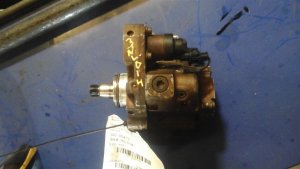
New Aftermarket Parts Available


The information in this article is provided for general reference and educational purposes only. Vehicle specifications, procedures, and part compatibility can vary by production date, trim level, and region. Always consult your vehicle's factory service manual and verify part numbers before purchasing or performing repairs. Safety-critical components such as airbags, seat belts, and braking systems should be installed by a qualified professional.
- Ram 3500:
- 🧭 Diagnostic Flowchart
- 🎬 Helpful Videos
- 🛍️ Shop This Part
- What's Unique About the 2014-2020 Ram 3500
- Symptoms You May Notice
- Most Likely Causes
- Rare But Worth Checking
- Diagnosis Steps
- Parts You'll Likely Need
- Related Codes That Often Appear With This One
- Technical Service Bulletins (TSBs) & Recalls
- Platform-Specific Known Issues
- Mechanic-Grade Diagnostic Values
- Scan Tool Commands That Help
- Wiring & Ground Locations
- Real Owner Repair Stories
- OEM Part Supersession History
- Model Year Variations Within This Range
- 🎟️ Get 5% Off