

P0192 on 2012-2016 Mazda CX-5 2.5L: Fuel Rail Pressure Low Causes and Fixes
On a 2012-2016 Mazda CX-5 with the 2.5L SKYACTIV-G engine, the P0192 code almost always indicates a failing high-pressure fuel pump (HPFP). This is a known issue, and replacing the pump is the most common fix. When the code is active, the system defaults to low pressure (~60-70 psi), but a healthy system should show ~400 PSI at idle. Expect a repair cost of over $1,000 at a dealership.
- P0192 on a 2012-2016 CX-5 almost certainly points to a bad high-pressure fuel pump (HPFP).
- Symptoms include hard starting, stalling, and a significant lack of power. The engine may shut off completely while driving.
- A TSB was issued for 2013-2014 models for this exact problem, caused by a manufacturing defect in the pump.
- Diagnose by checking live fuel rail pressure; if it's stuck around 60-70 PSI while running, the HPFP has failed.
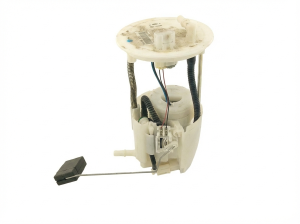
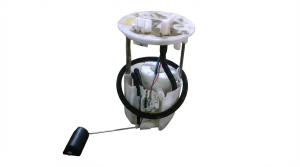
- Do not mistakenly replace the in-tank (low-pressure) fuel pump; the issue is with the engine-mounted high-pressure pump.
What's Unique About the 2012-2016 Mazda CX-5
The first-generation CX-5 with the SKYACTIV-G engine relies on a specific high-pressure fuel pump to achieve its efficiency. Early versions of this pump were prone to internal manufacturing defects, leading Mazda to issue a Technical Service Bulletin (TSB 01-010/14) for some 2013-2014 models. This TSB explicitly states that P0192 can be caused by the HPFP not generating target pressure due to an internal manufacturing error. As a result, a P0192 code on this particular vehicle is far more likely to be the pump itself rather than the sensor or wiring, which might be more common on other vehicles.
Symptoms You May Notice
- Check Engine Light is on
- Engine is hard to start or requires long cranking time
- Engine stalls, especially at idle or under load
- Hesitation or stumbling during acceleration
- Noticeable lack of engine power, may enter 'limp mode'
- Rough idle
- Engine will start but immediately sputters and dies
- Replacing the in-tank (low-pressure) fuel pump. This code specifically relates to the high-pressure side of the fuel system. Owners confirm the low-pressure pump works if the scan tool reads ~60-70 psi.
- Replacing the fuel rail pressure sensor without confirming the high-pressure pump is functioning correctly. The sensor is often reporting the low pressure accurately.
Most Likely Causes
- Failing High-Pressure Fuel Pump (HPFP) 🔴 High Probability → Shop Fuel Pump A known issue acknowledged by Mazda in TSB 01-010/14 for early models, citing a manufacturing error in the pump's internal parts. Numerous owner experiences on forums like Reddit and Mazdas247 confirm this is the most frequent failure point for this code, even on models outside the specific TSB VIN range.
How to confirm: A technician can monitor fuel rail pressure with a professional scan tool. A healthy 2.5L SKYACTIV-G should show around 400-500 PSI at idle and up to 3000 PSI under load. When code P0192 is active, the system may default to low-pressure mode, showing only the in-tank pump's pressure (around 62-69 psi), which can be misleading. If the pressure is stuck at this low value and does not increase with RPM, the HPFP has almost certainly failed.
Typical fix: Replace the high-pressure fuel pump and the associated rubber seal/gasket.
Est. part cost: $800-$1100 for an OEM pump.
Rare But Worth Checking
- Faulty Fuel Rail Pressure Sensor: → Shop Fuel Pressure Sensor This is a less common cause. Some owners have replaced the sensor/fuel rail assembly first without success, only to find the pump was the real problem. Mazda does not sell the sensor separately from the entire fuel rail assembly for this generation, making it an expensive part to replace speculatively. A faulty sensor might give erratic readings, but a reading stuck at ~62 PSI usually indicates the pump is offline and the sensor is accurately reporting the low pressure.
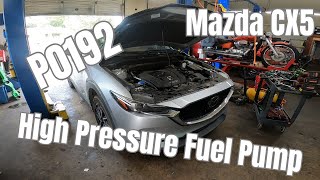
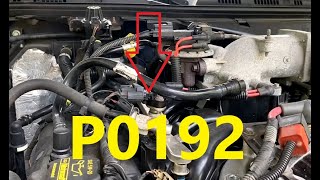
- Wiring or Connector Issue: A damaged wire, loose connection, or corrosion in the circuit for the fuel rail pressure sensor can cause a low voltage signal. A visual inspection of the harness and connector near the sensor and HPFP should be performed before replacing parts. 🎬 Watch: How to diagnose the sensor circuit and wiring
- Powertrain Control Module (PCM) Fault: → Shop Engine Control Module (ECM) This is extremely rare, but a software glitch or internal failure in the PCM could theoretically cause a false P0192 code. A PCM software update mentioned in TSB 01-003/18 for a different model (CX-9) shows that PCM logic can be related to this code being set, but this is not a known issue for the first-gen CX-5. 🎬 Watch: Common causes and fixes for code P0192
Diagnosis Steps
- Read the trouble codes with an OBD-II scanner to confirm P0192 is present and see if any other codes are stored.
- Use a scan tool with live data capability to monitor the Fuel Rail Pressure (FRP) reading. With the key on and engine off, the pressure should be around 60-70 psi from the in-tank pump.
- Start the engine and observe the FRP at idle. A healthy engine should build pressure to approximately 400-500 PSI. If the pressure remains stuck at ~62-69 PSI and does not increase when you rev the engine, the HPFP is the primary suspect.
- Inspect the wiring harness and connector for the fuel rail pressure sensor and the high-pressure fuel pump. 🎬 See this step-by-step high-pressure fuel pump replacement guide Look for any signs of damage, corrosion, or loose connections.
- Before replacing the pump, check for any applicable TSBs or warranty extensions for your specific VIN. TSB 01-010/14 specifically addresses this issue for 2013-2014 models with VINs lower than JM3KE**420619.
- Given the extremely high failure rate, if the live data confirms no high pressure is being built, the next step is to replace the high-pressure fuel pump.
- If the high-pressure fuel pump is replaced and the code persists, further diagnosis of the fuel rail pressure sensor and its circuit would be necessary, though this is highly unlikely.
Parts You'll Likely Need
- High-Pressure Fuel Pump
(OEM #PE19-20-3F0)— This is the most common failure point for the P0192 code on this engine due to a known manufacturing defect in early models. This part number also fits the Mazda3 and Mazda6 with the same engine.
Trusted brands: Mazda (OEM)
OEM price range: $700-$1100
Aftermarket price range: $125-$300 (Remanufactured or non-OEM)
Related Codes That Often Appear With This One
- P0171 — System Too Lean. If the high-pressure fuel pump isn't delivering enough fuel, the engine will run lean (too much air, not enough fuel), triggering this code alongside P0192. One owner reported clearing P0171 by replacing a MAF sensor, but the P0192 and drivability issues remained until the HPFP was replaced.
- P0087 — Fuel Rail/System Pressure - Too Low. This is a more general code for low fuel pressure and can appear with P0192, reinforcing the diagnosis of a weak high-pressure fuel pump.
- P0191 — Fuel Rail Pressure Sensor Circuit Range/Performance. This code is also cited in TSB 01-010/14 and points to the same HPFP failure.
Technical Service Bulletins (TSBs) & Recalls
- 01-010/14 - Check Engine Light on with DTC P0191:00 or P0192:00. Affects 2013-14 CX-5 vehicles with VINs lower than JM3KE**420619 (produced before Dec 1, 2013). States the cause is the high-pressure fuel pump not generating target pressure due to a manufacturing error and advises replacement. This TSB also applies to 2012-13 Mazda3 and 2014 Mazda6/Mazda3 with SKYACTIV engines.
- TSB Bulletin #01-010-14-2896B - Confirms that some vehicles may experience the check engine light on with DTC P0191:00 or DTC P0192:00 (Fuel Pressure Sensor Circuit Low Input) stored in memory.
Platform-Specific Known Issues
- Repeated HPFP Failures: One owner on Mazdas247 reported their 2017 CX-5 required a second HPFP replacement at only 63,000 miles, after the first one was replaced under warranty at 15,000 miles for the same P0192 code. This suggests that even replacement pumps can fail prematurely.
Mechanic-Grade Diagnostic Values
- High-Pressure Fuel System at Idle — expected: ~400-435 PSI (3.0 MPa). Failure: Pressure is stuck at the low-pressure value (~60-70 PSI) and does not increase with RPM.
- High-Pressure Fuel System Under Load — expected: Up to ~3000 PSI (20.0 MPa). Failure: Pressure does not rise significantly from idle when accelerating.
- Low-Pressure Fuel System (In-tank pump) — expected: 55-71 PSI. Failure: Pressure below this range indicates a problem with the in-tank pump, which can starve the HPFP.
- Fuel Rail Pressure Sensor Signal Voltage (Key On, Engine Off) — expected: ~0.5V. Failure: Voltage is stuck near 0V or 5V, indicating a sensor or wiring fault.
- Fuel Rail Pressure Sensor Signal Voltage (Engine Idling) — expected: ~1.3V - 1.7V. Failure: Voltage is erratic, does not correspond to the expected idle pressure, or is stuck low.
- Fuel Rail Pressure Sensor Reference Voltage — expected: Steady 5.0V. Failure: No voltage or low voltage indicates a wiring or PCM issue.
Wiring & Ground Locations
- Fuel Pressure Sensor Location — On the fuel rail, located at the left front of the engine.. This is the physical location of the sensor that triggers the P0192 code, necessary for inspection and testing of its connector and wiring.
- G07 (Ground Point) — Located on the left rear of the engine.. A wiring diagram for the 2014 model indicates this is a ground point used by the fuel pressure sensor circuit. A poor connection here could cause the low voltage reading of the P0192 code.
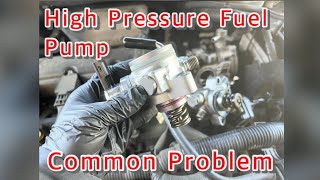
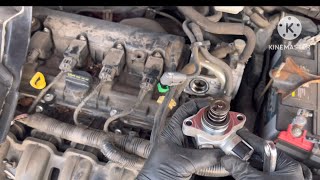
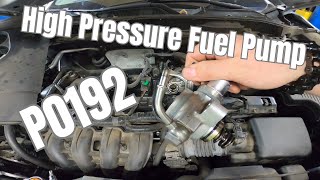
- High-Pressure Fuel Pump (HPFP) Location — Mounted on the cylinder head, typically near the valve cover, driven by the camshaft.. This is the location of the most common part to fail. Access requires removing the engine air box and some hoses.
Real Owner Repair Stories
- Reddit user on r/mazda (2016 Mazda CX-5 2.5L with 101,000 miles) — Sudden loss of power, struggling engine, rough idle for a few seconds then sputtering out.
❌ Tried (didn't work) Clearing codes (P0192 immediately returned), Attempting to test low-pressure fuel pump with a rental tool that did not have the correct fittings.
✅ What actually fixed it Replaced the high-pressure fuel pump (HPFP) with a used unit from a low-mileage donor engine. After replacement, idle fuel pressure returned to a normal ~400 PSI and reached 3000 PSI at wide-open throttle. - Mazdas247 Forum User (2016 Mazda CX-5 Grand Touring 2.5L) — Engine would not accelerate past 2000 RPM, P0192 and P0171 codes present.
❌ Tried (didn't work) Replaced the Mass Airflow (MAF) sensor, which cleared the P0171 code but not the P0192 or the performance issue.
✅ What actually fixed it Replaced the high-pressure fuel pump with an aftermarket unit (Standard Ignition GDP510). This cleared the P0192 code and restored normal fuel pressure (~300 PSI at idle). - Mazda Forum User (2015 Mazda CX-5 2.5L) — Stalling at idle, no power on acceleration, P0192 code.
❌ Tried (didn't work) Replaced the entire fuel rail with a new sensor. This did not fix the issue.
✅ What actually fixed it The ultimate cause was the high-pressure fuel pump. Live data showed pressure dropping to 430 kPa (62 PSI) when the engine started, confirming the HPFP was not functioning.
Documented NHTSA Reports
- NHTSA ODI #11523568: An owner reported the check engine indicator was on, the vehicle was not shifting correctly, and it was lacking RPM power. A mechanic found codes P0192 (low fuel rail pressure) and P0171 (system too lean).
- NHTSA ODI #11605868: After the check engine light remained on, a diagnostic revealed the P0192 code. A manager mechanic confirmed the issue was with the high-pressure fuel pump.
- NHTSA ODI #11505265: An owner experienced a situation where the vehicle would not restart; a diagnostic review showed codes P0192 and P0171. The report notes this is a known issue for these defective fuel pumps.
- NHTSA ODI #11492456: A driver reported the vehicle could have stopped in the middle of the freeway. After being towed to a mechanic, the error code P0192 was identified.
OEM Part Supersession History
PE18-20-3F0, PE18-20-3F0A, and a series starting with PE01...→PE19-20-3F0— Likely internal revisions to address the manufacturing defects noted in early TSBs.
Heads up: The latest part number, PE19-20-3F0, is the correct replacement for all previous versions including those stamped PE18-20-3F0.
Model Year Variations Within This Range
- 2016: The 2016 model year received a mid-cycle refresh (sometimes referred to as 2016.5) which included an upgraded interior, a new Mazda Connect infotainment system with a larger screen and commander switch, and an electronic parking brake. While the core 2.5L powertrain and HPFP issue remained the same, these interior and electronic changes are notable.
- 2013-2014: The 2.5L engine became widely available starting in the 2014 model year, replacing the less powerful 2.0L as the standard on most trims. The TSB for the faulty HPFP specifically calls out 2013-2014 models produced before December 1, 2013, indicating a change in the pump part or manufacturing process around that time.
Diagnostic Flowchart
Other Known Issues on This Vehicle
Issues unrelated to this code that are worth knowing about as an owner of this generation:
- LED Daytime Running Light (DRL) Failure 🟠 Medium — Common enough to trigger a recall for the 2016 model year. (Ref: NHTSA Campaign ID: 20V063000 (Mazda Recall 4320A). Caused by a sealing gasket that corrodes the DRL's circuit board.)
- Intake Valve Carbon Buildup 🟠 Medium — A common long-term issue inherent to all Gasoline Direct Injection (GDI) engines, including SKYACTIV-G. Typically becomes a concern after 80,000-100,000 miles, potentially causing rough idle or misfires.
- Liftgate Support Strut Corrosion 🟠 Medium — Affects 2013-2016 models, leading to potential failure of the liftgate struts and the gate dropping unexpectedly. (Ref: NHTSA ID: 16V593000 (Mazda Recall 9916H))
- Front Strut to Steering Knuckle Separation 🔴 High — A recall was issued for 2014-2016 models where the lower mounting nuts and bolts for the front strut could loosen. (Ref: NHTSA ID: 16V686000)
- Fuel Filler Pipe Rupture Risk 🔴 High — A recall was issued for 2014-2016 models due to a fuel filler pipe that could rupture in a crash, increasing fire risk. (Ref: NHTSA ID: 16V064000)
Used vs. New Parts: Buying Guide for This Vehicle
When a used part is the smart pick: For the High-Pressure Fuel Pump (HPFP), a used part can be a viable, cost-effective option, especially given the high cost of a new OEM unit. One owner successfully resolved their P0192 code by sourcing an HPFP from a low-mileage donor engine.
Donor-vehicle mileage cap: roughly under 75000 miles for the part to have meaningful remaining life.
What to inspect on the donor part:
- Verify the mileage of the donor vehicle; lower is always better.
- Inspect the part for any external damage, corrosion, or stripped threads on the fittings.
- If possible, get a part from a vehicle that was not involved in a front-end collision.
- Ensure the electrical connector and pins are clean and undamaged.
OEM-only on this vehicle (don't cheap out):
- While aftermarket HPFPs exist, the OEM pump is the most proven solution. Given reports of even replacement OEM pumps failing, the quality of non-OEM units is a significant gamble.
Aftermarket brands forum-validated for this vehicle:
- Standard Ignition (e.g., GDP510) has been successfully used by at least one owner to resolve the P0192 code.
Brands owners have reported issues with on this vehicle:
- No specific brands were consistently reported as problematic, but unbranded, low-cost options from online marketplaces carry a higher risk of premature failure.
Real Owner Stories
Aggregated from forums and TSBs cited above. Mileages and costs reflect what owners reported in those sources.
2016 CX-5 2.5L — 101000 miles
Symptoms: Sudden loss of power, struggling, check engine light, idling very rough for a few seconds then sputtering out, would not maintain idle.
What fixed it: Replaced the high-pressure fuel pump (HPFP) with a used unit; fuel rail pressure returned to 400 PSI at idle.
Source hint: r/mazda on Reddit: Thread '2016 CX-5 2.5L P0192 [fixed]'
2017 CX-5 — 63000 miles
Symptoms: Required a second HPFP replacement after the first was replaced at 15,000 miles for the same P0192 code.
What fixed it: Replacement of the high-pressure fuel pump.
Source hint: Mazdas247 Forum: Thread 'High pressure fuel pump or pressure sensor issue? 2017 CX-5'
2017 CX-5
Symptoms: Error code P0192 and high-pressure fuel pump failure.
What fixed it: Dealer replacement of the high-pressure fuel pump.
Cost: $1,200-$1,300
Source hint: r/mazda on Reddit: Thread '2017 Mazda CX5 - Error Code P0192 - High Pressure Fuel Pump replacement'
2015 CX-5
Symptoms: P0192 code and stalling.
What fixed it: The owner attempted to replace the fuel rail/sensor assembly first, but it did not fix the issue, highlighting that the pump is the actual culprit.
Source hint: Mazda Forum: Thread 'P0192 - Fuel Pressure Sensor and Grounding Questions'
2016 CX-5
Symptoms: Codes P0171 and P0192; live data showed fuel rail pressure was only 69 PSI at idle.
What fixed it: Replacing the HPFP with an aftermarket unit restored normal pressure readings of ~300 PSI at idle.
Source hint: Mazdas247 Forum: Thread 'High pressure fuel pump or pressure sensor issue? 2017 CX-5'
Related OBD-II Codes
Frequently Asked Questions
Does TSB 01-010/14 apply to my 2014 Mazda CX-5?
What should the fuel rail pressure (FRP) be at idle for a healthy 2.5L SKYACTIV-G engine?
Can I just replace the fuel rail pressure sensor to fix P0192?
Is there a specific part number for the replacement high-pressure fuel pump?
Are there any recalls for the 2016 CX-5 I should be aware of while fixing this?
How much does it typically cost to have a dealer fix the P0192 code on a CX-5?
Helpful Videos
We Have This Part in Stock

The information in this article is provided for general reference and educational purposes only. Vehicle specifications, procedures, and part compatibility can vary by production date, trim level, and region. Always consult your vehicle's factory service manual and verify part numbers before purchasing or performing repairs. Safety-critical components such as airbags, seat belts, and braking systems should be installed by a qualified professional.
- Mazda CX-5:
- 🧭 Diagnostic Flowchart
- 🎬 Helpful Videos
- 🛍️ Shop This Part
- What's Unique About the 2012-2016 Mazda CX-5
- Symptoms You May Notice
- Most Likely Causes
- Rare But Worth Checking
- Diagnosis Steps
- Parts You'll Likely Need
- Related Codes That Often Appear With This One
- Technical Service Bulletins (TSBs) & Recalls
- Platform-Specific Known Issues
- Mechanic-Grade Diagnostic Values
- Wiring & Ground Locations
- Real Owner Repair Stories
- Documented NHTSA Reports
- OEM Part Supersession History
- Model Year Variations Within This Range
- Other Known Issues on This Vehicle
- Used vs. New Parts: Buying Guide for This Vehicle
- Real Owner Stories
- 2016 CX-5 2.5L — 101000 miles
- 2017 CX-5 — 63000 miles
- 2017 CX-5
- 2015 CX-5
- 2016 CX-5
- Related OBD-II Codes
- Frequently Asked Questions
- 🎟️ Get 5% Off