

P0192 on 2004-2012 Volvo S40 2.4i: Causes and Fuel Pressure Sensor Fixes
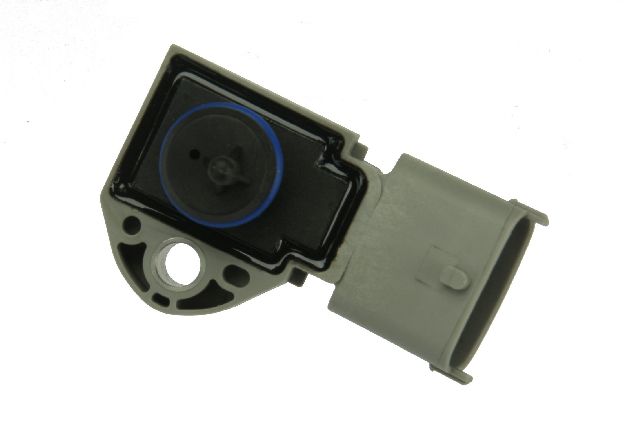
On a 2004-2012 Volvo S40 2.4i, code P0192 is almost always caused by a failed fuel rail pressure sensor. It's a very common failure on this car, but the fix is easy for a DIYer and costs between $45-$240 for the part. The correct Bosch part is number 0261230236.
- P0192 on your S40 2.4i almost certainly means you need a new fuel rail pressure sensor.
- This is a very common problem, especially on 2004.5-2007 models, but it is not a difficult or expensive DIY fix.
- Always relieve fuel system pressure before starting the repair for safety.
- Use a quality replacement part from a brand like Bosch (part no. 0261230236), which is the original equipment manufacturer, to ensure reliability and save money over the dealer part.
- The job requires only basic tools, primarily a T25 Torx bit, and can be completed in under an hour.
What's Unique About the 2004-2012 Volvo S40
The second-generation Volvo S40, particularly the earlier models from 2004.5 to 2007, is known for premature failure of the original fuel pressure sensor. The sensor, made by Bosch, was a common failure point that could cause a range of drivability issues like stalling and hard starts. Because this failure is so frequent, the fuel rail pressure sensor is the first and most likely part to check when a P0192 code appears on this specific vehicle and its P1 platform mates.
Symptoms You May Notice
- Check Engine Light is on
- Engine stalling, especially when coming to a stop or accelerating
- Hard starting or long crank times
- Hesitation or lack of power during acceleration
- Rough or unstable idle
- Reduced fuel economy
- Engine lurching or stumbling during driving
- Replacing the fuel pump before testing the fuel pressure sensor and its wiring. The P0192 code specifically points to a circuit issue, making the sensor or wiring the primary suspect, not the pump.
Most Likely Causes
- Faulty Fuel Rail Pressure Sensor 🔴 High Probability → Shop Fuel Pressure Sensor The original Bosch sensors on 2004-2007 models are known for a high rate of premature failure. It is a widely documented weak point on the 2.4i engine across the P1 platform.
How to confirm: After verifying wiring is intact, check live data with an OBD-II scanner. 🎬 See how to diagnose sensor codes using a scan tool. A reading that is stuck at zero or an abnormally low value points to a failed sensor. The most common confirmation is replacing the sensor, which is relatively inexpensive and almost always solves the problem.
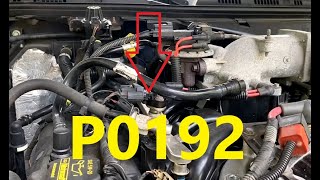
Typical fix: Replace the fuel rail pressure sensor. It is located on the end of the fuel rail and held by a single T25 Torx screw. 🎬 Watch this quick walkthrough of the sensor replacement process.
Est. part cost: $45-$240 - Wiring or Connector Issue 🟡 Medium Probability
How to confirm: Visually inspect the sensor's electrical connector and wiring harness for corrosion, damage, or loose pins. Check for chafed wires near the engine. Use a multimeter to check for 5V reference, good ground, and signal continuity back to the ECM.
Typical fix: Repair or replace the damaged section of the wiring harness or clean the connector terminals with electrical contact cleaner.
Est. part cost: $5-$50 - Low Actual Fuel Pressure ⚪ Low Probability While less common for a circuit code, a failing fuel pump or a faulty Fuel Pump Electronic Module (PEM) can cause pressure to drop. On earlier P1 models, the PEM was located in a vulnerable spot in the wheel well and was prone to water damage; it was later relocated under the rear seat.
How to confirm: Connect a mechanical fuel pressure gauge to the Schrader valve on the fuel rail to measure actual pressure. Compare the reading to the manufacturer's specification. For the PEM, check for corrosion on the module or test its output.
Typical fix: Replace the failing component, which could be the fuel filter, the complete fuel pump assembly, or the PEM.
Est. part cost: $40-$400
Rare But Worth Checking
- Faulty Engine Control Module (ECM): → Shop Engine Control Module (ECM) This is extremely rare. The ECM should only be considered after all other possibilities, including the sensor, wiring, and the entire fuel delivery system, have been thoroughly tested and ruled out.
Diagnosis Steps
- SAFETY FIRST: Before starting, relieve the fuel system pressure. You can do this by removing fuse #74 (fuel pump relay) from the fuse box under the glove box and running the engine until it stalls.
- Alternatively, you can use the Schrader valve on the fuel rail. Place rags underneath and press the center pin to release pressure. Be prepared for a small spray of fuel.
- Visually inspect the fuel rail pressure sensor, located on the end of the fuel rail. Check its electrical connector for corrosion, damage, or loose wires.
- If you have an advanced OBD-II scanner, check the live data for the 'Fuel Rail Pressure' PID. If it reads 0 or a fixed low value even with the key on, the sensor or its circuit is faulty.
- If the wiring looks good, the most likely cause is the sensor itself. Replacement is the most common and effective diagnostic step.
- To replace, disconnect the electrical connector, then remove the single T25 Torx screw holding the sensor to the fuel rail.
- Have the new sensor and plenty of rags ready. Quickly remove the old sensor and install the new one to minimize fuel spillage. A small amount of fuel will leak out, this is normal.
- Reinstall the T25 Torx screw (do not overtighten), reconnect the electrical connector, and replace the fuel pump fuse.
- Clear the trouble codes with your scanner. It's a good idea to cycle the key to the 'on' position for a few seconds to allow the fuel pump to prime the system before starting.
- Start the vehicle to confirm the fix. The car may stumble for a moment on initial startup as pressure rebuilds.
Parts You'll Likely Need
- Fuel Rail Pressure Sensor
(OEM #31272733 (supersedes 31251446))— This is the most common failure point for code P0192 on this specific vehicle, especially on 2004-2007 models.
Trusted brands: Bosch (OEM), Genuine Volvo
OEM price range: $175-$240
Aftermarket price range: $45-$85
Related Codes That Often Appear With This One
- P0190 — P0190 is a general 'Fuel Rail Pressure Sensor Circuit Malfunction' code. It often appears alongside P0192 as the ECM tries to diagnose the specific nature of the sensor fault.
- P0087 — P0087 means 'Fuel Rail/System Pressure - Too Low'. If the fuel pressure sensor is failing and reporting a low value that is still within its electrical range, it might trigger P0087. If the sensor fails completely and shorts to ground, it will trigger P0192. 🎬 Watch this video to understand P0192 causes and fixes.
- P0089 — P0089 is for 'Fuel Pressure Regulator 1 Performance'. An owner on Volvo Forums reported getting this code after replacing the sensor to fix P0192, indicating a potential follow-on issue or a deeper problem with the fuel pump/regulator system.
Platform-Specific Known Issues
- A safety recall (NHTSA ID: 07V-226) was issued for faulty fuel pressure sensors on some 2003-2004 Volvo models, but it primarily affected the S60 and V70 platforms, not the S40. However, it highlights a known issue with sensors from that era.
- Real Owner Repair Story: On a Polish Volvo forum, a user with a 2.4i engine reported codes P0089, P0191, P0192, and P0190, along with symptoms of the engine losing power and RPMs dropping to 400-1000 when accelerating. They replaced the fuel pressure sensor on the rail with a Bosch aftermarket part for ~140 zł (approx. $35 USD) and reported the issue was resolved.
Mechanic-Grade Diagnostic Values
- Fuel Rail Pressure Sensor Signal Voltage (KOEO) — expected: ~0.5 V. Failure: A reading below 0.2V or a reading of 0V indicates a short to ground or an open circuit in the signal, power, or ground wire.
- Fuel Rail Pressure at Idle (via VIDA scan tool) — expected: Approximately 400 kPa. Failure: A reading around 300 kPa or significantly lower at operating temperature may indicate a weak fuel pump or other issue, even if it doesn't set a pressure code.
- Fuel Pressure Sensor Connector - Power Supply — expected: 5V reference from the ECM. Failure: No voltage indicates a wiring problem or an issue with the ECM's 5V reference circuit.
Hidden / Shadow Codes Worth Checking
- ECM-2503: Fuel Pressure - Signal too low. This is the Volvo-specific Diagnostic Trouble Code (DTC) that corresponds to the generic P0192 code. (see via Volvo's VIDA/DiCE diagnostic tool is required to read these manufacturer-specific codes.)
Scan Tool Commands That Help
- Volvo VIDA: Quick test of fuel pump — This function in the ECM's 'Advanced' menu allows a technician to activate the fuel pump and monitor its pressure output directly from the scan tool. It's useful for determining if a low pressure reading is due to a failing pump or another component like the sensor or PEM, before starting physical parts replacement.
Wiring & Ground Locations
- Main Engine Ground — On the front of the transmission, about halfway down. The main negative battery cable connects here.. A poor engine ground can cause a variety of electrical issues and erratic sensor readings. While not a primary cause for a specific circuit-low code, it can introduce voltage drops that may affect sensor readings and should be checked for corrosion and tightness if multiple electrical faults are present.
- 31/115 — Ground connection point located at the driver's side (LHD) A-pillar.. This is a chassis ground point. While the fuel pressure sensor ground is likely routed directly to the ECM, verifying major chassis grounds is a good practice when diagnosing any electrical circuit fault, as other modules on the same ground path could be affected or be the source of electrical noise.
OEM Part Supersession History
31251446→31272733— Standard part revision and improvement by the manufacturer.
Heads up: The new part number (31272733) is a direct replacement for the old one (31251446) with no known compatibility issues.
Model Year Variations Within This Range
- 2004.5 - early 2006: The Fuel Pump Electronic Module (PEM) was originally mounted externally, near the passenger side fuel tank/wheel well area, making it highly vulnerable to water and salt corrosion. This was a known issue leading to Volvo Recall 190.
- Late 2006 - 2012: Due to high failure rates from corrosion, the PEM was relocated to a protected position underneath the rear seat cushion, significantly reducing the likelihood of water damage.
- 2007-2008: A minor facelift for the 2008 model year introduced cosmetic changes, a new center console, and a slight power bump for the T5 engine, but the 2.4i engine and its fuel system, including the failure-prone sensor, remained fundamentally the same as the 2007 model.
Diagnostic Flowchart
Other Known Issues on This Vehicle
Issues unrelated to this code that are worth knowing about as an owner of this generation:
- PCV/Oil Separator System Failure 🟠 Medium — Common, especially on higher mileage vehicles. Often presents as a loud whistling or 'howling' noise from the engine that stops when the oil dipstick is pulled.
- Clogged Sunroof Drains Causing CEM Damage 🔴 High — Very common issue. The drains clog with debris, causing water to overflow and drip onto the Central Electronic Module (CEM) in the passenger footwell, leading to widespread and bizarre electrical failures.
- Premature Front Lower Control Arm Bushing Wear 🟠 Medium — A frequent wear item. Leads to clunking noises over bumps, poor alignment, and vague steering feel. Often requires replacement of the entire control arm.
- A/C Compressor Clutch Gap 🟡 Low — Extremely common. The clutch gap increases over time, causing the A/C to stop engaging when the engine bay is hot. A simple DIY fix involves removing a shim ('bread clip hack') to restore proper spacing.
- Leaking Heater Core O-Rings 🟡 Low — Fairly common. The O-rings at the heater core connections in the driver's footwell can fail, causing a coolant leak onto the floor mat.
Used vs. New Parts: Buying Guide for This Vehicle
When a used part is the smart pick: For this repair, a used part is generally not recommended for the Fuel Pressure Sensor itself due to its high failure rate and the low cost of a new, reliable aftermarket part. However, a used Fuel Pump Electronic Module (PEM) from a reputable salvage yard can be a cost-effective option, especially if sourced from a later model-year vehicle (post-2006) where the part was located inside the car.
Donor-vehicle mileage cap: roughly under 100000 miles for the part to have meaningful remaining life.
What to inspect on the donor part:
- For a PEM, ensure the donor vehicle is a 2007 or newer S40/V50 to get the internally-mounted version.
- Check the part for any signs of water damage, corrosion on the pins, or physical damage to the casing.
- If possible, get the VIN of the donor car to verify its model year and that it was not involved in a flood.
Aftermarket brands forum-validated for this vehicle:
- Bosch: For the Fuel Pressure Sensor, Bosch is the Original Equipment Manufacturer (OEM). Buying the Bosch-branded part (0261230236) provides the same quality as the Genuine Volvo part at a significantly lower price.
Brands owners have reported issues with on this vehicle:
- Unnamed/white-box sensors from online marketplaces. While very cheap, their reliability and accuracy are questionable and may lead to recurring issues or poor performance.
Real Owner Stories
Aggregated from forums and TSBs cited above. Mileages and costs reflect what owners reported in those sources.
2005 Volvo S40 2.4i
Symptoms: Check Engine Light with codes P0190 and P0192.
What fixed it: Replacing the fuel rail pressure sensor with a new one.
Source hint: The Zen of Volvo S40 2005 Maintenance
Volvo S40 2.4i
Symptoms: Engine losing power and RPMs dropping to 400-1000 when accelerating, along with codes P0089, P0191, P0192, and P0190.
What fixed it: Replaced the fuel pressure sensor on the rail with a Bosch aftermarket part.
Cost: $35-$35
Source hint: Forum Volvo (volvoforum.pl/viewtopic.php?t=96956)
2005 Volvo S40 2.4i
Symptoms: Check Engine Light with codes P0192 and P0194.
What fixed it: Changing the fuel rail pressure sensor resolved the initial codes, but then code P0089 appeared, suggesting a possible related issue with the fuel pump or regulator.
Source hint: Volvo Forums (volvo-forums.com/t43890-fuel-problem.htm)
Volvo S60 (Cross-Model Reference)
Symptoms: An owner reported that after a second stalling incident, the check engine light illuminated with code P0192. The owner noted that online research linked this code to the failure of the vehicle's fuel pressure sensor (NHTSA ODI #10357926).
Related OBD-II Codes
Frequently Asked Questions
Is the fuel pressure sensor a known weak point on the 2004-2012 S40 2.4i?
Where is the fuel rail pressure sensor located on my S40?
Was there a recall for this fuel pressure sensor issue on the S40?
What is the safest way to relieve fuel pressure before changing the sensor?
I have a V50 (or C30/C70) with the 2.4i engine. Does this P0192 information apply to my car?
If the sensor isn't the problem, what else could cause low fuel pressure on this car?
Helpful Videos
We Have This Part in Stock


The information in this article is provided for general reference and educational purposes only. Vehicle specifications, procedures, and part compatibility can vary by production date, trim level, and region. Always consult your vehicle's factory service manual and verify part numbers before purchasing or performing repairs. Safety-critical components such as airbags, seat belts, and braking systems should be installed by a qualified professional.
- Volvo S40:
- 🧭 Diagnostic Flowchart
- 🎬 Helpful Videos
- 🛍️ Shop This Part
- What's Unique About the 2004-2012 Volvo S40
- Symptoms You May Notice
- Most Likely Causes
- Rare But Worth Checking
- Diagnosis Steps
- Parts You'll Likely Need
- Related Codes That Often Appear With This One
- Platform-Specific Known Issues
- Mechanic-Grade Diagnostic Values
- Hidden / Shadow Codes Worth Checking
- Scan Tool Commands That Help
- Wiring & Ground Locations
- OEM Part Supersession History
- Model Year Variations Within This Range
- Other Known Issues on This Vehicle
- Used vs. New Parts: Buying Guide for This Vehicle
- Real Owner Stories
- 2005 Volvo S40 2.4i
- Volvo S40 2.4i
- 2005 Volvo S40 2.4i
- Volvo S60 (Cross-Model Reference)
- Related OBD-II Codes
- Frequently Asked Questions
- 🎟️ Get 5% Off