

P0193 on 2015-2018 Ford Edge 2.0L EcoBoost: Fuel Rail Pressure Sensor Circuit High
On a 2015-2018 Ford Edge with the 2.0L EcoBoost engine, code P0193 is almost always caused by a failed Fuel Rail Pressure (FRP) sensor or a wiring issue. The most common fix is replacing the sensor itself, which is a DIY-friendly job with the part costing between $50 and $100. A key diagnostic step is to unplug the sensor; if a no-start condition is resolved by unplugging it, the sensor is faulty.
- P0193 on your Ford Edge almost always points to an electrical problem with the Fuel Rail Pressure (FRP) sensor or its wiring, not a mechanical fuel pressure issue.
- The most likely fix is replacing the FRP sensor, which is located on the fuel rail at the front of the engine.
- Before buying parts, use a scan tool to check live data. A voltage reading stuck near 5V is a strong indicator of a bad sensor or a wiring short.
- A key diagnostic trick: if the engine cranks but won't start, unplugging the FRP sensor may allow it to start, confirming a bad sensor.
- Always inspect the wiring harness for signs of rubbing or damage before replacing the sensor, as this is a common and often-overlooked cause.
- When working on the high-pressure fuel system, always relieve the pressure first to avoid serious injury.
What's Unique About the 2015-2018 Ford Edge
The 2.0L EcoBoost engine in the second-generation Ford Edge is a Gasoline Direct Injection (GDI) system that operates with very high fuel pressure. While P0193 is a generic code, its cause on this platform is very frequently the high-pressure Fuel Rail Pressure (FRP) sensor itself, which is a known failure point on many Ford EcoBoost engines. Another common issue on these vehicles is wiring harness chafing, which can short the sensor's signal wire to power and trigger this specific code. It is critical to distinguish this from the low-pressure fuel sensor, as this engine has both.
Symptoms You May Notice
- Check Engine Light is on
- Engine is hard to start or will not start
- Engine cranks but won't fire, but may start if the FRP sensor is unplugged
- Stalling, especially at idle or low speeds
- Rough running or misfiring
- Reduced engine power and poor acceleration (limp mode)
- Decreased fuel economy
- Strong fuel smell from the exhaust
- Replacing the high-pressure fuel pump. P0193 is an electrical circuit code, not a pressure performance code like P0087 (low pressure) or P0088 (high pressure). Replacing the pump will not fix a sensor circuit fault.
- Replacing the in-tank low-pressure fuel pump or fuel filter, which would typically cause low-pressure codes.
Most Likely Causes
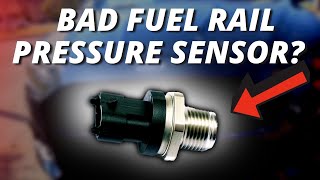
- Faulty Fuel Rail Pressure (FRP) Sensor 🔴 High Probability → Shop Fuel Pressure Sensor The FRP sensor is a common failure point on Ford EcoBoost engines. Internal failure can cause the sensor to send a constant high voltage signal regardless of actual pressure, leading to a no-start or poor running condition.
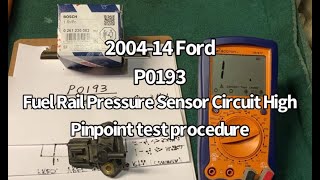
How to confirm: Using a scan tool, check the live data for the FRP sensor. If the voltage is stuck at or near 5V 🎬 Watch: Step-by-step Ford P0193 diagnostic testing procedure even with the key on and engine off, the sensor has likely failed. A definitive test is to unplug the sensor; if a vehicle that cranks but won't start then fires up (it will run poorly), the sensor is confirmed bad. This works because the PCM reverts to a default fuel map when it sees the open circuit.
Typical fix: Replace the Fuel Rail Pressure sensor. The sensor is located on the high-pressure fuel rail. On the 2.0L EcoBoost, it is typically on the driver's side of the engine. A 27mm or 1 1/16" deep socket is often required for removal.
Est. part cost: $50-$120 - Wiring Harness or Connector Issue 🟡 Medium Probability The engine bay is a harsh environment. The FRP sensor wiring can chafe against engine components, brackets, or other lines, causing a short to voltage which results in a P0193 code. The connector pins can also corrode or back out, causing a poor connection.
How to confirm: Visually inspect the entire length of the wiring harness from the FRP sensor. Look for rubbed-through insulation, melting, or corrosion, especially where the harness may contact other components. Unplug the connector and check for damage, corrosion, or pushed-out pins. With the sensor unplugged (key on), use a multimeter to verify a 5-volt reference, a good ground (near 0 volts), and the signal wire. If the signal wire reads 5V with the sensor unplugged, there is a short to power in the harness that must be traced and repaired.
Typical fix: Repair the damaged section of wire using solder and heat shrink. If the connector is damaged, it will need to be replaced with a new pigtail.
Est. part cost: $10-$50
Rare But Worth Checking
- Powertrain Control Module (PCM) Fault: This is very rare. The PCM's internal driver for the sensor circuit can fail. All other possibilities, especially the sensor and wiring, should be exhaustively ruled out before considering PCM replacement.
Diagnosis Steps
- Connect an OBD-II scanner and confirm the P0193 code is present. Note any other codes.
- Using the scanner's live data feature, monitor the 'FRP' (Fuel Rail Pressure) sensor voltage. If it is stuck at or near 5.0 volts with the Key On, Engine Off (KOEO), this confirms a circuit high condition.
- If the vehicle cranks but does not start, turn the ignition off, unplug the FRP sensor, and try to start the engine again. If it starts, the sensor is faulty and needs replacement.
- Turn the ignition off.
- Locate the Fuel Rail Pressure sensor on the high-pressure fuel rail.
- Thoroughly inspect the sensor's electrical connector and wiring harness. Look for any signs of chafing, melting, corrosion, or loose pins. Pay close attention to where the harness may rub against brackets or other engine parts.
- Disconnect the sensor. With the key on, engine off, use a multimeter to test the connector pins on the harness side. You should find: ~5 volts (reference), a good ground (near 0 volts), and the signal wire (should be near 0 volts).
- If the signal wire shows 5 volts with the sensor disconnected, there is a short to power in the wiring harness that needs to be located and repaired.
- If the wiring and connector appear to be in good condition and all voltages test correctly, the Fuel Rail Pressure sensor itself is the most likely cause of the fault.
- Before replacing the sensor, it is critical to relieve the pressure from the high-pressure fuel system. Failure to do so can result in serious injury. This can be done by pulling the fuel pump fuse/relay and running the engine until it stalls.
- Replace the Fuel Rail Pressure sensor. It is recommended to lubricate the new sensor's O-ring with clean engine oil before installation.
- Clear the trouble code with the scanner and perform a test drive to ensure the fault does not return.
Parts You'll Likely Need
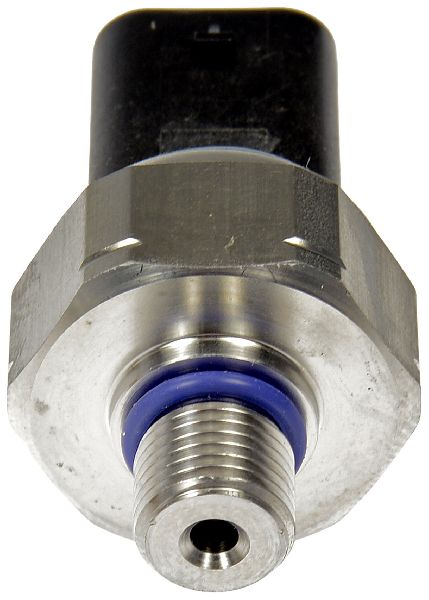
- Fuel Rail Pressure Sensor
(OEM #EJ7Z-9F972-A)— This is the most common cause for a P0193 code on this engine, as the sensor fails internally and sends a continuous high voltage signal.
Trusted brands: Motorcraft (OEM), Bosch, Standard Motor Products, NTK
OEM price range: $70-$112
Aftermarket price range: $50-$90
Related Codes That Often Appear With This One
- P0088 — P0088 means 'Fuel Rail/System Pressure - Too High'. While P0193 is an electrical fault, a sensor failing in a way that intermittently reports high pressure could potentially trigger a P0088 code before it fails completely into a 'Circuit High' state.
- P0192 — P0192 means 'Fuel Rail Pressure Sensor Circuit Low'. If you unplug the sensor to test it, the PCM will immediately log a P0192, which is expected behavior during this diagnostic step.
Technical Service Bulletins (TSBs) & Recalls
- While no TSB directly addresses P0193 on this specific platform, TSB 18-2062 for the 2012-2014 Focus mentions wiring harness chafing near the intake manifold that could cause similar sensor circuit faults. This highlights the importance of checking the wiring harness for damage.
- Manufacturer Bulletin #SSM 47337 notes that some Ford vehicles may exhibit an illuminated MIL and/or rough running condition with DTC P0192 and/or P0193 due to engine harness chafing at the cylinder head.
- Manufacturer Bulletin #SSM 46456 and #SSM 46351 describe instances where P0193 may be triggered alongside other codes like P06A6 or P0335 due to concerns with the reference voltage or signal return circuit of the crankshaft position sensor.
Platform-Specific Known Issues
- On some Ford 2.0L engines, the wiring harness can chafe near the intake manifold, potentially affecting the FRP sensor circuit. While a specific TSB for the Edge is not noted, this is a known pattern on the platform.
Diagnostic Flowchart
Other Known Issues on This Vehicle
Issues unrelated to this code that are worth knowing about as an owner of this generation:
- Engine Coolant Intrusion 🔴 High — Affects a significant number of 2015-2018 models. A design flaw in the engine block can allow coolant to leak into the cylinders, leading to misfires, white smoke, and eventual engine failure. (Ref: TSB 19-2346)
- 6F35 Transmission Problems 🟠 Medium — Common after 60,000-100,000 miles. Issues include harsh shifting, delayed engagement, shuddering, and occasional complete failure. Often related to fluid breakdown and internal component wear.
- Cracked Flexplate 🟠 Medium — Can occur on 2015-2018 models, causing a rattling sound from the engine area. If it shatters, it will result in a loss of power to the wheels. (Ref: Ford had a customer satisfaction program (19B37) for this, but it may have expired.)
- Front Brake Hose Rupture 🔴 High — Subject to a recall, these hoses can rupture, leading to a sudden loss of brake fluid and braking ability. (Ref: Recall 20S28)
- Torque Converter Weld Failures 🔴 High — Affected certain 2017-2018 models. A bad weld could cause the torque converter to disconnect from the engine, resulting in a sudden loss of motive power. (Ref: Recalls 17S16 and 18S03)
Real Owner Stories
Aggregated from forums and TSBs cited above. Mileages and costs reflect what owners reported in those sources.
2015-2018 Ford Edge 2.0L EcoBoost
Symptoms: Hard starting and stalling issues.
What fixed it: Replacing the fuel rail pressure sensor (part EJ7Z-9F972-A).
Source hint: fordedgeforum.com: Multiple threads on this forum discuss P0193
2012-2014 Ford Focus 2.0L EcoBoost
Symptoms: Sensor circuit faults caused by wiring harness issues.
What fixed it: Repairing wiring harness chafing near the intake manifold.
Source hint: TSB 18-2062
2014 Ford Edge
Symptoms: Transmission issues that can sometimes be confused with engine problems.
What fixed it: Accurate diagnosis to differentiate between 6F35 transmission failure and engine sensor codes.
Source hint: Reddit r/FordEdge: A user with a 2014 Edge with the 6F35 transmission
Ford Escape Owner Report
Symptoms: The check engine light had been on for several months with a P0193 generic code for fuel rail pressure sensor high input.
What fixed it: Repair required $275 in parts and labor. (NHTSA ODI #10593745)
Ford Five Hundred Owner Report
Symptoms: Owner reported that the only code present was P0193 for the fuel rail pressure sensor, though they were also experiencing unrelated electrical issues with door controls. (NHTSA ODI #11234304)
Related OBD-II Codes
Frequently Asked Questions
Is there a TSB for the P0193 code on my 2015-2018 Ford Edge 2.0L?
My Edge cranks but won't start; how can I tell if the FRP sensor is the problem?
Where is the FRP sensor located on the 2.0L EcoBoost engine?
What tools do I need to replace the fuel rail pressure sensor myself?
Are there any other major issues I should look out for on my 2015-2018 Edge while fixing this?
What specific part number should I look for to fix the P0193 code?
Helpful Videos
We Have This Part in Stock


The information in this article is provided for general reference and educational purposes only. Vehicle specifications, procedures, and part compatibility can vary by production date, trim level, and region. Always consult your vehicle's factory service manual and verify part numbers before purchasing or performing repairs. Safety-critical components such as airbags, seat belts, and braking systems should be installed by a qualified professional.
- Ford Edge:
- 🧭 Diagnostic Flowchart
- 🎬 Helpful Videos
- 🛍️ Shop This Part
- What's Unique About the 2015-2018 Ford Edge
- Symptoms You May Notice
- Most Likely Causes
- Rare But Worth Checking
- Diagnosis Steps
- Parts You'll Likely Need
- Related Codes That Often Appear With This One
- Technical Service Bulletins (TSBs) & Recalls
- Platform-Specific Known Issues
- Other Known Issues on This Vehicle
- Real Owner Stories
- 2015-2018 Ford Edge 2.0L EcoBoost
- 2012-2014 Ford Focus 2.0L EcoBoost
- 2014 Ford Edge
- Ford Escape Owner Report
- Ford Five Hundred Owner Report
- Related OBD-II Codes
- Frequently Asked Questions
- 🎟️ Get 5% Off