

P0193 on 2005-2011 Ford Focus ST 2.5T: Causes and Fixes for Fuel Rail Pressure Sensor Circuit High
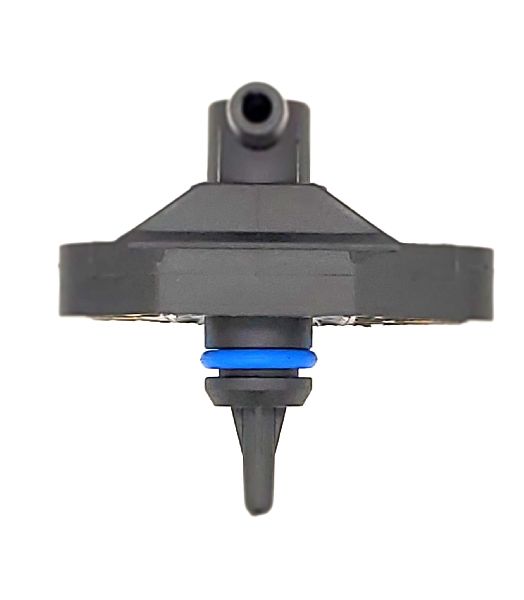
On the 2005-2011 Focus ST, code P0193 is almost always caused by a failed Fuel Rail Pressure (FRP) sensor located on the fuel rail. It's a common failure point for this Volvo-sourced engine. Replacing the sensor is a straightforward DIY job that typically costs between $40 and $90 for an OEM-quality part from Bosch or Ford.
- P0193 on a Focus ST 2.5T almost always points to a bad Fuel Rail Pressure (FRP) sensor.
- This is a common and well-documented failure for this specific Volvo-sourced engine and its platform mates (Volvo C30/S40/V50, Ford Kuga).
- Do not rush to replace the fuel pump; the sensor or its wiring is the far more likely culprit.
- The repair is simple, requires a T25 Torx bit and basic tools, and can be done in under an hour.
- You can save money by purchasing the Bosch OEM sensor (part no. 0261230238), as it's the same part used by both Ford and Volvo.
What's Unique About the 2005-2011 Ford Focus ST
The 2.5L 5-cylinder turbo engine in the Mk2 Ford Focus ST is a design sourced from Volvo. This is significant because this entire engine family (used in various Ford, Volvo, and Land Rover models) is notorious for Fuel Rail Pressure (FRP) sensor failures. This fact is well-documented in enthusiast communities for all related vehicles. Unlike many generic P0193 guides that suggest complex diagnostics, the cause on this specific platform is overwhelmingly the sensor itself, making the fix a simple and inexpensive sensor swap.
Symptoms You May Notice
- Check Engine Light is on
- Engine is hard to start or takes a long time to crank
- Hesitation or stumbling during acceleration
- Reduced engine power or 'limp mode'
- Poor fuel economy
- Engine may stall, especially at idle or when coming to a stop
- In some instances, the light may appear during mild acceleration with no noticeable change in performance
- Replacing the fuel pump. A P0193 code points to a circuit high (electrical) issue, which is rarely caused by the fuel pump itself. Owners may replace the pump when the issue is a much simpler and cheaper sensor failure.
Most Likely Causes
- Faulty Fuel Rail Pressure (FRP) Sensor 🔴 High Probability → Shop Fuel Pressure Sensor The sensor is a widely-known, notorious failure point on the Volvo 2.5T engine platform used in the Focus ST and its platform mates. 🎬 Watch a demonstration of this repair on a similar Volvo engine.
How to confirm: With the key on and engine off, use a scan tool to read the live data for the FRP sensor. A faulty sensor will often show a pressure reading that is impossibly high or a signal voltage stuck at or near 5 volts. Another diagnostic trick is to disconnect the sensor; if a different code like P0190 (Circuit Low) appears, it strongly suggests the sensor itself is internally shorted.
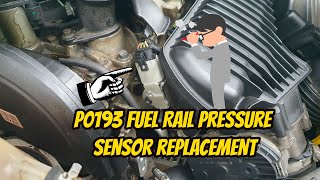
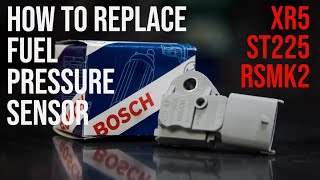
Typical fix: Replace the Fuel Rail Pressure sensor on the end of the fuel rail. This involves relieving fuel pressure via the Schrader valve, disconnecting the electrical connector, removing a single T25 Torx bolt, and swapping the sensor. 🎬 Watch this step-by-step guide to replacing the sensor on your Focus. The old sensor can be stuck and may require gentle prying with a flat-blade screwdriver to remove. It's recommended to apply a small amount of lubricant to the new sensor's O-ring before installation.
Est. part cost: $40-$90 - Wiring or Connector Issue 🟡 Medium Probability The engine bay environment can lead to corrosion on connector pins or damage to the wiring harness over time. The connector is located right on the end of the fuel rail and is exposed to heat and vibration.
How to confirm: Visually inspect the FRP sensor's electrical connector and wiring for any signs of corrosion, damage, or loose pins. With the sensor unplugged and key on, check for a 5V reference voltage and a good ground at the connector using a multimeter. A 'circuit high' code can be caused by an open in the ground circuit or the signal wire being shorted to the 5V reference line.
Typical fix: Clean the connector terminals if corroded. If the wiring is damaged, repair the affected wire or replace the connector pigtail.
Est. part cost: $15-$30 for a new pigtail connector
Rare But Worth Checking
- Powertrain Control Module (PCM) Fault: This is very uncommon, but a faulty PCM can misinterpret the sensor's signal. This should only be considered after the sensor and wiring have been definitively ruled out by a professional. Forum wisdom consistently states this is almost never the cause.
Diagnosis Steps
- Connect an OBD-II scanner and confirm P0193 is the primary code.
- View live data on the scanner. Check the 'Fuel Rail Pressure' reading with the key on, engine off. If it's abnormally high (often thousands of PSI) or the voltage is stuck near 5V, the sensor has almost certainly failed.
- Visually inspect the Fuel Rail Pressure sensor's connector and wiring harness for any obvious damage, corrosion, or loose connections. The sensor is located on the end of the silver fuel rail, held by a single Torx bolt.
- If the wiring looks good, the next step is to test the circuit. Disconnect the sensor. With the key on, use a multimeter to check for a 5-volt reference and a good ground at the connector pins.
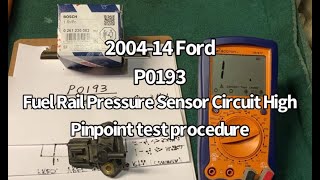
- If the reference voltage and ground are present, the sensor is the confirmed cause of the fault. 🎬 See how to perform a professional electrical test on the circuit.
- Before replacing the sensor, relieve the fuel system pressure. Locate the Schrader valve (looks like a tire valve) on the fuel rail, cover it with a rag to catch fuel, and briefly depress the center pin.
- Using a T25 Torx bit, remove the single bolt holding the sensor. The sensor may be stuck; gently pry it out with a flat-head screwdriver. Be prepared for a small amount of additional fuel spillage.
- Lubricate the O-ring on the new sensor and install it. Re-install the T25 bolt.
- Reconnect the electrical connector, clear the trouble code with the scanner, and cycle the ignition a few times to prime the fuel system before starting the vehicle to confirm the fix.
Parts You'll Likely Need
- Fuel Rail Pressure Sensor
(OEM #31272730 (Volvo), 7M5N9C968AA (Ford), Bosch 0261230238)— This is the most common failure part for a P0193 code on this specific engine. The Bosch part is the original equipment manufacturer and is often identical to the dealer part but cheaper.
Trusted brands: Bosch (OEM), Motorcraft/Volvo (Dealer)
OEM price range: $60-$90
Aftermarket price range: $40-$70
Platform-Specific Known Issues
- The Fuel Rail Pressure sensor is a known common failure item on the Volvo 2.5T engine, which is used in the Mk2 Focus ST.
- Owners report the sensor can be difficult to remove as the O-ring causes it to stick in the fuel rail. Gentle prying is often required.
- The Check Engine Light can sometimes appear intermittently, or even turn off on its own for a day or two before returning.
Technical Service Bulletins (TSBs) & Recalls
- TSB Bulletin #SSM 47337: While issued for other Ford models, this bulletin notes that P0193 can be caused by engine harness chafing at the cylinder head, which may lead to an illuminated MIL and rough running conditions.
- TSB Bulletin #SSM 46456: This manufacturer record indicates that P0193 may be triggered by concerns with the reference voltage or signal return circuit of the crankshaft position sensor, showing how shared electrical circuits can complicate diagnosis.
- TSB Bulletin #SSM 46351: Similar to other reports, this bulletin highlights that a P0193 code can be present alongside other codes like P06A6 or P0335 due to reference voltage circuit issues.
Mechanic-Grade Diagnostic Values
- Fuel Rail Pressure Sensor (FRP) Signal Voltage — expected: 0.5V to 4.5V, varies with pressure.. Failure: Stuck at or near 5.0V, or above the PCM's threshold of ~4.7-4.9V.
- FRP Sensor Reference Voltage (at connector, unplugged) — expected: ~5.0V.. Failure: No voltage or significantly low voltage indicates a wiring or PCM issue.
- FRP Sensor Ground Voltage (at connector, unplugged) — expected: Near 0V (less than 500mV is acceptable).. Failure: High voltage or an open reading indicates a bad ground connection.
- FRP Sensor Resistance (uninstalled) — expected: 1.2kΩ to 1.8kΩ between certain terminals at room temperature (varies by model).. Failure: Infinite resistance (open) or zero ohms (short) indicates an internally failed sensor.
Scan Tool Commands That Help
- Ford IDS, FORScan, high-end generic (e.g., XTOOL, Snap-on): Reset All Adaptations / Clear KAM (Keep Alive Memory) — After replacing the FRP sensor or fixing a wiring issue, it is good practice to reset the PCM's learned fuel trim and sensor adaptations. This forces the computer to relearn values with the new, correctly functioning component, which can resolve lingering drivability issues.
- FORScan: Live Data Scope Mode (FRP) — To diagnose intermittent issues. Graphing the Fuel Rail Pressure (FRP) voltage while wiggling the sensor connector and harness can help expose a wiring fault that isn't present during a static test.
Wiring & Ground Locations
- Main Engine-to-Chassis Ground — The main engine ground strap on the Mk2 Focus is typically connected to the gearbox casing and the chassis.. A corroded or loose main ground can cause floating voltages and erratic behavior in multiple sensors, including the FRP sensor, potentially leading to a P0193 code even if the sensor's dedicated ground wire appears intact.
- FRP Sensor Connector — On the end of the fuel rail, passenger side of the engine.. This is the primary point of failure for wiring issues. It's a 4-pin oval connector. Damage or corrosion on the 5V reference, signal, or ground pins will directly cause the code.
Real Owner Repair Stories
- Reddit user on r/MechanicAdvice (GM SUV (demonstrates a non-obvious cause applicable to other platforms)) — P0193 code appeared after replacing fuel injectors.
❌ Tried (didn't work) Initial diagnosis focused on the new injectors or the FRP sensor itself.
✅ What actually fixed it The P0193 code was caused by a bad ground pin in the fuel injector wiring harness. Re-seating the loose ground pin in the harness connector resolved the high circuit voltage reading. - NHTSA ODI #10593745: An owner reported that their engine light had been on for several months with the only code being P0193 (Fuel Rail Pressure Sensor High Input), resulting in a repair cost of approximately $275.
- NHTSA ODI #11234304: A report describes a situation where P0193 was the only code present in the vehicle, even when the owner was investigating unrelated electrical issues like driver control resets.
OEM Part Supersession History
Bosch 0261230239→Bosch 0261230238— Part revision/update by the manufacturer.
Heads up: The newer part number 0261230238 is the correct and current replacement for the older 0261230239. They are interchangeable for this application.Ford 7M5N9C968AA→Ford 7M5N9C968AB— Part revision/update by Ford.
Heads up: The parts are interchangeable. The Bosch 0261230238 is the OEM equivalent for both Ford part numbers.
Model Year Variations Within This Range
- 2005-2011: The Mk2 Focus platform had a significant facelift for the 2008 model year (often called the Mk2.5). However, the 2.5T (HYDA) engine and its fuel system, including the failure-prone fuel rail pressure sensor, remained fundamentally the same across the entire 2005-2011 production run.
Diagnostic Flowchart
Used vs. New Parts: Buying Guide for This Vehicle
When a used part is the smart pick: For this specific repair, buying a used Fuel Rail Pressure sensor is NOT recommended. It is a known high-failure electronic component, and a used part from a salvage yard has an unknown history and a high likelihood of either being already faulty or failing soon after installation.
What to inspect on the donor part:
- Not applicable as used parts are not advised for this repair.
OEM-only on this vehicle (don't cheap out):
- While not strictly 'OEM-only', using the OEM supplier (Bosch) is highly recommended for the Fuel Rail Pressure Sensor. It ensures compatibility and reliability.
Aftermarket brands forum-validated for this vehicle:
- Bosch (OEM supplier)
- Motorcraft / Genuine Volvo (Dealer parts)
Brands owners have reported issues with on this vehicle:
- Unnamed, no-brand sensors from online marketplaces should be avoided. While they may be cheaper, their reliability and accuracy are questionable and can lead to wasted time and money if they fail prematurely or are dead-on-arrival.
Real Owner Stories
Aggregated from forums and TSBs cited above. Mileages and costs reflect what owners reported in those sources.
Ford Focus ST 2.5L 5-Cylinder Turbo
Symptoms: The Engine Management Light came on, but the car ran perfectly with no hesitation, slowdown, or loss of boost.
What fixed it: Replaced the fuel rail pressure sensor. The owner first tried erasing the code, but it returned.
Source hint: youtube.com - P0193 Fuel Rail Pressure Sensor Replacement - Ford Focus ST Ep96
2007 Ford Focus ST 2.5L 5-Cylinder Turbo
Symptoms: Fault code P0193 appeared, but the car starts, runs, and drives flawlessly. The warning message was cleared but returned, and sometimes disappears on its own after the car sits for a day or two.
What fixed it: Other forum members confirmed that replacing the fuel pressure sensor is the common solution for this issue.
Source hint: Focusclub.nl
Ford Focus ST (XR5) 2.5L 5-Cylinder Turbo
Symptoms: An engine light appeared, and after scanning, it showed the fuel rail pressure sensor was not happy.
What fixed it: The owner ordered a new sensor and swapped it over easily to resolve the issue.
Source hint: focusonperformance.com.au customer review
Related OBD-II Codes
Frequently Asked Questions
Is the Fuel Rail Pressure sensor a known common problem on the 2005-2011 Focus ST?
My Focus ST threw a P0193 code, but it seems to be driving perfectly fine. Is this possible?
I'm trying to replace the FRP sensor myself, but it's stuck in the fuel rail. How do I get it out?
My Check Engine Light for P0193 turned off on its own. Is the problem fixed?
How can I confirm the FRP sensor has failed before buying a new one?
I have a Volvo S40 T5 with the same P0193 code. Is the diagnosis the same as for the Focus ST?
What specific tool do I need to remove the fuel rail pressure sensor on my ST?
Helpful Videos
We Have This Part in Stock


The information in this article is provided for general reference and educational purposes only. Vehicle specifications, procedures, and part compatibility can vary by production date, trim level, and region. Always consult your vehicle's factory service manual and verify part numbers before purchasing or performing repairs. Safety-critical components such as airbags, seat belts, and braking systems should be installed by a qualified professional.
- Ford Focus ST:
- 🧭 Diagnostic Flowchart
- 🎬 Helpful Videos
- 🛍️ Shop This Part
- What's Unique About the 2005-2011 Ford Focus ST
- Symptoms You May Notice
- Most Likely Causes
- Rare But Worth Checking
- Diagnosis Steps
- Parts You'll Likely Need
- Platform-Specific Known Issues
- Technical Service Bulletins (TSBs) & Recalls
- Mechanic-Grade Diagnostic Values
- Scan Tool Commands That Help
- Wiring & Ground Locations
- Real Owner Repair Stories
- OEM Part Supersession History
- Model Year Variations Within This Range
- Used vs. New Parts: Buying Guide for This Vehicle
- Real Owner Stories
- Ford Focus ST 2.5L 5-Cylinder Turbo
- 2007 Ford Focus ST 2.5L 5-Cylinder Turbo
- Ford Focus ST (XR5) 2.5L 5-Cylinder Turbo
- Related OBD-II Codes
- Frequently Asked Questions
- 🎟️ Get 5% Off