

P0196 on 2003-2024 Honda Accord: Engine Oil Temperature Sensor Causes and Fixes
On most Honda Accords, especially 4-cylinder models from 2003-2017, P0196 is usually caused by a faulty Engine Oil Temperature (EOT) sensor, which is often integrated into the VTEC oil pressure switch. This switch is a known failure point for both electrical faults and oil leaks. Replacing this switch/sensor is the most common fix, costing between $30-$80 for an aftermarket part.
- P0196 points to a problem with the engine oil temperature sensor's signal, not necessarily an overheating engine.
- For most 4-cylinder Accords (2003-2017), the most likely culprit is the VTEC oil pressure switch assembly, which includes the temperature sensor.
- Always check your oil level and condition first; it's a simple check that can sometimes be the root cause.
- Diagnosis is straightforward with a scan tool that can read live data, allowing you to see the sensor's faulty reading in real-time.
What's Unique About the 2003-2024 Honda Accord
For many Honda Accord models, particularly those with the popular K-series (2.4L 4-cylinder) engine from roughly 2003-2017, the Engine Oil Temperature (EOT) sensor is not a standalone part. Instead, its function is integrated into the VTEC oil pressure switch assembly. This means a P0196 code often points to the entire oil pressure switch assembly, which is a very common failure point known for both electrical faults and external oil leaks that saturate the connector. For V6 (J-series) engines, the sensor is typically a separate unit located near the oil filter housing or on the cylinder head. For newer 1.5T and 2.0T engines (2018+), the sensor configuration is different and less information is available linking them to this specific code.
Generation note: This guide covers multiple Accord generations (7th through 11th). The most specific information applies to the 7th, 8th, and 9th generations (2003-2017), especially those with the K24 4-cylinder engine where the EOT sensor is part of the VTEC oil pressure switch. The exact location and part type for V6 (J-series) and newer 1.5T/2.0T engines (2018+) vary. For the V6, the sensor is often a separate component.
Symptoms You May Notice
- Check Engine Light is on
- Oil temperature gauge (if equipped) may behave erratically, show no reading, or be stuck on a low value
- Slight decrease in fuel economy
- In rare cases, the engine may run rough or hesitate
- In some vehicles, the engine may enter a limited power or 'limp' mode
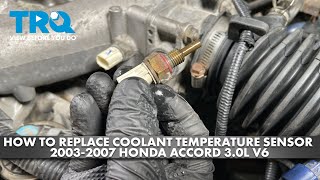
- Replacing the Engine Coolant Temperature (ECT) sensor. The ECT and EOT are different sensors in different locations. 🎬 Watch: How to replace the coolant temperature sensor P0196 is specific to the oil temperature circuit.
- Replacing the oil pressure switch for a low oil pressure warning light, when the fault is actually the integrated temperature sensor part of the component.
Most Likely Causes
- Faulty Engine Oil Temperature Sensor / VTEC Oil Pressure Switch 🔴 High Probability → Shop Engine Oil Pressure Switch On K-series 4-cylinder engines, this sensor is integrated into the VTEC oil pressure switch, a component known to fail and leak oil over time. The failure can be internal (electrical) or an external oil leak that contaminates the electrical connector, causing a bad signal.
How to confirm: Use a scan tool to monitor live data for 'Engine Oil Temperature'. With a cold engine, the reading should be close to the ambient air and engine coolant temperature. If it shows an extreme value (like -40°F or 250°F) or doesn't increase as the engine warms up, the sensor/switch is likely bad. Visually inspect the switch for oil leakage, which is a very common sign of failure.
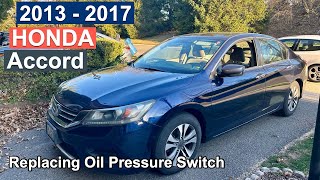
Typical fix: Replace the entire oil pressure switch assembly. It is typically located on the rear of the engine block on the passenger side, often accessed by removing the passenger-side front wheel. 🎬 Watch: Step-by-step 9th Gen Accord oil pressure switch replacement
Est. part cost: $30-$80 - Wiring or Connector Issue 🟡 Medium Probability The sensor is located low on the engine, exposing its wiring to heat, vibration, and potential oil contamination from a leaking switch, which can degrade the connector or wires over time.
How to confirm: Visually inspect the wiring harness and connector leading to the sensor. Look for frayed or melted wires, oil saturation, or green corrosion on the connector pins. Wiggle the connector with the engine running while watching live data to see if the reading jumps, indicating a loose connection.
Typical fix: Clean the connector pins with electrical contact cleaner. If the connector is oil-soaked from a leaking switch, replace the switch and thoroughly clean the connector. If the connector or wiring is damaged, it will need to be repaired or replaced.
Est. part cost: $5-$50 - Incorrect Engine Oil Level or Condition ⚪ Low Probability Some Accord models, particularly 2008-2012 V6 models and some K24 4-cylinders, are known for excessive oil consumption. A chronically low oil level can expose the sensor, preventing an accurate reading.
How to confirm: Check the engine oil dipstick. If the oil level is extremely low, the sensor may not be submerged and cannot get an accurate reading. If the oil is very old and sludgy, it can act as an insulator on the sensor probe, preventing it from reading the correct temperature.
Typical fix: Perform an oil and filter change using the correct viscosity oil specified for your vehicle. Ensure the oil is filled to the proper level. Address any underlying oil consumption issues.
Est. part cost: $40-$90
Rare But Worth Checking
- Faulty Powertrain Control Module (PCM): This is very rare. The PCM is the computer that receives the signal. Before condemning the PCM, all other possibilities (sensor, wiring, oil) must be exhaustively ruled out.
Diagnosis Steps
- Check Engine Oil: Before any technical diagnosis, check the oil level and condition on the dipstick. If it's very low or sludgy, address this first as it can cause the code.
- Scan Tool Live Data: Connect an OBD-II scanner and view the live data stream for the Engine Oil Temperature (EOT) sensor.
- Analyze Sensor Reading (Cold): With the engine cold for several hours, the EOT reading should be very close to the Engine Coolant Temperature (ECT) and Intake Air Temperature (IAT) readings. A significant deviation points to a sensor issue.
- Analyze Sensor Reading (Warm): Start the engine and let it warm up. The EOT value should climb steadily. If it's stuck at a low or high value, or jumps erratically, the sensor or its circuit is faulty.
- Inspect Sensor and Connector: Locate the sensor. On 4-cyl models, it's likely the VTEC oil pressure switch on the rear of the block. On V6 models, it's often near the oil filter. Inspect the connector for corrosion, damage, or oil saturation. Check the wiring for any signs of fraying, melting, or breaks.
- Test the Circuit: If the sensor reading is illogical and the wiring appears okay, you can test the circuit. Disconnect the sensor. Check for a 5-volt reference signal from the PCM at the connector with the ignition on. Check for good ground continuity. You can also use a multimeter to measure the sensor's resistance, which should change smoothly as its temperature changes.
- Replace the Component: If the sensor data is confirmed to be illogical and the wiring is intact, replace the Engine Oil Temperature sensor (or the integrated oil pressure switch assembly).
Parts You'll Likely Need
- Engine Oil Pressure Switch / Temperature Sensor
(OEM #37240-R70-A04 (or superseding part, common for 9th Gen 4-cyl); 37240-P13-013 / 37240-PT0-014 (common for older models). Always verify with VIN.)— On many 4-cylinder Accords, this single unit provides both pressure and temperature readings. It is the most common failure point for the P0196 code on these models, often leaking oil and causing electrical failure.
Trusted brands: Honda (OEM), Denso, Standard Motor Products, NTK
OEM price range: $60-$100
Aftermarket price range: $30-$80
Related Codes That Often Appear With This One
- P0197 (Engine Oil Temperature Sensor Circuit Low Voltage) and P0198 (Engine Oil Temperature Sensor Circuit High Voltage) are often seen with or as alternatives to P0196, pointing to the same faulty sensor/circuit.
Technical Service Bulletins (TSBs) & Recalls
- TSB 11-033: Addresses excessive oil consumption on some V6 models by updating the PCM software to alter VCM engagement, which could indirectly relate to P0196 if the oil level becomes critically low.
Platform-Specific Known Issues
- On 2008-2012 Accords with the 4-cylinder engine, excessive oil consumption was a known issue that led to a warranty extension (related to TSB 11-033 for V6 models). While not directly for P0196, a chronically low oil level from this issue could trigger the code.
- For 7th Gen V6 models (2003-2007), the oil pressure switch is a separate component, typically located above the oil filter and replaced with a 22mm wrench.
- For 9th Gen 4-cylinder models (2013-2017), the switch is notoriously prone to leaking. Replacement often requires removing the passenger front wheel for access and using a 24mm deep socket.
Mechanic-Grade Diagnostic Values
- EOT Sensor Resistance (NTC Thermistor) — expected: Resistance should decrease as temperature increases. At ~20°C (68°F), expect ~2,200–3,000Ω. At normal operating temp ~80°C (176°F), expect ~250–350Ω.. Failure: Resistance is infinite (open), near zero (shorted), or does not change smoothly with temperature.
- VTEC Oil Pressure Switch Resistance (for integrated sensors) — expected: With the engine off, the switch should be closed, showing continuity with very low resistance (less than 1.0 ohm).. Failure: The switch shows higher than expected resistance (e.g., 8 ohms) or is open circuit (no continuity) with the engine off. This can cause intermittent issues even on a new aftermarket part.
- EOT Sensor Connector Voltage — expected: With the key on and engine off, one pin should show a 5-volt reference signal from the PCM, and the other should have good continuity to ground.. Failure: Reference voltage is missing or significantly lower than 5V, or the ground circuit has high resistance.
Wiring & Ground Locations
- G101 — The main ECU and sensor ground point, typically a bolt on the thermostat housing on the cylinder head.. Corrosion or a loose connection at this critical ground point can cause erratic readings from multiple sensors, including the EOT, leading to range/performance codes. It is a common source of difficult-to-diagnose electrical issues.
- VTEC Oil Pressure Switch Connector — On the VTEC solenoid assembly, typically on the rear of the engine block for K-series 4-cylinders.. This 2-pin connector is where the integrated EOT sensor signal originates. One pin is the signal wire to the ECU, and the other is a ground. The connector is prone to oil contamination from a leaking switch, which degrades the connection. The wiring order may not matter as it is a simple switch, but some sources specify the pin closest to the locking tab is the signal wire.
- Engine/Transmission Grounds — Additional ground straps are typically found from the valve cover to the chassis and from the transmission case to the chassis.. A poor ground connection at any of these points can create a voltage potential difference, causing sensor signals to be misinterpreted by the PCM. Ensuring all grounds are clean and tight is a key step in diagnosing any electrical fault.
Real Owner Repair Stories
- Reddit user /u/modessitt in r/HondaElement (Honda Element (with similar K-series engine)) — Intermittent limp mode (revs limited to ~2600 RPM) and a VTEC-related trouble code (P2646/P2647).
❌ Tried (didn't work) Replaced the entire VTEC solenoid assembly with a new aftermarket unit from Amazon., Performed multiple engine oil flushes., Replaced the VTC solenoid and screen., Replaced the VTEC connector pigtail.
✅ What actually fixed it The new aftermarket oil pressure switch was faulty out of the box. It had a resistance of 8 ohms when it should have been near zero. Replacing it with a second new aftermarket switch that tested correctly (<1 ohm) before installation permanently solved the problem. - Reddit user in r/S2000 (Honda S2000) — Repeated failure of the VTEC oil pressure switch, causing oil to leak through the electrical connector.
❌ Tried (didn't work) Replacing the switch with four different non-OEM brands over 15,000 miles.
✅ What actually fixed it The consensus from the community was that the only long-term solution is to buy the genuine Honda (OEM) part, as aftermarket versions are notoriously unreliable and prone to leaking.
OEM Part Supersession History
37240-R70-A01, 37240-R70-A02, 37240-R70-A03→37240-R70-A04— Standard part revision and improvement by the manufacturer.
Heads up: The newest part number (A04) is the correct replacement for the previous versions. This part is common on J-series V6 engines but is also listed for some 4-cylinder models.
Model Year Variations Within This Range
- 2003-2017 (approx.): Most 4-cylinder (K-series) engines integrate the EOT sensor function into the VTEC oil pressure switch assembly located on the rear of the engine block.
- 2003-2017 (approx.): Most V6 (J-series) engines use a separate oil pressure switch (part 37240-R70-A04 or similar) which also contains the temperature sensing function, but it is located on one of the cylinder heads.
- 2018-2024: The 1.5T (L15B7) and 2.0T (K20C4) engines have different engine architecture and sensor locations. P0196 is less commonly reported on these models, and the sensor is a distinct part, not typically integrated with a VTEC assembly in the same manner.
Diagnostic Flowchart
Other Known Issues on This Vehicle
Issues unrelated to this code that are worth knowing about as an owner of this generation:
- Automatic Transmission Failure (7th Gen V6) 🔴 High — Very common on 2003-2004 models, less so on 2005-2007 but still a concern. Often fails before 100,000 miles. (Ref: Class-action lawsuits and warranty extensions were issued, but have long since expired.)
- VTC Actuator Rattle on Cold Start (K24 Engine) 🟠 Medium — Widespread on 2008-2012 Accords with the 2.4L K24 engine. A loud grinding/rattling noise for ~2 seconds on cold startup. (Ref: Honda TSB 09-010)
- Excessive Oil Consumption (K24 & J35 VCM Engines) 🟠 Medium — Common on 8th and 9th generation Accords (2008-2017). Can be caused by stuck piston rings. (Ref: Honda TSB 11-033 (for V6 VCM) and a related class-action lawsuit settlement for K24 engines.)
- Starter Motor Failure (9th Gen) 🟠 Medium — Common on 2013-2017 Accords, particularly earlier models in the generation. Can fail prematurely.
- Fuel Injector / Head Gasket Issues (10th Gen 1.5T) 🔴 High — A known issue on 2018 and newer Accords with the 1.5L Turbo engine, sometimes leading to misfires and coolant intrusion. (Ref: Warranty extensions have been issued for some vehicles.)
- Failing Clear Coat / Peeling Paint 🟡 Low — Affects many Honda models from the 2000s and early 2010s, including the 7th and 8th generation Accords.
Used vs. New Parts: Buying Guide for This Vehicle
When a used part is the smart pick: For this specific repair, especially when it involves the integrated VTEC oil pressure switch/sensor, buying a used part is NOT recommended. These are high-failure-rate items, and a used part is likely to have limited life or be faulty already.
Donor-vehicle mileage cap: roughly under 30000 miles for the part to have meaningful remaining life.
What to inspect on the donor part:
- If considering used, ensure there is no oil weeping from the plastic connector part of the switch; this indicates internal seal failure.
- Check the electrical pins for any corrosion or oil contamination.
- Test the resistance of the switch before purchase; it should be near zero ohms.
OEM-only on this vehicle (don't cheap out):
- Engine Oil Pressure Switch / Temperature Sensor Assembly
Aftermarket brands forum-validated for this vehicle:
- Denso (often the OEM supplier)
- NTK
- Standard Motor Products (SMP)
Brands owners have reported issues with on this vehicle:
- Unbranded parts from online marketplaces (e.g., Amazon, eBay) have a high reported failure rate, sometimes being faulty right out of the box.
- Beck/Arnley was specifically cited by one user as having poor quality for this part.
Real Owner Stories
Aggregated from forums and TSBs cited above. Mileages and costs reflect what owners reported in those sources.
2010 Honda Accord V6
Symptoms: Owner experienced issues related to the service bulletin 11-033 regarding excessive oil consumption, noting the importance of checking oil levels as a root cause for sensor-related codes.
What fixed it: Monitoring and maintaining proper oil levels and addressing the TSB 11-033 software update/oil consumption issues.
Source hint: honda-accord-forum.com: A thread titled '2010 V6 Service bulletin 11-033'
2013-2017 Honda Accord 4-cylinder
Symptoms: The VTEC oil pressure switch was leaking oil, which is a frequent failure point noted for this generation.
What fixed it: Replacement of the VTEC oil pressure switch assembly, often requiring a 24mm deep socket and removal of the passenger front wheel.
Source hint: driveaccord.net: Multiple threads discuss the failure of the VTEC oil pressure switch on 8th and 9th generation Accords
2003-2024 Honda Accord
Symptoms: Illogical sensor readings; owner was advised to check for a 5V reference from the ECU and test sensor resistance at different temperatures.
What fixed it: Testing the sensor's resistance at hot and cold temperatures and verifying the 5V reference from the ECU to confirm a faulty sensor or circuit.
Source hint: reddit.com/r/mechanicadvice: A user with a P0196 code on their Honda
Related OBD-II Codes
Frequently Asked Questions
Does TSB 11-033 apply to my Honda Accord's P0196 code?
Where is the sensor located on my 9th Gen (2013-2017) 4-cylinder Accord?
Can I just clean the connector if it's covered in oil?
Is the oil pressure switch different on a 7th Gen (2003-2007) V6 Accord?
Why does my K-series engine keep triggering this code?
Will low oil levels cause a P0196 on my 2010 Accord?
Helpful Videos


The information in this article is provided for general reference and educational purposes only. Vehicle specifications, procedures, and part compatibility can vary by production date, trim level, and region. Always consult your vehicle's factory service manual and verify part numbers before purchasing or performing repairs. Safety-critical components such as airbags, seat belts, and braking systems should be installed by a qualified professional.
- Honda Accord:
- 🧭 Diagnostic Flowchart
- 🎬 Helpful Videos
- What's Unique About the 2003-2024 Honda Accord
- Symptoms You May Notice
- Most Likely Causes
- Rare But Worth Checking
- Diagnosis Steps
- Parts You'll Likely Need
- Related Codes That Often Appear With This One
- Technical Service Bulletins (TSBs) & Recalls
- Platform-Specific Known Issues
- Mechanic-Grade Diagnostic Values
- Wiring & Ground Locations
- Real Owner Repair Stories
- OEM Part Supersession History
- Model Year Variations Within This Range
- Other Known Issues on This Vehicle
- Used vs. New Parts: Buying Guide for This Vehicle
- Real Owner Stories
- 2010 Honda Accord V6
- 2013-2017 Honda Accord 4-cylinder
- 2003-2024 Honda Accord
- Related OBD-II Codes
- Frequently Asked Questions
- 🎟️ Get 5% Off