

P0198 on 2001-2012 Ford Escape 3.0L: Engine Oil Temperature Circuit High Explained
This code is misleading on the 3.0L V6 Escape. The engine does not have an oil temperature sensor. The problem is almost always a faulty Cylinder Head Temperature (CHT) sensor or its wiring, which the computer uses to estimate oil temperature. The sensor is difficult to access, making replacement a labor-intensive job.
- P0198 on this Ford Escape is not an oil sensor problem; it's a fault with the Cylinder Head Temperature (CHT) sensor circuit.
- Do not waste time or money looking for an Engine Oil Temperature sensor, as this engine does not have one.
- The CHT sensor is located under the intake manifold, making this a labor-intensive repair (DIY Difficulty: 5/5).
- The most likely fix is replacing the CHT sensor and the intake manifold gaskets.
- This code is often accompanied by P1299, which indicates the engine is in a protective 'limp mode' due to the perceived overheating condition.
What's Unique About the 2001-2012 Ford Escape
The key issue for this platform is Ford's strategy of using an inferred temperature reading rather than a direct sensor. Many owners and even some mechanics are led astray looking for an Engine Oil Temperature sensor that doesn't exist. The actual cause, the Cylinder Head Temperature (CHT) sensor, is notoriously difficult to access on the 3.0L V6, as it is buried in the engine valley between the cylinder heads, under the lower intake manifold. This turns a relatively inexpensive part into a repair job requiring several hours of labor and significant engine disassembly.
Generation note: This guide covers the first (2001-2007) and second (2008-2012) generations of the Ford Escape with the 3.0L V6. While there are minor differences, the fundamental design of using a CHT sensor under the intake manifold for temperature readings is consistent across this year range for the V6 engine. The platform mates, Mazda Tribute and Mercury Mariner, share the exact same engine and issue.
Symptoms You May Notice
- Check Engine Light is on
- Engine cooling fans running constantly, even when the engine is cold
- Reduced engine power or 'limp mode'
- Temperature gauge may read incorrectly (either stuck on cold or maxed out on hot)
- In some cases, a false 'Engine Overheat' warning on the instrument cluster
- A/C compressor may not engage
- Potential for hard starting conditions
- Replacing a non-existent Engine Oil Temperature (EOT) sensor.
- Replacing the wrong temperature sensor, such as a more accessible Engine Coolant Temperature (ECT) sensor if one is present elsewhere in the cooling system.
- Replacing the thermostat, as symptoms can mimic a thermostat issue (e.g., incorrect temperature readings).
Most Likely Causes
- Failed Cylinder Head Temperature (CHT) Sensor 🔴 High Probability The sensor is subjected to extreme heat cycles in the engine valley under the intake manifold, which can lead to internal failure (open circuit) over time.
How to confirm: With a scan tool, observe the CHT sensor data; a reading that is nonsensical (e.g., -40°F on a warm engine) or a voltage reading above 4.9V points to a bad sensor or open circuit. The definitive test is to measure the sensor's resistance directly after removing the intake manifold for access. A healthy sensor should have a resistance that changes with temperature (e.g., ~30-40k ohms at 70°F, dropping as it heats up). An infinite resistance reading confirms an open circuit and a failed sensor. 🎬 Watch: How to test and replace an oil temperature sensor.
Typical fix: Replace the Cylinder Head Temperature (CHT) sensor. Due to its location, this also requires replacing the upper and lower intake manifold gaskets.
Est. part cost: $20-$50 for the sensor, $50-$100 for gaskets - Damaged CHT Sensor Wiring or Connector 🟡 Medium Probability The wiring harness is routed in a high-heat area under the intake manifold. Over time, the plastic conduit and wire insulation can become brittle, leading to cracks, chafing against the manifold, or corrosion at the connector pins.
How to confirm: Visually inspect the CHT sensor connector and wiring pigtail for signs of damage, corrosion, or loose pins. This can only be done after removing the upper intake manifold for access. A continuity test from the connector back to the PCM can also be performed.
Typical fix: Repair the damaged section of the wiring harness or replace the connector pigtail. The Motorcraft WPT-118 is a commonly used pigtail for this repair.
Est. part cost: $15-$30 for a new connector pigtail
Rare But Worth Checking
- Faulty Powertrain Control Module (PCM): → Shop Engine Control Module (ECM) This is extremely rare and a last resort. The PCM should only be considered after the CHT sensor and its entire circuit have been thoroughly tested and confirmed to be in good working order. Some owners have reported PCM failure on these vehicles, but it's not a common cause for P0198 specifically.
Diagnosis Steps
- Connect an OBD-II scanner and confirm P0198 is the active code. Note any other codes, especially P1299 or other temperature-related codes.
- Using the scanner's live data function, monitor the PID for the Cylinder Head Temperature (it may be labeled as CHT, ECT, or even EOT depending on the scanner). Look for an irrational reading, such as -40°F or an extremely high value, that doesn't change as the engine warms up.
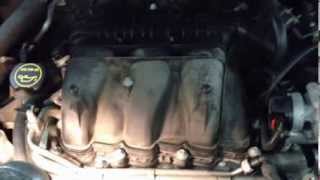
- If the reading is irrational, the fault is in the CHT circuit. The next step is to access the sensor. This requires removing the upper and lower intake manifolds. 🎬 Watch this video to see how to remove the intake manifold.
- Once accessible, visually inspect the CHT sensor's connector and wiring for any signs of melting, corrosion, or physical damage.
- Disconnect the sensor. With a multimeter, test the resistance across the two pins of the CHT sensor itself. Compare this reading to the manufacturer's specifications for the current ambient temperature (a common value is around 37k Ohms at 70°F/21°C). A reading of infinite resistance (OL) indicates an open circuit and a failed sensor.
- Before installing a new sensor, test it out of the box to ensure it has a plausible resistance reading.
- If the sensor's resistance is within spec, test the wiring harness. With the key on, engine off, check for a 5-volt reference signal on one wire and a good ground on the other.
- If the sensor has failed, replace it. It is highly recommended to also replace the upper and lower intake manifold gaskets at the same time to prevent vacuum leaks.
- If the sensor and wiring are good, the fault may lie within the PCM, but this is extremely unlikely and should be confirmed by a professional.
- After reassembly, clear the codes and perform a drive cycle to ensure the repair was successful.
Parts You'll Likely Need
- Cylinder Head Temperature (CHT) Sensor
(OEM #9L8Z-6G004-F (Motorcraft DY-1145))— This sensor is the source of the signal that the PCM uses to calculate oil temperature. Its failure is the direct cause of the P0198 code on this engine.
Trusted brands: Motorcraft, Bosch, NTK, Standard Motor Products
OEM price range: $25-$40
Aftermarket price range: $15-$30 - Upper and Lower Intake Manifold Gasket Set
(OEM #Fel-Pro MS 96432 (2005-08), MS 96124 (2001-04))— These gaskets must be replaced whenever the intake manifold is removed to access the CHT sensor. Reusing old gaskets will almost certainly cause vacuum leaks.
Trusted brands: Motorcraft, Fel-Pro, Mahle
OEM price range: $60-$90
Aftermarket price range: $40-$70 - CHT Sensor Connector Pigtail
(OEM #Motorcraft WPT-118)— If the original connector is brittle, melted, or corroded, it must be replaced to ensure a solid connection to the new sensor.
Trusted brands: Motorcraft, Dorman
OEM price range: $20-$35
Aftermarket price range: $15-$25
Related Codes That Often Appear With This One
- P1299 — P1299 ('Cylinder Head Overtemperature Protection Active') is often triggered alongside P0198. The faulty high voltage signal from the CHT sensor makes the PCM believe the engine is critically overheating, causing it to activate limp mode and set both codes.
- P0118 — P0118 ('Engine Coolant Temperature Sensor 1 Circuit High') can appear for the same reason. Since the CHT sensor serves as the primary temperature input, a high circuit fault can be registered under multiple definitions by the PCM.
Technical Service Bulletins (TSBs) & Recalls
- While no TSB directly addresses P0198 on the Escape, TSB 05-14-4 was issued for other Ford vehicles for throttle body issues, demonstrating a common practice of issuing TSBs for known electronic faults. No specific TSB for the CHT sensor issue on the Escape has been widely identified, likely because it is considered a standard wear-and-tear failure.
Platform-Specific Known Issues
- A user on Ford-Trucks.com described a 2001 Escape with P0198 and fans running constantly. After confirming the CHT sensor was bad by testing resistance, they replaced the sensor and intake gaskets, which resolved the issue. They noted the difficulty of the job, which took several hours.
- On Escape-City.com, a thread details a 2006 V6 model with P0198 and P1299. The owner was initially confused, looking for an oil temperature sensor. Forum members correctly guided them to the CHT sensor under the intake, and the replacement fixed both codes.
Mechanic-Grade Diagnostic Values
- CHT Sensor Resistance vs. Temperature — expected: See chart: 68°F (20°C) = ~37.4 kΩ; 104°F (40°C) = ~16.0 kΩ; 140°F (60°C) = ~7.5 kΩ; 212°F (100°C) = ~2.1 kΩ (interpolated); 248°F (120°C) = ~1.1 kΩ (interpolated).. Failure: A reading of infinite resistance (Open Loop) or near zero ohms (short circuit) at any temperature indicates a failed sensor. P0198 is caused by infinite resistance.
- CHT Sensor Signal Voltage (Key On, Engine Off) — expected: Typically 3.0V - 3.7V on a cold engine (e.g., ~3.4V at 61°F/16°C). Voltage should decrease as the engine warms, down to ~0.5V - 0.6V at full operating temperature.. Failure: A reading near 5.0V indicates an open circuit (the cause of P0198). A reading near 0.0V indicates a short to ground (which would set a P0197 code). The PCM may set a fault if the voltage exceeds 4.6V.
- CHT Sensor Harness Reference Voltage (Key On, Engine Off, Connector Unplugged) — expected: One of the two pins in the harness-side connector should show a steady ~5.0V reference signal from the PCM.. Failure: Absence of the 5V reference voltage indicates a wiring problem between the PCM and the connector, or a faulty PCM.
Wiring & Ground Locations
- PCM Connector C175B, Pins 39 & 49 — The Powertrain Control Module (PCM) is located at the rear center of the firewall. C175B is one of the main connectors on the PCM.. These are the specific pins for the CHT sensor circuit. Pin 39 is the CHT Signal and Pin 49 is the Signal Return (ground). Testing for continuity and voltage at these pins can definitively isolate a wiring fault from a sensor or PCM fault.
- G101 / G109 — On the firewall at the rear of the engine compartment.. This is a primary engine compartment ground. A loose or corroded connection here can cause floating grounds and erratic readings for multiple sensors, including the CHT sensor.
- G104 — At the left front corner of the engine compartment, near the Battery Junction Box (underhood fuse panel).. This is another critical chassis ground for engine bay components. Verifying it is clean and tight is a key step in diagnosing any persistent electrical fault.
- Shared Sensor Ground (Orange Wire) — On early models (e.g., 2001), a specific orange wire in the engine harness serves as a shared ground for the CHT/ECT, IAT, TPS, and Transmission Oil Temperature sensors.. A break in this specific wire can cause multiple sensor circuit high codes simultaneously. If you have P0198 along with codes for other sensors, this shared ground path is a likely culprit.
Real Owner Repair Stories
- Ford Truck Enthusiasts Forums (Ford Powerstroke Diesel (concept applies)) — P0198 code present. Scan tool showed EOT (Oil Temp) and ECT (Coolant Temp) readings were nearly identical during warmup.
❌ Tried (didn't work) Initially ignored the code based on previous owner's incorrect advice.
✅ What actually fixed it Owner found a broken wire on the sensor pigtail and spliced it back together. A forum member explained that when the EOT/CHT signal is lost, the PCM substitutes the ECT value as a default, explaining the identical readings. The repair restored normal, differentiated temperature readings. - YouTube Channel 'MECANICO DE CRISTO' (2001 Ford Escape 3.0L V6) — Problems with ground wiring.
✅ What actually fixed it The technician identified a broken orange ground wire in the harness. He demonstrated with a multimeter that this single wire provided the ground path for the Throttle Position (TP) sensor, Engine Coolant Temp (ECT/CHT) sensor, Intake Air Temp (IAT) sensor, and Transmission Range (TR) sensor. Repairing this single broken wire was necessary to restore function to multiple components.
Model Year Variations Within This Range
- 2001-2004 vs. 2005-2008: The intake manifold design was updated for the 2005 model year. This requires different upper and lower intake manifold gaskets. The Fel-Pro part number for 2001-2004 is MS 96124, while the number for 2005-2008 is MS 96432. The CHT sensor itself and its location remain the same, but using the correct gaskets for the year is critical to prevent vacuum leaks after the repair.
Diagnostic Flowchart
Other Known Issues on This Vehicle
Issues unrelated to this code that are worth knowing about as an owner of this generation:
- Rear Shock Tower Rust 🔴 High — Very common on vehicles in the salt belt, can occur after 8-10 years. The passenger side is often worse. Can make the vehicle unsafe. (Ref: No recall, but aftermarket repair kits (e.g., Dorman 924-358) are widely available due to the commonality of the problem.)
- Automatic Transmission Failure (CD4E) 🔴 High — Common in earlier models (2001-2008), with failures often reported between 80,000 and 150,000 miles. Issues include slipping, harsh shifts, or complete loss of drive. (Ref: Multiple recalls and TSBs exist, including a recall for remanufactured units with improperly tightened shift lever bolts.)
- Alternator Failure 🟠 Medium — The alternator is in a difficult-to-access location, making replacement labor-intensive. Failures can occur around 100,000-150,000 miles, sometimes causing flickering lights or battery issues.
- Collapsed/Cracked PCV Hose 🟠 Medium — The PCV hose, located under the intake manifold, can collapse or crack, causing vacuum leaks, rough idle, and lean codes (P0171/P0174). Often replaced at the same time as the CHT sensor.
- Worn Valve Cover Gaskets / Oil in Spark Plug Wells 🟡 Low — Gaskets become brittle with age, leading to oil leaks on the outside of the engine or into the spark plug tubes, which can cause misfires.
Used vs. New Parts: Buying Guide for This Vehicle
When a used part is the smart pick: For this repair, using used parts is generally not recommended for the critical components. However, if the plastic upper intake manifold or other hard parts are damaged during disassembly, a used component from a salvage yard is a viable and cost-effective option.
Donor-vehicle mileage cap: roughly under 120000 miles for the part to have meaningful remaining life.
What to inspect on the donor part:
- For a used intake manifold, inspect carefully for any cracks, especially around bolt holes and seams.
- Ensure all threaded inserts are intact and not stripped.
- Verify the donor vehicle was not in a front-end collision that could have stressed the plastic components.
OEM-only on this vehicle (don't cheap out):
- While not strictly 'OEM-only', using a Motorcraft CHT sensor (DY-1145) is highly recommended. Given the extreme labor involved in accessing it, the risk of a premature failure from a low-quality aftermarket sensor is not worth the small cost savings.
Aftermarket brands forum-validated for this vehicle:
- For gaskets: Fel-Pro is a widely trusted and recommended brand in forums for intake gaskets (e.g., MS 96432, MS 96124).
- For the CHT sensor: If Motorcraft is unavailable, brands like NTK, Bosch, or Standard Motor Products (SMP) are considered reliable alternatives.
Brands owners have reported issues with on this vehicle:
- Avoid unbranded, 'white-box' sensors from online marketplaces. The sensor's internal thermistor quality is critical for accuracy and longevity, and these parts have a high failure rate.
Real Owner Stories
Aggregated from forums and TSBs cited above. Mileages and costs reflect what owners reported in those sources.
2001 Ford Escape 3.0L V6
Symptoms: Check engine light on and cooling fans running constantly. The owner confirmed the CHT sensor was bad by testing resistance.
What fixed it: Replaced the CHT sensor and intake gaskets. The owner noted the job was difficult and took several hours.
Source hint: Ford-Trucks.com Enthusiasts Forums
2006 Ford Escape 3.0L V6
Symptoms: Owner observed codes P0198 and P1299 and was initially confused, searching for an oil temperature sensor.
What fixed it: Replaced the CHT sensor located under the intake manifold, which resolved both codes.
Source hint: Escape-City.com
Related OBD-II Codes
Frequently Asked Questions
My 2001 Ford Escape has P0198 and the cooling fans won't stop running. Is there a TSB for this?
I'm seeing P0198 on my 2006 V6 Escape but I can't find the oil temperature sensor. Where is it?
Do I need to replace the intake gaskets when fixing P0198 on my Duratec 30 engine?
My Mazda Tribute has the same P0198 code as the Ford Escape. Are the parts the same?
Is there a specific replacement pigtail for the CHT sensor wiring on the Escape?
Can a failed CHT sensor cause my Ford Escape to go into 'limp mode'?
Helpful Videos

We Have This Part in Stock


The information in this article is provided for general reference and educational purposes only. Vehicle specifications, procedures, and part compatibility can vary by production date, trim level, and region. Always consult your vehicle's factory service manual and verify part numbers before purchasing or performing repairs. Safety-critical components such as airbags, seat belts, and braking systems should be installed by a qualified professional.
- Ford Escape:
- 🧭 Diagnostic Flowchart
- 🎬 Helpful Videos
- 🛍️ Shop This Part
- What's Unique About the 2001-2012 Ford Escape
- Symptoms You May Notice
- Most Likely Causes
- Rare But Worth Checking
- Diagnosis Steps
- Parts You'll Likely Need
- Related Codes That Often Appear With This One
- Technical Service Bulletins (TSBs) & Recalls
- Platform-Specific Known Issues
- Mechanic-Grade Diagnostic Values
- Wiring & Ground Locations
- Real Owner Repair Stories
- Model Year Variations Within This Range
- Other Known Issues on This Vehicle
- Used vs. New Parts: Buying Guide for This Vehicle
- Real Owner Stories
- 2001 Ford Escape 3.0L V6
- 2006 Ford Escape 3.0L V6
- Related OBD-II Codes
- Frequently Asked Questions
- 🎟️ Get 5% Off