

P0201 on 1995-1999 Dodge RAM WAGON: Injector Circuit Causes and Fixes
On a 1995-1999 Dodge Ram Wagon, code P0201 is frequently caused by a faulty wiring harness that passes through the valve cover gasket, a known issue cited in a manufacturer TSB. Before replacing the #1 fuel injector, thoroughly inspect this harness and its connector, as this is the most likely fix.
- For a P0201 on a 1995-1999 Ram Wagon, suspect the wiring harness under the valve cover before you suspect the injector itself.
- A simple injector swap (moving the #1 injector to another cylinder) is a great way to determine if the injector is faulty or if the problem is with the wiring.
- Ignoring this code can lead to an expensive catalytic converter replacement due to damage from unburnt fuel.
- Symptoms are straightforward: a rough, misfiring engine and a constant Check Engine Light.
What's Unique About the 1995-1999 Dodge RAM WAGON
For this generation of Dodge Ram Wagon with Magnum engines, a known weak point exists that is not common on all vehicles. The fuel injector wiring harness is routed in a high-heat area near the valve covers and intake manifold where it is exposed to oil and heat cycles. This causes the wiring insulation to become brittle, crack, and short out, leading to a P0201 code. Dodge issued a Technical Service Bulletin (TSB #9002688) advising technicians to check this specific wiring before condemning the fuel injector, as a fault in the harness often mimics injector failure.
Diagnostic Flowchart
Tap your situation to follow the diagnostic path that matches what you're seeing on this vehicle.
Symptoms You May Notice
- Engine misfires and runs rough, often felt as shaking or stumbling.
- Check Engine Light is illuminated on the dashboard.
- Noticeable loss of power and poor acceleration.
- Worse than normal fuel economy.
- Engine may be difficult to start or stall.
- A smell of raw fuel may be present from the exhaust.
- Replacing the fuel injector for cylinder #1 without first thoroughly inspecting the wiring harness and connector. The TSB specifically warns that this wiring is a common root cause and can mimic the symptoms of a failed injector.
- Replacing the PCM without first finding and fixing the shorted injector wiring that caused the PCM driver to fail. The new PCM will be damaged immediately if the external short still exists.
Most Likely Causes
- Faulty Injector Wiring Harness or Connector 🔴 High Probability → Shop Engine Wiring Harness As noted in TSB #9002688, the injector wiring is a common failure point. The harness is routed in a high-heat environment where prolonged exposure to heat and oil vapor causes the insulation to become brittle and flake off, leading to shorts or open circuits. The connector itself can also break.
How to confirm: Visually inspect the wiring harness for cylinder #1, looking for cracked, bare, or oily wires. Pay close attention to the injector connector and the loom where it runs near the valve cover and intake manifold. Wiggle the connector with the engine running to see if it affects the idle. Perform a continuity test on both wires from the injector connector back to the PCM.
Typical fix: Splice in a new fuel injector connector pigtail if the damage is localized at the connector. If the damage is more extensive, individual wires may need to be repaired or, in severe cases, the entire engine wiring harness replaced.
Est. part cost: $10-$50 for a pigtail, $400-$800+ for a full harness. - Defective Fuel Injector 🟡 Medium Probability → Shop Fuel Injector
How to confirm: Swap the cylinder #1 injector with another cylinder (e.g., cylinder #3). Clear the codes and run the engine. If the code changes to P0203, the injector is bad. Alternatively, measure the injector's resistance with a multimeter. It should be approximately 12-15 ohms; a reading of 0 or infinity (OL) indicates a failed injector.
Typical fix: Replace the faulty fuel injector. 🎬 Watch: Step-by-step fuel injector replacement for Dodge Magnum engines. It is often recommended to replace all injectors as a set if they are original, as others may soon fail.
Est. part cost: $40-$90 per injector. - Faulty Powertrain Control Module (PCM) ⚪ Low Probability → Shop Engine Control Module (ECM) A short circuit in the injector wiring can damage the injector driver circuit inside the PCM, requiring PCM replacement even after the wiring is fixed.
How to confirm: This is a last resort after the injector and all wiring have been definitively ruled out. A professional can use an oscilloscope to check the driver signal directly from the PCM, but a good indicator is if a noid light fails to flash at the connector even when wiring continuity to the PCM is confirmed.
Typical fix: Replace and reprogram the PCM.
Est. part cost: $200-$500
Rare But Worth Checking
- Failed Crankshaft Position Sensor:
Diagnosis Steps
- Read the codes with an OBD-II scanner to confirm P0201 is present and note any other codes, such as P0301 or P0200. 🎬 See a real-world fix for P0301 and P0201 codes.
- Perform a thorough visual inspection of the cylinder #1 fuel injector, its connector, and the wiring harness. Look for obvious signs of damage, such as brittle/cracked insulation, corrosion, or oil saturation, especially where the harness is exposed to high heat near the intake and exhaust manifolds.
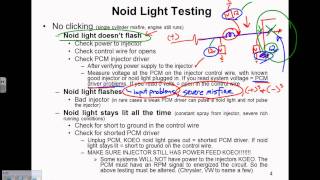
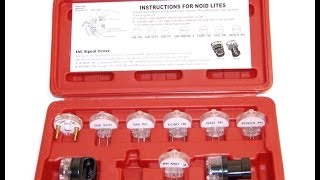
- Use a noid light to test 🎬 Watch: How to use a noid light to test the circuit. for a signal at the injector connector. Disconnect the injector and plug in the noid light. Start the engine. A consistently flashing light indicates the PCM and wiring are likely sending a signal, pointing towards a bad injector. No light or a steady light points to a wiring or PCM issue.
- If the noid light flashes, test the injector. Turn off the engine and set a multimeter to resistance (Ohms). Measure across the two pins of the fuel injector. A good injector should read between 12-15 Ohms. An open (OL) or shorted (0 Ohms) reading means the injector is bad.
- As a final confirmation for a bad injector, swap the cylinder #1 injector with cylinder #3. Clear the codes, run the engine, and see if the code returns as P0203. If it does, the injector is confirmed bad.
- If the noid light does not flash, check the wiring. With the key on (engine off), use a multimeter to check for battery voltage (12V) on one of the terminals in the injector connector. Then, check the continuity of the other wire (the control wire) from the injector connector back to the PCM connector pin.
- If wiring and the injector all test good, but the noid light does not flash, the injector driver circuit in the Powertrain Control Module (PCM) may be faulty. This is especially possible if a wiring short was found and repaired.
Parts You'll Likely Need
- Fuel Injector
(OEM #53030778AB)— If the injector itself has failed electrically (open or shorted coil), it will need to be replaced. This is a common failure after the wiring is ruled out.
Trusted brands: Mopar, Bosch, Standard Motor Products, Delphi
OEM price range: $70-$110
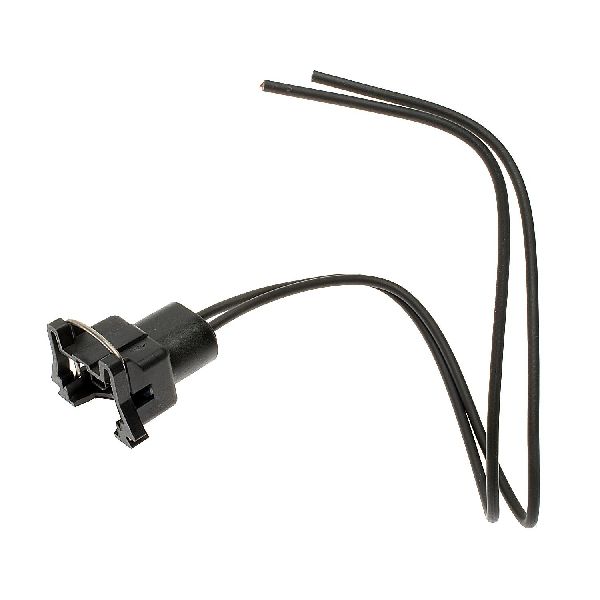
Aftermarket price range: $40-$80 - Fuel Injector Connector Pigtail — If only the connector is broken or its wires are damaged right at the injector, splicing in a new pigtail is the most cost-effective repair.
Trusted brands: Dorman, Standard Motor Products
OEM price range: $25-$40
Aftermarket price range: $10-$30 - Engine Wiring Harness — In cases of severe, widespread heat damage to the injector harness section, repairing individual wires may not be feasible. Mopar typically sells this as a complete engine harness, making used/salvage parts a common alternative.
Trusted brands: Mopar (OEM), Used/Salvage
OEM price range: $800+
Aftermarket price range: $200-$400 (Used)
Related Codes That Often Appear With This One
- P0301 — P0301 means 'Cylinder 1 Misfire Detected'. Since P0201 indicates a fuel delivery circuit problem for cylinder 1, that cylinder will not receive the correct amount of fuel, directly causing a misfire that the PCM will detect and log as P0301.
- P0200 — P0200 is a general 'Injector Circuit Malfunction' code. It is often set alongside a more specific code like P0201 when a fault is detected in the overall injector control circuit, which may be triggered by the specific fault in cylinder 1.
Technical Service Bulletins (TSBs) & Recalls
- 9002688: Advises checking the wiring loom and/or connector for faults before replacing fuel injectors for codes P0201-P0206.
Platform-Specific Known Issues
- A Technical Service Bulletin (TSB #9002688) highlights that the injector wiring is a common failure point for P0201 and related codes. While the TSB text can be slightly misleading by referencing parts for other engines, the core advice is sound: check the harness for faults caused by heat and oil degradation before replacing any fuel injectors.
Mechanic-Grade Diagnostic Values
- Fuel Injector Coil Resistance — expected: 12.5 Ohms (High-Impedance). Failure: A reading of 0 ohms (short) or infinite/OL (open) indicates a failed injector.
- Auto Shutdown (ASD) Relay Coil Resistance — expected: 75 +/- 5 Ohms. Failure: A reading significantly outside this range indicates a faulty relay coil.
- Injector #1 Control Circuit to PCM — expected: Pin A17 on the PCM C1 (Black) connector.. Failure: This is the pin to test for continuity from the injector connector. An open or short on this wire will cause P0201.
- Injector Power Supply Voltage — expected: 12V+ (Battery Voltage). Failure: Low or no voltage at the injector connector (with key on) points to a problem with the ASD relay or its wiring, not the PCM driver.
Scan Tool Commands That Help
- Chrysler DRB III: Actuator Tests -> Fuel Injector Kill — This dealer-level function allows a technician to command individual injectors on or off while the engine is running. Disabling cylinder #1 should cause no change in RPM if it's already malfunctioning, confirming the fault is on that cylinder. It can also be used to check if the PCM is capable of controlling the injector, helping to differentiate a wiring problem from a PCM driver failure.
- Chrysler DRB III: View Freeze Frame Data — When P0201 is set, the DRB III (and most modern scanners) captures a snapshot of sensor data (engine speed, load, temperature, etc.). This is critical for diagnosing intermittent faults, as it shows the exact conditions under which the failure occurred.
Wiring & Ground Locations
- PCM C1 Connector - Pin A17 — The Powertrain Control Module (PCM) is located on the passenger side firewall in the engine bay. C1 is the black 60-pin connector. Pin A17 is the control (ground pulse) wire for injector #1.. This is the specific pin on the PCM that controls the cylinder 1 fuel injector. All continuity and short-to-ground tests for the control wire must trace back to this pin.
- Auto Shutdown (ASD) Relay — Located in the Power Distribution Center (PDC), which is the main fuse/relay box in the engine compartment, typically near the battery.. The ASD relay supplies battery voltage to all fuel injectors. If this relay fails or its circuit has a fault, none of the injectors will receive power, though a specific code like P0201 can sometimes be set first.
- Engine Block Ground — A large ground cable connects the negative battery terminal directly to the engine block, often on the left front side.. A poor main engine ground can cause a host of erratic electrical issues, including problems with sensor readings and actuator signals that the PCM relies on for injector control.
- Firewall/Body Grounds — Multiple smaller ground wires are attached to the firewall and inner fenders. A key location is on the LH side of the firewall, sometimes near the wiper motor.. These grounds are essential for the PCM and other sensors. A corroded or loose body ground can create voltage offsets and electrical noise that may disrupt the sensitive injector driver circuits.
Real Owner Repair Stories
- DodgeForum.com user (2011 Dodge Ram 1500 4.7L (Later model, but same diagnostic principle)) — P0201, misfiring, dumping fuel.
❌ Tried (didn't work) Replaced fuel injector for cylinder 1., Checked the wiring harness., Replaced the PCM with a refurbished unit (worked for 3 weeks then failed again).
✅ What actually fixed it The user was seeking a wiring diagram to perform a continuity check from the PCM to the injector, suspecting a persistent wiring issue was the root cause that damaged the replacement PCM. This highlights the importance of confirming wiring integrity before replacing the PCM. - GMTNation Forum User (on a GM vehicle, but illustrates universal diagnosis) (GMC Envoy) — P0201 and P0301 (misfire).
❌ Tried (didn't work) Swapping ignition coils., Swapping spark plugs., Checking injector resistance (ohms were good)., Checking wiring continuity to PCM (was good)., Replacing the entire fuel injector wiring harness.
✅ What actually fixed it The user replaced all fuel injectors as a set, which resolved the issue. Even though the wiring harness looked chewed by critters, replacing it did not solve the problem. The final fix was the injectors themselves, demonstrating that even when wiring is a likely culprit, the component itself can still be the cause.
OEM Part Supersession History
53030778→53030778AB, RL030778AB— Standard part revision and updates by the manufacturer.
Heads up: The -AB revision is the currently accepted replacement for the original part number and is compatible with the specified vehicle range.
Model Year Variations Within This Range
- 1995: 1995 was a transition year. While carrying over the established body style, it saw the introduction of a standard driver's side airbag and 4-wheel anti-lock brakes for the Ram Wagon model. These changes do not directly affect the P0201 diagnosis but are important for overall vehicle service.
- 1998-2003: A significant interior and exterior facelift occurred for the 1998 model year, updating the dashboard, front fascia, and other cosmetics. However, the underlying Magnum V6/V8 powertrains and their associated wiring, which are the source of the P0201 issue, remained largely the same through the end of production in 2003.
Helpful Videos

We Have This Part in Stock


The information in this article is provided for general reference and educational purposes only. Vehicle specifications, procedures, and part compatibility can vary by production date, trim level, and region. Always consult your vehicle's factory service manual and verify part numbers before purchasing or performing repairs. Safety-critical components such as airbags, seat belts, and braking systems should be installed by a qualified professional.
- Dodge RAM WAGON:
- 🧭 Diagnostic Flowchart
- 🎬 Helpful Videos
- 🛍️ Shop This Part
- What's Unique About the 1995-1999 Dodge RAM WAGON
- Symptoms You May Notice
- Most Likely Causes
- Rare But Worth Checking
- Diagnosis Steps
- Parts You'll Likely Need
- Related Codes That Often Appear With This One
- Technical Service Bulletins (TSBs) & Recalls
- Platform-Specific Known Issues
- Mechanic-Grade Diagnostic Values
- Scan Tool Commands That Help
- Wiring & Ground Locations
- Real Owner Repair Stories
- OEM Part Supersession History
- Model Year Variations Within This Range
- 🎟️ Get 5% Off