

P0201 on 2010-2019 Ford Taurus 3.5L EcoBoost: Injector Circuit Causes and Fixes
P0201 on a 2010-2019 Ford Taurus with the 3.5L EcoBoost engine indicates an electrical fault in the cylinder 1 fuel injector circuit. The most common cause is a failed fuel injector, which is a complex repair requiring intake manifold removal. Other causes include a damaged wiring harness or connector. Expect a shop cost of $600-$1100.
- P0201 is an electrical circuit code for the cylinder 1 injector; do not immediately replace ignition components like spark plugs or coils.
- The most likely cause is a failed fuel injector, but always test the wiring and connector first to avoid unnecessary repairs. Check for chafing near A/C lines.
- This is a difficult DIY repair due to the GDI engine design, which places the injectors under the intake manifold.
- Due to the high labor cost, it is strongly recommended to replace all six fuel injectors at once if one has failed at high mileage.
- Always replace the upper intake manifold gaskets when performing this repair to prevent future vacuum leaks.
What's Unique About the 2010-2019 Ford Taurus
The 3.5L EcoBoost is a Gasoline Direct Injection (GDI) engine, where fuel is injected directly into the combustion chamber at very high pressure. Unlike port-injected engines, the fuel injectors are located in the cylinder head, underneath the intake manifold. This makes accessing and replacing an injector a much more involved and labor-intensive job. While no TSBs are specific to the Taurus for this code, the broader 3.5L EcoBoost family has known issues with wiring harnesses chafing on engine components. TSB 22-2223 for the F-150, for example, describes the engine harness rubbing against an A/C line stud, causing injector circuit faults like P0201, a pattern which should be inspected on the Taurus. Additionally, TSB 25-2569 notes that an illuminated MIL with codes P0201-P0206 can be caused by the engine harness contacting a hose crimp end or spring clamp, further emphasizing the need for a thorough harness inspection.
Symptoms You May Notice
- Check Engine Light is on (may be flashing)
- Rough or shaky engine idle
- Engine misfire or hesitation during acceleration
- Noticeable loss of engine power
- Poor fuel economy
- Smell of raw fuel (less common, but possible with a wiring short)
- Replacing the spark plug or ignition coil. A P0201 code is an electrical circuit code for the fuel injector, not an ignition system code. While a bad injector will cause a misfire (P0301), replacing ignition parts will not fix the underlying circuit fault.
Most Likely Causes
- Failed Cylinder 1 Fuel Injector 🔴 High Probability → Shop Fuel Injector GDI injectors operate under high heat and pressure, leading to eventual electronic failure of the internal coil windings, creating an open circuit.
How to confirm: After confirming the wiring is good, the easiest way to verify a bad injector is to swap it with an adjacent one (e.g., swap injector #1 and #2). If the code changes to P0202, the injector is faulty. Alternatively, a multimeter can be used to check the injector's resistance; if it's out of spec (typically 1-2 ohms for these GDI injectors) or shows an open circuit (infinite resistance), it has failed.
Typical fix: Replace the failed fuel injector. It is highly recommended to replace all six injectors at the same time due to the high labor cost of accessing them. This ensures balanced performance and prevents repeat repairs for other aging injectors. After replacement, the new injector's IQA code must be programmed into the PCM.
Est. part cost: $50-$120 per injector - Damaged Wiring Harness or Connector 🟡 Medium Probability Engine vibrations and heat can cause wires to chafe against brackets or other components. A known issue on the 3.5L EcoBoost family is the harness rubbing against A/C line studs or hose crimps near the passenger-side valve cover, leading to an open or short circuit. The injector connector itself can also become brittle and fail. Manufacturer service bulletin TSB 16-0163 describes intermittent MIL illumination and various drivability issues associated with codes P0201-P0204, often linked to wiring or connection integrity.
How to confirm: Visually inspect the wiring harness leading to the cylinder 1 injector for any signs of damage, melting, or chafing against metal parts. Use a noid light to confirm if the PCM is sending a pulse signal to the connector. If there's no signal, check for continuity on the power and ground wires between the injector connector and the PCM.
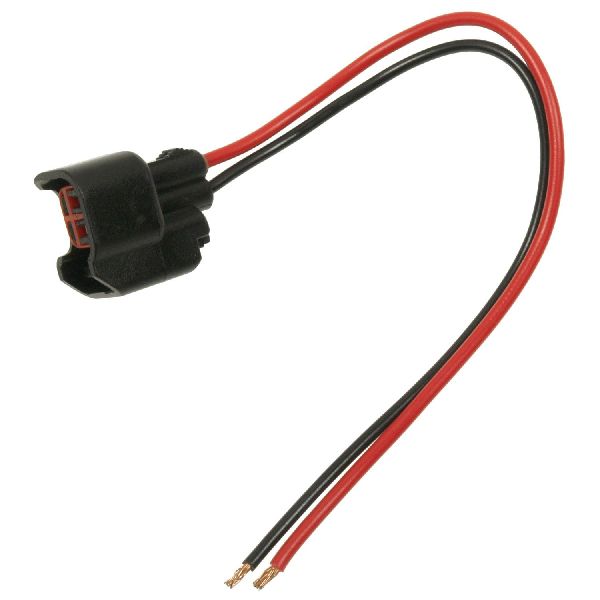
Typical fix: Repair the broken or shorted wire. If the connector is damaged, replace it with a new pigtail connector (Motorcraft WPT-1175 is a common example, but verify application).
Est. part cost: $15-$40 for a pigtail connector.
Rare But Worth Checking
- Faulty Powertrain Control Module (PCM): → Shop Engine Control Module (ECM) This is the least likely cause. The PCM's internal driver for the injector circuit can fail. This should only be considered after thoroughly ruling out the injector and wiring as the cause.
Diagnosis Steps
- Scan for codes and confirm P0201 is present. Note any other codes, especially P0301.
- Perform a visual inspection of the wiring harness and connector for cylinder 1. On the transverse 3.5L EcoBoost, cylinder 1 is on the rear bank (closest to the firewall), on the passenger side. Look for any obvious signs of damage, chafing, or corrosion, paying close attention to where the harness passes A/C lines.
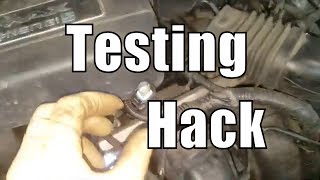
- Disconnect the injector and use a 'noid light' to test for a signal from the PCM while cranking the engine. 🎬 Watch: This simple hack for testing fuel injector circuits. A flashing light indicates the PCM and wiring are likely good, pointing towards a bad injector.
- If the noid light does not flash, use a multimeter to check for 12V power on one pin of the connector and then check the ground signal wire for continuity back to the PCM.
- If the signal is present, test the fuel injector itself. Use a multimeter to measure the resistance across the two pins of the injector. Compare the reading to the manufacturer's specification (typically 1-2 ohms for GDI injectors). An infinite reading (OL) means the injector coil is open and has failed.
- For definitive confirmation, swap the cylinder 1 fuel injector with the cylinder 2 injector. Clear the codes and run the engine. If the code returns as P0202, the fuel injector is confirmed to be the faulty part. If P0201 returns, the problem lies in the wiring or PCM.
Parts You'll Likely Need
- Fuel Injector
(OEM #CM-5248 (2011-2019), CM-5199 (2010))— This is the most common failure point for a P0201 code. The internal electronics of the injector fail over time.
Trusted brands: Motorcraft, Bosch, Standard Motor Products
OEM price range: $115-$130
Aftermarket price range: $50-$90 - Upper Intake Manifold Gasket Set
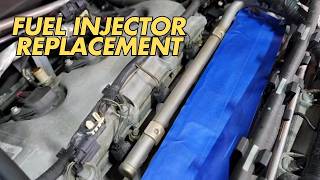
(OEM #Motorcraft CG-901)— The intake manifold must be removed to access the fuel injectors. The gaskets are single-use and must be replaced to prevent vacuum leaks. 🎬 Watch: A complete walkthrough of the Taurus injector replacement process.
Trusted brands: Motorcraft, Fel-Pro, Mahle
OEM price range: $40-$60
Aftermarket price range: $20-$40 - Fuel Injector Connector Pigtail
(OEM #Motorcraft WPT-1175 (Verify application))— If the wiring is damaged at the connector or the locking tab is broken, replacing the pigtail is the standard repair.
Trusted brands: Motorcraft, Dorman
OEM price range: $30-$50
Aftermarket price range: $15-$30
Related Codes That Often Appear With This One
- P0301 — P0301 means 'Cylinder 1 Misfire Detected'. Since the P0201 code indicates the injector circuit for cylinder 1 is not working, no fuel is being delivered, which directly causes a misfire.
- P0300 — This indicates a 'Random Misfire'. It can appear alongside P0201 if the electrical fault in the injector or wiring is intermittent, causing the misfire to be inconsistent before failing completely.
Technical Service Bulletins (TSBs) & Recalls
- While not for the Taurus specifically, Ford TSB 22-2223 for the F-150 with the same 3.5L EcoBoost engine describes a known issue where the engine wiring harness can chafe against an A/C line stud or hose crimp, causing injector circuit faults like P0201. This highlights a potential failure point to inspect closely on the Taurus, as the engine architecture is very similar.
- TSB 25-2569 notes that some vehicles may exhibit an illuminated MIL with DTCs P0301-P0306 and P0201-P0206 due to the engine harness contacting a hose crimp end or spring clamp.
- TSB 16-0163 addresses intermittent MIL illumination with various drivability issues and codes including P0201-P0204, suggesting a pattern of circuit-related faults across similar Ford platforms.
- Searches for TSB 18-234 did not yield specific details linking it to P0201; other TSBs with similar numbers relate to different issues like transmission or exhaust pressure sensor problems.
Platform-Specific Known Issues
- Owner Experience: Intermittent to Hard Fault: An owner on a Ford forum reported their 2013 Taurus SHO began with an intermittent stumble and P0201 code that would occasionally appear and disappear. Over a week, the issue became permanent, with a constant rough idle and a solid check engine light. The diagnosis confirmed a failed #1 injector. The shop advised replacing all six injectors due to the 5 hours of labor required for access, a recommendation the owner followed to prevent future failures.
Mechanic-Grade Diagnostic Values
- Gasoline Direct Injector (GDI) Coil Resistance — expected: 1.0 - 2.0 Ohms. Failure: A reading of infinite resistance (Open Loop) or a value significantly outside the expected range indicates a failed injector coil.
- High-Pressure Fuel System Pressure (Scan Tool) — expected: ~500 PSI while cranking, up to 2,150 PSI at wide-open throttle.. Failure: If the actual pressure reading lags the requested pressure by more than 200 PSI, it can indicate a failing high-pressure fuel pump or a leak.
- Low-Pressure Fuel System Pressure (Scan Tool) — expected: 40 - 60 PSI at idle.. Failure: Pressure below this range indicates a problem with the in-tank fuel pump or its control module.
- Injector Circuit Inductive Kick (Oscilloscope) — expected: A sharp voltage spike to approximately 50-65V immediately after the injector pulse ends.. Failure: The absence of this spike is what the PCM detects to set the P0201 code, indicating an open in the circuit.
- Injector Power Supply Voltage Drop (Multimeter) — expected: Less than 0.5 Volts.. Failure: A drop greater than 0.5V between the battery and the injector's power pin (while running) indicates high resistance from corrosion or a failing wire that a simple continuity test might miss.
Scan Tool Commands That Help
- Ford IDS (or high-end bidirectional scanner): Power Balance Test — To confirm cylinder 1 is not contributing to engine power. The tool disables cylinder 1 and measures the RPM drop; little to no drop confirms the fault is active.
- Ford IDS: Relative Injector Flow Test — This is an advanced test to definitively identify a failing injector. The PCM pulses each injector and measures the corresponding drop in fuel rail pressure, allowing direct comparison of flow rates between cylinders.
- FORScan or Ford IDS: Injector Code Programming (IQA) — This is mandatory after replacing a GDI fuel injector. The new injector's specific flow characteristic code (printed on the injector body) must be written to the PCM to ensure correct fuel metering and prevent performance issues.
Wiring & Ground Locations
- Cylinder 1 Injector Connector — On the fuel injector for the rearmost cylinder on the passenger side (firewall side). Access requires removing the upper intake manifold.. This is the primary point for testing voltage, signal, and resistance for the cylinder 1 injector circuit.
- Main Engine Ground — Typically located on the firewall on the passenger side, where the main engine harness connects.. A poor or corroded main ground can cause a variety of difficult-to-diagnose electrical issues, including intermittent injector circuit faults.
- A/C Line Stud / Hose Crimp — Near the passenger-side valve cover where the engine wiring harness may come into contact with the A/C lines.. This is a known chafe point on the 3.5L EcoBoost platform that can rub through the insulation on the injector wiring, causing a short or open circuit that triggers P0201.
"I Checked Everything" — The Actual Cause
- A common scenario for this electrical code is when a noid light test and resistance test on the injector both pass, yet the code persists intermittently. This often points to a wiring harness issue that only manifests under specific conditions (vibration, heat). The known harness chafing issue near the A/C lines is a prime example; the wire may have continuity when stationary but create an open circuit when the engine torques under load, causing the fault. A wiggle test of the harness while monitoring live data is often required to find such a fault.
OEM Part Supersession History
ba5z9f593a, ba5z9f593b, cm5204→Motorcraft CM-5248— Part consolidation and potential design revisions over the production run.
Heads up: Vehicles built before 8/30/2010 use a different injector, CM-5199. Using the wrong injector can lead to fueling issues.
Model Year Variations Within This Range
- 2010: Early 2010 models (built before 8/30/2010) use a different fuel injector (CM-5199) than later models.
- 2013-2019: The 2013 model year refresh included a power increase for the base 3.5L V6, but the 3.5L EcoBoost power output remained the same. However, the harmonic balancer design changed with the switch to electric power steering around this time.
- 2015+: Models from 2015 onwards began using plastic valve covers instead of aluminum.
- 2017+: Engines from 2017 and later may have an updated block, a different crankshaft ('Raptor crank'), and improved cylinder heads with an extra exhaust manifold stud hole to prevent warping. While a newer engine can often be swapped into an older car, these component differences are important to note for repairs.
Diagnostic Flowchart
Other Known Issues on This Vehicle
Issues unrelated to this code that are worth knowing about as an owner of this generation:
- Internal Water Pump Failure 🔴 High — Often occurs between 80,000 and 150,000 miles. A leak can contaminate the engine oil, leading to catastrophic engine failure if not caught early.
- Power Transfer Unit (PTU) Overheating and Failure 🔴 High — Common on AWD models. The PTU fluid overheats due to proximity to the exhaust, leading to seal and bearing failure. Symptoms include a grinding noise or binding during turns.
- Timing Chain Stretch (Early Models) 🟠 Medium — Primarily affects 2010-2015 models. Causes a distinct rattle on cold startups that lasts for a few seconds. Can lead to P0016 codes and loss of power if not addressed. (Ref: Multiple TSBs issued for F-150, including 14-0194, 16-0027, and 18-2305, address this issue by replacing the chain and VCT phasers.)
- Carbon Buildup on Intake Valves 🟠 Medium — A known side effect of first-generation GDI engines. Over time, carbon deposits can restrict airflow, causing misfires and power loss that can mimic injector symptoms.
- Cracked Turbo Oil Return Line 🟠 Medium — The oil return line from the turbocharger can become brittle and crack, leaking oil onto the hot exhaust, which poses a fire risk.
Used vs. New Parts: Buying Guide for This Vehicle
When a used part is the smart pick: For this repair, using a used part is generally not recommended. The only potential exception would be sourcing a complete, low-mileage engine wiring harness if a section is found to be unrepairable, as this can be more cost-effective than a new harness.
Donor-vehicle mileage cap: roughly under 50000 miles for the part to have meaningful remaining life.
What to inspect on the donor part:
- For a wiring harness, inspect thoroughly for any signs of cuts, abrasions, melting, or previous repairs.
- Ensure all connector locking tabs are intact and pins are straight.
- Avoid parts from vehicles with signs of flood, fire, or major front-end damage.
OEM-only on this vehicle (don't cheap out):
- Fuel Injector: Due to the high-pressure GDI system and the need for precise flow matching, using new OEM (Motorcraft) or reputable high-performance aftermarket injectors is critical. Used or cheap aftermarket injectors are a major gamble and can cause persistent performance issues.
- High-Pressure Fuel Pump: This is another critical, high-wear component where a new OEM part is the safest choice to ensure proper fuel pressure and longevity.
Aftermarket brands forum-validated for this vehicle:
- Bosch (Often the original OEM supplier)
- Standard Motor Products (SMP)
- Xtreme-DI (For high-performance upgrades)
- DeatschWerks (For high-performance upgrades)
Brands owners have reported issues with on this vehicle:
- Unnamed or 'white-box' brands from online marketplaces. These often lack quality control, may not be flow-matched, and can fail prematurely, forcing a repeat of the expensive labor to access them.
Real Owner Stories
Aggregated from forums and TSBs cited above. Mileages and costs reflect what owners reported in those sources.
2013 Ford Taurus SHO 3.5L EcoBoost
Symptoms: The issue began with an intermittent stumble and a P0201 code that would occasionally appear and disappear. Over a week, it became a permanent hard fault with a constant rough idle and a solid check engine light.
What fixed it: Replacement of the #1 fuel injector. Following shop advice, the owner replaced all six injectors simultaneously to avoid future labor costs for the same access procedure.
Source hint: vehicle_specific_issues: Owner Experience: Intermittent to Hard Fault
2012 Ford Taurus SEL 3.5L
Symptoms: P0201 and P0301 engine codes present simultaneously.
What fixed it: Repairing the injector circuit fault which was causing the cylinder 1 misfire.
Source hint: r/MechanicAdvice - 'P0201 and P0301 Engine Code for 2012 Ford Taurus SEL? Is it worth it?'
Ford Taurus 3.5L EcoBoost
Symptoms: Limp mode and codes P0251 & P0201 appearing after a cylinder head replacement.
What fixed it: Diagnostic process focused on the injector circuit voltage signature monitored by the PCM.
Source hint: FordOwnersClub.com - 'Limp Mode with codes P0251 & P0201'
Documented NHTSA Reports
Manufacturer Service Bulletin TSB 25-2569
Symptoms: Illuminated malfunction indicator lamp (MIL) with DTCs P0301-P0306 and P0201-P0206.
What fixed it: This may be due to the engine harness contacting the hose crimp end or spring clamp, requiring inspection and repair of the harness.
NHTSA ODI #10944544
Symptoms: An owner reported that while on the shoulder of the road, the vehicle would turn over but not start, with the check engine light on and codes P0201 and P0202 indicating an open circuit for every injector.
What fixed it: The vehicle required towing for professional diagnosis of the total injector circuit failure.
NHTSA ODI #10405277
Symptoms: The vehicle prompted the driver to pull over immediately. Codes pulled were P0010, P0201, P0202, P0203, and P0204.
What fixed it: The dealer checked the electrical connections and reassembled the components, though the issue recurred shortly after.
NHTSA ODI #11551180
Symptoms: An owner reported a P0301 misfire and P0201 fuel injector fault occurring simultaneously, which led to a collision with a pole.
Related OBD-II Codes
Frequently Asked Questions
Where is the cylinder 1 injector located on my 3.5L EcoBoost Taurus?
Does Ford TSB 22-2223 apply to the P0201 code on my Taurus?
Should I replace just the one faulty injector or all six?
What is the correct resistance for a 3.5L EcoBoost GDI fuel injector?
Is there a specific replacement connector for the cylinder 1 injector?
Does TSB 18-234 provide a fix for the P0201 injector circuit fault?
Helpful Videos
We Have This Part in Stock


The information in this article is provided for general reference and educational purposes only. Vehicle specifications, procedures, and part compatibility can vary by production date, trim level, and region. Always consult your vehicle's factory service manual and verify part numbers before purchasing or performing repairs. Safety-critical components such as airbags, seat belts, and braking systems should be installed by a qualified professional.
- Ford Taurus:
- 🧭 Diagnostic Flowchart
- 🎬 Helpful Videos
- 🛍️ Shop This Part
- What's Unique About the 2010-2019 Ford Taurus
- Symptoms You May Notice
- Most Likely Causes
- Rare But Worth Checking
- Diagnosis Steps
- Parts You'll Likely Need
- Related Codes That Often Appear With This One
- Technical Service Bulletins (TSBs) & Recalls
- Platform-Specific Known Issues
- Mechanic-Grade Diagnostic Values
- Scan Tool Commands That Help
- Wiring & Ground Locations
- "I Checked Everything" — The Actual Cause
- OEM Part Supersession History
- Model Year Variations Within This Range
- Other Known Issues on This Vehicle
- Used vs. New Parts: Buying Guide for This Vehicle
- Real Owner Stories
- 2013 Ford Taurus SHO 3.5L EcoBoost
- 2012 Ford Taurus SEL 3.5L
- Ford Taurus 3.5L EcoBoost
- Documented NHTSA Reports
- Manufacturer Service Bulletin TSB 25-2569
- NHTSA ODI #10944544
- NHTSA ODI #10405277
- NHTSA ODI #11551180
- Related OBD-II Codes
- Frequently Asked Questions
- 🎟️ Get 5% Off