

P0201 on 2014-2016 Mazda MAZDA6: Injector Circuit Malfunction Causes and Fixes
On a 2014-2016 Mazda6, code P0201 often points to an internal PCM failure, not a bad fuel injector. A Mazda Technical Service Bulletin (TSB) notes that P0201 frequently appears with P0204. If you see this combination, the likely fix is replacing the PCM, specifically on models with a DENSO-produced unit.
- For a 2014-2016 Mazda6, P0201 is not a straightforward diagnosis. Always check if code P0204 is also present.
- If P0201 and P0204 are stored together, the most likely cause is a failed PCM, as per Mazda's own service bulletins.
- If P0201 appears alone, follow standard diagnostic procedures: check the injector wiring, connector, and the injector's resistance before condemning the PCM.
- Driving with this code can lead to a rough running engine and may cause expensive damage to the catalytic converter over time.
What's Unique About the 2014-2016 Mazda MAZDA6
While P0201 commonly points to a failed injector or wiring on many vehicles, the 2014-2016 Mazda6 has a well-documented, specific issue. Mazda issued a Technical Service Bulletin (TSB 01-017/16, later superseded by 01-004/17) indicating that P0201 often appears paired with P0204 (or P0202 with P0203), along with misfire codes. This specific combination is frequently caused by an internal failure of the DENSO-produced PCM, rather than a problem with the injectors or wiring harness. Diagnosing this pattern correctly can save significant time and money by pointing directly to the likely faulty component.
Diagnostic Flowchart
Tap your situation to follow the diagnostic path that matches what you're seeing on this vehicle.
Symptoms You May Notice
- Check Engine Light is on
- Rough or shaking engine idle
- Engine misfires, sometimes causing a flashing Check Engine Light
- Hesitation or stumbling during acceleration
- Reduced engine power
- Poor fuel economy
- Hard starting or stalling
- Replacing the fuel injector when the actual cause is the PCM. This is a common mistake on this specific vehicle due to the known TSB. If codes P0201 and P0204 are present together, suspect the PCM first.
Most Likely Causes
- Internal PCM Failure (DENSO units) 🔴 High Probability As identified in Mazda TSB #01-004-17 and #01-017/16, certain DENSO-produced PCMs are prone to an internal failure that specifically causes paired injector circuit codes (P0201/P0204 or P0202/P0203). This issue affects 2014-2016 Mazda6 models produced before May 23, 2016.
How to confirm: Scan for codes and confirm the presence of both P0201 and P0204 simultaneously, often with corresponding misfire codes (P0301, P0304). Visually inspect the PCM label to see if it is a DENSO-branded unit. The TSB instructs technicians to check a 4-digit code on the label. If both conditions are met, the PCM is the most likely cause.
Typical fix: Replace the Powertrain Control Module (PCM). The new or remanufactured PCM will need to be programmed to the vehicle's VIN. The TSB states that the internal failure in the PCM was eliminated in later production.
Est. part cost: $400-$800 - Faulty Fuel Injector 🟡 Medium Probability → Shop Fuel Injector Skyactiv-G direct injection engines can be susceptible to carbon buildup, and injectors can fail electrically over time.
How to confirm: Using a multimeter, measure the resistance of the fuel injector. The specific resistance for a Skyactiv-G injector is between 1.74–2.04 ohms at 20°C (68°F). 🎬 See how to test injector resistance with a multimeter. A reading of 0 (short) or OL (open) indicates a faulty injector. A definitive test is to swap the cylinder 1 injector with another cylinder (e.g., cylinder 2). Clear the codes and drive the vehicle. If the code changes to P0202, the injector is faulty.
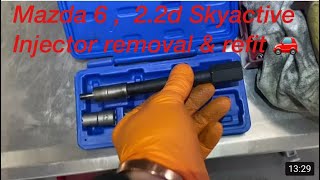
Typical fix: Replace the faulty fuel injector for cylinder 1. It is often recommended to replace all four injectors at the same time 🎬 Watch: Step-by-step Mazda 6 injector removal and refit guide. for balanced performance.
Est. part cost: $70-$150 - Wiring or Connector Issue 🟡 Medium Probability Engine harnesses can be subject to heat and vibration, which can cause wires to break, chafe, or for pins in the connector to become corroded or loose over time.
How to confirm: Visually inspect the wiring harness and connector going to the cylinder 1 fuel injector for any signs of damage, corrosion, or loose pins. Use a multimeter to check for continuity between the PCM connector (Terminal 1EE) and the injector connector (Terminal B) to rule out an open or shorted wire. A 'wiggle test' on the harness while the engine is running can sometimes reveal an intermittent connection.
Typical fix: Repair the damaged section of the wiring harness or replace the injector pigtail connector.
Est. part cost: $15-$50
Rare But Worth Checking
- Blown Fuse or Faulty Relay: The fuel injectors are often powered by a shared fuse or relay. While less common for a single injector code, it's a quick and easy check that can save a lot of diagnostic time. A user on a forum with multiple injector codes found the issue was a loose fuse.
Diagnosis Steps
- Scan the vehicle for all stored trouble codes. Pay close attention to see if P0201 is paired with P0204 (or if P0202 is with P0203).
- If P0201 and P0204 are present, locate the PCM and check if it is a DENSO unit. If so, the PCM is the most likely culprit per TSB #01-017/16 and #01-004/17. Proceed with PCM replacement.
- If only P0201 is present, begin by visually inspecting the wiring harness and connector for the cylinder 1 fuel injector. Look for any signs of melting, chafing, corrosion, or pulled-out pins.
- Disconnect the injector and use a 'noid' light to verify that the PCM is sending a pulse signal to the connector while the engine is cranked or running. If the light flashes, the PCM driver and wiring are likely good.
- If there is a pulse, the wiring is likely okay. Turn the engine off and use a multimeter to measure the internal resistance of the fuel injector. It should be within the manufacturer's specified range of 1.74-2.04 ohms. If the resistance is out of spec or shows an open circuit (OL), the fuel injector is bad.
- As a final confirmation for a bad injector, swap the cylinder 1 injector with the cylinder 2 injector. Clear the codes, run the engine, and see if the fault code changes to P0202. If it does, the injector is confirmed faulty.
- If the noid light did not flash in step 4, use a multimeter to check for battery voltage on one pin of the injector connector (with key on) and check for continuity on the other wire (the driver circuit) back to the PCM connector, specifically terminal 1EE.
- If all wiring and the injector test good, but there is no pulse from the PCM, the fault lies within the PCM's injector driver circuit, and the PCM will need to be repaired or replaced.
Parts You'll Likely Need
- Powertrain Control Module (PCM)
(OEM #PE20-18-881R (example, part varies by VIN))— This is the most likely cause if P0201 is present with P0204, as documented in Mazda TSBs for this vehicle range. The TSB notes to order the latest part number applicable to the vehicle's VIN.
Trusted brands: Mazda (OEM), Cardone (Remanufactured), Flagship One (Remanufactured)
OEM price range: $700-$900
Aftermarket price range: $400-$600 - Fuel Injector
(OEM #PY01-13-250 (for 2.5L engine))— If the injector itself has an internal electrical failure (open or shorted coil), it will need to be replaced. This is a common cause if P0201 appears by itself. The OEM part number for the 2.5L engine is PY01-13-250.
Trusted brands: Mazda (OEM), Bosch, Hitachi, GP Sorensen
OEM price range: $150-$250
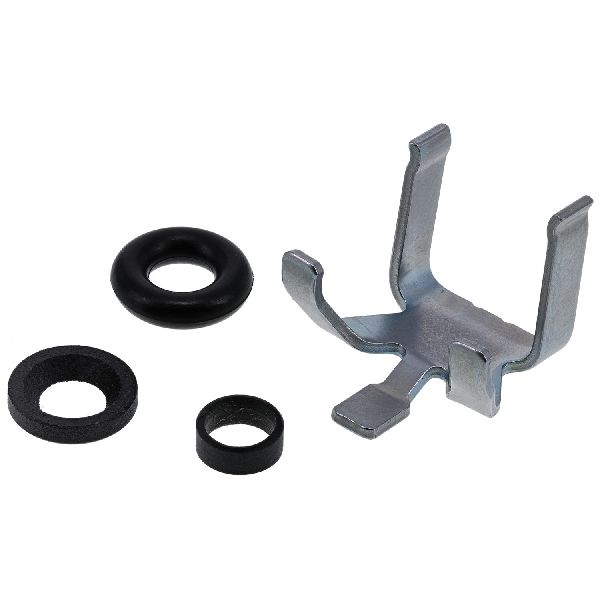
Aftermarket price range: $70-$150 - Fuel Injector Connector Pigtail — If the connector or wiring right at the injector is damaged or corroded, replacing the pigtail is the standard repair.
Trusted brands: Dorman, Standard Motor Products
OEM price range: $30-$50
Aftermarket price range: $15-$30
Related Codes That Often Appear With This One
- P0204 — According to Mazda TSBs 01-017/16 and 01-004/17, an internal PCM fault often causes these two codes to appear together as a pair.
- P0301 — This is the code for 'Cylinder 1 Misfire Detected'. Since P0201 indicates a problem with the fuel injector circuit for cylinder 1, that cylinder isn't getting the right amount of fuel, which directly causes a misfire. The TSBs confirm that misfire codes are usually stored at the same time.
- P0304 — This code for 'Cylinder 4 Misfire Detected' will often accompany P0301 when the root cause is the specific PCM failure outlined in the TSB, as both injector circuits are affected.
- P0300 — This code for 'Random/Multiple Cylinder Misfire Detected' can appear if the injector issue is intermittent or if the PCM is failing in a way that affects multiple cylinders.
Technical Service Bulletins (TSBs) & Recalls
- 01-004-17: "MULTI-MODEL - ENGINE RUNS ROUGH AND CHECK ENGINE LIGHT ON WITH DTCS P0201 AND P0204 OR P0202 AND P0203". This bulletin supersedes 01-017/16 and confirms the cause is an internal failure of the DENSO-produced PCM.
- 01-017/16: Original bulletin describing the same PCM failure issue on 2014-16 Mazda6 and other models, specifying VIN ranges and production dates.
Platform-Specific Known Issues
- A known issue, documented in Mazda TSB #01-004-17 and its predecessor #01-017/16, points to an internal failure in DENSO-produced PCMs. This failure causes injector circuit codes to be stored in pairs (P0201 with P0204, or P0202 with P0203) and is often accompanied by misfire codes. The repair is to replace the PCM. The TSB applies to Japan-built Mazda6 vehicles with VINs lower than JM1GJ**484154, produced before May 23, 2016.
Mechanic-Grade Diagnostic Values
- Fuel Injector Coil Resistance — expected: 1.74 - 2.04 Ohms at 20°C (68°F). Failure: A reading of 0 ohms (shorted) or OL/infinity (open) on a multimeter.
- High-Pressure Fuel System Pressure — expected: Up to 200 bar (2900 psi). Failure: Significantly lower pressure readings may indicate a problem with the high-pressure fuel pump, though this would likely trigger other codes.
- Injector Circuit Power Supply — expected: Battery voltage (approx. 12V) at one terminal of the injector connector with key on, engine off.. Failure: No voltage indicates a problem in the power supply circuit, possibly a fuse or relay.
Hidden / Shadow Codes Worth Checking
- P0201:00: This is a Mazda-specific sub-type code. The ':00' indicates the PCM did not detect the expected injection verification signal during the fuel injector's operation. (see via Most professional scan tools and some advanced consumer tools like FORScan will display this two-digit failure-type code along with the main DTC.)
Scan Tool Commands That Help
- FORScan: Injector Buzz Test — This bidirectional test commands the PCM to cycle each injector individually, creating an audible 'buzz' or 'click'. It helps verify that the injector's coil and pintle are mechanically functioning when commanded by the PCM. A silent injector points to a failure in the injector itself or the wiring to it.
- Mazda IDS (or advanced equivalent like Autel): Active Test / Power Balance — This function allows a technician to disable one injector at a time while the engine is idling. If disabling an injector causes a significant drop in RPM, it's working. If disabling the cylinder 1 injector causes no change in how the engine runs, it confirms that cylinder was not contributing, strengthening the diagnosis of a fault in that circuit.
- Mazda IDS: Fuel Injector Correction Factors — While more critical on diesel engines, this function is used after replacing an injector to program its specific calibration code into the PCM. This ensures the PCM can precisely control the new injector for optimal fuel delivery and engine stability.
Wiring & Ground Locations
- PCM Terminal 1EE — At the Powertrain Control Module connector.. This is the specific terminal for the cylinder 1 fuel injector control (driver) circuit. A technician can perform a continuity test from this pin to Terminal B at the injector connector to confirm the integrity of the control wire.
- Fuel Injector No. 1 Terminal B — At the fuel injector connector for cylinder 1.. This is the control wire terminal at the injector. Testing from here back to the PCM (Terminal 1EE) is the definitive way to check for an open or short in the control circuit wiring.
Real Owner Repair Stories
- Mazdas247 Forum User (Mazda CX-9 (uses a similar engine family)) — Check engine light on, loss of power, codes P0204 and P0304.
❌ Tried (didn't work) Initial diagnosis pointed to a potential PCM issue based on some online research.
✅ What actually fixed it The user tested the resistance of the #4 fuel injector and found it read 0 ohms (a dead short). The other injectors tested within a normal range (12.3-12.6 ohms on this specific engine). Replacing only the faulty fuel injector resolved the codes and symptoms. This highlights that when the TSB-specific P0201/P0204 pair is NOT present, the injector itself is a very likely culprit.
When the Usual Fixes Don't Work
- While the Mazda TSB is highly authoritative for the paired codes P0201/P0204 pointing to a PCM failure, it's crucial to note this applies primarily when they appear *together*. Real-world owner reports confirm that if only a single code like P0201 is present, the diagnostic path should revert to traditional methods. In these cases, a faulty fuel injector or a wiring issue is the more probable cause, and replacing the PCM would be an unnecessary expense.
OEM Part Supersession History
Varies by VIN (e.g., PE20-18-881*, PY1J-18-881*)→Same Part Number— The TSBs explicitly state that the PCM part numbers were not changed for this fix. The correction was an internal manufacturing process change to eliminate the failure mode in newly produced units.
Heads up: It is critical to order the latest applicable part number for the vehicle's VIN from Mazda parts catalog (GEPC). Simply finding a used PCM with the same part number from an older vehicle will likely have the same defect.
Model Year Variations Within This Range
- 2014-2016: The known PCM failure documented in TSB 01-004-17 applies specifically to Japan-built Mazda6 vehicles with VINs lower than JM1GJ**484154, which were produced before May 23, 2016. Vehicles produced after this date or with higher VINs have a PCM where the internal failure has been eliminated.
Helpful Videos
We Have This Part in Stock


The information in this article is provided for general reference and educational purposes only. Vehicle specifications, procedures, and part compatibility can vary by production date, trim level, and region. Always consult your vehicle's factory service manual and verify part numbers before purchasing or performing repairs. Safety-critical components such as airbags, seat belts, and braking systems should be installed by a qualified professional.
- Mazda MAZDA6:
- 🧭 Diagnostic Flowchart
- 🎬 Helpful Videos
- 🛍️ Shop This Part
- What's Unique About the 2014-2016 Mazda MAZDA6
- Symptoms You May Notice
- Most Likely Causes
- Rare But Worth Checking
- Diagnosis Steps
- Parts You'll Likely Need
- Related Codes That Often Appear With This One
- Technical Service Bulletins (TSBs) & Recalls
- Platform-Specific Known Issues
- Mechanic-Grade Diagnostic Values
- Hidden / Shadow Codes Worth Checking
- Scan Tool Commands That Help
- Wiring & Ground Locations
- Real Owner Repair Stories
- When the Usual Fixes Don't Work
- OEM Part Supersession History
- Model Year Variations Within This Range
- 🎟️ Get 5% Off