

P0201 on 2008-2017 Mitsubishi Lancer: Injector Circuit Malfunction Causes and Fixes
P0201 on a 2008-2017 Lancer indicates an electrical fault with the cylinder 1 fuel injector. The most common cause is a failed fuel injector itself, followed by wiring issues. A DIY replacement can cost around $40-$120 for the part, while a shop repair may range from $150 to $300.
- P0201 on a 2008-2017 Lancer points directly to an electrical issue with the cylinder 1 fuel injector circuit.
- The most likely culprit is the fuel injector itself failing internally.
- A simple way to confirm a bad injector is to swap it with one from another cylinder and see if the trouble code follows it.
- Before replacing parts, always perform a quick visual inspection of the injector's wiring and connector for any obvious damage.
- Driving with this code can lead to more expensive repairs, such as a damaged catalytic converter, so it should be addressed promptly.
What's Unique About the 2008-2017 Mitsubishi Lancer
For the 2008-2017 Lancer generation (with engines like the 4B11 and 4B12), the P0201 code is a straightforward electrical fault. 🎬 Watch: How to diagnose and fix a P0201 code Unlike some earlier performance models (like the Lancer Evolution 8/9 which used low-impedance injectors), these non-turbo Lancers use high-impedance fuel injectors and do not have a separate injector resistor pack, which simplifies diagnosis. The problem is almost always located at the injector, its connector, or the wiring leading to it.
Symptoms You May Notice
- Check Engine Light is on
- Rough or unstable idle
- Engine misfire (may feel like a shake or stumble)
- Poor acceleration and loss of power
- Reduced fuel economy
- Engine may stall in some cases
- A smell of raw fuel from the exhaust
- Replacing the spark plug or ignition coil for cylinder 1. While these can cause a misfire (P0301), they will not cause an injector circuit code like P0201.
Most Likely Causes
- Faulty Cylinder 1 Fuel Injector 🔴 High Probability → Shop Fuel Injector The internal coil windings of the injector can fail over time due to heat cycles and age, leading to an open or shorted circuit.
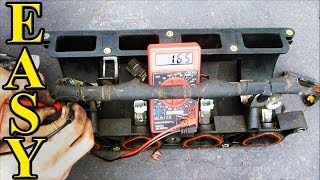
How to confirm: Swap the cylinder 1 injector with another cylinder (e.g., cylinder 2). Clear the codes and drive the vehicle. If the code changes to P0202, the injector is faulty. Alternatively, use a multimeter to check the resistance of the injector. It should be within the manufacturer's specified range, typically around 13-16 Ohms for these models. 🎬 See how to test injector resistance with a multimeter Compare the reading to the other injectors; a reading of infinite resistance (open) or near-zero (short) indicates a bad injector.
Typical fix: Replace the failed fuel injector. It's good practice, especially on higher mileage vehicles, to replace all four injectors as a set to ensure balanced fuel delivery and prevent future failures.
Est. part cost: $40-$140 - Wiring or Connector Issue 🟡 Medium Probability The plastic injector connector and its locking clip can become brittle from engine heat and age, potentially leading to a loose connection or breaking during service. Wires can also chafe or corrode.
How to confirm: Visually inspect the wiring harness and connector for cylinder 1's injector. Look for any signs of damage, corrosion, loose pins, or frayed wires. Use a 'noid light' to test for a pulse signal at the injector connector while cranking the engine. A flashing light indicates the ECM is sending a signal; no light or a steady light points to a wiring or ECM issue. Wiggle the connector and harness with the engine running to see if it causes the misfire to change, indicating a loose connection.
Typical fix: Repair the damaged section of wiring or replace the pigtail connector for the fuel injector.
Est. part cost: $10-$30
Rare But Worth Checking
- Failed Powertrain Control Module (PCM): → Shop Engine Control Module (ECM) This is the least likely cause. The PCM's internal driver transistor for the injector can fail, but all other possibilities should be exhausted before condemning the PCM. This usually requires professional diagnosis and replacement often requires programming the new unit to the vehicle.
Diagnosis Steps
- Scan for Codes: Use an OBD-II scanner to confirm P0201 is the primary code. Note any other codes, such as P0301.
- Visual Inspection: Inspect the fuel injector #1 connector and its wiring harness. Cylinder 1 is on the far left (passenger side in US) of the engine. Look for obvious damage, corrosion, or loose connections. Ensure the connector clip is fully seated.
- Test Injector Resistance: Disconnect the injector and use a multimeter set to Ohms to measure the resistance across its two pins. A typical reading for these injectors is between 13 and 16 Ohms. An open circuit (infinite resistance) or a short (zero resistance) means the injector is bad.
- Check for Signal with a Noid Light: Disconnect the injector and plug a noid light into the connector. Crank the engine. A rhythmic flashing light confirms the PCM is sending the signal to fire the injector. If there's no flash or a steady light, there is a problem with the wiring or the PCM.
- Swap Injectors: If the resistance test is inconclusive, swap the cylinder 1 injector with an adjacent one (e.g., cylinder 2). This is the most definitive DIY test. Clear the codes and run the engine. If the fault code moves to the new cylinder (P0202), the injector is the confirmed problem.
- Check Wiring Integrity: If the code remains P0201 after swapping injectors, the issue is in the wiring or the PCM. Check for power (12V) at one pin of the injector connector with the key on. Then, check for continuity on the signal (ground pulse) wire between the injector connector and the PCM connector.
Parts You'll Likely Need
- Fuel Injector
(OEM #1465A029)— This is the most common failure point for a P0201 code, where the internal coil of the injector fails.
Trusted brands: Mitsubishi Genuine, Denso, Hitachi, GB Remanufacturing, Standard Motor Products
OEM price range: $150-$200
Aftermarket price range: $40-$120 - Fuel Injector Connector Pigtail — The plastic connector or its wiring can become brittle and fail, causing an open or short in the circuit. The locking tab is especially prone to breaking.
Trusted brands: Standard Motor Products, Dorman, ACDelco
Aftermarket price range: $10-$30
Related Codes That Often Appear With This One
- P0301 — This code means 'Cylinder 1 Misfire Detected'. Since P0201 indicates the injector for cylinder 1 isn't working, that cylinder cannot combust properly, which the computer then registers as a misfire.
Platform-Specific Known Issues
- A user on the MitsubishiForum detailed a frustrating P0201 case where a brand new aftermarket injector was also faulty out of the box. After swapping the new injector to another cylinder confirmed the issue, a second replacement part solved the problem. This highlights the importance of using the 'swap test' even with new parts.
- On EvolutionM forums, a user with a similar engine experienced a P0201 code that persisted after replacing the injector. The cause was ultimately traced to a poor connection at the injector wiring harness clip, which had been slightly damaged during the initial replacement. Re-seating the connector firmly resolved the code.
Mechanic-Grade Diagnostic Values
- Fuel Injector Coil Resistance — expected: 13 to 16 Ohms. Failure: A reading of infinity (OL) indicates an open circuit, while a reading near zero indicates a shorted coil.
- Injector Connector Power Supply Voltage (Key On, Engine Off) — expected: Battery positive voltage (approx. 12V). Failure: Voltage below 10V or no voltage indicates a problem with the power supply from the injector relay or MFI relay.
- Injector Driver Circuit Current Draw (via Scan Tool) — expected: Normal operating range (not specified, but should be consistent across cylinders). Failure: The ECM will set P0201 if the coil current is 4.5 amperes or more while the injector is being driven.
Scan Tool Commands That Help
- Mitsubishi M.U.T.-III (MB991958): Actuator Test - Item 1: No. 1 Injector — This command allows a technician to manually fire the cylinder 1 injector while the engine is idling. A successful test will cause the idle to become slightly rougher, confirming the ECM driver and wiring are capable of activating the injector. If the idle does not change, it points to a fault in the circuit or the injector itself.
- Mitsubishi M.U.T.-III (MB991958): Injector Coding/Learning — While not typically required for standard, non-GDI Lancers when replacing an injector with an identical part, this function is available in the MUT-III software and is critical for vehicles with more advanced fuel systems to ensure the ECU knows the precise flow characteristics of the new injector.
Wiring & Ground Locations
- B-101 — The electrical connector directly on the No. 1 cylinder fuel injector.. This is the primary point for testing voltage, signal, and injector resistance. Terminal 1 is the power supply from the injector relay, and the other terminal is the ground pulse signal from the ECM.
- A-21X — The harness connector for the injector relay, likely in the underhood fuse/relay box.. A poor connection here can cut power to the injector. The service manual specifies checking for damage at this connector and testing continuity between terminal 3 of this connector and terminal 1 of the injector connector (B-101).
- G18 — A body ground point located in the left front of the engine compartment.. While the injector is controlled by a switched ground from the ECM, the ECM itself relies on clean body grounds. A corroded or loose main engine ground can cause a variety of electrical issues, including erratic sensor and actuator behavior.
- Engine Control Module (ECM) — Located in the left rear of the engine compartment.. The ground pulse signal wire for the cylinder 1 injector runs directly from the injector connector to a specific pin on the ECM. Verifying continuity on this wire is the final step before suspecting a faulty ECM driver.
Real Owner Repair Stories
- EvolutionM Forum User (2003 Mitsubishi Lancer Evolution (Note: This is an older model but the diagnostic principle for the P0201 code is similar, and this highlights a component not present on the 2008-2017 non-turbo models)) — Bad misfire on cylinder 1, OBD-II code P0201.
❌ Tried (didn't work) Swapped fuel injectors, Swapped the ECU with a known-good unit
✅ What actually fixed it The injector resistor pack mounted to the firewall had a rusted and broken lead for the cylinder 1 injector. Replacing the resistor pack resolved the issue.
OEM Part Supersession History
1465A029→N/A— This is the primary OEM part number for this generation.
Heads up: According to parts diagrams, this part number is specified for Lancers built up to 10/31/2015. Later 2016 and 2017 models may use a different part number (e.g., 1465A412), and using the wrong one could lead to incorrect fuel trims. Always verify the part number with the vehicle's VIN.
Diagnostic Flowchart
Other Known Issues on This Vehicle
Issues unrelated to this code that are worth knowing about as an owner of this generation:
- CVT Transmission Failure 🔴 High — Can occur as early as 60,000-80,000 miles. Symptoms include whining, jerking, hesitation, and 'Slow Down' warnings. Regular fluid changes (every 30,000 miles) are critical for longevity. (Ref: Multiple TSBs exist regarding CVT fluid levels and diagnostic procedures.)
- Clear Coat / Paint Peeling 🟡 Low — Very common, especially on darker colors and cars exposed to high UV levels. Peeling often starts on the roof, trunk, and hood after 5-10 years.
- ETACS-ECU Failure 🟠 Medium — A known weak point, causing bizarre electrical issues like non-functional headlights, wipers, and interior lights. Most common on 2009-2010 models. (Ref: Safety Recall NHTSA 14V569000 (Mitsubishi SR-15-002) was issued for 2009-2010 models for this issue.)
- Engine Stalling 🟠 Medium — Some owners report intermittent stalling when coming to a stop or at idle, which can be difficult to diagnose. Often linked to a faulty MAP sensor or a dirty throttle body.
- Blower Motor Resistor Failure 🟡 Low — Common failure causing the HVAC fan to only work on the highest setting or not at all. The part is inexpensive and relatively easy to replace.
Used vs. New Parts: Buying Guide for This Vehicle
When a used part is the smart pick: A used OEM fuel injector from a reputable salvage yard is a reasonable choice for this repair, especially if on a tight budget. Since it's an external electronic and mechanical part, its failure is not typically tied to a gradual wear pattern that would make a new part essential. It's a good way to get a genuine Denso or Mitsubishi part for less than a new aftermarket one.
Donor-vehicle mileage cap: roughly under 80000 miles for the part to have meaningful remaining life.
What to inspect on the donor part:
- Check the plastic connector for any cracks or brittleness.
- Ensure the pintle (nozzle) end is clean and free of heavy carbon buildup or rust.
- Look for intact, pliable O-rings (though it's always recommended to install new O-rings regardless).
- If possible, ask the seller to test the resistance with a multimeter before purchase to ensure it's within the 13-16 Ohm range.
OEM-only on this vehicle (don't cheap out):
- Powertrain Control Module (PCM/ECM) - Due to the need for VIN-specific programming, a used PCM is difficult to implement without specialized tools and knowledge.
Aftermarket brands forum-validated for this vehicle:
- Denso (often the original OEM supplier)
- Hitachi
- Standard Motor Products (SMP)
- GB Remanufacturing (for remanufactured units)
Brands owners have reported issues with on this vehicle:
- Unbranded, no-name injectors from online marketplaces can be poorly manufactured, have inconsistent flow rates, and may fail prematurely, as highlighted in some forum discussions.
Real Owner Stories
Aggregated from forums and TSBs cited above. Mileages and costs reflect what owners reported in those sources.
2008-2017 Mitsubishi Lancer
Symptoms: P0201 code persisted even after installing a brand new aftermarket injector.
What fixed it: A second replacement injector was installed after a swap test confirmed the first new aftermarket part was faulty out of the box.
Source hint: MitsubishiForum user detail mentioned in vehicle_specific_issues
Mitsubishi Lancer Evolution (4B11 engine)
Symptoms: P0201 code remained active after the fuel injector was replaced.
What fixed it: Re-seating the injector wiring harness clip firmly; the connection was poor due to slight damage during the initial repair.
Source hint: EvolutionM forums user report mentioned in vehicle_specific_issues
Related OBD-II Codes
Frequently Asked Questions
Where is cylinder 1 located on my Mitsubishi Lancer engine?
Is there a recall for electrical issues that might affect my 2009-2010 Lancer's fuel system?
What is the correct resistance for a replacement fuel injector on this vehicle?
Should I buy a new or used fuel injector to fix the P0201 code?
Can I just replace the one faulty injector, or do I need to replace all four?
I replaced the injector but the P0201 code is still there. What else should I check?
Helpful Videos

We Have This Part in Stock


The information in this article is provided for general reference and educational purposes only. Vehicle specifications, procedures, and part compatibility can vary by production date, trim level, and region. Always consult your vehicle's factory service manual and verify part numbers before purchasing or performing repairs. Safety-critical components such as airbags, seat belts, and braking systems should be installed by a qualified professional.
- Mitsubishi Lancer:
- 🧭 Diagnostic Flowchart
- 🎬 Helpful Videos
- 🛍️ Shop This Part
- What's Unique About the 2008-2017 Mitsubishi Lancer
- Symptoms You May Notice
- Most Likely Causes
- Rare But Worth Checking
- Diagnosis Steps
- Parts You'll Likely Need
- Related Codes That Often Appear With This One
- Platform-Specific Known Issues
- Mechanic-Grade Diagnostic Values
- Scan Tool Commands That Help
- Wiring & Ground Locations
- Real Owner Repair Stories
- OEM Part Supersession History
- Other Known Issues on This Vehicle
- Used vs. New Parts: Buying Guide for This Vehicle
- Real Owner Stories
- 2008-2017 Mitsubishi Lancer
- Mitsubishi Lancer Evolution (4B11 engine)
- Related OBD-II Codes
- Frequently Asked Questions
- 🎟️ Get 5% Off