

P0202 on 1995-1999 Dodge Ram Wagon: Injector Circuit Causes and Fixes
P0202 indicates an electrical fault with the cylinder 2 fuel injector. On these Dodge Magnum engines, before replacing the injector, inspect the wiring harness where it passes through the valve cover gasket. A TSB confirms this harness is a common failure point and is often the real cause of the code.
- P0202 on a 1995-1999 Ram Wagon points to an electrical issue with the cylinder 2 injector.
- Before you buy a new fuel injector, you MUST inspect the wiring harness that runs through the valve cover gasket, as this is a known failure point according to a manufacturer TSB.
- A simple 'noid light' test can quickly tell you if the injector is receiving a pulse signal from the computer.
- This code will cause a noticeable misfire and rough running.
- The same issue is common on Dodge Ram pickups, Dakotas, and Jeep Grand Cherokees with Magnum engines from the same era.
What's Unique About the 1995-1999 Dodge RAM WAGON
The Dodge Ram Wagon from this era uses Magnum series engines (3.9L V6, 5.2L V8, and 5.9L V8). A well-documented issue, highlighted by a manufacturer Technical Service Bulletin (TSB), points to the wiring loom that passes through the valve cover gasket as a common point of failure. This design can lead to broken or shorted wires due to engine heat and vibration, which mimics a failed injector and sets codes like P0202. Owners often mistakenly replace the injector when the true fault lies in this specific part of the harness. This issue is also common on platform mates like the Dodge Ram pickup, Dakota, and Jeep Grand Cherokee (ZJ) with the same Magnum engines.
Diagnostic Flowchart
Tap your situation to follow the diagnostic path that matches what you're seeing on this vehicle.
Symptoms You May Notice
- Check Engine Light is on
- Rough or unstable idle
- Engine misfiring, which may feel like a stumble or hesitation
- Reduced engine performance and poor acceleration
- Decreased fuel economy
- Engine stalling
- Replacing the fuel injector without first inspecting the wiring harness inside the valve cover gasket, as recommended by TSB #9002688.
Most Likely Causes
- Faulty Wiring Loom in Valve Cover Gasket 🔴 High Probability → Shop Engine Valve Cover As cited in TSB #9002688, the wiring harness that passes through the valve cover gasket area is a known weak point that can become open or shorted due to heat and vibration, causing injector circuit codes. This TSB explicitly advises checking this component before replacing injectors for P0201-P0206 codes.
How to confirm: Visually inspect the wiring harness where it connects to and passes through the valve cover. Check for continuity on the injector #2 wires through this harness section using a multimeter. A resistance reading of less than 10 Ohms is expected on a good circuit.
Typical fix: Replace the valve cover gasket and integrated wiring loom assembly. 🎬 Watch this step-by-step guide to replacing the valve cover gasket. Aftermarket brands like Fel-Pro and Mahle offer replacements.
Est. part cost: $50-$150 - Failed Fuel Injector #2 🟡 Medium Probability → Shop Fuel Injector
How to confirm: Check the injector's internal resistance with a multimeter. 🎬 See how to check fuel injector resistance with a multimeter. For 1993-1998 5.2L/5.9L engines, it should be 13.3-15.7 Ohms; for 1998-2000, it's 10.8-13.2 Ohms. An open circuit (infinite resistance) or a reading far out of spec indicates failure. You can also swap the injector with another cylinder (e.g., #4) and see if the code changes to P0204.
Typical fix: Replace the faulty fuel injector. The OEM part number has been updated to 53030778AB.
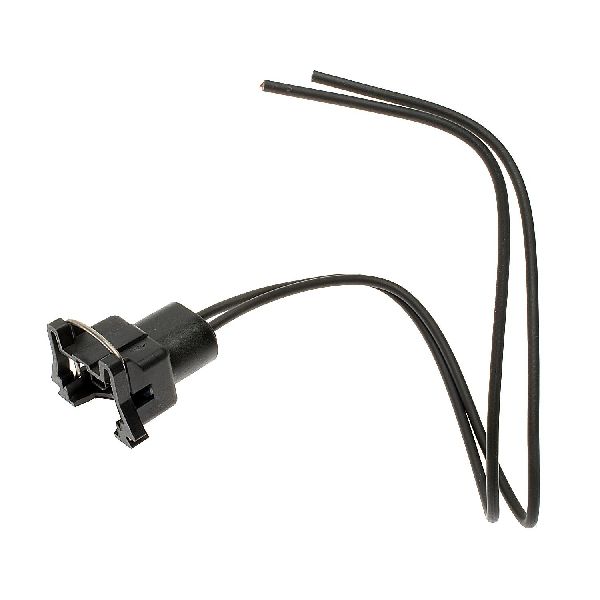
Est. part cost: $40-$90 - Damaged Wiring or Connector ⚪ Low Probability Wiring can become brittle and connectors can get corroded over time. The injector pigtail itself is a common point of failure.
How to confirm: Visually inspect the external wiring harness and the connector at the fuel injector for breaks, corrosion, or loose pins. Use a noid light to confirm if a pulse signal is reaching the injector connector. If the noid light flashes, the control circuit is likely good.
Typical fix: Repair the damaged section of wire or replace the pigtail connector.
Est. part cost: $10-$30 - Faulty Powertrain Control Module (PCM) ⚪ Low Probability → Shop Engine Control Module (ECM) While rare, the internal driver circuit for the injector can fail within the PCM. This is more common in older vehicles after experiencing voltage spikes or shorts in the wiring.
How to confirm: This is a last resort. All other possibilities (wiring, injector) must be definitively ruled out first. A professional may need to test the injector driver circuit within the PCM. A diagnostic procedure involves checking for shorts to ground or voltage on the driver circuit pin at the PCM connector.
Typical fix: Replace and reprogram the PCM.
Est. part cost: $200-$500
Diagnosis Steps
- Scan for Codes: Use an OBD-II scanner to confirm P0202 is present and check for other codes, like P0302.
- Check for Pulse: Disconnect the electrical connector from the #2 fuel injector. Use a 'noid light' to check for a flashing signal while the engine is cranked or running. If the light flashes, the wiring and PCM are likely okay, and the injector is the problem. If it does not flash, the problem is in the wiring or PCM.
- Inspect External Wiring: Visually inspect the injector's pigtail connector and the surrounding harness for any signs of damage, corrosion, or loose connections.
- Follow the TSB: Heed TSB #9002688. Carefully inspect the wiring loom where it passes through the valve cover gasket. This is a very common failure point on Magnum engines. Check continuity through this harness.
- Test the Injector: If wiring appears good, turn the ignition off and disconnect the injector. Use a multimeter set to Ohms to measure the resistance across the two pins on the injector. Compare your reading to the specification (approx. 12-15 Ohms for this vehicle). An infinite reading means an open circuit and a bad injector. You can also compare the reading to an adjacent, working injector; a significant difference points to a bad injector.
- Swap the Injector: As a final confirmation, swap the cylinder 2 injector with an adjacent one (like cylinder 4). Clear the codes and run the engine. If the code returns as P0204, the injector is faulty. If P0202 returns, the problem is confirmed to be in the wiring or PCM.
- Check for Shorts/Opens in Harness: If the noid light didn't flash, disconnect the PCM connector and the injector connector. Check for continuity on the injector control wire between the two connectors. Also check that same wire for a short to ground.
- Check the PCM: If all else fails, the injector driver circuit in the PCM may be faulty. This is rare and should be the last step.
Parts You'll Likely Need
- Cylinder Head Cover Gasket (with wiring loom)
(OEM #R8069384A$)— This is the most likely cause of the problem according to manufacturer TSB #9002688, due to the integrated wiring failing.
Trusted brands: Mopar, Fel-Pro (VS50668R), Mahle (VS50543)
OEM price range: $100-$180
Aftermarket price range: $50-$120 - Fuel Injector
(OEM #53030778AB (replaces 53030778))— If the wiring is confirmed to be good, the fuel injector itself is the next most likely component to have failed.
Trusted brands: Mopar, Bosch, Siemens, Standard Motor Products
OEM price range: $80-$130
Aftermarket price range: $40-$70
Related Codes That Often Appear With This One
- P0302 — P0302 means 'Cylinder 2 Misfire Detected.' Since P0202 indicates a problem with fuel delivery to cylinder 2, a misfire in that same cylinder is a direct consequence.
Technical Service Bulletins (TSBs) & Recalls
- Bulletin #9002688 (NHTSA ID: #10139009): Advises checking the wiring loom/connector in the valve cover gasket before replacing fuel injectors for P020x codes. The TSB lists multiple part numbers including R8069384A$ and others.
Platform-Specific Known Issues
- TSB #9002688 explicitly calls out that the wiring loom and/or connector in the valve cover gasket should be inspected as a root cause for codes P0201 through P0206 before an injector is replaced.
- A user on DodgeForum.com described chasing a P0201 code on a similar vehicle, replacing multiple parts before finding a frayed wire at the injector connector was the cause.
Mechanic-Grade Diagnostic Values
- Injector Circuit Voltage — expected: 12V ± 2V at the injector connector while cranking or at idle.. Failure: Voltage outside the 10V-14V range suggests a wiring, power supply (ASD relay), or PCM driver fault.
- Injector Control Wire Continuity (PCM to Injector) — expected: Near 0 Ω, and less than 5.0 Ohms.. Failure: A reading above 5.0 Ohms indicates high resistance or an open in the harness.
- Injector Inductive Kick Voltage Spike — expected: A spike of approximately 50 volts when the injector is turned off by the PCM.. Failure: Absence of this spike, which is monitored by the PCM, is a primary trigger for setting code P0202.
- PCM Monitoring Conditions — expected: Code is monitored when battery voltage is greater than 10 Volts and engine speed is below 3000 RPM.. Failure: N/A - These are the conditions under which the test runs.
Scan Tool Commands That Help
- DRB III or equivalent modern scanner: Injector Kill / Power Balance Test — This bidirectional test allows a technician to command off each injector individually. When the cylinder 2 injector is disabled, if there is no change in engine RPM or smoothness, it confirms that injector was not contributing, pointing the diagnosis toward the injector or its circuit. If RPM drops, the injector was working, and the fault may be intermittent.
Wiring & Ground Locations
- PCM Connector C2, Pin 11 — On the Powertrain Control Module (PCM), which is located on the passenger side firewall in the engine bay. C2 is the red connector on 1998-99 models.. This is the specific pin for the Cylinder 2 injector control wire. The wire color is Light Green with a Black stripe. Probing this pin is essential for confirming if the PCM is sending the ground signal to fire the injector.
- Injector Power Supply — Power is supplied to all injectors from the Auto Shutdown (ASD) relay, located in the Power Distribution Center (PDC) under the hood.. A fault with the ASD relay or its circuit can cut power to the injectors. The PCM provides the ground, not the power. A common wire color for the power supply at the injector is Dark Green/Orange.
- Engine/Body Grounds — Key grounds are located on the LH side of the firewall, near the LH rocker cover, and a main body ground on the radiator core support near the battery.. These vans are known for having corrosion issues at ground points. A poor engine or PCM ground can cause a host of intermittent electrical issues, including injector circuit faults, by creating an unstable voltage reference.
Real Owner Repair Stories
- 2CarPros Forum Contributor (Dodge Van (year unspecified)) — Intermittent misfire on one cylinder.
❌ Tried (didn't work) Standard diagnostic procedures.
✅ What actually fixed it The technician, suspecting a faulty PCM, attempted a modification and accidentally drilled through an internal layer of the four-layer circuit board, severing the injector trace for a different cylinder. This confirmed the PCM was faulty and demonstrated that injector driver circuits can fail internally within the multi-layer board where it is impossible to see or repair. - DodgeForum.com user 'Scuba Sam' (1999 Ram 1500, 5.9L gas) — P0206 (Injector Circuit Open - Cylinder 6), no power to injector.
❌ Tried (didn't work) Confirmed wiring from injector plug to PCM connector was intact., Back-probed and used a noid light, confirming no pulse from the PCM.
✅ What actually fixed it The diagnostic process concluded that with good wiring and a non-responsive injector, the only remaining possibility was a failed injector driver within the PCM. The user was advised the PCM needed replacement.
Model Year Variations Within This Range
- 1998-1999: These later models use the JTEC (Jeep/Truck Engine Controller) with a three-plug, black/white/red connector setup. The injector control for cylinder #2 is on the red C2 connector at pin 11. Earlier models (1995-1997) may use a different PCM with different pinouts.
- 1998-2000 vs. earlier: The specified resistance for the fuel injectors changed around 1998. 1993-1998 5.2L/5.9L injectors are rated at 13.3-15.7 Ohms, while 1998-2000 injectors are rated at 10.8-13.2 Ohms. Using the wrong injector could potentially cause issues or be flagged by the PCM.
Helpful Videos
We Have This Part in Stock


The information in this article is provided for general reference and educational purposes only. Vehicle specifications, procedures, and part compatibility can vary by production date, trim level, and region. Always consult your vehicle's factory service manual and verify part numbers before purchasing or performing repairs. Safety-critical components such as airbags, seat belts, and braking systems should be installed by a qualified professional.
- Dodge RAM WAGON:
- 🧭 Diagnostic Flowchart
- 🎬 Helpful Videos
- 🛍️ Shop This Part
- What's Unique About the 1995-1999 Dodge RAM WAGON
- Symptoms You May Notice
- Most Likely Causes
- Diagnosis Steps
- Parts You'll Likely Need
- Related Codes That Often Appear With This One
- Technical Service Bulletins (TSBs) & Recalls
- Platform-Specific Known Issues
- Mechanic-Grade Diagnostic Values
- Scan Tool Commands That Help
- Wiring & Ground Locations
- Real Owner Repair Stories
- Model Year Variations Within This Range
- 🎟️ Get 5% Off