

P0202 on 2000-2003 Dodge RAM WAGON: Injector Circuit Malfunction Causes and Fixes
On a 2000-2003 Dodge Ram Wagon, code P0202 is most often caused by a faulty wiring harness that passes through the valve cover gasket, not the fuel injector itself. Before replacing the injector, inspect the internal harness as recommended by Dodge's Technical Service Bulletin (TSB #9002688). This is a well-documented failure point due to heat and oil degradation.
- P0202 on a 2000-2003 Ram Wagon points to an electrical issue with the cylinder 2 fuel injector.
- The most likely culprit is NOT the injector, but the wiring harness that passes through the valve cover gasket, as per Dodge TSB #9002688.
- Always inspect or test this internal harness before spending money on a new fuel injector to avoid a common misdiagnosis.
- This repair requires removing the valve cover, making it a moderately involved DIY job (Difficulty 3/5).
- Driving with this code will cause a noticeable misfire and can lead to catalytic converter damage if ignored.
What's Unique About the 2000-2003 Dodge RAM WAGON
For this generation of Dodge Ram Wagon with Magnum engines, there is a well-documented and specific failure point. The wiring for the fuel injectors passes through the valve cover gasket to reach the injectors. Over time, engine heat and oil exposure can degrade this internal harness, causing an open or short circuit. This issue is so common that Dodge issued a Technical Service Bulletin (TSB #9002688) advising technicians to check this wiring loom before replacing the fuel injector itself, as the harness is often the true root cause. Forum discussions frequently confirm that replacing the valve cover gasket with the integrated harness resolves P020x codes on these engines.
Diagnostic Flowchart
Tap your situation to follow the diagnostic path that matches what you're seeing on this vehicle.
Symptoms You May Notice
- Check Engine Light is on
- Rough or unstable idle
- Engine misfiring, may feel like a stumble or shake.
- Poor or hesitant acceleration.
- Reduced fuel economy
- Engine may run poorly enough to be put into a limited power "limp-in mode".
- Noticeable fuel odor if the injector is stuck open or the connection is intermittent, causing incomplete combustion.
- Replacing the #2 fuel injector without first inspecting the internal valve cover gasket wiring harness. The TSB specifically warns against this, as the harness is a more frequent failure point on these engines. Many owners in forums report replacing the injector only to have the P0202 code return, finally fixing it by replacing the harness.
Most Likely Causes
- Faulty Valve Cover Gasket Wiring Harness 🔴 High Probability → Shop Engine Valve Cover As documented in TSB #9002688, the wiring loom integrated into the valve cover gasket is a known failure point due to engine heat and oil degradation. The insulation on the wires becomes brittle, cracks, and can short against the cylinder head or other wires.
How to confirm: Remove the valve cover for cylinder 2's bank. Visually inspect the wiring harness that passes through the gasket for signs of brittle, cracked, or oil-soaked insulation. Pay close attention to the area where the harness plugs into the injector. Check for continuity on the cylinder 2 injector wires from the main external connector to the injector plug inside the valve cover.
Typical fix: Replace the entire valve cover gasket assembly, which includes the new integrated wiring harness. The TSB lists relevant part numbers like R8069384A$, 68086182A$, and R8027067A$. Aftermarket solutions from brands like Fel-Pro are also widely used.
Est. part cost: $70-$150 - Failed Fuel Injector #2 🟡 Medium Probability → Shop Fuel Injector
How to confirm: After confirming the wiring is good, test the injector. Use a multimeter to measure the resistance across the two terminals of the injector. Compare the reading to the manufacturer's specification (typically 10.8-13.2 ohms for these Magnum engines). An infinite reading means it's open, and a near-zero reading means it's shorted. You can also compare the resistance of injector #2 to a known good injector on another cylinder.
Typical fix: Replace the fuel injector for cylinder #2. It is recommended to lightly lubricate the new injector's O-rings with clean engine oil before installation.
Est. part cost: $40-$90 - Damaged External Wiring or Connector ⚪ Low Probability Harnesses can become damaged from heat, chafing against other components, or rodent damage.
How to confirm: Visually inspect the wiring harness leading to the valve cover gasket connector. Check for chafing, breaks, or corrosion at the connector pins. Use a noid light to verify if the PCM is sending a pulse signal to the harness connector. If there is no pulse, the issue is between the connector and the PCM.
Typical fix: Repair the damaged section of wire or clean/replace the faulty connector.
Est. part cost: $5-$30
Rare But Worth Checking
- Faulty Powertrain Control Module (PCM): → Shop Engine Control Module (ECM) This is the least likely cause. The PCM's internal driver for the injector can fail, but all other possibilities, especially the TSB-identified wiring, must be exhaustively ruled out first before condemning the PCM. This is a last-resort diagnosis after all wiring and the injector have been proven good.
Diagnosis Steps
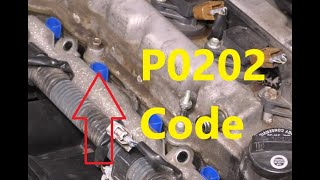
- Scan for codes and confirm P0202 is present. 🎬 Watch: A quick guide to diagnosing P0202 causes and fixes. Note any other codes, especially P0302, which is expected.
- Locate cylinder #2. On Dodge V8s (5.2L/5.9L), it's the front cylinder on the passenger side. On the V6 (3.9L), it's the middle cylinder on the driver's side. Verify the firing order for your specific engine.
- Disconnect the main engine harness from the valve cover gasket connector on the passenger side. Test for a pulse signal on the pins corresponding to cylinder #2 using a noid light while an assistant cranks the engine. If there is a pulse, the PCM and external wiring are likely good, and the problem is inside the valve cover. If there is no pulse, check the wiring back to the PCM for breaks or shorts.
- Following TSB #9002688, remove the passenger side valve cover.
- Carefully inspect the integrated wiring harness for any signs of damage, such as brittle or cracked insulation, exposed wires, or corrosion, particularly around the connector for injector #2. The wires may be stiff and break upon being moved.
- If the harness appears damaged, replace the valve cover gasket/harness assembly. This is the most probable fix.
- If the harness looks pristine, disconnect the wiring from the #2 fuel injector. Use a multimeter set to Ohms to measure the resistance across the injector's two pins. A reading outside of the 10.8-13.2 ohm range indicates a faulty injector. A reading of 'OL' or infinite resistance means the injector coil is open.
- As a final check, you can swap the #2 injector with another injector (e.g., from cylinder #4). Clear the codes and run the engine. If the code changes to P0204, the injector is confirmed to be faulty. If P0202 returns, the problem is in the wiring or PCM.
- If both the harness and injector test good, the fault may lie in the external wiring or, in very rare cases, the PCM itself.
Parts You'll Likely Need
- Valve Cover Gasket with Injector Harness
(OEM #R8069384A$, 68086182A$, R8027067A$)— This is the most probable cause of P0202 on this vehicle, as identified by manufacturer TSB #9002688. The harness degrades from heat and oil, causing an electrical fault.
Trusted brands: Mopar, Fel-Pro, Dorman
OEM price range: $120-$180
Aftermarket price range: $70-$120 - Fuel Injector
(OEM #53030778)— If the wiring harness is confirmed to be good, the fuel injector itself may have failed electrically (open or shorted coil). This part number fits many 1996-1999 Magnum engines; verify for your specific year.
Trusted brands: Bosch (0280155784 is a common cross-reference/upgrade), Standard Motor Products (SMP), Delphi
OEM price range: $70-$110
Aftermarket price range: $40-$90
Related Codes That Often Appear With This One
- P0302 — P0302 means 'Cylinder 2 Misfire Detected'. Since P0202 indicates a problem with the fuel injector circuit for cylinder 2, that cylinder isn't receiving the correct amount of fuel, which directly causes a misfire. These two codes almost always appear together for this fault.
Technical Service Bulletins (TSBs) & Recalls
- 9002688: Advises checking the wiring loom/connector in the valve cover gasket before replacing fuel injectors for codes P0201-P0206.
Platform-Specific Known Issues
- A Technical Service Bulletin (TSB #9002688) was issued by the manufacturer specifically for P020x codes on 2000 model year vehicles, pointing to the wiring loom in the valve cover gasket as a primary cause before suspecting the injectors themselves.
- Owner experiences in forums repeatedly confirm the TSB's accuracy. A common story involves a user first replacing the fuel injector, only for the P0202 code to persist. The problem is ultimately solved by replacing the valve cover gasket and its integrated harness.
Mechanic-Grade Diagnostic Values
- Fuel Injector Coil Resistance — expected: 10.8 to 13.2 Ohms (Ω) at room temperature.. Failure: A reading of infinity or 'OL' indicates an open coil. A reading near zero indicates a shorted coil. Any reading outside the specified range suggests a faulty injector.
- Injector Power Supply Voltage — expected: 12 Volts (or battery voltage) at the power wire with Key On, Engine Off (when ASD relay is briefly energized) and while running.. Failure: Low or no voltage indicates a problem with the ASD relay or the power feed wire (typically Dark Green/Orange).
- Injector Control Circuit Wire Resistance — expected: Less than 1.0 Ohm (Ω) from the PCM connector to the injector connector.. Failure: Resistance above 1.0-5.0 Ohms suggests corrosion or a break in the wire, which is the classic failure for the under-valve-cover harness.
Scan Tool Commands That Help
- DRB III or equivalent bidirectional scan tool: Injector Actuator Test / Injector Kill Test — After confirming the presence of P0202, this test allows the technician to command the PCM to fire only the #2 injector (or cut it out while the engine is running). Listening for an audible 'click' from the injector can help determine if the entire circuit (PCM driver, wiring, and injector coil) is capable of functioning at that moment. The DRB III was the OEM tool for this vehicle era.
Wiring & Ground Locations
- PCM Connector C1, Pin 4 — At the Powertrain Control Module (PCM), which is typically mounted on the passenger-side firewall in the engine bay.. This is the specific pin for the 'Injector 2 Control' circuit. The wire color is typically Light Green with a Black tracer (LT GRN/BLK). This is the ground-side signal wire that the PCM pulses to fire the injector. Testing for continuity from this pin to the injector connector is a key diagnostic step.
- Injector Power Feed — This circuit runs from the Auto Shutdown (ASD) relay, located in the Power Distribution Center (PDC) next to the battery, to all fuel injectors.. All injectors share a common power wire, typically Dark Green with an Orange tracer. A fault in this wire before it splits to the #2 injector could cause the code, though it's less common than a control-side or internal harness failure.
- G105 — A primary engine ground point located on the left rear of the cylinder head.. While the injector circuit is controlled directly by the PCM, a poor engine or PCM ground can cause erratic electrical behavior and voltage drops, potentially leading to false codes. Ensuring all engine-to-chassis grounds are clean and tight is a fundamental step.
Real Owner Repair Stories
- Reddit user on r/Cartalk (2001 Dodge Durango 5.9L Magnum V8) — P0202, large clouds of white smoke with a strong smell of raw gasoline, lack of power, poor gas mileage. A noid light test on the #2 injector harness showed an inconsistent pulse before failing completely.
❌ Tried (didn't work) The user was in the diagnostic phase.
✅ What actually fixed it The story documents symptoms that perfectly match an intermittent electrical failure in the injector circuit, highly indicative of the known valve cover harness issue, though a final resolution was not posted. The inconsistent noid light flash is a key real-world indicator. - RamForum.com user (2003 Ram 1500 5.7L Hemi (Note: Different engine, but analogous electrical issue)) — P0202 code that would only appear after driving, not at idle.
❌ Tried (didn't work) Replaced all 8 fuel injectors., Swapped injector #2 with injector #4 (code remained P0202)., Verified continuity from PCM to injector connector (tested good)., Verified noid light flashed correctly at idle., Swapped the PCM with a known-good unit., Replaced the injector pigtail connector.
✅ What actually fixed it The thread ended without a final confirmed fix, but serves as an expert-level example of how an intermittent open/short (likely in the harness) that only occurs with heat and vibration can pass all static bench tests (continuity, noid light at idle) and even persist after swapping the injector and PCM.
"I Checked Everything" — The Actual Cause
- The electrical equivalent of a 'smoke test clean' scenario for P0202 is when basic electrical tests pass, but the code persists. A common story involves a technician verifying that a noid light flashes at idle and the injector resistance is within spec. However, the P0202 code returns during a test drive. This happens because the root cause, the brittle wiring inside the valve cover, often creates an intermittent open circuit only when the engine heats up or vibrates at certain RPMs. A static test in the bay will not reveal this fault, leading to misdiagnosis. The repair story from RamForum.com is a perfect example of this, where continuity and noid light tests passed, but the problem continued.
Helpful Videos
We Have This Part in Stock


The information in this article is provided for general reference and educational purposes only. Vehicle specifications, procedures, and part compatibility can vary by production date, trim level, and region. Always consult your vehicle's factory service manual and verify part numbers before purchasing or performing repairs. Safety-critical components such as airbags, seat belts, and braking systems should be installed by a qualified professional.
- Dodge RAM WAGON:
- 🧭 Diagnostic Flowchart
- 🎬 Helpful Videos
- 🛍️ Shop This Part
- What's Unique About the 2000-2003 Dodge RAM WAGON
- Symptoms You May Notice
- Most Likely Causes
- Rare But Worth Checking
- Diagnosis Steps
- Parts You'll Likely Need
- Related Codes That Often Appear With This One
- Technical Service Bulletins (TSBs) & Recalls
- Platform-Specific Known Issues
- Mechanic-Grade Diagnostic Values
- Scan Tool Commands That Help
- Wiring & Ground Locations
- Real Owner Repair Stories
- "I Checked Everything" — The Actual Cause
- 🎟️ Get 5% Off