

P0203 on 1998-2005 Dodge RAM 3500: Injector Circuit Malfunction Causes & Fixes
On a 5.9L Cummins-powered Dodge Ram, code P0203 is most often caused by a faulty injector wiring harness located under the valve cover, not the injector itself. Heat and oil saturation cause the connectors to fail. Before replacing the expensive #3 injector, inspect or replace the harness that connects to it, especially on the 2003-2005 common rail engines.
- P0203 on a 1998-2005 Ram 3500 with a 5.9L Cummins engine points to an electrical fault in the cylinder 3 injector circuit.
- The most likely cause is a bad wiring harness located under the valve cover, which fails from heat and vibration.
- Always inspect and test the wiring harness before spending money on a new fuel injector.
- This repair requires removing the valve cover but is a manageable DIY job for someone with moderate mechanical skill.
- Be sure to identify your specific engine (1998.5-2002 24v vs. 2003-2005 Common Rail) to get the correct replacement parts.
What's Unique About the 1998-2005 Dodge RAM 3500
On the 5.9L Cummins engines used in this era of Ram trucks, the injector wiring harnesses are routed underneath the valve cover. They are constantly exposed to engine heat, oil, and vibration, which causes the connectors and wiring to become brittle and fail over time. This is such a common failure that Dodge issued a Technical Service Bulletin (TSB #9002688, also referenced in relation to TSB 18-04-02) warning technicians to check this internal wiring before replacing the fuel injector itself, as the harness is the more likely culprit. 🎬 Watch: Step-by-step troubleshooting for Cummins injector circuit faults Another common point of failure is the main pass-through connector, which can become saturated with oil that has wicked through the harness, causing a poor connection.
Diagnostic Flowchart
Tap your situation to follow the diagnostic path that matches what you're seeing on this vehicle.
Generation note: This range covers the late second-generation Ram (1998.5-2002) with the 24v VP44-injected Cummins and the early third-generation Ram (2003-2005) with the Common Rail Cummins. While both are susceptible to under-valve-cover wiring issues, the failure is more prevalent on the 2003-2005 models. The specific part numbers for the harnesses and injectors are different between these two engine types.
Symptoms You May Notice
- Check Engine Light is on or flashing
- Rough idle or engine stumbling
- Noticeable engine misfire, sometimes described as a 'pop' or 'jerk'.
- Loss of power and sluggish acceleration.
- Increased fuel consumption.
- Engine may stall intermittently.
- White smoke from the exhaust on startup or at idle, indicating unburnt fuel.
- Replacing the fuel injector before thoroughly checking the under-valve-cover wiring harness. The TSB specifically warns against this, as the harness is the more frequent failure point.
- Replacing only the injector and not the injector connector tube, which can lead to high-pressure fuel leaks.
Most Likely Causes
- Faulty Injector Wiring Harness (Under Valve Cover) 🔴 High Probability → Shop Engine Wiring Harness As documented in TSB #9002688, the harness is exposed to extreme heat and oil under the valve cover, causing connectors to become brittle and wires to fail. This is the most common point of failure for this code, especially on 2003-2005 models.
How to confirm: Remove the valve cover. Visually inspect the harness for cylinder #3 for signs of damage, brittle connectors, or oil saturation. Test for continuity from the injector connector back to the main pass-through connector on the valve cover gasket. A common failure point is the small nuts on the injector solenoid studs coming loose.
Typical fix: Replace the faulty section of the injector wiring harness. Three harnesses are used in total, each serving two injectors. It is best practice to replace all three at the same time.
Est. part cost: $40-$140 - Failed #3 Fuel Injector 🟡 Medium Probability → Shop Fuel Injector Injectors are high-wear items that can fail electrically over time. The internal solenoid coil can develop an open or short circuit. Early common rail injectors (2003-2004) were known for higher failure rates.
How to confirm: After confirming the wiring is good, test the injector's resistance with a multimeter. It should be less than 1 ohm (typically 0.2-0.6 ohms). An infinite reading means the injector coil is open. A definitive test is to swap the #3 injector with an adjacent one (e.g., #4). If the code changes to P0204, the injector is faulty.
Typical fix: Replace the fuel injector for cylinder #3. It is also recommended to replace the injector connector tube (feed tube) at the same time to prevent leaks.
Est. part cost: $250-$500 - Poor Connection at Valve Cover Pass-Through Connector 🟡 Medium Probability → Shop Engine Valve Cover The main external connector that sends the signal through the valve cover gasket can suffer from corrosion or become saturated with oil that wicks through the internal harness, leading to a poor connection.
How to confirm: Disconnect and inspect the main circular connector on the side of the engine that feeds the injector harness (the front connector is for cylinders 1-3). Check for oil saturation, bent, or corroded pins and ensure a snug fit.
Typical fix: Clean the connector terminals thoroughly with electrical contact cleaner. If the connector is full of oil, the internal harness is likely compromised and should be replaced to prevent the issue from returning.
Est. part cost: $5-$20 for cleaner
Rare But Worth Checking
- Faulty Powertrain Control Module (PCM): → Shop Engine Control Module (ECM) This is very rare. The internal driver circuit for the #3 injector can fail. This should only be considered after all wiring and the injector itself have been proven to be good. A lab scope would be needed to confirm a bad driver by observing the waveform.
Diagnosis Steps
- Read the code with an OBD-II scanner to confirm P0203 is active.
- Check for other codes. If you have P2146, the issue is almost certainly in the wiring/harness for cylinders 1-3.
- Perform a visual inspection of the external engine wiring harness. Locate the two large round connectors near the front of the valve cover. The front connector serves injectors 1-3. Disconnect it and inspect for oil saturation, corrosion, or bent pins.
- If the connector is clean, remove the valve cover to access the injector harnesses.
- Visually inspect the wiring and connector for injector #3 (third from the front). Look for brittle plastic, broken locking tabs, oil-soaked wires, or loose nuts on the injector solenoid studs.
- Disconnect the harness from the #3 injector. Use a multimeter set to ohms to check the resistance of the injector itself. It should be very low, typically 0.2-0.6 ohms. An infinite reading (OL) means the injector coil is open and bad.
- If the injector resistance is good, test the harness. Check for continuity on both wires from the injector connector back to the pass-through connector. Check for shorts to ground and shorts between the two wires. Resistance should be less than 1.0 ohm.
- A definitive test is to swap components. Swap the #3 injector with the #4 injector. Clear codes and run the engine. If the code moves to P0204, the injector is the confirmed problem. If the code remains P0203, the wiring harness is the problem.
- If a fault is found in the harness, replace it. If the harness and injector test good, the fault may be in the external engine harness or the PCM, which requires more advanced diagnostics.
Parts You'll Likely Need
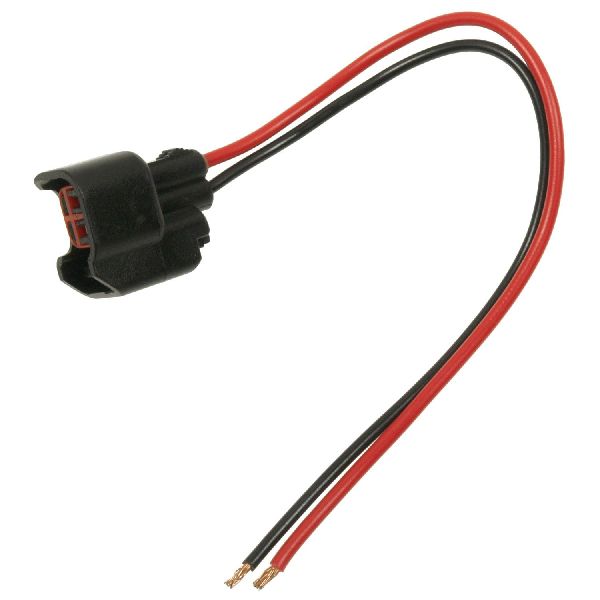
- Fuel Injector Wiring Harness (2003-2005)
(OEM #3966805)— This is the most common failure point due to heat and vibration under the valve cover, as noted in TSB #9002688. Part number 3966805 is for 2003-2005 models. Three are required per engine.
Trusted brands: Cummins (OEM), Dorman, Standard Motor Products, NPBoosted
OEM price range: $120-$150
Aftermarket price range: $40-$80 - Fuel Injector Wiring Harness (1998.5-2002)
(OEM #3287699 (cross-reference))— The harness for the earlier 24v VP44 engine is also prone to failure but has a different design and part number.
Trusted brands: Cummins (OEM), NPBoosted
OEM price range: $50-$100
Aftermarket price range: $30-$60 - Fuel Injector (Cylinder #3) — If the wiring harness is confirmed to be good, the injector's internal solenoid has likely failed. This is the second most common cause.
Trusted brands: Bosch (OEM), Industrial Injection, BD Diesel
OEM price range: $350-$500
Aftermarket price range: $250-$400 - Valve Cover Gasket — The valve cover must be removed for this repair, and it is best practice to replace the gasket to prevent oil leaks. The gasket incorporates the pass-through connectors for the injector harnesses.
Trusted brands: Cummins (OEM), Fel-Pro, Mahle
OEM price range: $50-$100
Aftermarket price range: $30-$60
Related Codes That Often Appear With This One
- P0303 — P0303 indicates a misfire on cylinder 3. Since P0203 means the injector circuit is failing, the cylinder isn't getting fuel, which directly causes a misfire.
- P0200 — P0200 is a generic 'Injector Circuit Malfunction' code. It can sometimes appear alongside a specific cylinder code like P0203 if the fault is intermittent or affects the shared power or ground path.
- P2146 — This code ('Fuel Injector Group 'A' Supply Voltage Circuit/Open') often appears with P0201, P0202, or P0203 on common rail Cummins engines, as injectors 1-3 are in the same group. It points strongly to a wiring or connector issue for that bank.
Technical Service Bulletins (TSBs) & Recalls
- 9002688: Warns against replacing injectors before checking the under-valve-cover wiring harness for P020x codes.
- 18-04-02: A related TSB that also addresses injector circuit fault codes and points towards wiring issues.
Platform-Specific Known Issues
- TSB #9002688 / 18-04-02: A Dodge Technical Service Bulletin was issued for 2002 models but is widely applicable to the platform. It states: 'Before replacing injectors for Diagnostic Trouble Codes P0201, P0202, P0203, P0204, P0205, and/or P0206, please make sure that the wiring loom and/or connector in the valve cover gasket is not the root cause to your concern.'
Mechanic-Grade Diagnostic Values
- Fuel Injector Solenoid Resistance (Common Rail) — expected: 0.2 - 0.6 Ohms. Failure: A reading over 1.0 Ohm or an open loop (OL) indicates a failed injector solenoid.
- Injector Circuit Resistance (Harness + Injector) — expected: 0 - 1 Ohm. Failure: Resistance higher than 1 Ohm points to high resistance in the wiring or a faulty injector.
- Injector Circuit Short to Ground/Voltage (Key On) — expected: Below 1.0 Volt. Failure: Voltage present on the circuit when measured to ground indicates a short to power.
Scan Tool Commands That Help
- High-end scan tool (e.g., DRB III, Snap-on, Autel): Injector Kill / Cylinder Cutout Test — This test allows a technician to manually disable one cylinder at a time to isolate a misfire. When cylinder #3 is cut out, if there is no change in engine RPM or sound, it confirms that cylinder was not contributing, which is expected with a P0203 code. It helps verify the fault's presence before disassembly.
Wiring & Ground Locations
- ECM Ground (2nd Gen) — A ground point for the ECM is located on the engine block, above/behind the starter.. A poor sensor ground can cause erratic signals and fault codes. While not the most common cause for a single injector code, ensuring this ground is clean and tight is a crucial step in advanced electrical diagnosis.
- ECM Ground (3rd Gen) — The ECM is bolted directly to the side of the engine block, and one of the mounting bolts also secures a ground wire.. The ECM case itself needs a solid ground. A loose or corroded ground at the mounting point can cause a variety of issues, including injector driver faults.
- ECM Connector C1 (Bank 1) — This is one of the main connectors at the Engine Control Module (ECM).. Injector circuits for cylinders 1, 2, and 3 run through this connector. Advanced diagnosis involves checking for continuity and shorts at the specific pins for the #3 injector (e.g., K13 and K613 circuits) back to the injector.
Real Owner Repair Stories
- Diesel Truck Resource Forums user (2005 Dodge Ram Cummins) — Truck went into limp mode, throwing codes P0201 and P2146.
❌ Tried (didn't work) Initial diagnosis was unclear.
✅ What actually fixed it The user found oil inside the main electrical connector for the injector harness (serving cylinders 1 & 2). Replacing the under-valve-cover wiring pack for that pair of injectors resolved the codes and the running issue. This is directly analogous to a P0203/P2146 fault. - Mopar1973Man.Com Forums user (2005 Dodge Ram Cummins) — Check engine light, loss of power, rough running, high EGTs (1200°F), and smoke. Codes P0203 and P2146 were present.
❌ Tried (didn't work) Clearing codes with a tuner provided a temporary fix, but the problem returned.
✅ What actually fixed it The user suspected a stuck-open #3 injector based on the high EGTs and smoke. The combination of P0203 and P2146 pointed to an issue in the bank 1 (cylinders 1-3) injector circuit, with the injector itself being the likely failure causing the severe symptoms.
OEM Part Supersession History
3957309, 3964316→3966805— Improved materials and construction to better withstand under-valve-cover heat and oil exposure.
Heads up: Part number 3966805 is specific to 2003-2005 Common Rail engines. It is not compatible with 1998.5-2002 VP44 engines.Mopar 5139865AA→Cummins 3966805— This is the Mopar part number which is directly replaced by the Cummins OEM part.
Model Year Variations Within This Range
- 1998.5-2002: These models use a VP44 rotary injection pump. While they also have under-valve-cover harnesses, the injectors are mechanically controlled for timing, with electronics controlling fuel quantity. The injector lines themselves are precision-timed components. The electrical failure points are similar but involve different part numbers and diagnostic approaches focused on the Injection Pump Control Module.
- 2003-2005: These models use a high-pressure Common Rail system with a CP3 pump. The injectors are fully electronically controlled by the ECM. This system is more sensitive to electrical faults, and the combination of P0203 with P2146 (Injector Group A Fault) is a common signature pointing to a wiring issue on the front bank of cylinders (1-3).
Helpful Videos

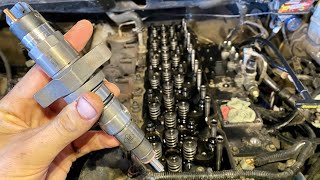
We Have This Part in Stock


The information in this article is provided for general reference and educational purposes only. Vehicle specifications, procedures, and part compatibility can vary by production date, trim level, and region. Always consult your vehicle's factory service manual and verify part numbers before purchasing or performing repairs. Safety-critical components such as airbags, seat belts, and braking systems should be installed by a qualified professional.
- Dodge RAM 3500:
- 🧭 Diagnostic Flowchart
- 🎬 Helpful Videos
- 🛍️ Shop This Part
- What's Unique About the 1998-2005 Dodge RAM 3500
- Symptoms You May Notice
- Most Likely Causes
- Rare But Worth Checking
- Diagnosis Steps
- Parts You'll Likely Need
- Related Codes That Often Appear With This One
- Technical Service Bulletins (TSBs) & Recalls
- Platform-Specific Known Issues
- Mechanic-Grade Diagnostic Values
- Scan Tool Commands That Help
- Wiring & Ground Locations
- Real Owner Repair Stories
- OEM Part Supersession History
- Model Year Variations Within This Range
- 🎟️ Get 5% Off