

P0203 on 2005-2014 Ford E-350 5.4L: Injector Circuit Malfunction Causes and Fixes
This code indicates an electrical fault with the fuel injector for cylinder #3. The most common cause is a failed fuel injector, followed by a damaged wiring connector. Expect to pay $60-$110 for a Motorcraft injector and significant labor costs ($300-$600+) due to difficult engine access in the van. A noid light test and multimeter resistance check are key diagnostic steps.
- P0203 is an electrical fault, not a fuel flow or spark problem. Focus diagnosis on the injector, its connector, and the wiring.
- The most likely fix is replacing the #3 fuel injector. Use a quality brand like Motorcraft to ensure reliability.
- Always check the plastic connector for cylinder #3. They are known to get brittle and break, causing a bad connection.
- Due to poor engine access in the E-350 van, replacing the #3 injector is a labor-intensive job. What is a 1-hour job on an F-150 can take 2-4 hours on an E-350.
- Do not drive extensively with this code. The resulting misfire can quickly damage your expensive catalytic converter.
What's Unique About the 2005-2014 Ford E-350
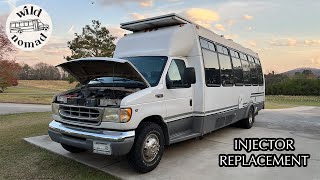
On the E-350 with the 5.4L Triton V8, the primary challenge is engine access. 🎬 Watch this guide on diagnosing misfires in the E-Series engine bay. Unlike the F-150 where the engine is relatively open, the injector for cylinder #3 is tucked deep within the engine bay, partially under the cowl, making diagnosis and repair significantly more time-consuming. The wiring harness connectors in the hot, tight engine compartment of these vans are known to become brittle and break, making a wiring fault nearly as likely as an injector failure. Owners of 2005 models should also be aware of a specific Customer Satisfaction Program (07M08) that extended the warranty for failing injectors on this engine due to a high failure rate.
Generation note: The 2005-2014 year range covers two phases of the fourth-generation E-Series. A major facelift occurred in 2008, giving the van the front grille and headlights of the Super Duty truck. However, the 5.4L Triton V8 engine and its fuel system architecture remained fundamentally the same, so the causes and repair procedures for P0203 are consistent across this entire year span.
Symptoms You May Notice
- Check Engine Light is on
- Rough, shaking idle
- Engine misfire (may feel like a shudder or stumble)
- Noticeable loss of power and poor acceleration
- Reduced fuel economy
- In some cases, a smell of raw fuel if the injector is stuck open
- Black smoke from the tailpipe if the injector fails in a rich condition
- Overheat warning lights may occasionally trigger during driving alongside the misfire, as noted in NHTSA ODI #11351494
- Replacing the spark plug or ignition coil for cylinder #3. While these parts can cause a misfire code (P0303), they will not cause an injector *circuit* code like P0203, which specifically points to an electrical fault in the fuel injector system. The presence of P0203 is the key differentiator.
Most Likely Causes
- Failed #3 Fuel Injector 🔴 High Probability → Shop Fuel Injector The 5.4L Triton engine has a history of fuel injector failure, where the internal electrical coil shorts out or breaks, creating an open circuit. This was common enough on 2005 models that Ford issued Customer Satisfaction Program 07M08 to extend the warranty. This is the most frequent cause of a P0203 code.
How to confirm: Measure the resistance across the two terminals of the disconnected injector using a multimeter. A good injector should read between 11-16 ohms. A reading of infinity (OL) or zero ohms indicates a failed injector. The most definitive test is to swap the #3 injector with an adjacent one (like #1). If the code changes to P0201, the injector is faulty.
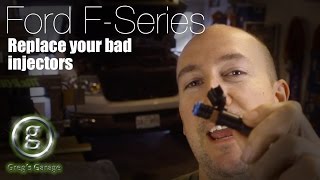
Typical fix: Replace the failed fuel injector. It is highly recommended to use a quality OEM part, such as Motorcraft, to avoid premature failure. The updated Motorcraft part number is often listed as CM-5138, which supersedes the original 5C3Z-9F593-AA. 🎬 See this walkthrough on how to replace 5.4L Triton fuel injectors.
Est. part cost: $60-$110 - Damaged Injector Wiring or Connector 🟡 Medium Probability Due to high heat in the E-350's tight engine bay, the plastic injector connectors become very brittle over time and can crack or break, especially during other maintenance like a spark plug change. Wires can also chafe and short against engine components. Manufacturer Bulletin #SSM 49759 notes that for several Ford models, technicians should follow specific pinpoint tests in the PC/ED manual when P0203 is present to differentiate between component and circuit failure.
How to confirm: Visually inspect the wiring harness and the connector for cylinder #3 for any signs of cracking, melting, or broken wires. Disconnect the injector and plug a 'noid light' into the connector; the light should flash steadily while the engine is cranked or running. If there is no flash, or the light stays on constantly, the problem is in the wiring or the PCM.
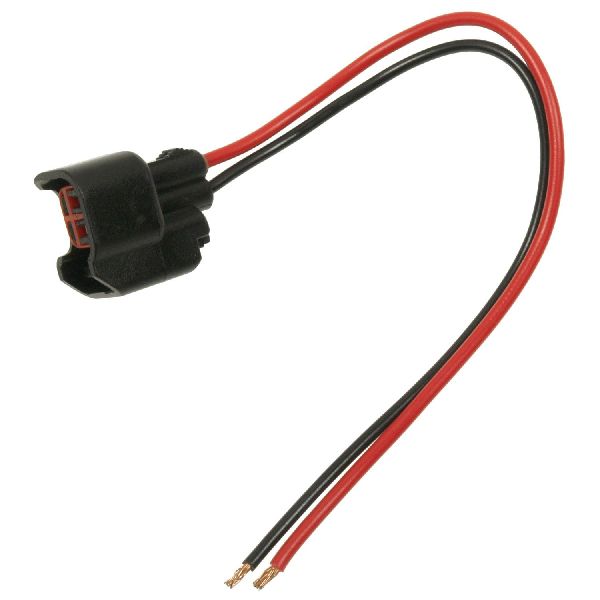
Typical fix: If the connector is broken, it can be replaced with a new pigtail connector (Motorcraft WPT-1051). Damaged sections of wire must be carefully repaired with solder and heat-shrink tubing or replaced.
Est. part cost: $20-$40
Rare But Worth Checking
- Powertrain Control Module (PCM) Failure: → Shop Engine Control Module (ECM) This is uncommon, but possible. The internal transistor (driver) that fires the injector can fail. A forum member on Ford Truck Enthusiasts with a 2005 E-350 reported this as the ultimate fix after replacing the injector and checking wires. This should only be considered after definitively ruling out the injector and wiring, as it is the most expensive and complex repair. A new programmed PCM can cost $800-$1150.
- Melted Fuel Pump Fuse (Fuse 27 on F-150): TSB 15-0137 was issued for 2009-2014 F-150s where the fuel pump fuse (Fuse 27) overheats and melts, causing a loss of fuel pressure and potentially logging multiple injector codes, including P0203. While this TSB is specific to the F-150, the underlying electrical system is similar. If you have P0203 along with other injector codes and stalling issues, inspect the fuel pump fuse in the battery junction box for signs of melting or heat damage. A relocation kit (part number EL3Z-14293-A) is available to move the fuse to a more robust location in the fuse box.
Diagnosis Steps
- Scan for codes: Use an OBD-II scanner to confirm P0203 is present. Note any other codes, especially P0303.
- Locate Cylinder #3: On the 5.4L V8, cylinder #3 is the third cylinder from the front on the passenger side (Bank 1).
- Visual Inspection: Carefully inspect the electrical connector and the surrounding wires for cylinder #3's injector. Look for brittle or broken plastic, corrosion, or chafed wires. Wiggle the connector with the engine running to see if the misfire changes, indicating a poor connection.
- Check for PCM Signal (Noid Light Test): Disconnect the injector and plug a 'noid light' into the harness connector. Crank or start the engine. A steady, repeating flash indicates the PCM and wiring are sending the signal correctly. No flash or a steady light points to a wiring or PCM issue.
- Test the Injector: If the noid light flashes correctly, the injector is the prime suspect. Disconnect the battery. Unplug the injector and measure the resistance across its two pins with a multimeter set to Ohms. A good injector will read between 11 and 16 ohms. A reading of 'OL' (open loop/infinite resistance) or 0 ohms means the injector has failed internally.
- Swap Injectors (Definitive Test): If you have a good resistance reading but still suspect the injector, swap the #3 injector with the #1 injector (the front-most on the passenger side). Clear the codes and run the engine. If the code returns as P0201, the injector is confirmed bad. If the code remains P0203, the problem is in the wiring or PCM.
- Check Wiring Integrity: If the noid light test failed, check for 12V power on one wire of the injector connector (with key on, engine off). Then, check for continuity on the other wire (the signal/ground wire) back to the corresponding pin on the PCM connector. Repair any breaks or shorts found.
- Suspect the PCM: If the wiring and injector are confirmed good, but the noid light test fails, the PCM's injector driver has likely failed. This is rare and should be the last step after all other possibilities are exhausted.
Parts You'll Likely Need
- Fuel Injector
(OEM #CM-5138 (supersedes 5C3Z-9F593-AA))— This is the most common failure point for a P0203 code on this engine. The internal coil winding fails, creating an open or shorted circuit.
Trusted brands: Motorcraft, Bosch, Standard Motor Products
OEM price range: $60-$110
Aftermarket price range: $40-$80 - Fuel Injector Connector Pigtail
(OEM #WPT-1051)— The original connector often becomes brittle from engine heat and breaks during diagnosis or repair, requiring replacement. A broken locking tab can cause an intermittent connection.
Trusted brands: Motorcraft, Dorman
OEM price range: $25-$40
Aftermarket price range: $15-$25
Related Codes That Often Appear With This One
- P0303 — This code means 'Cylinder 3 Misfire Detected.' Since P0203 indicates the injector circuit for cylinder 3 has failed, the cylinder isn't receiving fuel, which directly causes it to misfire. This code is almost always present with P0203.
- P0171 or P0174 — These are 'System Too Lean' codes for Bank 1 and Bank 2. A non-firing injector causes the oxygen sensors to detect excess unburned air in the exhaust, leading the PCM to flag a lean condition.
- P0200 — This code for 'Injector Circuit Malfunction' is a general code not specific to one cylinder. It may appear alongside P0203 if there is a systemic issue, like a problem with the shared power feed to the injectors, as can happen with a melting fuel pump fuse.
Technical Service Bulletins (TSBs) & Recalls
- TSB 15-0137 - While officially for the F-150, it describes a condition where the fuel pump fuse (Fuse 27) can melt, causing stalling and multiple injector circuit codes. This is worth investigating if P0203 appears with other codes and drivability issues.
- Bulletin #SSM 49759 - Notes that P0203 may be accompanied by an illuminated MIL and instructs technicians to follow pinpoint tests in the PC/ED manual for accurate circuit diagnosis.
Platform-Specific Known Issues
- Customer Satisfaction Program 07M08: For 2005 models with the 5.4L 3V engine, Ford issued this program extending the warranty on fuel injectors to 11 years or 120,000 miles due to a high rate of failure. While expired, it confirms a known weakness for this model year.
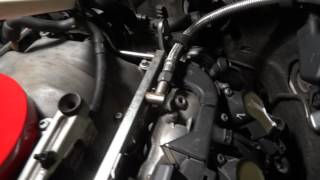
- Difficult Access: Unlike in F-Series trucks, the passenger side injectors on an E-Series van are buried deep in the engine doghouse, requiring removal of the airbox and other components for access.
Mechanic-Grade Diagnostic Values
- Fuel Injector Coil Resistance — expected: 11 - 16 Ohms. Failure: A reading of 'OL' (Open Loop/infinite resistance) or near 0 Ohms indicates a failed injector.
- Injector Connector Power (Key On, Engine Off) — expected: ~12.6V (Battery Voltage). Failure: No voltage indicates a break in the power supply wire from the fuel pump relay or a related fuse.
- Injector Pulse Width (at idle, warm engine) — expected: 2.0 - 4.0 milliseconds (ms). Failure: A value of 0 ms on cylinder #3 while others are in spec points to a circuit or driver issue.
- PCM Injector Driver Circuit Resistance to Ground (PCM disconnected) — expected: Greater than 10,000 Ohms (10 kΩ). Failure: A low resistance reading indicates a short to ground in the wiring harness.
- Fuel Pressure (Key On, Engine Off) — expected: 35 to 65 psi. Failure: Low pressure could indicate a fuel pump or fuse issue, though this typically affects all cylinders, not just one.
Scan Tool Commands That Help
- Ford IDS (or equivalent professional scanner): Power Balance Test — To visually confirm the misfire and lack of power contribution from cylinder #3 in real-time. The graph will show a clear drop for the affected cylinder, confirming the impact of the P0203 fault.
- Ford IDS (or equivalent professional scanner): Injector Buzz Test — This is an active test that commands each injector to 'buzz' or click. It can help determine if the injector is capable of activating, but it may not catch an intermittent electrical failure under load.
Wiring & Ground Locations
- G109 — Right front of the engine compartment.. This is a primary engine ground point. While a bad ground here would likely cause multiple, more widespread issues, ensuring it is clean and tight is a crucial step when diagnosing any electrical fault, including an isolated injector circuit code.
- Catalyst Monitor Wiring Harness (Cutaway models) — Above the original equipment crossmember on E-350/E-450 Cutaway chassis.. On vehicles modified by body builders, there is a known issue where an added crossmember can chafe this harness. This can cause shorts and may trigger various codes, including those related to O2 sensors (P0135, P0155) and the EVAP system (P0443), which share power circuits that could potentially affect injectors.
Real Owner Repair Stories
- Ford Truck Enthusiasts user 'fixingstill' (2005 Ford E-350 5.4L V8 Van) — Persistent P0203 code.
❌ Tried (didn't work) Replaced the #3 fuel injector twice., Tested the wiring harness multiple times., Checked and cleaned ground connections.
✅ What actually fixed it The user concluded the only remaining possibility was a failed PCM (injector driver). While the final repair was not posted, this case highlights that after thoroughly ruling out the injector and wiring, the PCM can be the root cause. - NHTSA ODI #10405277 — An owner reported a sudden loss of power where the vehicle had to be pulled over immediately. The dealer checked electrical connections and reassembled the system after pulling codes P0201, P0202, P0203, and P0204.
OEM Part Supersession History
5C3Z-9F593-AA→CM-5138— Updated design to improve reliability and address the high failure rate noted in early 5.4L 3V engines.
Heads up: The CM-5138 injector is specified for 2005-2007 models. While the 2009-2014 engines are similar, they use different injectors and fuel rails, so CM-5138 may not be compatible with later model years in this range.
Model Year Variations Within This Range
- 2009-2014: For the 2009 model year, the 5.4L 3V engine received redesigned cylinder heads for one-piece spark plugs. Along with this, the intake manifold, fuel injectors, and fuel rails were changed. While the P0203 diagnosis is the same, the specific part number for the injector will be different than the earlier CM-5138 used from 2005-2008.
- 2005-2008 vs 2009+: The PCM hardware and software calibrations may differ. When replacing a PCM, it is critical to order based on the hardware ID code printed on the original unit's label (e.g., '9C2A-12A650-ATA' for a 2009 model) rather than just by year and model, as multiple versions can exist for the same vehicle.
Diagnostic Flowchart
Other Known Issues on This Vehicle
Issues unrelated to this code that are worth knowing about as an owner of this generation:
- Spark Plug Breakage During Removal 🔴 High — Extremely common on all 5.4L 3V engines, especially on original plugs with high mileage. The two-piece plug design allows carbon to build up on the lower electrode shield, causing it to seize in the cylinder head and break upon removal. (Ref: No TSB, but a well-known issue with a specific Lisle tool (65600/65700) designed for extraction.)
- Timing Chain, Guide, and Cam Phaser Failure 🔴 High — Very common, typically starting after 80,000-100,000 miles. Symptoms include a diesel-like ticking or rattling noise at idle that may quiet down at higher RPM. Caused by failing plastic timing chain guides, worn tensioners, and failing cam phasers due to low oil pressure. (Ref: Multiple TSBs exist for related symptoms, but no single recall covers the entire systemic issue.)
- Fuel Pump Driver Module (FPDM) Failure 🟠 Medium — Common across many Ford trucks and vans of this era. The aluminum module is mounted directly to the steel frame, causing galvanic corrosion that cracks the housing and exposes the electronics to moisture. Symptoms include stalling, no-start, and rough running. (Ref: No recall for the E-350 specifically, but a known design flaw. Aftermarket replacements often include spacers to prevent direct contact with the frame.)
Used vs. New Parts: Buying Guide for This Vehicle
When a used part is the smart pick: A used wiring harness pigtail or a section of the engine harness can be a cost-effective fix if the damage is localized and the donor part is in good condition. A complete used engine harness from a low-mileage van is also a viable option if multiple connectors are brittle or damaged.
Donor-vehicle mileage cap: roughly under 100000 miles for the part to have meaningful remaining life.
What to inspect on the donor part:
- For wiring: Check for flexibility; avoid any harness that feels stiff or brittle.
- For connectors: Squeeze the locking tab. If it flexes without cracking, it's likely still good. If it snaps, the plastic is too old.
- Inspect for any signs of previous repairs, like mismatched tape or crimp connectors.
OEM-only on this vehicle (don't cheap out):
- Fuel Injector: Due to the known high failure rate on this engine, using a new, quality OEM (Motorcraft) or reputable aftermarket (Bosch) injector is strongly recommended. The labor to access the injector is significant, making it unwise to risk an early failure with a used part.
- Powertrain Control Module (PCM): While a used PCM can work, it must be an exact hardware match and will require reprogramming to the vehicle's VIN and options. This often requires dealer-level tools. It's often safer to use a reputable remanufacturing service that provides a pre-programmed, warrantied unit.
Aftermarket brands forum-validated for this vehicle:
- Bosch (often the OEM manufacturer for Motorcraft)
- Standard Motor Products (SMP)
Brands owners have reported issues with on this vehicle:
- Unbranded, no-name injectors from online marketplaces. These often have poor quality control, incorrect flow rates, and high failure rates, leading to a repeat repair.
Real Owner Stories
Aggregated from forums and TSBs cited above. Mileages and costs reflect what owners reported in those sources.
2005 E-350 5.4L
Symptoms: Persistent P0203 code. The owner replaced the injector twice and verified the wiring, but the code remained.
What fixed it: The owner ultimately suspected the PCM injector driver had failed after exhausting all other possibilities.
Source hint: Ford-Trucks.com thread titled 'P0203. I have changed the injector twice and tested the wiring.'
2004 E-350
Symptoms: Stalling and lean codes (P0171/P0174) that mimic fuel delivery problems.
What fixed it: Traced the issue to a corroded Fuel Pump Driver Module (FPDM) and its associated wiring.
Source hint: Ford-Trucks.com thread titled '2004 E-350 Fuel Pump Driver Module Mess'
2005-2014 Ford E-350 5.4L Triton V8 — ~90000 miles
Symptoms: Diesel-like ticking or rattling noise at idle that quiets down at higher RPM.
What fixed it: Repair of timing chain, guides, and cam phasers.
Source hint: vehicle_specific_issues section regarding Timing Chain, Guide, and Cam Phaser Failure
Ford Owner Report (NHTSA ODI #11351494)
Symptoms: An owner reported a misfire on cylinder 3 with code P0203 at approximately 75,000 miles. The vehicle also displayed an overheat warning light that would intermittently turn on and off while driving.
Related OBD-II Codes
Frequently Asked Questions
Is there a special warranty for fuel injector failure on my 2005 Ford E-350 with the 5.4L engine?
Why is it harder to fix P0203 on my E-350 van compared to an F-150 truck?
What specific replacement fuel injector should I use for my 5.4L Triton V8?
Could a blown fuse cause my P0203 code on the E-350?
What is the correct resistance for a fuel injector on a 2005-2014 Ford E-350 5.4L?
If I need to replace a broken injector connector, is there a specific Ford part number?
Helpful Videos
We Have This Part in Stock


The information in this article is provided for general reference and educational purposes only. Vehicle specifications, procedures, and part compatibility can vary by production date, trim level, and region. Always consult your vehicle's factory service manual and verify part numbers before purchasing or performing repairs. Safety-critical components such as airbags, seat belts, and braking systems should be installed by a qualified professional.
- Ford E-350:
- 🧭 Diagnostic Flowchart
- 🎬 Helpful Videos
- 🛍️ Shop This Part
- What's Unique About the 2005-2014 Ford E-350
- Symptoms You May Notice
- Most Likely Causes
- Rare But Worth Checking
- Diagnosis Steps
- Parts You'll Likely Need
- Related Codes That Often Appear With This One
- Technical Service Bulletins (TSBs) & Recalls
- Platform-Specific Known Issues
- Mechanic-Grade Diagnostic Values
- Scan Tool Commands That Help
- Wiring & Ground Locations
- Real Owner Repair Stories
- OEM Part Supersession History
- Model Year Variations Within This Range
- Other Known Issues on This Vehicle
- Used vs. New Parts: Buying Guide for This Vehicle
- Real Owner Stories
- 2005 E-350 5.4L
- 2004 E-350
- 2005-2014 Ford E-350 5.4L Triton V8 — ~90000 miles
- Ford Owner Report (NHTSA ODI #11351494)
- Related OBD-II Codes
- Frequently Asked Questions
- 🎟️ Get 5% Off