

P0203 on 2008-2012 Ford Escape: Injector Circuit Malfunction Causes & Fixes
P0203 on a 2008-2012 Ford Escape means there's an electrical fault in the cylinder 3 fuel injector circuit. The most common cause is a failed fuel injector, followed by a damaged wire or connector. A new injector costs between $40 and $150, and it's a manageable DIY repair for most owners, though access on the 3.0L V6 is difficult.
- P0203 is an electrical circuit code for the cylinder 3 fuel injector, not a fuel flow or mixture code.
- The most likely cause is a failed fuel injector, which can be confirmed by testing its resistance or swapping it with another cylinder.
- The second most likely cause is a damaged wire or connector at the injector.
- On the 3.0L V6, be prepared for a more involved repair as cylinder 3 is on the firewall side, requiring intake manifold removal.
- Do not drive extensively with this code, as the resulting misfire can damage your catalytic converter.
- Always rule out the injector and wiring before considering the expensive and rare possibility of a bad PCM.
What's Unique About the 2008-2012 Ford Escape
For the second-generation Ford Escape (2008-2012), the P0203 code is a straightforward electrical fault. The key difference between the 2.5L I4 and 3.0L V6 engines is the location and accessibility of cylinder 3. On the V6, cylinder 3 is on the rear bank against the firewall, requiring the removal of the upper intake manifold for access. This significantly increases the complexity and labor time for any repair involving that injector. The 2.5L I4 is much simpler, with all injectors easily accessible on the front of the engine.
Symptoms You May Notice
- Check Engine Light is on
- Engine misfiring, shaking, or running rough, especially at idle
- Reduced engine power and poor acceleration
- Decreased fuel economy
- A popping or jerking sensation during acceleration
- Replacing the spark plug or ignition coil for cylinder 3. While these can cause a misfire (P0303), they will not cause an injector circuit code (P0203).
Most Likely Causes
- Failed Cylinder 3 Fuel Injector 🔴 High Probability → Shop Fuel Injector
How to confirm: Use a multimeter to test the resistance of the injector. It should be within the manufacturer's specified range (typically 11-18 ohms). An infinite (OL) reading indicates an open circuit. You can also swap the injector with an adjacent cylinder (e.g., cylinder 2 or 4) and see if the code follows to the new cylinder (e.g., P0202 or P0204).
Typical fix: Replace the faulty fuel injector.
Est. part cost: $40-$150 - Damaged Wiring or Connector for Injector 3 🟡 Medium Probability Engine harnesses are exposed to heat and vibration, which can cause wires to break or connectors to become brittle and fail over time. Wires can also be damaged by rodents or during previous repairs, especially around the difficult-to-access rear bank of the V6.
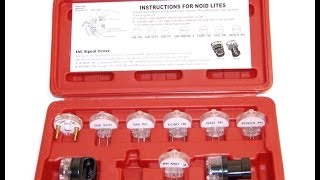
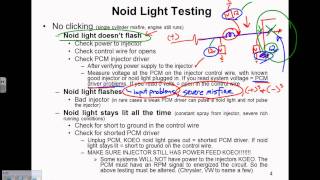
How to confirm: Visually inspect the wiring harness and connector for cylinder 3 for any signs of melting, chafing, or corrosion. Use a noid light plugged into the injector connector to verify the PCM is sending a pulse signal. If the light flashes, the wiring and PCM are likely good. 🎬 See this expert guide on testing injector circuits with noid lights
Typical fix: Repair the damaged section of wire or replace the connector pigtail.
Est. part cost: $15-$30 - Clogged or Dirty Fuel Injector ⚪ Low Probability → Shop Fuel Injector
How to confirm: This is less likely to cause an electrical code like P0203, which points to a circuit fault, not a flow issue. However, if electrical tests pass, a severely restricted injector could potentially cause erratic electrical readings. The definitive test is an injector flow bench test.
Typical fix: Professionally clean the fuel injector or replace it.
Est. part cost: $20-$100 (cleaning service), $40-$150 (replacement)
Rare But Worth Checking
- Faulty Powertrain Control Module (PCM): → Shop Engine Control Module (ECM) This should be the last resort after all other possibilities (injector, wiring) have been exhaustively tested and ruled out. A failed injector driver inside the PCM can cause this code, but it is uncommon.
Diagnosis Steps
- Scan the vehicle for codes. Confirm P0203 is present and note any other codes, especially P0303.
- Locate cylinder 3. On the 2.5L I4 engine, cylinders are numbered 1-2-3-4 from the passenger side (belt side) to the driver's side. On the 3.0L V6, the rear bank (against the firewall) is cylinders 1-2-3, and the front bank is 4-5-6, both numbered from passenger to driver side. Cylinder 3 is the rear, driver's side cylinder.
- Visually inspect the fuel injector connector and nearby wiring for any obvious damage, melting, or corrosion. On the V6, this will require a flashlight and mirror to see behind the intake manifold.
- With the engine off, disconnect the injector and measure its resistance with a multimeter. Compare the reading to a known good injector on the same engine. A reading of infinity (OL) or zero indicates a failed injector.
- Perform a 'noid light' test. Plug the noid light into the injector's electrical connector and start the engine. A steady, flashing light indicates the PCM and wiring are sending the command to fire. No light or a weak light points to a wiring or PCM issue.
- If the noid light flashes correctly and the injector resistance is good, swap the cylinder 3 injector with another cylinder (e.g., cylinder 2 on the V6, or cylinder 2/4 on the I4).
- Clear the codes, drive the vehicle, and rescan. If the code moves to the new cylinder (e.g., P0202), the fuel injector is confirmed to be faulty.
- If the code remains P0203 after swapping the injector, the problem lies in the wiring harness or the PCM. A continuity test of the wires between the injector connector and the PCM would be the next step.
Parts You'll Likely Need
- Fuel Injector
(OEM #2.5L I4: Motorcraft CM5138 (9L8Z-9F593-A) / 3.0L V6: Motorcraft CM5120 (8L8Z-9F593-B))— This is the most common failure component for a P0203 code.
Trusted brands: Motorcraft, Bosch, Standard Motor Products (SMP), GB Remanufacturing
OEM price range: $90-$150
Aftermarket price range: $40-$90 - Fuel Injector Connector Pigtail
(OEM #Motorcraft WPT-1051 (3U2Z-14S411-VAA))— If the plastic connector or its locking tab is broken, or if the wires are damaged right at the connector, replacing the pigtail is the correct repair. This part is widely used across many Ford models.
Trusted brands: Motorcraft, Dorman
OEM price range: $25-$40
Aftermarket price range: $15-$25
Related Codes That Often Appear With This One
- P0303 — This code means 'Cylinder 3 Misfire Detected.' Since P0203 indicates a problem with the fuel injector circuit for cylinder 3, that cylinder isn't getting the correct amount of fuel, which directly causes it to misfire.
- P0201, P0202, P0204 — If you see multiple injector circuit codes, it may point to a larger issue like a damaged wiring harness affecting several injector circuits, or a problem with the power supply or ground common to the injectors.
Technical Service Bulletins (TSBs) & Recalls
- TSB 16-0043: Addresses a fluid leak at the left side half-shaft seal on 6F35 transmissions. While not directly causing P0203, a significant fluid leak in this area could potentially contaminate nearby wiring harnesses over time.
- Bulletin #SSM 49759: While issued for other Ford models like the Expedition, this manufacturer bulletin notes that an illuminated MIL with codes P0201 through P0206 requires following specific Pinpoint Tests in the Powertrain Control/Emissions Diagnosis Manual.
Platform-Specific Known Issues
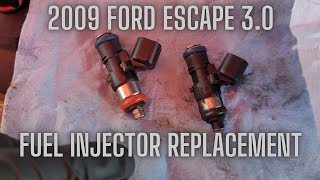
- 3.0L V6 Rear Injector Access: On the 3.0L V6 engine, cylinder 3 is on the rear bank, located under the upper intake manifold against the firewall. 🎬 Watch: How to replace fuel injectors on the 3.0L V6 Replacing this injector requires removing the intake manifold, which adds significant time (2-3 hours of labor) and complexity to the job compared to the easily accessible front injectors or the injectors on the 2.5L I4 engine.
Mechanic-Grade Diagnostic Values
- Fuel Injector Coil Resistance — expected: 11 - 18 Ohms. Failure: A reading of infinity (OL) indicates an open coil; a reading near zero indicates a shorted coil.
- Injector Connector Power Wire Voltage (Key On, Engine Off) — expected: ~12V (Battery Voltage). Failure: Voltage significantly below battery level or 0V points to a problem in the power supply wire (typically Red) or a related fuse/relay.
- Injector Pulse Width (Live Scan Data at Idle) — expected: 2.5 - 4.0 milliseconds (ms). Failure: A value of 0 ms on cylinder 3 while other cylinders show a normal pulse width indicates the PCM is not commanding the injector to fire, or the circuit is open.
- Injector Control Circuit Waveform (via Oscilloscope) — expected: A square wave pattern starting at battery voltage, dropping to ~0V during the pulse, followed by a sharp inductive kick (voltage spike) of 35-50V when the injector closes.. Failure: A flat line at battery voltage indicates an open circuit (bad injector or wire) or the PCM is not sending the ground signal. The absence of the inductive kick is the key indicator the PCM looks for.
Scan Tool Commands That Help
- Ford IDS (or equivalent professional scanner): Power Balance Test — This is a functional test that graphically displays the power contribution of each cylinder. For P0203, the graph will show a significant power drop for cylinder 3, confirming the misfire location and impact before any disassembly.
- Ford IDS (or equivalent professional scanner): Injector Buzz Test / KOEO Self-Test — With the Key On, Engine Off, this command manually fires each injector. You should hear an audible 'click' from the injector (best heard with a mechanic's stethoscope). If cylinder 3 is silent while others click, it points strongly to a bad injector or a complete open in the wiring.
Wiring & Ground Locations
- Cylinder 3 Injector Connector — On the 3.0L V6, it's on the rear bank (firewall side), driver's side cylinder. On the 2.5L I4, it's the third cylinder from the passenger side.. This is the primary point for testing resistance, voltage, and noid light signal. The power wire is typically Red (RD). The control wire (ground pulse from PCM) color varies by engine.
- PCM Connector C175E (3.0L V6) — One of the three main connectors at the Powertrain Control Module (PCM), located at the center rear of the firewall.. This connector contains the control wires for the rear bank of injectors (Cylinders 1, 2, 3). The Cylinder 3 Injector Control wire is located at Pin 57 (Brown/White wire). A continuity test between this pin and the injector connector pin will verify the wire's integrity.
- PCM Connector C175B (2.5L I4) — One of the three main connectors at the Powertrain Control Module (PCM), located at the center rear of the firewall.. This connector contains the control wires for the I4 injectors. The Cylinder 3 Injector Control wire is located at Pin 10 (White/Brown wire). A continuity test between this pin and the injector connector pin will verify the wire's integrity.
- Ground G101 (3.0L V6) — Located on the chassis near the battery.. A poor main engine ground can cause erratic electrical behavior across multiple systems, including the PCM and its sensor readings. It should be inspected for corrosion and tightness.
- Ground G109 — Located on the firewall in the rear of the engine compartment.. This is a critical ground point for the PCM and various engine sensors. A fault here can lead to unexplained electrical codes.
Model Year Variations Within This Range
- 2009-2012: In 2009, the base engine was upgraded from a 2.3L to a 2.5L I4, and the 3.0L V6 received updates including Variable Valve Timing (VVT). The transmission was also upgraded from a 4-speed to the 6F35 6-speed automatic. While the P0203 diagnosis is fundamentally the same, technicians should always verify wiring diagrams and pinouts specific to the model year and engine, as wire colors and PCM logic can have subtle differences.
Diagnostic Flowchart
Other Known Issues on This Vehicle
Issues unrelated to this code that are worth knowing about as an owner of this generation:
- 6F35 Transmission Failure 🔴 High — Widespread on 2009-2012 models. Issues include harsh shifting, slipping, shuddering, and complete failure, often before 100,000 miles. (Ref: Multiple TSBs issued, including TSB 16-0043 for a leaking half-shaft seal which can lead to fluid loss and damage.)
- Electronic Power Steering (EPAS) Failure 🔴 High — Very common issue where power steering assist is suddenly lost, making the vehicle difficult to steer at low speeds. (Ref: Recall 14S05 was issued to reprogram the PSCM and replace the steering torque sensor if fault codes were present.)
- Rusted Rear Shock Towers 🔴 High — Extremely common in regions using road salt. The upper rear shock mount area of the unibody rusts through, causing the shock to detach from the body. (Ref: No recall, but aftermarket repair kits are widely available as a common solution.)
- Electronic Throttle Body (ETB) Failure 🟠 Medium — Common failure causing the vehicle to enter a reduced-power 'limp mode'. (Ref: Ford issued Customer Satisfaction Program 13N03, extending the warranty on the ETB to 10 years or 150,000 miles.)
- Leaking Driver's Side Axle Seal 🟠 Medium — A frequent source of transmission fluid leaks on models with the 6F35 transmission. (Ref: TSB 14-0056 and TSB 16-0043 address this leak with an updated service kit.)
Used vs. New Parts: Buying Guide for This Vehicle
When a used part is the smart pick: A used fuel injector connector pigtail from a junkyard is an excellent, cost-effective choice if the original connector is broken or corroded. A complete used engine wiring harness can also be a viable option if multiple circuits are damaged. Used fuel injectors are a budget option but carry risk.
Donor-vehicle mileage cap: roughly under 80000 miles for the part to have meaningful remaining life.
What to inspect on the donor part:
- For injectors, ask for the donor vehicle's mileage. Lower is always better.
- For wiring, inspect the harness thoroughly for any signs of brittleness, melting, or previous repairs (e.g., splices wrapped in electrical tape).
- Ensure the locking tabs on any used connector are intact and click securely.
OEM-only on this vehicle (don't cheap out):
- Powertrain Control Module (PCM): While available rebuilt, avoid untested used units. A replacement PCM must be from a reputable rebuilder and will require programming to your vehicle's VIN and immobilizer system.
Aftermarket brands forum-validated for this vehicle:
- Injectors: Bosch, Standard Motor Products (SMP), GB Remanufacturing (for remanufactured units).
- Connectors: Dorman is a widely available and generally reliable source for connector pigtails.
Real Owner Stories
Aggregated from forums and TSBs cited above. Mileages and costs reflect what owners reported in those sources.
2012 Ford Escape
Symptoms: Check engine light came on while on the highway; previously fixed a cylinder misfire (P0203) by replacing the fuel injector but then received a P0102 code after reassembly.
What fixed it: Replacing the fuel injector (though the owner noted a secondary MAF sensor issue appeared after the intake manifold was reassembled).
Source hint: r/AskMechanics
2009 Ford Escape V6
Symptoms: Experienced codes P0203 and P0303 simultaneously.
What fixed it: Replacing the fuel injector on the rear bank (cylinder 3), which required removing the intake manifold.
Source hint: escape-city.com - 'P0303 and P0203'
2008 Ford Escape V6
Symptoms: P0203 code present.
What fixed it: The owner traced the issue to a wiring fault after performing diagnostic steps including a noid light test and checking continuity back to the PCM.
Source hint: ford-trucks.com - '2008 Escape V6 P0203'
NHTSA Reported Incident
Symptoms: An owner reported a misfire on cylinder 3 with code P0203 at 75,000 miles, which occurred after the transmission had already been replaced at 62,000 miles. The vehicle also displayed an overheat warning light intermittently while driving.
Source hint: NHTSA ODI #11351494
Cross-Manufacturer Reference (Ford Fusion)
Symptoms: A driver reported the vehicle losing power and needing to pull over immediately. Diagnostic codes pulled included P0010, P0201, P0202, P0203, and P0204. The dealer checked electrical connections and reassembled, but the issue recurred.
Source hint: NHTSA ODI #10405277
Related OBD-II Codes
Frequently Asked Questions
Where is cylinder 3 located on my 2008-2012 Ford Escape 3.0L V6?
Is it true that I have to remove the intake manifold to fix P0203 on the V6 engine?
Does TSB 16-0043 relate to my P0203 injector code?
How can I tell if the P0203 code is a bad injector or a PCM wiring issue on my Escape?
Can I swap injectors to test the P0203 code on the 2.5L I4 engine?
Are there any other common failures on the 2008-2012 Escape I should look out for while fixing this?
Helpful Videos

We Have This Part in Stock



The information in this article is provided for general reference and educational purposes only. Vehicle specifications, procedures, and part compatibility can vary by production date, trim level, and region. Always consult your vehicle's factory service manual and verify part numbers before purchasing or performing repairs. Safety-critical components such as airbags, seat belts, and braking systems should be installed by a qualified professional.
- Ford Escape:
- 🧭 Diagnostic Flowchart
- 🎬 Helpful Videos
- 🛍️ Shop This Part
- What's Unique About the 2008-2012 Ford Escape
- Symptoms You May Notice
- Most Likely Causes
- Rare But Worth Checking
- Diagnosis Steps
- Parts You'll Likely Need
- Related Codes That Often Appear With This One
- Technical Service Bulletins (TSBs) & Recalls
- Platform-Specific Known Issues
- Mechanic-Grade Diagnostic Values
- Scan Tool Commands That Help
- Wiring & Ground Locations
- Model Year Variations Within This Range
- Other Known Issues on This Vehicle
- Used vs. New Parts: Buying Guide for This Vehicle
- Real Owner Stories
- 2012 Ford Escape
- 2009 Ford Escape V6
- 2008 Ford Escape V6
- NHTSA Reported Incident
- Cross-Manufacturer Reference (Ford Fusion)
- Related OBD-II Codes
- Frequently Asked Questions
- 🎟️ Get 5% Off