

P0203 on 2011-2019 Ford Explorer 3.5L EcoBoost: Injector Circuit Malfunction Causes and Fixes
P0203 on a 2011-2019 Ford Explorer with the 3.5L EcoBoost engine indicates an electrical fault in the cylinder 3 fuel injector circuit. The most common cause is a failed fuel injector, followed by wiring issues. Replacing the injector is a moderately difficult DIY job due to its location under the upper intake manifold.
- P0203 is an electrical circuit fault for the cylinder 3 fuel injector.
- The most likely cause is a failed fuel injector, which can be confirmed by measuring its resistance (should be 0.5-2.0 ohms) or swapping it with another cylinder.
- A known wiring harness chafe point against an A/C line stud on the passenger side is a very common cause of this code and should be inspected thoroughly.
- Do not immediately replace the spark plug or ignition coil; this code is specific to the injector's electrical circuit.
- Accessing the #3 injector requires removing the upper intake manifold, making the job significantly more labor-intensive.
What's Unique About the 2011-2019 Ford Explorer
The 3.5L EcoBoost V6 in the Ford Explorer uses high-pressure gasoline direct injection (GDI), where fuel is sprayed directly into the combustion chamber at pressures that can exceed 2,000 PSI. This system's injectors operate on a lower resistance circuit (around 0.5-2.0 ohms) compared to traditional port injectors and are activated by a high-voltage signal (around 65V) from the PCM. For this engine, cylinder 3 is located in the rear bank (closest to the firewall), making access significantly more difficult as the upper intake manifold must be removed to reach the injector.
Symptoms You May Notice
- Check Engine Light is on
- Engine misfire or rough idle
- Poor acceleration and reduced engine performance
- Decreased fuel economy
- Engine may hesitate or stumble under load
- Fuel smell from the exhaust
- Replacing the spark plug or ignition coil for cylinder 3. While these parts can cause a misfire code (P0303), they will not cause an injector circuit code like P0203. The P0203 code is specific to the injector's electrical circuit, pointing to a fuel delivery problem, not a spark problem.
Most Likely Causes
- Faulty Cylinder 3 Fuel Injector 🔴 High Probability → Shop Fuel Injector Direct injectors operate under high pressure and temperature, leading to eventual electrical failure of the internal coil. Carbon buildup can also be a contributing factor to injector stress.
How to confirm: Measure the resistance of the injector with a multimeter; for these GDI injectors, it should be very low, typically between 0.5-2.0 ohms. An infinite reading (OL) means an open circuit. The most definitive test is to swap the cylinder 3 injector with another cylinder (e.g., cylinder 2). Clear the codes and run the engine. If the code changes to P0202, the injector is confirmed bad.
Typical fix: Replace the faulty fuel injector. It is often recommended to replace all injectors on the same bank (or all six) at the same time, especially on higher mileage vehicles, to ensure balanced fuel delivery.
Est. part cost: $75-$200 - Wiring Harness or Connector Issue 🟡 Medium Probability Engine vibrations and high heat in the engine bay can cause wires to chafe, break, or corrode over time. A known chafe point on this engine platform is where the harness can rub against an A/C line stud near the passenger-side valve cover.
How to confirm: Visually inspect the wiring harness leading to the cylinder 3 injector for any signs of damage, chafing, or melting, paying close attention to the area near the A/C lines on the passenger side. Check the connector for corrosion, bent pins, or a loose connection. Use a noid light to confirm the PCM is sending a pulse signal to the injector connector. If the noid light test fails, perform a continuity test on the two wires from the PCM 🎬 See how to diagnose the P0203 injector circuit fault. connector to the injector connector to find the open or short circuit.
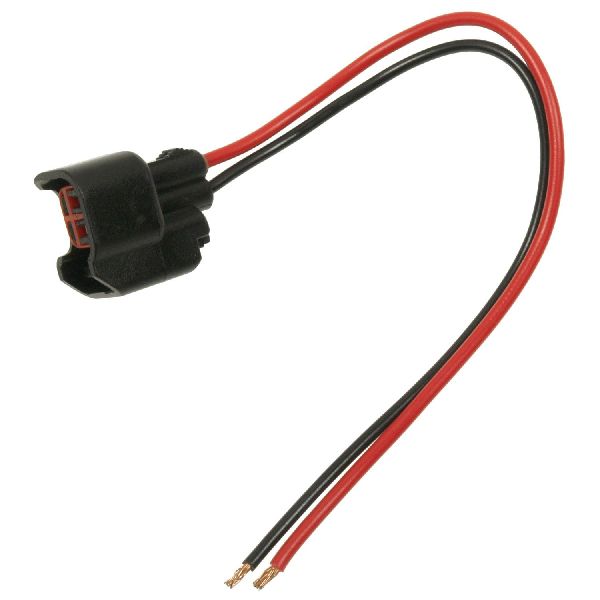
Typical fix: Repair the damaged section of the wiring harness or replace the injector pigtail connector. Clean any corrosion from the connector pins. If chafing is found on the A/C stud, Ford's fix for other platforms is to repair the wire and install a protective shield over the stud.
Est. part cost: $15-$50
Rare But Worth Checking
- Faulty Powertrain Control Module (PCM): → Shop Engine Control Module (ECM) This is the least likely cause. The PCM's internal driver for the injector can fail, but all other possibilities (injector, wiring) should be exhaustively ruled out first before considering PCM replacement. This is a last resort after confirming the injector and wiring are good.
Diagnosis Steps
- Read the trouble codes with an OBD-II scanner to confirm P0203 is present and note any other codes, like P0303.
- Visually inspect the wiring harness and connector for the cylinder 3 fuel injector. On the 3.5L V6, cylinder 3 is on the rear bank (against the firewall), on the passenger side. Pay special attention to the known chafe point where the harness may rub an A/C line stud near the passenger valve cover. This will require removing the upper intake manifold for proper access.
- Disconnect the injector and use a noid light to test for a signal from the PCM. The light should flash while the engine is cranked, indicating the control circuit is working. Note: The PCM may shut off the driver if it detects a fault; you may need to clear the codes first. Do not backprobe the connector while running, as this can damage the PCM.
- If a signal is present, test the fuel injector itself. Measure its internal resistance with a multimeter. For a GDI injector, it should be between 0.5-2.0 ohms. Compare the reading to a known-good injector on the same engine. A reading that is significantly different, open (OL), or shorted (near 0 ohms) indicates a bad injector.
- If the injector tests good but the noid light does not flash, check for continuity on the control wire between the injector connector and the PCM. Also, verify the power wire has battery voltage with the key on.
- As a final confirmation, swap the cylinder 3 injector with an injector from another cylinder (e.g., cylinder 4 on the front bank, which is easier to access again if needed). Clear the codes and run the engine. If the fault code moves to the new cylinder (e.g., P0204), the injector is faulty. If P0203 returns, the problem is in the wiring or PCM.
- If all wiring and the injector are confirmed to be good, the issue may be a rare failure of the PCM's injector driver, which can fail under heat or load while passing static tests.
Parts You'll Likely Need
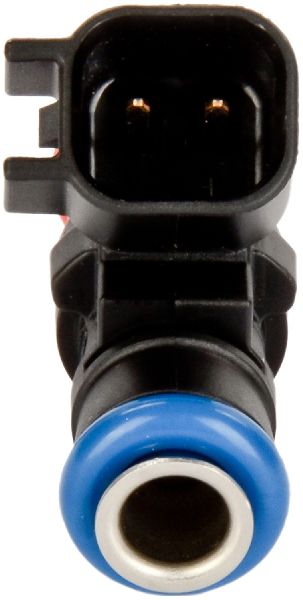
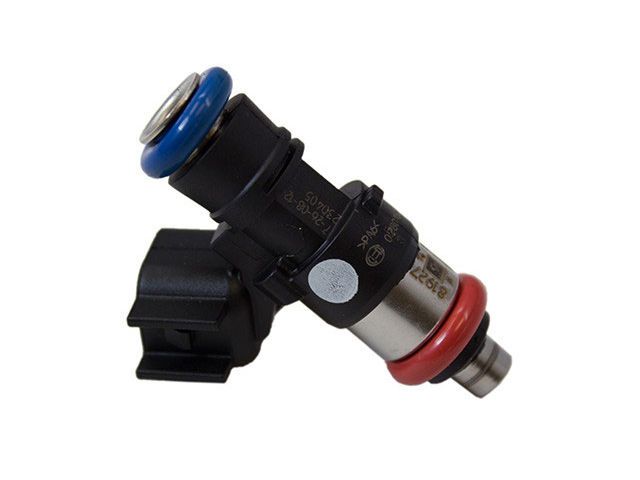
- Fuel Injector
(OEM #BL3E-9F593-HB (also BL3E-HB))— This is the most common component to fail for a P0203 code, due to an internal electrical fault in the injector's coil.
Trusted brands: Motorcraft, Bosch, Standard Motor Products
OEM price range: $120-$180
Aftermarket price range: $75-$130 - Upper Intake Manifold Gaskets — Required for reinstallation of the intake manifold after accessing the rear fuel injectors. These are typically single-use and should be replaced to prevent vacuum leaks.
Trusted brands: Motorcraft, Fel-Pro, Mahle
OEM price range: $20-$40
Aftermarket price range: $15-$30
Related Codes That Often Appear With This One
- P0303 — P0303 means 'Cylinder 3 Misfire Detected.' Since P0203 indicates an electrical fault stopping the injector from firing, the cylinder does not receive fuel, which directly causes a misfire. P0203 is the cause, and P0303 is the effect.
Technical Service Bulletins (TSBs) & Recalls
- TSB 22-2223 — While officially for 2021-2022 F-150s with the 3.5L EcoBoost, this TSB is highly relevant as it identifies a critical design issue where the engine wiring harness can rub against a stud on the A/C suction hose near the passenger side valve cover. This chafing causes wires to short or break, leading to injector circuit codes like P0203. This location should be a primary inspection point on the Explorer as well.
- Bulletin #SSM 49759 — This manufacturer bulletin notes that an illuminated malfunction indicator lamp (MIL) may occur with diagnostic trouble codes P0201, P0202, P0203, P0204, P0205 or P0206, and directs technicians to follow specific pinpoint tests in the PC/ED manual.
Platform-Specific Known Issues
- Access to the rear bank of injectors (including cylinder 3) on the transversely mounted 3.5L V6 requires the removal of the upper intake manifold, making the repair more time-consuming than for the front bank. 🎬 Watch: Step-by-step guide to removing the intake manifold for access.
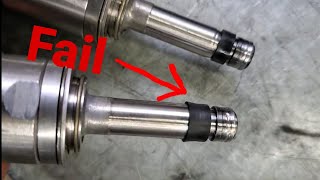
- When replacing injectors, it is critical to also replace the Teflon seals and use the special tools designed for their installation to prevent high-pressure fuel leaks.
Mechanic-Grade Diagnostic Values
- GDI Fuel Injector Resistance — expected: 0.5 - 2.0 Ohms. Failure: An open circuit (OL on multimeter) or a reading significantly outside the expected range.
- High-Pressure Fuel Rail Pressure (GDI) — expected: Approx. 500 PSI at idle, rising to over 2,000 PSI under load. Max system pressure is around 2,150 PSI.. Failure: Actual pressure consistently lagging more than 200 PSI below requested pressure on a scan tool.
- Low-Pressure Fuel System Pressure — expected: 40 - 60 PSI. Failure: Pressure dropping below 40 PSI, which can starve the high-pressure pump.
- Injector Activation Voltage — expected: Approx. 65 Volts (pulsed by PCM). Failure: This is a reference value. Direct measurement is not recommended as back-probing the connector can damage the PCM. A noid light is the correct tool to verify the pulse signal.
Scan Tool Commands That Help
- Ford IDS (or equivalent high-end scanner): Power Balance Test — To graphically confirm which cylinder is not contributing power. For P0203, the graph will show a significant power drop for cylinder 3, verifying the misfire location before disassembly.
- Ford IDS (or equivalent high-end scanner): Injector Buzz Test / Actuator Test — With the engine off, this command manually fires each injector. You should hear an audible 'click' from the injector with a stethoscope. If cylinder 3 is silent while others click, it confirms a failure in the injector or its immediate wiring.
Wiring & Ground Locations
- Engine Harness Chafe Point — Near the passenger-side valve cover, where the engine wiring harness can make contact with a metal stud on the A/C suction hose or hose crimp.. This is a known failure point on the 3.5L EcoBoost platform. Abrasion can wear through the insulation on the injector control wire, causing a short to ground or an open circuit, directly triggering P0203.
- Main Engine Ground — Typically located on the firewall on the passenger side where the main engine harness connects.. A loose or corroded main ground can introduce electrical noise and voltage drops throughout the system, potentially causing intermittent and difficult-to-diagnose injector circuit faults.
"I Checked Everything" — The Actual Cause
- The electrical equivalent for P0203 is when basic tests pass but the code returns. A scenario described by technicians is when a noid light flashes correctly and the injector's resistance measures within spec at idle, yet the P0203 code persists, especially under load. This often points to a weak PCM injector driver. The internal transistor in the PCM fails when it gets hot or is under the dynamic load of a running engine, even though it passes simple static or low-load tests.
OEM Part Supersession History
BL3E-9F593-HB (or BL3E-HB)→BL3Z-9F593-A, then BL3Z-9F593-B. The Motorcraft service part number is often CM5211.— Standard part revisions for improved reliability or manufacturing changes.
Model Year Variations Within This Range
- 2011-2019: While the 3.5L EcoBoost engine family saw a major update around 2017 (Gen 2) which added port fuel injection, this change was primarily for the F-150. The Ford Explorer Sport and Platinum trims continued to use the first-generation style GDI-only 3.5L EcoBoost engine throughout the 2011-2019 model run. Therefore, for this specific vehicle, P0203 always refers to the high-pressure GDI injector.
Diagnostic Flowchart
Other Known Issues on This Vehicle
Issues unrelated to this code that are worth knowing about as an owner of this generation:
- Internal Water Pump Failure 🔴 High — Commonly occurs between 80,000 and 150,000 miles. Failure allows coolant to mix with engine oil, leading to catastrophic engine damage if not caught early via the external weep hole.
- Power Transfer Unit (PTU) Failure 🔴 High — Can fail under 100,000 miles on AWD models. The unit's fluid overheats due to proximity to the catalytic converter and lack of a drain plug for service on early models, leading to gear oil breakdown and failure.
- Timing Chain Stretch and Phaser Rattle 🟠 Medium — Primarily affects earlier models (approx. 2011-2015). Causes a distinct rattle on cold starts for 2-5 seconds. Can lead to timing-related codes (like P0016) and eventual engine damage if ignored. (Ref: TSB 18-2305)
- Intake Valve Carbon Buildup 🟠 Medium — An inherent issue with all GDI engines. Oil vapors from the PCV system bake onto the intake valves over time, causing misfires, hesitation, and reduced performance, typically noticeable after 60,000-100,000 miles.
- Cracked Flex Plate 🟠 Medium — Some owners report a rhythmic ticking or knocking sound from the transmission bellhousing area, which is traced to cracks in the flexplate. Requires transmission removal to replace.
Used vs. New Parts: Buying Guide for This Vehicle
When a used part is the smart pick: A used part is a reasonable choice for a wiring harness pigtail or a section of the engine harness sourced from a reputable auto recycler. These components have low failure rates unless physically damaged.
Donor-vehicle mileage cap: roughly under 80000 miles for the part to have meaningful remaining life.
What to inspect on the donor part:
- For wiring: Check for any signs of previous repair, brittleness in the plastic loom, or corrosion on the connector pins.
- Ensure the donor vehicle was not in a front-end collision that could have stressed the harness.
OEM-only on this vehicle (don't cheap out):
- Fuel Injector: Due to the high pressures and tight tolerances of the GDI system, using an OEM (Motorcraft) or original equipment manufacturer (Bosch) injector is critical. Cheap, unbranded aftermarket injectors are known to have inconsistent flow rates and high failure rates, leading to repeat repairs and potential engine damage.
Aftermarket brands forum-validated for this vehicle:
- Bosch (often the OE manufacturer for Motorcraft)
- Standard Motor Products (for connectors/pigtails)
Brands owners have reported issues with on this vehicle:
- Unbranded, no-name injectors from online marketplaces like eBay or Amazon. While inexpensive, their quality control is often non-existent.
Real Owner Stories
Aggregated from forums and TSBs cited above. Mileages and costs reflect what owners reported in those sources.
Ford Truck (3.5L EcoBoost)
Symptoms: Persistent P0203 code even after changing the injector twice and testing the wiring.
What fixed it: The discussion suggests the issue may be a PCM fault or requires deeper wiring harness tracing if the injector and basic wiring tests pass.
Source hint: Ford Truck Enthusiasts Forum - P0203. I have changed the injector twice and tested the wiring. (https://www.ford-trucks.com/forums/1624843-p0203-i-have-changed-the-injector-twice-and-tested-the-wiring.html)
Ford Truck (3.5L EcoBoost)
Symptoms: Vehicle experiencing both P0203 and P0303 codes simultaneously.
What fixed it: The P0203 injector circuit fault was identified as the root cause for the P0303 misfire, confirming the problem was in the injector circuit rather than ignition components.
Source hint: Ford Truck Enthusiasts Forum - PO203 and PO303 Help (https://www.ford-trucks.com/forums/1000222-po203-and-po303-help.html)
NHTSA ODI #11351494
Symptoms: An owner reported a misfire on cylinder 3 with code P0203 at 75,000 miles, following a previous transmission replacement. The vehicle also displayed an overheat warning light that would intermittently turn on and off while driving.
NHTSA ODI #10405277
Symptoms: A driver reported that the vehicle had to be pulled over immediately after pulling codes P0010, P0201, P0202, P0203, and P0204. The dealer checked electrical connections and reassembled, but the issue recurred.
Related OBD-II Codes
Frequently Asked Questions
Where is the cylinder 3 fuel injector located on my 3.5L EcoBoost Explorer?
Is there a known wiring issue that causes P0203 on this platform?
What should the resistance be for a 2011-2019 Explorer 3.5L EcoBoost fuel injector?
Can I just replace the one faulty injector, or should I do all of them?
Are there special tools required for this repair?
Could my P0203 code be related to the common water pump failure on this engine?
Helpful Videos
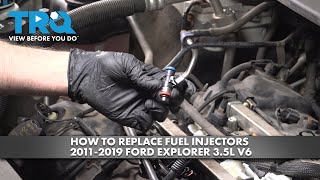
We Have This Part in Stock


The information in this article is provided for general reference and educational purposes only. Vehicle specifications, procedures, and part compatibility can vary by production date, trim level, and region. Always consult your vehicle's factory service manual and verify part numbers before purchasing or performing repairs. Safety-critical components such as airbags, seat belts, and braking systems should be installed by a qualified professional.
- Ford Explorer:
- 🧭 Diagnostic Flowchart
- 🎬 Helpful Videos
- 🛍️ Shop This Part
- What's Unique About the 2011-2019 Ford Explorer
- Symptoms You May Notice
- Most Likely Causes
- Rare But Worth Checking
- Diagnosis Steps
- Parts You'll Likely Need
- Related Codes That Often Appear With This One
- Technical Service Bulletins (TSBs) & Recalls
- Platform-Specific Known Issues
- Mechanic-Grade Diagnostic Values
- Scan Tool Commands That Help
- Wiring & Ground Locations
- "I Checked Everything" — The Actual Cause
- OEM Part Supersession History
- Model Year Variations Within This Range
- Other Known Issues on This Vehicle
- Used vs. New Parts: Buying Guide for This Vehicle
- Real Owner Stories
- Ford Truck (3.5L EcoBoost)
- Ford Truck (3.5L EcoBoost)
- NHTSA ODI #11351494
- NHTSA ODI #10405277
- Related OBD-II Codes
- Frequently Asked Questions
- 🎟️ Get 5% Off