

P0203 on 1997-2001 Jeep Cherokee 4.0L: Injector Circuit Malfunction Causes and Fixes
On a 1997-2001 Jeep Cherokee with the 4.0L engine, code P0203 almost always points to a failed #3 fuel injector, often due to heat soak. Replacement is straightforward and a common DIY job. Expect to pay $40-$70 for a single aftermarket injector or consider a popular 4-hole or 12-hole Bosch upgrade for all six.
- P0203 on a 1997-2001 Cherokee 4.0L specifically means an electrical fault in the cylinder 3 injector circuit, not a spark or compression issue.
- The most common cause is a failed #3 fuel injector, often triggered by 'heat soak' from the exhaust manifold.
- Diagnosis is straightforward: check injector resistance with a multimeter (12-15 ohms is good) or swap the injector to another cylinder to see if the code follows.
- A popular and recommended fix is to upgrade all six injectors to a modern 4-hole or 12-hole design for improved performance and reliability.
- Always inspect the wiring harness for chafing against the fuel rail, as this is a known, though less common, cause.
What's Unique About the 1997-2001 Jeep Cherokee
The Jeep Cherokee XJ with the 4.0L inline-six is legendary for its durability, but its engine bay components are now decades old. The primary issue leading to a P0203 code is often related to heat and age. The fuel injectors and their wiring harnesses are subjected to constant heat cycles, which can cause the injector's internal coil to fail or the wiring and connectors to become brittle and crack. A common failure mode is 'heat soak,' where an injector works when cold but fails once the engine warms up and is shut down for 15-20 minutes. The #3 injector is particularly susceptible because it sits directly over the hot exhaust manifold, leading to fuel vaporization within the injector after shutdown.
Symptoms You May Notice
- Check Engine Light is on
- Rough or unstable idle
- Engine misfire (may feel like a stumble or shake)
- Poor acceleration and loss of power
- Decreased fuel economy
- Engine may stall
- Engine stumbles or runs rough for 20-30 seconds on a hot restart (heat soak)
- Replacing the spark plug or ignition components for cylinder 3. While these parts can cause a misfire (code P0303), they will not trigger an injector circuit code like P0203. The P0203 code specifically points to an electrical fault in the fuel injector circuit.
Most Likely Causes
- Failed Cylinder 3 Fuel Injector 🔴 High Probability → Shop Fuel Injector The injectors are located directly above the hot intake and exhaust manifolds. Years of heat cycles can cause the internal coil windings to develop an open circuit, especially when hot (a condition known as 'heat soak'). The #3 injector is the most common to fail this way due to its position over the exhaust manifold.
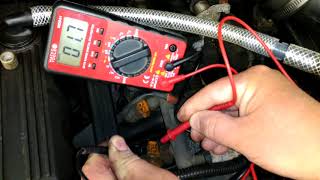
How to confirm: With the engine running, unplug the electrical connector for injector #3; if there is no change in how the engine runs, the injector is likely dead. A more definitive test is to measure the resistance across the two terminals of the injector with a multimeter. A good 1997 injector should read 13.3-15.7 ohms, while a 1998-2001 injector should read 10.8-13.2 ohms. An 'open' or infinite reading (OL) confirms it's bad. A reading of zero ohms indicates a short. 🎬 Watch: How to test a Jeep 4.0 fuel injector
Typical fix: Replace the faulty fuel injector. Many owners choose to replace all six at once with upgraded 4-hole or 12-hole injectors for better fuel atomization and smoother idle. This is a well-documented and popular community upgrade. 🎬 Watch: Upgrading to 4-hole injectors and replacing harness plugs
Est. part cost: $40-$70 for a single aftermarket injector, $150-$250 for a set of six upgraded Bosch-style injectors. - Damaged Wiring or Connector 🟡 Medium Probability Similar to the injector itself, the plastic connector and wiring insulation become brittle from age and heat. The locking tab on the connector can easily break, leading to a poor connection. Wires can also chafe against the fuel rail or other components, causing a short to ground.
How to confirm: Visually inspect the wiring harness and the connector for injector #3. Look for cracks, exposed copper wire, or a loose-fitting connector. A common point of failure is where the harness rubs against the back of the fuel rail. Use a 'noid light'—a special tool that plugs into the injector connector—to verify the PCM is sending a pulse. If the noid light flashes while cranking the engine, the wiring and PCM are likely good.
Typical fix: If the connector is broken, replace it with a new pigtail connector. If the wire is damaged, repair the broken section, ensuring the connection is sealed against moisture. Some owners have found the #3 injector wire shorted to ground on the fuel rail.
Est. part cost: $10-$20 for a new connector pigtail.
Rare But Worth Checking
- Faulty Powertrain Control Module (PCM): → Shop Engine Control Module (ECM) This is the least likely cause. Before condemning the PCM, all other possibilities (the injector and wiring) must be exhaustively ruled out. A failure of the injector driver circuit inside the PCM can cause this code. A noid light test that shows no pulse at the connector is a key indicator that the PCM or wiring is the issue, not the injector itself.
Diagnosis Steps
- Scan for codes. Confirm P0203 is present, and note any other codes like P0303.
- Perform a quick 'balance test'. With the engine idling, carefully unplug the electrical connector for the #3 fuel injector. If the engine's idle does not change, it confirms that cylinder was not contributing, likely due to a dead injector.
- Inspect the wiring. Carefully examine the connector and the wires going to the #3 injector. Look for any signs of cracking, melting, or loose connections. Pay close attention to where the harness may rub against the fuel rail.
- Test the injector resistance. Disconnect the injector and use a multimeter set to Ohms (Ω) to measure the resistance between the two pins on the injector itself. For 1997 models, expect 13.3-15.7 Ohms. For 1998-2001 models, expect 10.8-13.2 Ohms. A reading of infinity (OL) means the injector is open and bad.
- Test the circuit with a noid light. Plug a noid light into the injector's electrical connector. Crank the engine. A steady flashing light confirms the PCM and wiring are sending the signal to fire the injector, pointing to a bad injector. No light or a steady light points to a wiring or PCM problem.
- Swap injectors. If you don't have a noid light, you can swap the #3 injector with an adjacent one (like #2 or #4). Clear the codes and run the engine. If the code changes to P0202 or P0204, you have confirmed the injector is the faulty part. If the code remains P0203, the problem is in the wiring or PCM.
Parts You'll Likely Need
- Fuel Injector
(OEM #04854181)— This is the most common failure point for a P0203 code on the 4.0L engine due to age and heat exposure.
Trusted brands: Mopar, Bosch, Standard Motor Products
OEM price range: $95-$120
Aftermarket price range: $40-$70 - Upgraded Fuel Injector Set (4-hole or 12-hole)
(OEM #Bosch 0280155784 (4-hole), Bosch 0280156161 (12-hole))— A very popular and well-regarded upgrade in the Jeep community. These provide better fuel atomization, leading to a smoother idle, better throttle response, and potentially improved MPG. Many owners replace all six injectors at once when one fails. 🎬 See this step-by-step fuel injector replacement tutorial
Trusted brands: Bosch (remanufactured/flow-matched sets are common)
OEM price range: N/A
Aftermarket price range: $150-$250 for a set of 6 - Fuel Injector Connector Pigtail — The original plastic connector often becomes brittle and breaks when being disconnected, or fails to make a secure connection, causing an open circuit.
Trusted brands: Dorman, Standard Motor Products
OEM price range: N/A
Aftermarket price range: $10-$20
Related Codes That Often Appear With This One
- P0303 — P0303 means 'Cylinder 3 Misfire Detected'. Since P0203 indicates the injector isn't firing correctly, the cylinder isn't getting fuel, which directly causes a misfire. These two codes almost always appear together.
Technical Service Bulletins (TSBs) & Recalls
- TSB 18-031-03: Addresses cylinder #3 misfire (P0303) on 2000-2001 models due to heat soak. The official fix is to install a special insulator sleeve on the #3 fuel injector to shield it from exhaust manifold heat.
Platform-Specific Known Issues
- A well-documented issue is 'heat soak', where an injector fails only after the engine is hot and has been shut off for a short period (15-30 minutes). Upon restart, the engine misfires and throws the code. This points directly to an injector with an internal winding that opens up when hot.
- There was a Technical Service Bulletin (TSB 18-031-03) for 2000-2001 models specifically for a cylinder #3 misfire (P0303) caused by heat soak. The fix was to install a fuel injector insulator sleeve on the #3 injector to shield it from exhaust manifold heat. While this TSB addresses the misfire, the underlying cause is the heat affecting the injector, which can also lead to the P0203 electrical fault.
- The wiring harness is known to rub against the fuel rail, which can wear through the insulation and cause the #3 injector wire to short out. This has been documented by owners on forums like NAXJA.
Mechanic-Grade Diagnostic Values
- Fuel Pressure (at fuel rail test port) — expected: 49.2 +/- 5 PSI. Failure: Pressure significantly below 44 PSI indicates a weak pump or faulty regulator. Pressure that drops quickly after shutdown indicates a leaking injector or bad check valve.
- Fuel Injector Coil Resistance (1997 models) — expected: 13.3 - 15.7 Ohms. Failure: A reading of 'OL' (infinite) or significantly outside this range indicates a bad injector.
- Fuel Injector Coil Resistance (1998-2001 models) — expected: 10.8 - 13.2 Ohms. Failure: A reading of 'OL' (infinite) or significantly outside this range indicates a bad injector.
- Injector Pulse Width (at warm idle) — expected: 2.5 - 4.8 ms. Failure: Values far outside this range suggest a fueling problem but do not directly diagnose the P0203 circuit fault.
- Injector Power Supply Voltage (at connector, engine running) — expected: ~14 Volts (Battery Voltage). Failure: Low or no voltage on the Dark Green/Orange wire points to an issue with the ASD relay or power feed wiring.
Scan Tool Commands That Help
- DRB III (or equivalent professional scanner): Fuel Injector Kill Test / Actuator Test — This command allows a technician to individually disable the #3 injector. If there is no change in engine RPM or sound when the injector is 'killed,' it confirms that cylinder was not contributing, pointing towards a problem with that injector or its circuit.
Wiring & Ground Locations
- G101 — Two bolts on the engine block near the alternator on the passenger side.. This is a primary ground point for the PCM and TCM. A poor connection here can cause a wide range of erratic electronic issues, including injector driver faults.
- Dipstick Tube Stud Ground — A stud on the engine block used to mount the oil dipstick tube.. This is a critical ground point for the fuel injectors and multiple engine sensors. A loose or corroded connection here is a well-known cause of mysterious misfires and injector codes on the 4.0L engine.
- G106 — On the fender near the PCM (passenger side firewall area).. Provides a chassis ground for components in the vicinity of the PCM.
- Injector Power Feed Splice — Inside the main engine wiring harness.. All injectors receive power from a single wire (Dark Green/Orange) that is spliced inside the harness. While not a common failure, corrosion at this internal splice could cause power issues to one or more injectors.
Real Owner Repair Stories
- Jeep Cherokee Forum user 'bus68us' (2001 Jeep Cherokee 4.0L) — Misfire and P0203 code, particularly after a hot soak (engine warmed up, shut off for 15 mins, then restarted).
❌ Tried (didn't work) Initial diagnosis pointed towards heat-related failure.
✅ What actually fixed it The user identified the symptoms as classic heat soak of an injector. Replacing the faulty fuel injector resolved the issue. - Jeep Cherokee Forum user 'Stinkfoot' (2000 Jeep Cherokee 4.0L) — Repeatedly frying the #1 injector driver in the PCM, causing a misfire (P0201). The vehicle would run fine after a PCM swap, then fail again after sitting overnight.
❌ Tried (didn't work) Replacing the PCM (worked temporarily but failed again)., Testing wiring harness continuity (checked out okay).
✅ What actually fixed it The suspected root cause was the #1 fuel injector's internal coil failing in a way that drew excessive amperage, overheating and destroying the driver circuit in the PCM. The final fix, though not explicitly confirmed in the thread, is to replace the faulty injector *before* installing another new PCM.
OEM Part Supersession History
rl854181→04854181— Standard part number update/replacement.OEM Siemens Deka (EV1 style connector)→OEM Siemens Deka (EV6 style connector)— Connector style updated by Chrysler for improved connection.
Heads up: 1997 to mid-1998 models use an EV1 connector (rectangular, push-to-release tab on top). Late 1998 to 2001 models use an EV6 connector (oval, side-slide locking clip). The injectors are not interchangeable without changing the harness-side connectors.
Model Year Variations Within This Range
- 1997 vs 1998-2001: The specified resistance for the stock fuel injectors is different. 1997 models require 13.3-15.7 Ohms, while 1998-2001 models use injectors with a 10.8-13.2 Ohm resistance.
- Late 1998: The fuel injector electrical connector style changed from EV1 to EV6. This is a critical difference when ordering replacement injectors.
- 2000-2001: These models feature a distributorless ignition system with a coil rail instead of a distributor and plug wires. They also use a different cylinder head (casting #0331) and a different PCM. While the P0203 diagnosis is fundamentally the same, the PCM part number and some surrounding engine components are different from 1997-1999 models.
Diagnostic Flowchart
Other Known Issues on This Vehicle
Issues unrelated to this code that are worth knowing about as an owner of this generation:
- Cracked 0331 Cylinder Head 🔴 High → Shop Engine Cylinder Head — Very common on 2000-2001 models with the '0331' casting number. The crack typically forms between cylinders 3 and 4, leading to coolant mixing with oil ('milkshake'). Can occur any time after 100,000 miles.
- Rear Main Seal Leak 🟠 Medium — Extremely common across all years of the 4.0L engine. It is often described as a feature, not a bug. The two-piece seal design is prone to leaking oil where the engine meets the transmission.
- Faulty Neutral Safety Switch (NSS) 🟡 Low — Common on all XJs with an automatic transmission. The switch, located on the side of the transmission, gets contaminated with dirt and grease, causing no-start conditions or loss of reverse lights. Usually fixed by cleaning, not replacement.
- Leaking Oil Filter Adapter O-Rings 🟡 Low — A very frequent oil leak source. The O-rings for the oil filter adapter housing, where it bolts to the engine block, become hard and brittle over time, causing a significant oil leak that can be mistaken for a rear main seal leak.
- Failed A/C Evaporator Core 🟠 Medium — A common failure point for the air conditioning system. The evaporator core is located inside the HVAC box under the dashboard and is a labor-intensive (8-10+ hours) job to replace, requiring removal of the entire dashboard assembly.
- Cracked Exhaust Manifold 🟠 Medium — The factory exhaust manifolds are prone to cracking due to heat cycles, causing an exhaust leak, ticking noises, and potentially allowing exhaust fumes into the cabin.
Used vs. New Parts: Buying Guide for This Vehicle
When a used part is the smart pick: A used wiring harness or injector connector pigtail from a junkyard can be a smart choice, as new harnesses can be expensive or discontinued. This allows for repairing a specific damaged section without replacing the entire harness.
Donor-vehicle mileage cap: roughly under 150000 miles for the part to have meaningful remaining life.
What to inspect on the donor part:
- For wiring harnesses, check for flexibility; avoid any that are stiff, cracked, or have brittle plastic loom.
- Inspect connectors for broken locking tabs, corrosion on the pins, or signs of melting.
- If possible, find a donor vehicle that appears well-maintained or has been recently taken out of service, rather than one that has sat exposed to the elements for years.
OEM-only on this vehicle (don't cheap out):
- Powertrain Control Module (PCM): While remanufactured units are available, they have a mixed reputation in the Jeep community. Sourcing a correct, used OEM unit from a matching year/engine/transmission vehicle is often considered a more reliable, if riskier, option than a low-quality reman.
Aftermarket brands forum-validated for this vehicle:
- Bosch: Widely recommended by the community for 4-hole and 12-hole injector upgrades (e.g., Bosch #784 for EV6 models) which are known to improve idle and throttle response.
Real Owner Stories
Aggregated from forums and TSBs cited above. Mileages and costs reflect what owners reported in those sources.
2000 Jeep Cherokee 4.0L
Symptoms: The engine stumbles or runs rough for 20-30 seconds specifically during a hot restart.
What fixed it: Replaced the #3 fuel injector which had an internal winding that opened up when hot.
Source hint: Jeep Cherokee Forum - cherokeeforum.com thread 'Injector swap, 00', P0203 code'
1997-2001 Jeep Cherokee 4.0L
Symptoms: P0203 code present; diagnosis found the injector circuit was shorted.
What fixed it: Repaired the injector wiring harness where it had rubbed through against the fuel rail.
Source hint: NAXJA Forums - naxja.org thread 'p0203 code, need help'
2000-2001 Jeep Cherokee 4.0L — ~100000 miles
Symptoms: Cylinder #3 misfire caused by heat soak from the exhaust manifold.
What fixed it: Installed a fuel injector insulator sleeve on the #3 injector per the technical service bulletin.
Source hint: TSB 18-031-03
Related OBD-II Codes
Frequently Asked Questions
Does TSB 18-031-03 apply to my 1997 Jeep Cherokee?
What should the resistance be for a fuel injector on a 1999 Cherokee 4.0L?
Is there a specific part recommended to prevent P0203 heat soak issues on the 2000-2001 XJ?
Can I upgrade my injectors to fix this issue, and what is the cost?
Where is the most common place for the injector wiring to fail on the 4.0L PowerTech I6?
Why is the #3 injector more prone to P0203 than the others on my Jeep?
Helpful Videos
We Have This Part in Stock


The information in this article is provided for general reference and educational purposes only. Vehicle specifications, procedures, and part compatibility can vary by production date, trim level, and region. Always consult your vehicle's factory service manual and verify part numbers before purchasing or performing repairs. Safety-critical components such as airbags, seat belts, and braking systems should be installed by a qualified professional.
- Jeep Cherokee:
- 🧭 Diagnostic Flowchart
- 🎬 Helpful Videos
- 🛍️ Shop This Part
- What's Unique About the 1997-2001 Jeep Cherokee
- Symptoms You May Notice
- Most Likely Causes
- Rare But Worth Checking
- Diagnosis Steps
- Parts You'll Likely Need
- Related Codes That Often Appear With This One
- Technical Service Bulletins (TSBs) & Recalls
- Platform-Specific Known Issues
- Mechanic-Grade Diagnostic Values
- Scan Tool Commands That Help
- Wiring & Ground Locations
- Real Owner Repair Stories
- OEM Part Supersession History
- Model Year Variations Within This Range
- Other Known Issues on This Vehicle
- Used vs. New Parts: Buying Guide for This Vehicle
- Real Owner Stories
- 2000 Jeep Cherokee 4.0L
- 1997-2001 Jeep Cherokee 4.0L
- 2000-2001 Jeep Cherokee 4.0L — ~100000 miles
- Related OBD-II Codes
- Frequently Asked Questions
- 🎟️ Get 5% Off