

P0204 on 2009-2017 Chevrolet Traverse: Cylinder 4 Injector Circuit Causes and Fixes
P0204 on a Traverse 3.6L V6 indicates an electrical fault with the cylinder 4 fuel injector. The most common causes are a damaged wire in the harness or a failed injector. Crucially, cylinder 4 is on the rear bank of the engine (near the firewall), requiring removal of the intake manifold for access. This makes it a more involved repair than a front-bank cylinder. A known TSB points to harness chafing as a frequent culprit.
- P0204 is an electrical circuit code for the #4 fuel injector, not a misfire code (though it causes a misfire).
- Always inspect the wiring harness for chafing near the injector, as this is a known issue on the Traverse.
- Cylinder #4 is on the front bank near the radiator, making it much easier to access than cylinders 1, 3, or 5.
- The easiest way to confirm a bad injector is to swap it with a neighboring one (like #2 or #6) and see if the code follows.
- Driving with this code can cause expensive damage to your catalytic converter over time.
What's Unique About the 2009-2017 Chevrolet Traverse
For the first-generation Traverse and its Lambda platform mates (Acadia, Enclave, Outlook) with the 3.6L V6, this code has two key platform-specific details. First, General Motors issued a Technical Service Bulletin (TSB PIP4924D) highlighting that the injector wiring harness is prone to chafing against engine components. According to TSB Bulletin #PIP4924D, technicians may find DTC P0204 along with other injector circuit codes like P0201 through P0206 or P2146, often accompanied by a Service Engine Soon Malfunction Indicator Lamp and a misfire. A related and often overlooked issue is that a broken underhood fuse box mounting bracket can allow the entire harness to sag and rub, leading to this exact problem. Second, and most importantly for repair, the engine is mounted transversely, and cylinder #4 is located on the rear bank (Bank 2), closest to the firewall. This makes it significantly harder to access, as diagnosis and replacement require removing the entire upper intake manifold.
Symptoms You May Notice
- Check Engine Light is on
- Rough, shaking idle
- Engine misfiring or stumbling on acceleration
- Noticeable loss of power
- Reduced fuel economy
- Engine may stall
- Replacing the spark plug or ignition coil for cylinder 4. While these can cause a misfire (P0304), they will not cause an injector circuit code (P0204). The P0204 code is specifically for an electrical fault in the injector circuit.
- Replacing the fuel injector without thoroughly inspecting the wiring harness first. Given the known TSB and harness chafe issues on this platform, the wiring is a more likely culprit than the injector itself.
Most Likely Causes
- Injector Wiring Harness or Connector Damaged 🔴 High Probability → Shop Engine Wiring Harness GM TSB PIP4924D specifically notes that the injector harness on the 3.6L V6 can chafe against the intake manifold, valve cover bolts, or fuel lines. TSB Bulletin #PIP4924D confirms that this chafing can trigger a wide range of codes including P0204, P0264, and P2149. A common contributing factor on this platform is a broken plastic mounting bracket for the underhood fuse box, which allows the harness to move excessively and rub through. Forum users have found wires chafed against the transmission bell housing as well.
How to confirm: Visually inspect the wiring harness leading to the rear bank. Check the integrity of the fuse box mounting bracket. Wiggle the harness with the engine running to see if the misfire changes. A noid light can be plugged into the connector to verify if the PCM is sending a pulse signal; no flash or a constantly lit light points to a wiring or PCM issue.
Typical fix: If a damaged section of wire is found, repair it using solder and heat-shrink tubing. If the connector is damaged, replace the connector pigtail. Secure the harness away from sharp edges or moving parts. If the fuse box bracket is broken, it must be repaired or replaced to prevent recurrence.
Est. part cost: $10-$50 - Faulty Fuel Injector #4 🟡 Medium Probability → Shop Fuel Injector Direct injection (DI) injectors on both the LLT and LFX engines operate under high pressure and can fail electrically (internal coil shorts or opens) after many years and miles.
How to confirm: After confirming the wiring is good with a noid light, test the injector's internal resistance with a multimeter. For 2009-2011 LLT engines, expect ~11-14 ohms. For 2012-2017 LFX engines, expect ~1.5-2.5 ohms. A reading outside the spec indicates a failed injector. Swapping the injector with another is difficult due to its location, so resistance testing is the preferred first step.
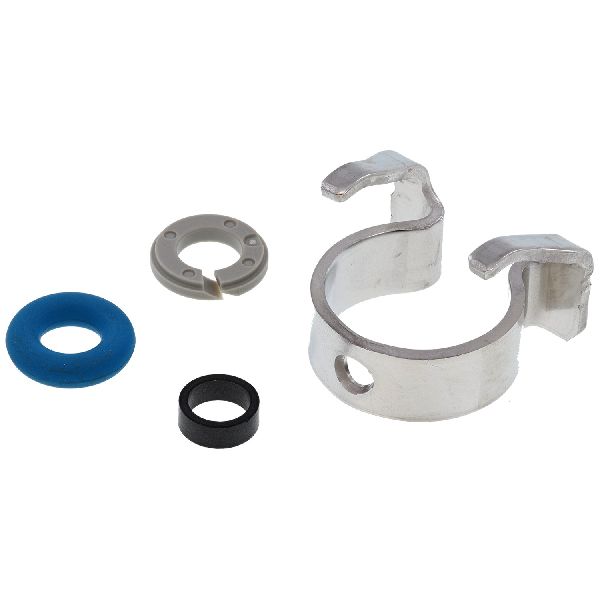
Typical fix: Replace the faulty fuel injector. This requires removing the upper intake manifold. It's wise to replace the Teflon seal and O-rings on any injector that is removed. Many technicians recommend replacing all three injectors on the rear bank at the same time due to the high labor cost to access them.
Est. part cost: $60-$150
Rare But Worth Checking
- Faulty Powertrain Control Module (PCM): → Shop Engine Control Module (ECM) This is the least likely cause. The internal transistor (driver) that controls the injector can fail. This should only be considered after the injector and wiring have been proven to be good.
Diagnosis Steps
- Read the codes with an OBD-II scanner and confirm P0204 is present. Note any other codes like P0304, P0202, or P0206.
- Locate cylinder #4. On the Traverse 3.6L, the banks are 1-3-5 (front) and 2-4-6 (rear). Cylinder #4 is the middle cylinder on the rear bank, near the firewall. Access will require removing the upper intake manifold.
- Before disassembly, perform a thorough visual inspection of the engine wiring harness where accessible. Pay special attention to the area around the underhood fuse box and check if its mounting bracket is broken or loose. Also inspect for chafing near the intake, valve covers, and where the harness routes down toward the transmission bell housing.
- If access allows, disconnect the injector and plug a noid light into the harness connector. Crank the engine. A steady, rhythmic flash indicates the wiring and PCM are likely okay. No flash or a solid light points to a problem in the wiring or PCM.
- If the noid light flashes correctly, the injector is the prime suspect. Disconnect the injector and measure its internal resistance with a multimeter. Compare the reading to the correct specification for your engine: ~11-14 ohms for 2009-2011 LLT, or ~1.5-2.5 ohms for 2012-2017 LFX. A reading of infinity (open) or near zero (short) confirms a bad injector.
- If the noid light test fails, the problem is in the wiring or PCM. With the intake manifold removed for access, perform a continuity test on both wires for injector #4 from the connector back to the PCM. Check for opens (high resistance) and shorts to ground or power.
- If the injector and wiring are confirmed good, the final, least likely possibility is a failed injector driver in the Powertrain Control Module (PCM).
Parts You'll Likely Need
- Fuel Injector
(OEM #2009-2011 (LLT): 12638530; 2012-2017 (LFX): 12669384)— This is the most common failure part if the wiring is intact. Part number is engine-specific.
Trusted brands: ACDelco (OEM Part for LLT: 217-3445; for LFX: 217-3445 is often cross-referenced but verify), Bosch, Standard Motor Products
OEM price range: $90-$150
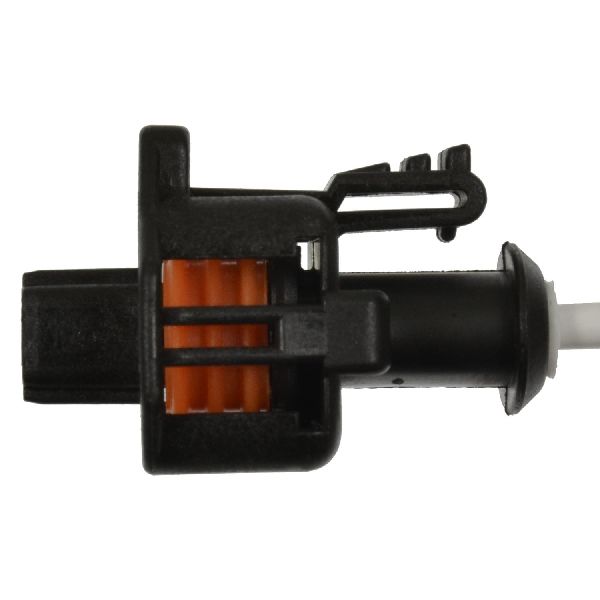
Aftermarket price range: $60-$110 - Fuel Injector Connector Pigtail
(OEM #ACDelco PT2183 / Dorman 645-215 / SMP S-1024)— Needed if the electrical connector at the injector is corroded, melted, or has a broken locking tab, or if a section of wire needs to be replaced. Both LLT and LFX engines on this platform use the same USCAR/EV6 style connector.
Trusted brands: ACDelco, Dorman, Standard Motor Products (SMP)
OEM price range: $25-$40
Aftermarket price range: $10-$25 - Upper Intake Manifold Gasket Set — Required for reassembly whenever the upper intake manifold is removed to access the rear bank of injectors.
Trusted brands: Fel-Pro, ACDelco, Mahle
OEM price range: $30-$60
Aftermarket price range: $15-$40
Related Codes That Often Appear With This One
- P0304 — P0304 means 'Cylinder 4 Misfire Detected.' Since P0204 indicates the injector circuit for cylinder 4 is not working, the cylinder isn't getting fuel, which directly causes a misfire.
- P0300 — P0300 means 'Random/Multiple Cylinder Misfire.' This can appear if the wiring issue is intermittent or if a damaged harness is starting to affect the circuits of adjacent injectors.
- P0202, P0206 — These are injector circuit codes for the other cylinders on the same rear bank (Bank 2). If these appear with P0204, it strongly points to a shared wiring harness problem, such as damage near a common connector or a power/ground issue for that bank.
Technical Service Bulletins (TSBs) & Recalls
- PIP4924D: Addresses intermittent misfires, rough idle, or a crank-no-start condition that can be caused by the injector wiring harness chafing against the intake, valve cover bolts, or fuel lines. TSB Bulletin #PIP4924D notes that this condition may trigger DTCs P0201 through P0206.
Platform-Specific Known Issues
- A known issue documented in GM Technical Service Bulletin PIP4924D involves the fuel injector wiring harness chafing on parts of the engine, leading to shorts or open circuits that can trigger this code.
- A common underlying cause for the harness chafing is a broken underhood fuse box mounting bracket, which allows for excessive harness movement. This should be inspected on any Lambda platform vehicle presenting with P020x codes.
Mechanic-Grade Diagnostic Values
- Fuel Injector Coil Resistance (2012-2017 LFX Engine) — expected: 1.5 - 2.5 Ohms when measured cold at the injector terminals or ECM connector.. Failure: A reading of OL (infinite resistance) indicates an open coil. A reading near 0 Ohms indicates a shorted coil.
- Fuel Injector Coil Resistance (2009-2011 LLT Engine) — expected: 11.0 - 14.0 Ohms when measured cold.. Failure: A reading significantly outside this range indicates a faulty injector coil.
- Injector Circuit Continuity (Wiring Test) — expected: < 0.5 Ohms from the injector connector pin to the corresponding ECM pin.. Failure: Higher resistance indicates corrosion or a partially broken wire. OL (infinite) indicates a complete break in the wire.
- Injector Circuit Voltage (Engine Running) — expected: On the power feed wire, voltage should be stable and near battery voltage (12V+). The control wire will show a pulsing pattern on an oscilloscope.. Failure: Low voltage (<10V) on the power feed suggests a wiring problem upstream. A flat line on the control wire indicates no signal from the PCM or a short to ground.
Scan Tool Commands That Help
- GDS2 (GM Dealer Tool) or high-end bidirectional scanner (Autel, Snap-on): Fuel Injector Balance Test / Injector Kill — This function allows the technician to command each injector off one by one while the engine is idling. When a good injector is turned off, the engine RPM will drop noticeably. If you turn off injector #4 and there is NO change in how the engine runs, it confirms that cylinder was not contributing, reinforcing the diagnosis of a circuit or injector problem.
- GDS2 / Kent Moore AFIT Tool: Active Fuel Injector Test (AFIT) — This is a dealer-level test that runs a comprehensive electrical check on the injectors, including coil resistance and circuit integrity, without requiring manual probing. It can quickly identify an electrical fault and pinpoint it to a specific cylinder circuit.
Wiring & Ground Locations
- G106 — On the rear of the Bank 2 (firewall side) cylinder head.. This is a primary ground point for the Bank 2 ignition coils and injectors. A loose or corroded connection at G106 can cause intermittent or simultaneous circuit codes (P0202, P0204, P0206) and misfires for the entire rear bank.
- Injector #4 Circuit (LFX Engine) — A twisted pair of wires running from the injector to the ECM. The wires are Light Blue (low-side driver) and Light Blue/White (high-side driver).. These are the specific wires to test for continuity and shorts. They connect to pins 50 and 74 in the X1 connector at the ECM. Knowing the colors and pin locations is essential for accurate testing at the ECM.
- Underhood Fuse Block Connector — The large electrical connectors on the underside of the underhood fuse block.. In rare cases, terminal fretting or corrosion within these main connectors can cause intermittent power loss to an entire bank of injectors, leading to codes like P0202, P0204, and P0206. This is often missed as the external wiring appears fine.
Real Owner Repair Stories
- ScannerDanner Forum (2008 GMC Acadia 3.6L (Lambda Platform Sibling)) — Codes P0300, P0202, P0204, and P0206 all appeared at once. Service Stabilitrak light was also on.
❌ Tried (didn't work) Cleaned the corroded G106 ground on the Bank 2 cylinder head.
✅ What actually fixed it The plastic mounting bracket for the underhood fuse box was broken, allowing the main engine harness to sag and rub through on other components. Repairing the bracket and the damaged wires resolved all codes. - YouTube channel 'Silverback Automotive' (2011 Chevrolet Traverse 3.6L LLT) — Persistent misfire codes for the entire rear bank (P0302, P0304, P0306) that would return intermittently.
❌ Tried (didn't work) GDI carbon cleaning service, Throttle body cleaning, Mass air flow sensor cleaning
✅ What actually fixed it The root cause was a bad electrical connection in the main harness connector located *underneath* the underhood fuse block. The technician removed the fuse block, found and tightened the loose/corroded terminals for the Bank 2 injector circuits, and reassembled. This permanently fixed the issue.
OEM Part Supersession History
12638530 (For LLT Engine 2009-2011)→12669384— Standard manufacturer revision, possibly for improved internal components.
Heads up: This is a high-impedance (~12 Ohm) injector. It is NOT compatible with the 2012+ LFX engine, which requires a low-impedance injector.12642126 (For LFX Engine 2012-2017)→12634126— Standard manufacturer revision, possibly for improved durability or sealing.
Heads up: This is a low-impedance (~1.5-2.5 Ohm) injector. It is NOT compatible with the pre-2012 LLT engine, which requires a high-impedance injector.
Model Year Variations Within This Range
- 2009-2011 (approx.): These models use the 3.6L LLT V6 engine. Key features are high-impedance fuel injectors (~12 Ohms), a Bosch ECM, and an aluminum intake manifold. Diagnostic values and parts are specific to this version.
- 2012-2017 (approx.): These models use the updated 3.6L LFX V6 engine. Key features are low-impedance fuel injectors (~1.5-2.5 Ohms), a Delphi ECM, and a composite (plastic) intake manifold. Parts and resistance values are not interchangeable with the earlier LLT engine.
Diagnostic Flowchart
Used vs. New Parts: Buying Guide for This Vehicle
When a used part is the smart pick: A used part is a smart choice for replacing the underhood fuse box if the mounting bracket on yours is broken, as this is a common failure point. A used wiring harness pigtail from a junkyard can also be a cost-effective source for connector shells and correctly colored wire for repairs.
Donor-vehicle mileage cap: roughly under 120000 miles for the part to have meaningful remaining life.
What to inspect on the donor part:
- For a fuse box, ensure the plastic mounting tabs and feet are intact and not brittle.
- For a wiring harness pigtail, inspect for any signs of previous repair, brittleness, or chafing on the insulation.
- Ensure the donor vehicle is from the same engine family (LLT or LFX) to match connectors.
OEM-only on this vehicle (don't cheap out):
- Fuel Injector: Due to the precise nature of direct injection, aftermarket injectors for the LLT/LFX have a poor reputation for quality and longevity. A technician in a detailed repair video explicitly stated the aftermarket injectors he purchased were 'junk' and recommended only using OEM parts.
Aftermarket brands forum-validated for this vehicle:
- Fel-Pro for the upper intake manifold gasket set.
- Dorman or SMP for the injector connector pigtail if an OEM ACDelco part is unavailable.
Brands owners have reported issues with on this vehicle:
- Unbranded, no-name fuel injectors from online marketplaces like Amazon or eBay. The risk of premature failure is very high.
Real Owner Stories
Aggregated from forums and TSBs cited above. Mileages and costs reflect what owners reported in those sources.
2011 Chevrolet Traverse
Symptoms: Check engine light on, rough running, codes P0206 (Injector Circuit Malfunction Cylinder 6) and P0306 (Cylinder 6 Misfire).
What fixed it: Found and repaired a broken wire in the wiring harness directly at the fuel injector connector for cylinder 6.
Source hint: traverseforum.com user experience summarized on parts websites regarding P0206
GMC Acadia (3.6L V6)
Symptoms: Misfire and code P0206 (Injector Circuit/Open - Cylinder 6).
What fixed it: Located the injector wiring harness where it was clipped to a sharp metal fuel line bracket, found the chafed/broken wire, and repaired it.
Source hint: acadiaforum.net P0206 chafed wire on fuel line bracket
2008 GMC Acadia (3.6L V6)
Symptoms: Check Engine Light with codes P0202, P0204, and P0206 appearing simultaneously.
What fixed it: The root cause was a broken plastic bracket under the fuse box, which allowed the main wiring harness to rub against the transmission bell housing and short out multiple injector wires.
Source hint: forum_citations: https://www.scannerdanner.com/forum/post-your-repaired-vehicles-here/13191-fixed-bank-two-miss.html
Related OBD-II Codes
Frequently Asked Questions
Where is cylinder #4 located on my 2009-2017 Traverse 3.6L engine?
My mechanic mentioned TSB PIP4924D. Does that apply to the P0204 code on my Traverse?
Could a broken plastic piece near my fuse box really cause an engine code like P0204?
What is the correct resistance for the fuel injector on my 2011 Traverse?
What is the correct resistance for the fuel injector on my 2015 Traverse?
I have a 2014 Buick Enclave with a P0204, not a Traverse. Is this information still relevant?
Is it a good idea to replace only the #4 fuel injector if it's bad?
We Have This Part in Stock


The information in this article is provided for general reference and educational purposes only. Vehicle specifications, procedures, and part compatibility can vary by production date, trim level, and region. Always consult your vehicle's factory service manual and verify part numbers before purchasing or performing repairs. Safety-critical components such as airbags, seat belts, and braking systems should be installed by a qualified professional.
- Chevrolet Traverse:
- 🧭 Diagnostic Flowchart
- 🛍️ Shop This Part
- What's Unique About the 2009-2017 Chevrolet Traverse
- Symptoms You May Notice
- Most Likely Causes
- Rare But Worth Checking
- Diagnosis Steps
- Parts You'll Likely Need
- Related Codes That Often Appear With This One
- Technical Service Bulletins (TSBs) & Recalls
- Platform-Specific Known Issues
- Mechanic-Grade Diagnostic Values
- Scan Tool Commands That Help
- Wiring & Ground Locations
- Real Owner Repair Stories
- OEM Part Supersession History
- Model Year Variations Within This Range
- Used vs. New Parts: Buying Guide for This Vehicle
- Real Owner Stories
- 2011 Chevrolet Traverse
- GMC Acadia (3.6L V6)
- 2008 GMC Acadia (3.6L V6)
- Related OBD-II Codes
- Frequently Asked Questions
- 🎟️ Get 5% Off