

P0204 on 1995-1999 Dodge RAM WAGON: Injector Circuit Causes and Fixes
This code indicates a fault in the cylinder 4 fuel injector circuit. On this vehicle, the most likely cause is a faulty wiring harness that passes through the valve cover gasket, a known issue cited in a manufacturer TSB. Check this harness for oil saturation, chafing, and broken wires before replacing the fuel injector.
- P0204 on a 1995-1999 Dodge Ram Wagon is most often caused by a failed wiring harness inside the passenger side valve cover, not a bad injector.
- Always inspect the valve cover pass-through harness for oil damage and test its continuity before buying parts.
- If the harness is good, test the injector by checking its resistance (should be ~12 ohms) or swapping it with another cylinder.
- A P0304 misfire code is a direct symptom of the P0204 injector circuit fault.
What's Unique About the 1995-1999 Dodge RAM WAGON
For this generation of Dodge vans and trucks with Magnum engines, a Technical Service Bulletin (TSB) highlights a specific, common failure point. The wiring harness for the fuel injectors passes through the valve cover gasket, where it is constantly exposed to intense engine heat and oil. Over time, this environment causes the wire insulation to become brittle and crack, and the connectors can degrade, leading to an open or short circuit that triggers a P0204 code. Owners and shops often mistakenly replace the fuel injector when the wiring is the actual root cause, making inspection of this harness a critical first step.
Diagnostic Flowchart
Tap your situation to follow the diagnostic path that matches what you're seeing on this vehicle.
Generation note: The 1995-1999 period covers two generations: the second generation (until 1997) and the third generation (starting 1998). While the Magnum engines are similar, there were significant body and electrical changes. The wiring issue noted in the TSB is confirmed for the 1995 model and is highly relevant to all years in this range, as the engine architecture and harness design philosophy are shared. Be aware of potential differences in harness routing and connector specifics between the generations.
Symptoms You May Notice
- Check Engine Light is on (may be flashing if misfire is severe)
- Rough idle or engine stumbling
- Engine misfire, which may be felt as a shake or shudder
- Poor acceleration and reduced engine power
- Increased fuel consumption
- Engine backfiring
- Raw fuel smell from the exhaust
- Replacing the #4 fuel injector without first inspecting the valve cover pass-through wiring harness. The TSB was issued specifically to address this common and costly misdiagnosis.
Most Likely Causes
- Faulty Injector Wiring Harness in Valve Cover Gasket 🔴 High Probability → Shop Engine Wiring Harness As documented in TSB #9002688, the wiring loom that passes through the valve cover is a common failure point due to heat and oil exposure, leading to brittle wires and broken connections. This design is a known weakness on Magnum engines.
How to confirm: Visually inspect the wiring harness where it passes through the valve cover. Check for oil saturation, brittle or cracked insulation, and exposed copper. Test for continuity from the main engine harness connector to the injector connector with a multimeter. Perform a 'wiggle test' on the harness while the engine is running to see if it induces a misfire.
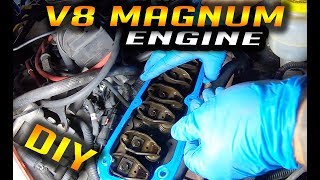
Typical fix: Replace the valve cover gasket and the integrated wiring harness. 🎬 Watch: Step-by-step guide to replacing the valve cover gasket. The TSB lists part numbers such as 68086182A$ and R8027067A$. A popular, high-quality aftermarket option is the Fel-Pro PermaDryPlus set (e.g., VS50468R), which is designed to resist oil and heat better than the original.
Est. part cost: $70-$150 - Failed #4 Fuel Injector 🟡 Medium Probability → Shop Fuel Injector
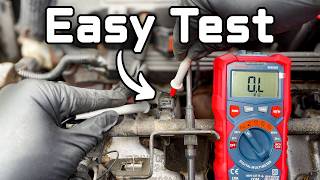
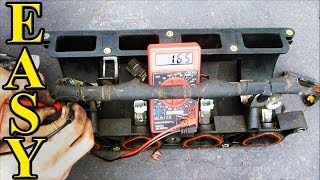
How to confirm: After confirming the wiring is good, test the injector's resistance with a multimeter. It should be between 10.8 and 15.7 ohms, depending on the year. If the reading is infinite (open) or zero (shorted), the injector has failed. A more definitive test is to swap the #4 injector with an adjacent one (e.g., #2). Clear the codes and run the engine. If the code changes to P0202, the injector is confirmed to be faulty.
Typical fix: Replace the fuel injector. The OEM Mopar part number is 53030778, which has been superseded by 53030778AB.
Est. part cost: $40-$90 - Damaged or Corroded Injector Connector ⚪ Low Probability The connector is exposed to engine bay heat and vibrations, which can cause the locking tab to break or the internal pins to develop fretting corrosion (black powder residue).
How to confirm: Visually inspect the electrical connector at the #4 fuel injector for corrosion, bent/loose pins, or a broken locking tab. Perform a 'wiggle test' on the connector while the engine is running to see if it affects the idle.
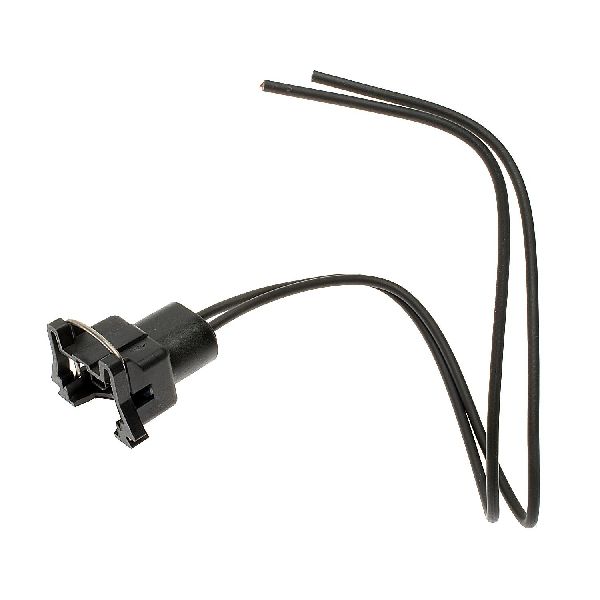
Typical fix: Clean the connector terminals with electrical contact cleaner. If the connector is damaged, replace the connector pigtail.
Est. part cost: $10-$25
Rare But Worth Checking
- Faulty Powertrain Control Module (PCM): → Shop Engine Control Module (ECM) This is the least likely cause. The internal driver circuit for the #4 injector can fail, but all other possibilities, especially the wiring, must be exhaustively ruled out before condemning the PCM. A user on DodgeForum.com reported having to replace the PCM for a P0204 after verifying the wiring and swapping injectors.
Diagnosis Steps
- Connect an OBD-II scanner to confirm P0204 is the active code and check for other codes like P0304.
- Locate cylinder #4. On Dodge Magnum V-engines, it is the fourth cylinder on the passenger side bank, counting from the front.
- Disconnect the electrical connector from the #4 fuel injector. Connect a noid light to the connector.
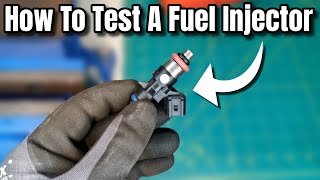
- Start the engine. If the noid light flashes steadily, the PCM and wiring up to the connector are likely good. This points to a bad injector. 🎬 See this video for 5 simple ways to test injectors. Proceed to step 7.
- If the noid light is off, stays on solid, or is dim/erratic, there is a problem in the wiring or PCM.
- Following TSB #9002688, inspect the injector wiring harness where it passes through the passenger side valve cover. Look for signs of oil saturation, chafing, or brittle insulation. Test for continuity and shorts on the wire for cylinder #4 between the main harness connector and the injector connector.
- If the wiring is confirmed to be good, test the injector itself. Turn the engine off.
- Use a multimeter to measure the electrical resistance across the two terminals of the #4 fuel injector. A good injector should read between 10.8 and 15.7 Ohms, depending on the model year. An infinite reading means an open circuit, and a zero reading means a short circuit.
- For a definitive test, swap the #4 injector with the #2 injector. Clear the codes, run the engine, and see if the fault code moves to P0202. If it does, the injector is bad. If P0204 returns, the problem is in the wiring or PCM.
- If all wiring and the injector test good, the issue may be a rare fault with the PCM's injector driver circuit.
Parts You'll Likely Need
- Valve Cover Gasket with Integrated Wiring Harness
(OEM #68086182A$, R8027067A$)— This is the most probable cause of the fault, as identified by a manufacturer TSB. The harness degrades from heat and oil, causing an electrical fault in the injector circuit.
Trusted brands: Mopar, Fel-Pro (Part #VS50468R), Dorman
OEM price range: $100-$180
Aftermarket price range: $70-$150 - Fuel Injector
(OEM #53030778AB (supersedes 53030778))— If the wiring harness is intact, the fuel injector itself is the next most likely component to have failed.
Trusted brands: Mopar, Bosch, Standard Motor Products
OEM price range: $70-$120
Aftermarket price range: $40-$90
Related Codes That Often Appear With This One
- P0304 — P0304 means 'Cylinder 4 Misfire Detected.' Since P0204 causes the #4 injector to stop working, the cylinder will not fire, directly causing a misfire code.
- P0420 — P0420 means 'Catalyst System Efficiency Below Threshold.' A persistent misfire from cylinder 4 allows unburnt fuel to enter the exhaust, which can overheat and damage the catalytic converter, triggering this code.
Technical Service Bulletins (TSBs) & Recalls
- Bulletin #9002688: Advises checking the wiring loom and/or connector in the valve cover gasket as the potential root cause for codes P0201 through P0206 before replacing injectors.
Platform-Specific Known Issues
- A manufacturer Technical Service Bulletin (TSB #9002688) specifically advises technicians to inspect the injector wiring loom inside the valve cover gasket for faults before replacing any fuel injectors for P020x codes.
- The passenger side valve cover harness is particularly susceptible due to its routing and proximity to heat sources.
Mechanic-Grade Diagnostic Values
- Fuel Injector Coil Resistance (1995-1997 models) — expected: 13.3 - 15.7 Ohms @ 68°F/20°C. Failure: Near zero ohms (shorted) or infinite ohms/OL (open circuit).
- Fuel Injector Coil Resistance (1998-1999 models) — expected: 10.8 - 13.2 Ohms @ 68°F/20°C. Failure: Near zero ohms (shorted) or infinite ohms/OL (open circuit).
- Fuel Pressure at Fuel Rail (Engine at Idle) — expected: 35 - 45 PSI (241 - 310 kPa). Failure: Pressure significantly below 35 PSI could indicate a weak pump, but would not directly cause a P0204 electrical code.
- Injector Pulse Width (at idle, normal operating temp) — expected: 2.5 - 3.5 milliseconds (ms). Failure: A value of 0 ms on cylinder 4 would confirm the PCM is not firing the injector. Unusually high values on other cylinders could indicate compensation for the dead cylinder.
- Voltage at Injector Connector (Key On, Engine Off) — expected: One pin should show battery voltage (approx. 12V). The other pin is the PCM driver.. Failure: No voltage on the power feed pin indicates a problem upstream in the harness or ASD relay circuit.
Scan Tool Commands That Help
- DRB III (or equivalent modern scanner): Injector Kill / Cylinder Power Balance Test — To confirm that cylinder #4 is not contributing power. While a P0204 already strongly implies this, this test can verify the severity of the misfire and confirm the PCM can communicate with other injectors.
- DRB III (or equivalent modern scanner): View Live Data - Injector Pulse Width — To compare the commanded pulse width for cylinder #4 against the other cylinders. For a P0204, you would expect to see 0 ms or a static value for cylinder 4 while others show a fluctuating value.
Wiring & Ground Locations
- Injector #4 Driver Wire — On 1998+ models, this is typically a White wire with a Tan tracer (WT/TN) running from the PCM Connector C2, Pin 17, to the injector harness.. This is the specific wire the PCM uses to ground-switch and fire the #4 injector. Testing for continuity and shorts on this wire is essential for diagnosing an open or shorted circuit.
- Injector Power Feed Wire — A Dark Green wire with an Orange tracer (DG/OR) that provides power to all injectors on the bank. It receives power from the Auto Shut Down (ASD) relay.. If this wire is broken before it reaches injector #4, the injector will have no power. However, a break in this wire would likely affect other injectors on the same bank as well.
- Engine/Body Grounds — Key grounds are located on the back of the cylinder heads, from the battery negative terminal to the body/frame, and from the engine block to the firewall.. A poor engine or PCM ground can cause erratic voltage signals and unpredictable behavior from electronic components, including injector drivers. While less likely to isolate to a single injector, checking that main grounds are clean and tight is a crucial step in any electrical diagnosis.
- Power Distribution Center (PDC) — Located in the left front corner of the engine compartment, just behind the battery.. The PDC houses the Auto Shut Down (ASD) relay, which supplies power to the fuel injector circuit. A faulty ASD relay or corroded PDC connection could cause a loss of power to the injectors.
Real Owner Repair Stories
- iATN (International Automotive Technicians Network) Help Request (2001 Dodge Dakota 3.9L (Similar Magnum engine architecture)) — Instant P0204 code on startup. Check Engine Light on.
❌ Tried (didn't work) Replaced the #4 fuel injector., Replaced the injector pigtail connector because it was cracked.
✅ What actually fixed it The technician observed with a noid light that the light for cylinder #4 was staying on constantly, not flashing. This indicated a short to ground on the driver circuit. The ultimate resolution was not posted, but the diagnosis correctly shifted from a bad injector to a wiring or PCM problem, which is a critical diagnostic step.
OEM Part Supersession History
53030778→53030778AB, Mopar RL030778AB— Standard part revision and updates by the manufacturer.
Model Year Variations Within This Range
- 1995-1997: These models specify a fuel injector resistance of 13.3-15.7 Ohms.
- 1998-1999: The 1998 model year refresh brought electrical changes. These models specify a lower fuel injector resistance of 10.8-13.2 Ohms. The PCM connectors and some wiring colors may also differ from earlier years. Using an injector from a 1997 model in a 1999 model could cause slight fueling inaccuracies due to the resistance difference.
Helpful Videos
We Have This Part in Stock


The information in this article is provided for general reference and educational purposes only. Vehicle specifications, procedures, and part compatibility can vary by production date, trim level, and region. Always consult your vehicle's factory service manual and verify part numbers before purchasing or performing repairs. Safety-critical components such as airbags, seat belts, and braking systems should be installed by a qualified professional.
- Dodge RAM WAGON:
- 🧭 Diagnostic Flowchart
- 🎬 Helpful Videos
- 🛍️ Shop This Part
- What's Unique About the 1995-1999 Dodge RAM WAGON
- Symptoms You May Notice
- Most Likely Causes
- Rare But Worth Checking
- Diagnosis Steps
- Parts You'll Likely Need
- Related Codes That Often Appear With This One
- Technical Service Bulletins (TSBs) & Recalls
- Platform-Specific Known Issues
- Mechanic-Grade Diagnostic Values
- Scan Tool Commands That Help
- Wiring & Ground Locations
- Real Owner Repair Stories
- OEM Part Supersession History
- Model Year Variations Within This Range
- 🎟️ Get 5% Off