

P0204 on 2021-2024 GMC Yukon 3.0L Duramax: Injector Circuit Causes and Fixes
On a 2021-2024 GMC Yukon with the 3.0L Duramax, code P0204 is most often caused by a wiring harness or connector issue at the #4 injector, not the injector itself. Inspect the harness for chafing and the connector for damage before replacing parts. A pigtail repair costs ~$20, while a new injector is ~$200+.
- For a P0204 code on a 3.0L Duramax, always inspect the cylinder #4 injector connector for fretting corrosion (black dust) and the wiring harness for chafing before replacing the injector.
- Replacing the connector pigtail is a common, effective, and low-cost repair.
- This is a well-documented issue across the entire GM T1 platform with this engine, not just the Yukon.
What's Unique About the 2021-2024 GMC Yukon
For this specific generation of GM trucks and SUVs with the 3.0L Duramax (LM2 and LZ0) engine, the root cause of a P0204 code is frequently a problem with the engine wiring harness or the injector's electrical connector, rather than a failed injector. General Motors has issued multiple Technical Service Bulletins (TSBs) about harness chafing and connector pin issues causing these exact codes. The harness for cylinder #4 is particularly vulnerable to heat from the nearby EGR pipe, which can accelerate the failure of the connector. Technicians widely report that cylinder #4 is a problematic cylinder for this issue across the Duramax family.
Generation note: The 3.0L Duramax engine was introduced with the LM2 RPO code for the 2020 model year and was updated to the LZ0 RPO code for the 2023 model year. While there are internal differences, the fuel injector connector design and harness routing are similar, and both are susceptible to this P0204 issue.
Symptoms You May Notice
- Check Engine Light is on
- Rough or shaking idle
- Engine misfire, which may be intermittent
- Hesitation or stumbling during acceleration
- Reduced engine power and performance ('limp mode')
- Poor fuel economy
- 'Service Emission System' message on the driver information center
- 'Service ESC' message and disabled traction control
- Speed limited to a preset maximum, such as 55 or 65 mph
- Replacing the fuel injector without first thoroughly inspecting the wiring harness and connector. TSBs and extensive owner reports strongly suggest wiring is a more common failure point on this platform.
Most Likely Causes
- Damaged Engine Wiring Harness or Injector Connector 🔴 High Probability → Shop Engine Wiring Harness Multiple GM TSBs (e.g., 21-NA-149, 22-NA-087) document this as a known issue. The harness can rub against engine components like the generator or steering shaft, and the #4 connector is exposed to high heat from the EGR pipe, causing pin wear ('fretting'). This fretting corrosion from vibration is a very common point of failure.
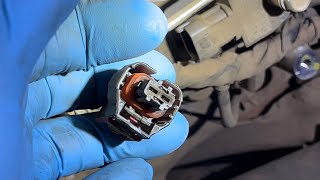
How to confirm: Visually inspect the wiring harness leading to the #4 injector for any signs of melting, chafing, or rubbing. Disconnect the connector and check for corrosion, black dust (fretting), or loose/damaged pins. A technician can test terminal tension to see if the pins have lost their grip.
Typical fix: If the harness is damaged, repair the affected wires and protect the harness from future rubbing. If the connector is the issue, replace the connector pigtail by splicing in a new one. 🎬 See a technician fix this wiring issue on a Duramax. Aftermarket pigtails with gold-plated pins are available to provide a more robust connection.
Est. part cost: $15-$50 - Faulty Cylinder 4 Fuel Injector 🟡 Medium Probability → Shop Fuel Injector
How to confirm: Swap the #4 fuel injector with another cylinder (e.g., cylinder #2). Clear the codes and drive. If the code changes to P0202, the injector is faulty. If P0204 returns, the issue is in the wiring or ECM. A professional can also perform an injector balance test or resistance test (a healthy LM2 injector should be under 1 ohm).
Typical fix: Replace the fuel injector. On this engine, the high-pressure fuel line to the injector must also be replaced, and the new injector's flow rate must be programmed into the ECM. TSB 22-NA-087 recommends replacing the injector harness at the same time as the injector.
Est. part cost: $180-$300
Rare But Worth Checking
- Faulty Engine Control Module (ECM): → Shop Engine Control Module (ECM) This is the least likely cause. The ECM's internal driver for the injector can fail, but all other possibilities, especially wiring, should be exhaustively ruled out before considering ECM replacement. TSB 21-NA-149 notes that the ECM has been unnecessarily replaced for this concern in many cases.
Diagnosis Steps
- Read the trouble codes with an OBD-II scanner to confirm P0204 and any other related codes like P0304, P0300, or P0216.
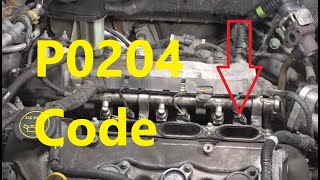
- Locate cylinder #4. The 3.0L Duramax is a straight-six engine, with cylinders numbered 1-6 from front to back. Cylinder #4 is the fourth one back from the radiator.
- Perform a thorough visual inspection of the wiring harness leading to the #4 injector. Look for signs of rubbing against the engine, melting from exhaust heat (especially near the EGR pipe), or pinching. TSB 21-NA-149 points to specific chafe points on top of the generator and at a PCV hose clamp.
- Disconnect the electrical connector at the #4 injector. Inspect the terminals on both the injector and the connector for corrosion, moisture, bent/broken pins, or a fine black/brown dust, which indicates fretting corrosion. 🎬 Watch: How terminal fretting causes these specific misfire codes. This is a key sign of failure noted in TSB 22-NA-087 and multiple technician videos.
- If a capable scan tool is available, perform an injector balance test or monitor the misfire counters for cylinder #4 to see if it is contributing less than the others.
- To definitively test the injector vs. wiring, swap the #4 injector with another one (e.g., #2). Clear the codes and run the engine. If the code returns as P0204, the problem is in the wiring or ECM. If the code moves with the injector and becomes P0202, the injector itself has failed.
- If wiring is suspected, use a multimeter to check for continuity on the ground and signal wires from the injector connector back to the ECM. Check for shorts to power or ground.
- If all wiring and the injector prove to be good, the final and least likely possibility is a faulty injector driver in the ECM.
Parts You'll Likely Need
- Fuel Injector Connector Pigtail
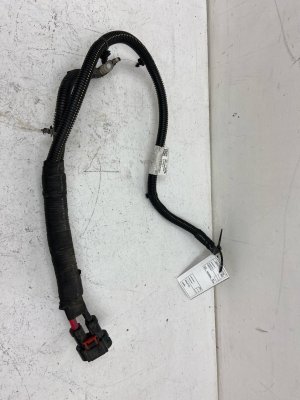
(OEM #19368140 (also known as PT3739))— This is the most likely fix, needed when the original connector has failed due to heat, vibration, or internal pin wear ('fretting'), a known issue on this platform. Splicing in a new pigtail restores the electrical connection.
Trusted brands: ACDelco, Fleece Performance, BD Diesel, BackWoods Diesel
OEM price range: $30-$50
Aftermarket price range: $15-$30 - Diesel Fuel Injector
(OEM #55506244)— This is needed if the injector itself has failed internally (e.g., a bad solenoid coil). This is less common than a wiring issue but is the second most likely cause. TSB 22-NA-087 recommends replacing this along with the harness connector.
Trusted brands: ACDelco (GM Genuine), Bosch
OEM price range: $250-$350
Aftermarket price range: $180-$250 - Engine Injector Wiring Harness
(OEM #55513485)— In cases of severe or multiple chafing points, or as a preventative measure per TSB 22-NA-087, the entire injector sub-harness may be replaced instead of just one pigtail.
Trusted brands: ACDelco (GM Genuine)
OEM price range: $70-$120
Related Codes That Often Appear With This One
- P0304 — P0304 means 'Cylinder 4 Misfire Detected.' Since P0204 indicates an electrical fault preventing the injector from firing correctly, a misfire on that same cylinder is a direct and expected consequence.
- P0300 — If the wiring fault is intermittent or affects a shared power/ground circuit, it can cause random misfires across multiple cylinders, triggering a P0300 code.
- P0216 — This code means 'Injector/Injection Timing Control Circuit.' It is mentioned in TSB 22-NA-087 and is frequently seen with P020x codes on the 3.0L Duramax, suggesting a broader electrical issue originating from the harness or connector.
Technical Service Bulletins (TSBs) & Recalls
- 21-NA-149: Addresses widespread engine wire harness chafing issues on multiple GM trucks, including the 3.0L Duramax. It guides technicians to inspect for rubbing on components like the generator, which can cause various electrical DTCs, including injector circuit faults.
- 22-NA-087: While specifically calling out a broken terminal pin in the #2 injector connector, this TSB is highly relevant as it covers codes P0201 through P0206. It establishes a known failure pattern for this family of
Platform-Specific Known Issues
- Owner Experience: Intermittent Misfire and Limp Mode: A user on Reddit with a 2022 Silverado 1500 3.0L Duramax described driving cross-country when the truck began shaking violently, displaying 'Reduced Acceleration' and 'Service Emission System' messages, and limiting speed. The dealer diagnosed codes P0204, P0216, P0300, and P0304, pointing to the common cylinder 4 injector circuit fault.
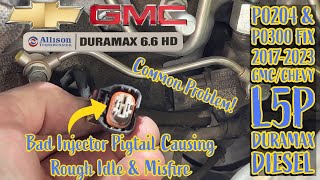
- DIY Repair: Pigtail Replacement on the Road: A YouTuber documented getting a P0204 code on his L5P Duramax (which uses a similar connector) while on the road. He ordered a new pigtail connector from Amazon, and performed the repair himself, splicing the new connector in. He noted the tell-tale sign of fretting corrosion (black dust) on the old connector and confirmed the fix cleared the codes and restored normal operation.
Mechanic-Grade Diagnostic Values
- Fuel Injector Piezo Stack Resistance (3.0L LM2 Diesel) — expected: 160,000 - 190,000 Ohms (160k - 190k Ω). Failure: A reading significantly outside this range indicates a failure of the injector's internal piezo element.
- Fuel Injector Solenoid Coil Resistance — expected: Approximately 0.8 Ohms. Failure: A reading of infinity (open) or significantly higher resistance points to a failed coil. This is a more common failure mode than the piezo stack.
- Injector Connector Voltage (Key On, Engine Off) — expected: 10 - 14 Volts (Battery Voltage). Failure: Low or no voltage indicates a problem in the power supply side of the circuit.
- Low-Side Fuel Pressure (Scan Tool Data) — expected: 60 - 70 PSI. Failure: Pressure below this range indicates a problem with the lift pump or fuel supply, which is not the cause of a P0204 but is important system context.
- High-Pressure Common Rail (System Specification) — expected: Up to 36,250 psi (2500 bar). Failure: While not a direct test for P0204, low high-side pressure would trigger other codes (e.g., P0087).
Scan Tool Commands That Help
- GDS2, Autel, Launch, or equivalent professional scanner: Injector Flow Rate Programming (IQA - Injection Quantity Adjustment) — This is mandatory after replacing a fuel injector. Each new injector has a unique multi-digit code that must be programmed into the ECM to ensure correct fuel delivery and smooth engine operation.
- GDS2 or equivalent: Fuel Injection Small Quantity Data Reset — This function should be performed along with the IQA programming after an injector replacement to reset the learned adaptive values for the injectors.
- GDS2 or equivalent: Fuel Injector Balance Test — Used during diagnosis to identify a failing injector. The tool commands each injector to fire and measures the corresponding drop in fuel rail pressure. A cylinder with a significantly different pressure drop indicates a faulty injector.
- Aftermarket Scanners (e.g., Snap-on, Autel): Injector Rate Programming / IQA Tip — A known quirk on some aftermarket tools requires prepending 'F7' to the trim code found on the injector for the programming to be accepted correctly.
Wiring & Ground Locations
- Injector Harness Connector X160 — This is a harness-to-harness connector, not the connector at the injector itself.. TSB 22-NA-087 instructs technicians to inspect this specific connector for poor terminal tension or missing terminal locks when diagnosing injector circuit codes P0201-P0206.
- Engine Harness Chafe Point - Generator — On top of the generator (alternator).. TSB 21-NA-149 specifically calls out this location as a common place for the engine wiring harness to rub through, causing shorts or open circuits for various components, including the injectors.
- Engine Harness Chafe Point - PCV Hose Clamp — At a clamp for a Positive Crankcase Ventilation (PCV) hose.. Another specific chafe point identified in TSB 21-NA-149 for the 3.0L Duramax engine harness.
- Engine-to-Cab Ground Strap — Typically a braided strap from the rear of the driver's side cylinder head to the firewall.. While not a direct cause, a poor engine ground can introduce electrical noise and voltage issues that can lead to intermittent and difficult-to-diagnose electrical codes, including injector circuit faults.
Real Owner Repair Stories
- YouTube channel 'That's Good To Know' (2018 GMC Sierra Denali HD with 6.6L L5P Duramax (uses a similar injector connector)) — Check engine light on, truck running very rough, 'Service Emission System' message, speed restricted to 55 mph. Codes P0204 and P0300.
❌ Tried (didn't work) The owner immediately suspected the common pigtail issue and did not report trying other fixes first.
✅ What actually fixed it The owner replaced the cylinder 4 fuel injector pigtail connector. After splicing in the new pigtail, the truck ran smoothly, the check engine light was off, and the fault codes did not return after a test drive. - YouTube channel 'Pine Hollow Auto Diagnostics' (Duramax L5P (specific year/model not stated)) — P0204 - Injector #4 circuit fault.
❌ Tried (didn't work) A basic pin tension test using standard probes might show the connection is okay, which can be misleading.
✅ What actually fixed it The technician diagnosed a high-resistance connection by measuring resistance from the ECM connector to the injector connector while wiggling the pigtail. The resistance jumped from ~3.8 ohms to an open circuit, proving the connector was bad internally. The confirmed fix is to replace the injector pigtail.
"I Checked Everything" — The Actual Cause
- The equivalent for this electrical code is when a simple continuity or pin-drag test passes, but the fault persists. This is common with fretting corrosion. A technician demonstrated that while static resistance was merely high (3.8 ohms vs a spec of <1 ohm), wiggling the connector at the injector caused the circuit to go completely open (infinite resistance), revealing the intermittent nature of the fault that a basic test would miss.
OEM Part Supersession History
19299882→19368140— Standard part lifecycle update. The new part number is also cross-referenced to the service part name PT3739.
Model Year Variations Within This Range
- 2021-2023: These model years primarily use the LM2 version of the 3.0L Duramax. This includes the 2023 Yukon SUVs, even though the 2023 pickup trucks had already switched to the newer LZ0 engine.
- 2023 (Pickups), 2024+ (All models): These model years use the updated LZ0 version of the 3.0L Duramax. This engine features different pistons (steel vs. aluminum), a revised turbo, improved cooling, and, most importantly for this code, new fuel injectors with a different design. The injectors for the LM2 and LZ0 are NOT interchangeable.
Diagnostic Flowchart
Used vs. New Parts: Buying Guide for This Vehicle
When a used part is the smart pick: A used injector wiring harness from a low-mileage, non-corroded donor vehicle could be a cost-effective option if the entire harness needs replacement. However, for just the connector pigtail, the low cost of a new part ($15-$50) makes buying new the smarter choice.
Donor-vehicle mileage cap: roughly under 75000 miles for the part to have meaningful remaining life.
What to inspect on the donor part:
- For wiring, check for any signs of abrasion, melting near exhaust components, or oil saturation.
- Inspect connectors for cracked plastic, missing locking tabs, or any black dust inside the pin sockets (a sign of fretting).
- Avoid parts from vehicles in the salt belt or coastal areas, as corrosion is more likely.
OEM-only on this vehicle (don't cheap out):
- Fuel Injector: While Bosch is the OEM manufacturer, it is strongly recommended to use genuine GM/ACDelco or new Bosch parts. Remanufactured injectors from unknown brands can have quality control issues, leading to repeat failures or poor performance.
Aftermarket brands forum-validated for this vehicle:
- Injector Pigtail Connector: Fleece Performance, BD Diesel, and BackWoods Diesel are reputable brands in the diesel community that offer robust replacement pigtails, sometimes with superior gold-plated terminals to prevent fretting.
Real Owner Stories
Aggregated from forums and TSBs cited above. Mileages and costs reflect what owners reported in those sources.
2021 GMC Sierra with 3.0L Duramax engine — 115000 miles
Symptoms: Check Engine Light with codes P0204 and P0304 (Cylinder 4 injector circuit and misfire).
What fixed it: The owner replaced the fuel injector wiring harness themselves. The root cause was a loose connection at the #4 injector connector, which had been affected by heat from the nearby EGR pipe.
Source hint: Reddit r/gmcsierra
2022 Silverado 1500 3.0L Duramax
Symptoms: Truck began shaking violently, displaying 'Reduced Acceleration' and 'Service Emission System' messages, and limiting speed during a cross-country trip.
What fixed it: The dealer diagnosed codes P0204, P0216, P0300, and P0304, confirming the common cylinder 4 injector circuit fault.
Source hint: Owner Experience: Intermittent Misfire and Limp Mode (from Reddit)
Related OBD-II Codes
Frequently Asked Questions
Is the wiring harness problem that causes P0204 a known issue on the 3.0L Duramax?
Where is cylinder #4 located on my 2021-2024 GMC Yukon's 3.0L Duramax engine?
My truck went into 'limp mode' and says 'Service Emission System' with the P0204 code. Is this normal?
What should I look for when inspecting the #4 injector connector for the P0204 fault?
If I need to replace the fuel injector for cylinder 4, is there anything else I should replace at the same time?
Does this P0204 wiring issue affect other GM vehicles besides the Yukon?
Helpful Videos
We Have This Part in Stock

The information in this article is provided for general reference and educational purposes only. Vehicle specifications, procedures, and part compatibility can vary by production date, trim level, and region. Always consult your vehicle's factory service manual and verify part numbers before purchasing or performing repairs. Safety-critical components such as airbags, seat belts, and braking systems should be installed by a qualified professional.
- GMC Yukon:
- 🧭 Diagnostic Flowchart
- 🎬 Helpful Videos
- 🛍️ Shop This Part
- What's Unique About the 2021-2024 GMC Yukon
- Symptoms You May Notice
- Most Likely Causes
- Rare But Worth Checking
- Diagnosis Steps
- Parts You'll Likely Need
- Related Codes That Often Appear With This One
- Technical Service Bulletins (TSBs) & Recalls
- Platform-Specific Known Issues
- Mechanic-Grade Diagnostic Values
- Scan Tool Commands That Help
- Wiring & Ground Locations
- Real Owner Repair Stories
- "I Checked Everything" — The Actual Cause
- OEM Part Supersession History
- Model Year Variations Within This Range
- Used vs. New Parts: Buying Guide for This Vehicle
- Real Owner Stories
- 2021 GMC Sierra with 3.0L Duramax engine — 115000 miles
- 2022 Silverado 1500 3.0L Duramax
- Related OBD-II Codes
- Frequently Asked Questions
- 🎟️ Get 5% Off