

OBD-II Code P0205: Injector Circuit Malfunction Cylinder 5
The Ultimate 2026 Guide to Diagnosing and Fixing P0205
- P0205 flags a strict electrical failure in the cylinder #5 fuel injector circuit, not a mechanical fuel pressure issue.
- Over 80% of P0205 codes stem from either a dead fuel injector coil or a chafed wiring harness, especially on Ram and GM trucks.
- Stop driving immediately to prevent unburned fuel from melting your catalytic converter, which adds $1,500 to $3,000 in secondary repair costs.
- Perform a $20 noid light test before buying parts to definitively prove whether the PCM is sending a firing signal to the injector.
What Does P0205 Mean?
P0205 indicates the Powertrain Control Module (PCM) detected an electrical fault in the cylinder 5 fuel injector circuit. The PCM activates the injector by grounding its control circuit and expects a specific voltage drop and inductive 'kick' in return. If it reads unexpected voltage or resistance—due to a broken wire, a short, or a dead injector coil—it triggers P0205 and illuminates the Check Engine Light.
Technical definition: The SAE/OBD-II definition for P0205 is "Cylinder 5 Injector Circuit Malfunction". The DTC sets when the PCM detects voltage or resistance on the cylinder 5 injector control circuit outside the expected parameters. The PCM monitors the circuit for high voltage (near battery voltage) when the injector is off, and near-zero voltage when activated. A missing inductive kick (the voltage spike from the coil's collapsing magnetic field) also triggers the code.
Can I Drive With P0205?
No — Do Not Drive. Do not drive with an active P0205 code. Cylinder #5 has a fuel delivery failure, causing a direct misfire. This pumps unburned fuel into the exhaust, which rapidly overheats and destroys the catalytic converter or Diesel Particulate Filter (DPF). Continuing to drive adds $1,500 to $3,000+ in secondary exhaust replacement costs. Drive only to a safe stopping point or directly to a repair shop at low speeds.
Common Causes
- Faulty Cylinder 5 Fuel Injector (Very Common) — The internal solenoid coil develops an open circuit (broken wire) or a short circuit, preventing activation. This is the leading cause on vehicles over 80,000 miles.
- Damaged or Corroded Wiring Harness (Very Common) — Engine heat, vibration, or rodents damage the wires leading to the injector, causing them to fray, break, or short against the engine block. On Dodge/Ram and GM trucks, harness chafing is more common than actual injector failure.
- Bad Electrical Connector (Common) — The plastic connector at the injector becomes loose, loses its locking clip, or develops pin corrosion. This prevents a solid electrical connection, causing an intermittent or total loss of signal.
- Metal Shavings on Injector Terminals (Cummins) (Uncommon) — On 2013-2018 Ram trucks with the 6.7L Cummins, tiny metallic particles accumulate on the injector terminals under the valve cover. These short the electrical connection and trigger P0205.
- Inadequate Power Supply or Ground (Uncommon) — Injector circuits require a stable 12V supply and solid ground. A failing main relay (ASD relay), blown fuse, or corroded engine ground strap causes low voltage. This usually triggers multiple injector codes simultaneously.
- Faulty Injector Driver Module (IDM/FICM) (Uncommon) — On older diesel trucks (e.g., Ford Power Stroke), a separate module controls the injectors. Failure of this module causes P0205 alongside other bank-specific codes.
- Powertrain Control Module (PCM) Failure (Rare) — The internal driver circuit within the PCM that controls the #5 injector fails. Consider this a last resort only after definitively ruling out wiring and the injector.
Symptoms
- Check Engine Light On — The Malfunction Indicator Lamp illuminates steadily. If the misfire is severe enough to damage the catalytic converter, the light flashes.
- Engine Misfire and Rough Idle — The engine shakes and vibrates violently at idle because cylinder #5 is dead and not contributing to the crankshaft's rotation.
- Reduced Engine Power and Hesitation — The vehicle feels sluggish and stumbles during acceleration. The engine is effectively running on one less cylinder.
- Poor Fuel Economy — Fuel mileage drops significantly. The PCM attempts to compensate for the dead cylinder by dumping excess fuel into the others.
- Fuel Smell — If the circuit shorts and holds the injector open, raw fuel dumps into the exhaust, creating a strong gasoline odor from the tailpipe.
- Hard Starting or Stalling — The engine cranks longer than usual before starting, or stalls unexpectedly when coming to a stop.
- Injector Circuit Voltage Out of Range (scan-tool only — no driver-felt sign) — A scan tool or multimeter shows abnormal voltage (stuck high or low) on the cylinder 5 control circuit during PCM activation.
Diagnostic Flowchart
Tap your situation to follow the diagnostic path that matches what you're seeing on this code.
Common Fixes & Costs
- Replace Fuel Injector #5 — Parts: $60-$350, Labor: $150-$500, ~1.5 hr book time (Intermediate)
- Repair Wiring Harness — Parts: $20-$100, Labor: $150-$350, ~2.5 hr book time (Intermediate)
- Replace Injector Connector Pigtail — Parts: $15-$40, Labor: $75-$175, ~1.2 hr book time (DIY)
- Clean Injector Terminals (Ram Cummins) — Parts: $5, Labor: $100-$200, ~1.5 hr book time (DIY)
- Replace Powertrain Control Module (PCM) — Parts: $800-$1500, Labor: $150-$300, ~1.5 hr book time (Professional)
Used vs. New Parts: Buying Guide
When a used part is worth it: Buying a used fuel injector is not recommended due to unknown history and high failure risk. A professionally remanufactured injector is a cost-effective alternative to brand new for expensive diesel or GDI applications.
Donor-vehicle mileage cap: roughly under 50000 miles for the part to have meaningful remaining life.
Donor quality checklist:
- Buy remanufactured parts from reputable suppliers offering at least a 1-year warranty.
- For salvage parts, verify the donor vehicle was wrecked, not junked for engine failure.
- Match the part number exactly. Identical-looking injectors have different flow rates.
Decision logic:
- If The part is an inexpensive, easy-to-access port fuel injector → Buy new. The savings from a used part are not worth the risk of repeat labor.
- If The part is a very expensive GDI or diesel injector and budget is tight → Buy a remanufactured unit from a reputable source with a warranty.
- If The vehicle has over 150k miles and you are performing the labor yourself → A low-mileage used injector is acceptable, provided you accept the risk of premature failure.
Warranty tradeoff: Salvage yard parts offer 30-90 day warranties. Remanufactured parts offer 1-year warranties. New OEM parts offer the longest warranties and highest reliability.
Worst-case if a used part fails: $200-$600 if a faulty used injector fails, requiring repeat labor and a second replacement part.
What Happens If You Wait — Timeline
- 0-2 weeks: Check Engine Light is on. You notice a slight rough idle, but no major drivability symptoms. (MPG impact: 0-5%% · Added cost: $0)
- 2 weeks - 2 months: Constant rough idle and hesitation. Fuel economy drops. The catalytic converter is continuously doused in raw fuel, running extremely hot. (MPG impact: 5-15%% · Added cost: $50-$150 in wasted fuel)
- 2-6 months: Check Engine Light flashes during acceleration. The internal ceramic honeycomb of the catalytic converter cracks and melts from extreme heat. (MPG impact: 15-25%% · Added cost: $1,200 - $2,800 (Catalytic converter replacement required))
- 6+ months: The melted catalytic converter blocks the exhaust. The engine loses extreme power or fails to start. Backpressure causes burnt exhaust valves or piston ring failure. (MPG impact: >25%% · Added cost: $3,000 - $7,000+)
Cost of Not Fixing It
- 0-1 month: Significant drop in fuel economy (5-15%), rough engine performance, and failed emissions test. The vehicle may enter a low-power 'limp mode'. (Added cost: Negligible, besides increased fuel cost.)
- 1-6 months: Raw fuel from the misfiring cylinder overheats and melts the internal ceramic structure of the catalytic converter, causing permanent failure. (Added cost: $1200-$2800)
- 6+ months: A melted catalytic converter creates extreme exhaust backpressure, leading to burnt exhaust valves or piston ring failure. Unburned fuel washes oil from cylinder walls, causing accelerated engine wear. (Added cost: $3000-$7000+)
Diagnosis Steps
- Scan for Codes and Review Freeze Frame Data
Use an OBD-II scanner to confirm P0205. Note any other codes. P0305 (Cylinder 5 Misfire) is expected. Multiple injector codes (e.g., P0204, P0206) prove a shared wiring or power supply problem, not a bad injector.
Tools: OBD-II Scanner (Beginner) - Perform a Detailed Visual Inspection
Locate cylinder #5. Inspect the electrical connector for corrosion, pushed-out pins, or a broken locking tab. Trace the wiring harness for chafing, melting, or rodent damage, especially where it touches engine brackets.
Tools: Flashlight, Inspection Mirror (Beginner) - Verify the Command Signal with a Noid Light
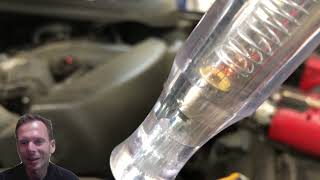
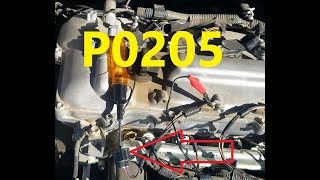
Unplug the injector connector and plug in a noid light. Have a helper crank the engine. A steady, flashing light confirms the PCM and wiring are working perfectly, meaning the injector is the problem. No flash means the fault is in the wiring or PCM.
Tools: Noid Light Kit (Intermediate) - Test the Injector's Coil Resistance
Disconnect the injector connector. Set a multimeter to Ohms (Ω) and touch the probes to the two metal pins on the injector. High-impedance port injectors read 11-16 Ohms. Low-impedance/GDI injectors read 1.2-6 Ohms. A reading of infinity (OL) or near zero confirms a dead injector.
Tools: Multimeter (Intermediate) - Perform an Injector 'Click' Test
With the engine idling, place a mechanic's stethoscope against the body of the #5 injector. You must hear a steady, rhythmic clicking. Compare it to an adjacent injector. No click means it is not activating.
Tools: Mechanic's Stethoscope or Long Screwdriver (Beginner) - Swap the Injector Location
To definitively prove the injector is bad before buying parts, swap it with an adjacent cylinder (e.g., cylinder #3). Clear codes and run the engine. If the code moves to P0203, the injector is faulty. If P0205 remains, the wiring is the issue.
Tools: Basic hand tools (socket set, pliers) (Advanced) - [PRO TIP] Perform a Voltage Drop Test
Back-probe the power wire at the injector connector with the red multimeter lead, and touch the black lead to the battery positive. With the key on, it must read under 0.5 volts. Repeat for the ground side while cranking. Higher readings indicate excessive circuit resistance.
Tools: Multimeter with back-probe pins (Advanced) - [PRO TIP] Check Live Data PIDs
Monitor live data for injector pulse width (ms). At a warm idle, port injectors run around 1.5 - 2.5 ms. A value of 0 ms on cylinder 5, or a value wildly different from other cylinders, points to a PCM control issue.
Tools: Advanced OBD-II Scanner (Advanced) - [PRO TIP] Analyze the Waveform with an Oscilloscope
Connect an oscilloscope to the injector's ground wire. A healthy 'peak and hold' waveform shows a sharp drop to near zero volts, a 35-70V inductive spike when the ground cuts, and a lower voltage hold. A missing spike proves an open injector coil.
Tools: Automotive Oscilloscope (Professional) - [CONTEXT] Check Fuel Pressure
Connect a fuel pressure gauge to the fuel rail. Key on, engine off (KOEO) pressure must match vehicle specs (typically 40-60 PSI). Low pressure does not cause P0205, but it causes identical misfire symptoms and must be ruled out.
Tools: Fuel Pressure Gauge (Intermediate)
When This Code Triggers (Freeze-Frame Conditions)
- Engine Coolant Temp: 180-200°F (Sets most frequently when the engine is fully warmed up and operating in closed-loop fuel control.)
- RPM: 1500-2500 (Occurs during steady cruising or light throttle application, rather than hard acceleration.)
- Engine Load: 30-60% (Detected under moderate engine load, such as maintaining speed on a level highway.)
- Vehicle Speed: 35-55 mph (Consistent with suburban or highway driving where injector pulse widths are stable.)
Related Codes
- P0305 — P0305 means 'Cylinder 5 Misfire Detected.' This is the direct mechanical result of the P0205 electrical fault. The dead injector causes the misfire. You will almost always see P0305 alongside P0205.
- P0200 — Indicates a generic 'Injector Circuit Malfunction' affecting the main power or ground circuit for all injectors. Seeing P0200 with P0205 points to a failing relay, blown fuse, or bad main ground.
- P0201, P0202, P0203, P0204, P0206 — Identical codes for different cylinders. Multiple simultaneous injector codes prove the injectors are fine; the fault is a shared damaged harness, bad ground, or failing PCM.
- P0172 / P0175 — Indicates 'System Too Rich'. A short to ground in the injector driver circuit forces the injector to stay open, dumping excessive fuel and triggering these rich condition codes.
Climate & Environmental Factors
- Extreme Cold/Heat Cycles: Temperature swings accelerate wiring harness degradation. Wires become brittle in the cold and crack from engine vibration. This is the primary cause of harness failures on Ram Cummins and GM vehicles.
- High Humidity / Salt: Moisture penetrates injector connectors in coastal or heavy road-salt climates, causing pin corrosion. This creates high resistance and triggers P0205. Inspect connectors for green or white crusty buildup.
- Altitude: Altitude does not cause electrical faults like P0205. If a vehicle runs poorly at altitude, diagnose the P0205 electrical circuit first before assuming mechanical or air/fuel ratio issues.
How to Talk to a Mechanic About This Code
Say this: "I need a diagnostic for a P0205 injector circuit code. Please have the technician verify with a noid light whether the command signal is reaching the injector connector before recommending a part replacement."
This proves you understand P0205 is an electrical fault and requests a specific diagnostic step. It prevents the shop from blindly replacing the injector without testing the wiring, saving you money.
Avoid saying:
- 'Just fix whatever's wrong'
- 'My check engine light is on, can you look at it?'
- 'I think I need a new fuel injector for cylinder 5.'
Questions to ask before authorizing the repair:
- Did the noid light test pass or fail? If it passed, what was the resistance of the old injector?
- If the noid light failed, have you checked for 12V power and good ground on the connector pins?
- If you are recommending a wiring repair, can you show me the damaged section of the harness?
- What is the warranty on the parts and labor for this specific repair?
Where to Take It: Dealer vs Independent vs Chain
- Dealer:
Best for: Vehicles under powertrain or emissions warranty., Complex, manufacturer-specific electrical issues., When PCM replacement and programming is required.
Downsides: Highest labor rates., May default to replacing entire harnesses instead of repairing a single wire. (Typical cost: +50% vs. baseline) - Independent Shop:
Best fit. A reputable independent shop with strong electrical diagnostic skills is perfectly equipped to handle P0205.
Best for: Out-of-warranty vehicles., Diagnosing common electrical faults like wiring shorts or open circuits.
Downsides: Diagnostic skill varies. Vet shops by looking for ASE certifications and positive reviews mentioning electrical work. (Typical cost: +0% vs. baseline) - Chain Shop:
Avoid. High risk of misdiagnosis and paying for an injector when the wiring is the actual problem.
Best for: Routine maintenance like oil changes or tire rotations.
Downsides: Technicians often lack experience for in-depth electrical diagnosis., High pressure to meet sales targets leads to replacing parts without proper diagnosis. (Typical cost: -10% vs. baseline)
When to Walk Away From the Repair
If the total estimated repair cost for the P0205 fault exceeds 40-50% of your car's current private-party value, reconsider the investment.
- Car worth $5000, fix is $750: Fix it. This repair cost is well within a reasonable range to keep the vehicle running.
- Car worth $3000, fix is $1800: Walk away. The repair cost is over half the car's value.
- Car worth $8000, fix is $1500: Borderline. Get a second opinion before authorizing the repair, especially if it involves a PCM replacement.
What Scan Tool You Need for This Code
Minimum: A basic code reader to confirm P0205, a multimeter to test resistance, and a noid light set to test the signal.
A $20 code reader only confirms the code exists. It cannot test the electrical circuit. You must use a multimeter and noid light to find the root cause.
Budget: BlueDriver Pro Scan Tool or MUCAR BT200 Max (~$100) — Reads and clears codes, provides freeze-frame data, and graphs live data streams to monitor injector pulse width.
Mid-range: Innova 5610 or XTOOL D7 (~$300-400) — Offers bidirectional controls. You can command the #5 injector to fire directly from the scan tool, instantly isolating a wiring vs. injector problem.
Professional: Autel MaxiCOM MK808 / MK906BT (~$500-1200) — Provides full bidirectional control, access to manufacturer-specific codes, and advanced functions like diesel injector coding.
Rent vs buy: Get a free code scan at an auto parts store, but purchase a multimeter and noid light kit. They are inexpensive and essential for this repair.
How to Clear the Code After You Fix It
- Use an OBD-II scan tool to clear the P0205 code.
- Perform a complete drive cycle to allow the vehicle's readiness monitors to run.
- Rescan the vehicle to ensure the code has not returned.
Drive cycle (~30 minutes): Cold start and idle for 3 minutes. Drive at a steady 55 mph for 15 minutes. Perform 10 minutes of stop-and-go city driving. Allow the vehicle to cool down completely.
Readiness monitors affected: Catalyst monitor, Evaporative System monitor, O2 sensor monitor, Misfire monitor
Before emissions retest: drive at least 100 miles to fully set monitors.
Watch out for:
- Disconnecting the battery clears the code but resets all readiness monitors to 'Not Ready', causing an automatic emissions test failure.
- The code returns immediately upon startup if the underlying electrical fault was not repaired.
- EVAP monitors require specific fuel levels (usually between 1/4 and 3/4 tank) to run.
Will This Fail Emissions / State Inspection?
Yes — this code typically fails an OBD-II emissions inspection.
- California: An active P0205 code results in an automatic smog check failure. After repair, all readiness monitors must be set to 'Ready' before a retest.
- New York: The NYS DMV inspection includes an OBD-II scan. An illuminated Check Engine Light for P0205 is an automatic failure.
- Texas: In emissions-testing counties, an active P0205 causes automatic failure. After clearing, you can have at most one monitor 'Not Ready' to pass.
Most Commonly Affected Vehicles
- Dodge/Ram Ram 1500/2500/3500 (1998-2020) — Extremely common. On 6.7L Cummins engines, the under-valve-cover wiring harness (P/N 5367847) fails from heat. On 2013-2018 models, metal shavings short the terminals. On 2019-2020 models, P0205 is a symptom of a failing CP4 high-pressure fuel pump (Recall Y78).
- Chevrolet/GMC Silverado / Sierra / Traverse / Malibu (2007-2021) — Wiring harness chafing is the primary issue. GM TSBs (PIP4924D, 21-NA-149) detail specific points where the harness rubs against engine brackets or the intake plenum, causing shorts.
- Ford F-150 / Expedition (2004-2024) — On V8 engines (3-valve 5.4L and 5.0L Coyote), the fuel injector itself frequently develops an internal open circuit. Swapping the injector is the most effective diagnostic step.
- Jeep Cherokee / Grand Cherokee / Wrangler (2000-2018) — On older 4.0L engines, injector 'heat soak' from exhaust manifold proximity causes circuit codes. On newer 3.6L Pentastar engines, both injector and wiring issues are common.
- Honda Accord / Odyssey (2003-2017) — Honda injectors are highly reliable; P0205 on these vehicles almost always traces to a wiring harness or connector problem. Inspect wiring thoroughly before replacing parts.
- Toyota Tundra / Tacoma / Camry (2005-2020) — Typically caused by a failed injector, but rodent damage to the wiring harness is a frequent culprit. On D-4S engines, diagnosis must include the injector driver (EDU).
Manufacturer-Specific Notes
- Dodge / Ram / Jeep (Chrysler): The wiring harness passing under the valve cover on 6.7L Cummins engines is the single most common cause of P0205. It becomes brittle and fails from constant heat cycles. Inspect this before condemning the injector.
- General Motors (Chevrolet/GMC): GM has multiple TSBs regarding engine wiring harness chafing against cylinder heads, A/C lines, and brackets. Check TSBs PIP4924D and 21-NA-149 for specific rub points before replacing parts.
- Ford: On 5.4L 3V and 5.0L V8s, the fuel injector itself is the most common failure point, failing electrically via an internal open coil. Swapping the injector to another cylinder is highly effective here.
- Ram (6.7L Cummins): For 2019-2020 models, a failing CP4 fuel pump sends debris through the system, causing injector codes (Recall Y78). On 2013-2018 models, clean metallic shavings off the injector terminals under the valve cover for a free fix.
Real Owner Stories
2015 Ram 2500 6.7L Cummins at 110K miles
Check engine light came on with codes P0205 and P0305. Engine shook at idle. Owner almost ordered a $400 injector.
What they tried:
- Read forums suggesting wiring checks.
- Removed the valve cover to access the injector harness.
- Discovered the under-valve-cover wiring harness was brittle and the #5 connector had crumbled.
Outcome: Replaced the under-valve-cover harness (part # 5367847) for $90. The repair took 2 hours. Cleared codes and the problem was solved without a new injector.
Lesson: On Ram Cummins engines, the under-valve-cover wiring harness is the primary failure point. Always inspect it before buying an expensive injector.
2010 Ford Escape V6 at 125K miles
Car idled roughly with P0205 and P0305. Took it to a mechanic.
What they tried:
- Mechanic performed a noid light test, which showed a good signal.
- Mechanic assumed the injector was bad and replaced all six injectors.
- The rough idle and P0205 code returned on the drive home.
Outcome: Wiggling the #5 injector connector caused the misfire to come and go. The connector pins had 'fretted' from vibration, creating an intermittent connection the noid light missed. Replacing the $20 pigtail fixed it permanently.
Lesson: A passing noid light test isn't foolproof. Always perform a 'wiggle test' on the harness with the engine running to find loose connections before replacing parts.
2013 Ford F-150 with 5.0L V8 after engine swap
After a DIY engine swap, the engine ran rough and threw codes for all passenger-side injectors (P0201, P0203, P0205, P0207).
What they tried:
- Suspected a faulty new engine or bad injectors.
- Consulted a forum, where members pointed out multiple simultaneous failures indicate a wiring issue.
Outcome: The owner found they failed to fully seat the main wiring harness connector supplying power to that bank. Clicking it into place resolved all codes.
Lesson: If multiple related codes appear at once, especially after a repair, the cause is a single shared failure point like a main connector or ground, not multiple dead components.
How to Prevent This Code From Triggering
- Periodically inspect engine wiring harnesses (During every oil change) — Visually checking for areas where wiring looms rub against sharp metal or hot exhaust allows you to add protective conduit before a wire breaks.
- Use protective sleeving and secure harnesses (When performing other repairs) — Covering exposed wires with split-loom conduit and securing them with zip ties prevents the physical damage that causes opens and shorts.
- Apply dielectric grease to critical connectors (When a connector is disconnected) — Dielectric grease seals out moisture and oxygen, preventing the pin corrosion that leads to high resistance and circuit faults.
- Use Top Tier certified gasoline (Every fill-up) — Detergent additives prevent carbon deposits on injector tips, ensuring overall fuel system health and preventing mechanical misfires.
Frequently Asked Questions
Can I fix P0205 myself?
Yes, inspecting wiring, testing with a multimeter, and replacing an accessible fuel injector are manageable DIY repairs. However, if the diagnosis points to a faulty PCM or the injector is buried under the intake manifold, seek professional help.
What is the difference between P0205 and P0305?
P0205 is an electrical code indicating a broken circuit to the injector. P0305 is a performance code indicating a misfire. The P0205 electrical fault causes the P0305 misfire.
Will a fuel injector cleaner fix a P0205 code?
No. P0205 signifies a hard electrical failure, like a broken wire or dead coil. Fuel injector cleaner only removes carbon deposits from mechanically clogged injectors and cannot repair a circuit fault.
What is the most common misdiagnosis for P0205?
The most common mistake is replacing the fuel injector without testing the circuit. Because wiring harness damage is the primary cause on many trucks, you risk wasting hundreds of dollars. Always use a noid light to confirm the signal is missing before buying an injector.
Why did the P0205 code come back after replacing the injector?
The injector was not the root cause. The problem is an intermittent open or short in the wiring harness, a poor connection at the plug, or a failing PCM driver.
My car only has 4 cylinders. Why am I getting a P0205 code?
This happens when a generic scanner misinterprets the data stream and displays a code for a non-existent cylinder. The underlying problem is still an injector circuit fault, but you must test cylinders 1 through 4 to find the actual issue.
How do I find cylinder #5 on my engine?
Search online for your vehicle's year, make, model, and engine size plus 'cylinder diagram' or 'firing order' to locate the exact position of cylinder #5.
Key Takeaways
- P0205 flags a strict electrical failure in the cylinder #5 fuel injector circuit, not a mechanical fuel pressure issue.
- Over 80% of P0205 codes stem from either a dead fuel injector coil or a chafed wiring harness, especially on Ram and GM trucks.
- Stop driving immediately to prevent unburned fuel from melting your catalytic converter, which adds $1,500 to $3,000 in secondary repair costs.
- Perform a $20 noid light test before buying parts to definitively prove whether the PCM is sending a firing signal to the injector.
Helpful Videos
Shop the Parts Behind P0205
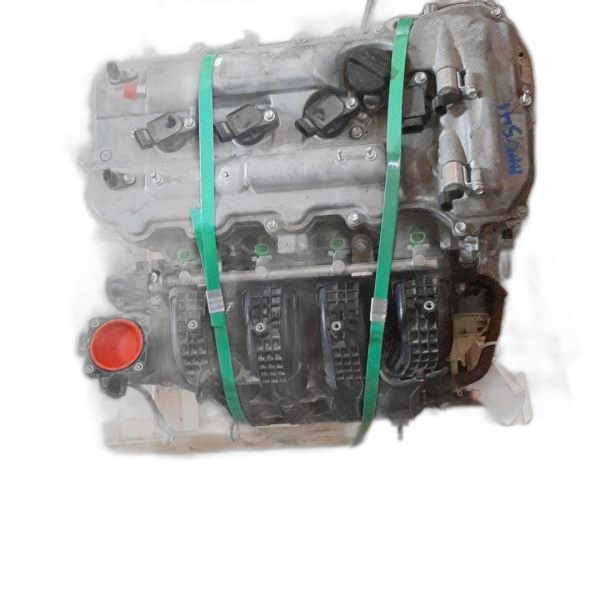
Below are the parts most often responsible for code P0205, ranked by how frequently each one is the actual culprit (per the diagnosis above). Tap any to see what we have for your vehicle.







The information in this article is provided for general reference and educational purposes only. Vehicle specifications, procedures, and part compatibility can vary by production date, trim level, and region. Always consult your vehicle's factory service manual and verify part numbers before purchasing or performing repairs. Safety-critical components such as airbags, seat belts, and braking systems should be installed by a qualified professional.
- 🧭 Diagnostic Flowchart
- 🎬 Helpful Videos
- 🛍️ Shop This Part
- What Does P0205 Mean?
- Can I Drive With P0205?
- Common Causes
- Symptoms
- Common Fixes & Costs
- Used vs. New Parts: Buying Guide
- What Happens If You Wait — Timeline
- Cost of Not Fixing It
- Diagnosis Steps
- When This Code Triggers (Freeze-Frame Conditions)
- Related Codes
- Climate & Environmental Factors
- How to Talk to a Mechanic About This Code
- Where to Take It: Dealer vs Independent vs Chain
- When to Walk Away From the Repair
- What Scan Tool You Need for This Code
- How to Clear the Code After You Fix It
- Will This Fail Emissions / State Inspection?
- Most Commonly Affected Vehicles
- Manufacturer-Specific Notes
- Real Owner Stories
- 2015 Ram 2500 6.7L Cummins at 110K miles
- 2010 Ford Escape V6 at 125K miles
- 2013 Ford F-150 with 5.0L V8 after engine swap
- How to Prevent This Code From Triggering
- Frequently Asked Questions
- Can I fix P0205 myself?
- What is the difference between P0205 and P0305?
- Will a fuel injector cleaner fix a P0205 code?
- What is the most common misdiagnosis for P0205?
- Why did the P0205 code come back after replacing the injector?
- My car only has 4 cylinders. Why am I getting a P0205 code?
- How do I find cylinder #5 on my engine?
- Key Takeaways
- 🎟️ Get 5% Off