

P0205 on 1998-2003 Dodge RAM 1500: Cylinder 5 Injector Circuit Causes and Fixes
On a 1998-2003 Dodge RAM 1500, code P0205 is most often caused by a faulty wiring harness or connector, particularly where the harness is exposed to high heat. A manufacturer TSB specifically advises checking the wiring before replacing the fuel injector. Inspecting the harness and replacing the pigtail connector is a common, low-cost first step. A bad injector is the next likely cause, followed by a rare but possible PCM failure.
- P0205 is an electrical circuit fault for the cylinder 5 fuel injector.
- For this Dodge Ram, a known weak point is the wiring harness at the valve cover gasket; check this before buying parts.
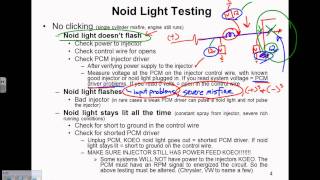
- A simple 'noid light' test can quickly tell you if the injector is receiving a signal from the computer.
- Driving with this code can lead to more expensive damage to your catalytic converter.
- This code is almost always paired with a P0305 misfire code.
What's Unique About the 1998-2003 Dodge RAM 1500
For this generation of Dodge Ram, a known weak point exists that is documented in a Technical Service Bulletin (TSB #9002688). The manufacturer specifically advises technicians to inspect the wiring loom and connector before assuming the fuel injector has failed. This wiring, particularly for the V8 engines, is prone to damage from high engine heat and vibration, often causing the exact circuit fault that triggers a P0205 code. Forum discussions frequently confirm that melted or brittle wires are the culprit.
Diagnostic Flowchart
Tap your situation to follow the diagnostic path that matches what you're seeing on this vehicle.
Generation note: This range covers two distinct generations of the Dodge RAM 1500. The 1998-2001 models are the second generation (BR/BE), while 2002-2003 models are the third generation (DR/DH). Engine options differ, with 1998-2001 models using the 3.9L V6, 5.2L V8, and 5.9L V8. The 2002-2003 models introduced the 3.7L V6, 4.7L V8, and in 2003, the 5.7L HEMI V8, while retaining the 5.9L V8. The underlying cause related to wiring harness vulnerability is common across these model years and engine types.
Symptoms You May Notice
- Check Engine Light is on
- Rough, shaking, or vibrating idle
- Engine misfire, sometimes felt as a rhythmic stumble or 'tap'.
- Hesitation and lack of power during acceleration.
- Reduced fuel economy.
- Difficulty starting the engine, or stalling after starting.
- Engine may enter 'Limp-Home' mode, limiting speed.
- Replacing the fuel injector for cylinder 5 without first thoroughly inspecting and testing the wiring harness and connector, as advised by Dodge's own service bulletin and numerous owner experiences.
Most Likely Causes
- Faulty Injector Wiring Harness or Connector 🔴 High Probability → Shop Engine Wiring Harness A manufacturer TSB (#9002688) specifically identifies the wiring loom as a common failure point. Engine heat and vibration can make the wire insulation brittle, causing it to crack, melt, or break, leading to a short or open circuit. Forum users often find melted wires in the harness section that runs near the power steering reservoir or along the fuel rail.
How to confirm: Visually inspect the wiring harness for cylinder #5 for any signs of cracking, melting, or corrosion at the connector. Perform a 'wiggle test' on the harness with the engine running to see if it affects the misfire. Use a multimeter to check for continuity from the PCM connector to the injector connector. Resistance should be less than 5.0 ohms, with some sources recommending less than 0.5 ohms.
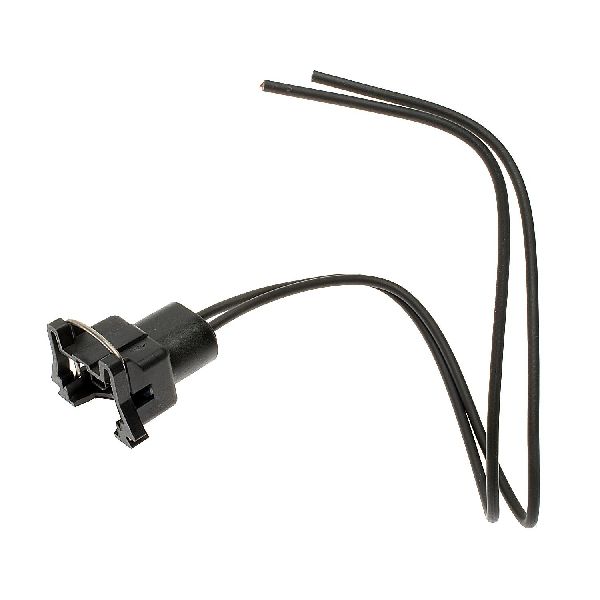
Typical fix: Repair the damaged section of wire or replace the injector connector pigtail. In some cases, the entire injector sub-harness may need replacement.
Est. part cost: $10-$30 - Failed Fuel Injector 🟡 Medium Probability → Shop Fuel Injector Injectors can fail internally over time due to wear on the internal solenoid coil, especially on vehicles with over 80,000 miles. Stale fuel from long periods of sitting can also contribute to clogging or failure.
How to confirm: After confirming the wiring is good, test the injector. Disconnect the injector and measure its internal resistance with a multimeter. A typical reading is between 11-16 Ohms. A reading of infinity (open) or near-zero (short) indicates a bad injector. You can also swap the cylinder 5 injector with an adjacent one (e.g., cylinder 3) and see if the misfire code follows (e.g., changes to P0203).
Typical fix: Replace the cylinder 5 fuel injector. It is often recommended to replace all injectors as a set on high-mileage vehicles to ensure balanced fuel delivery.
Est. part cost: $40-$100 - Faulty Powertrain Control Module (PCM) ⚪ Low Probability → Shop Engine Control Module (ECM) While less common, the internal driver circuit within the PCM that controls the injector can fail. This can sometimes be caused by a shorted injector or wiring harness, which damages the PCM.
How to confirm: This is diagnosed by exclusion. If the injector and the entire wiring circuit between the PCM and the injector have been tested and are confirmed to be good (good continuity, no shorts to ground or power), the injector driver circuit inside the PCM is the likely culprit.
Typical fix: The PCM must be repaired or replaced. A replacement unit will need to be programmed to the vehicle's VIN and mileage.
Est. part cost: $200-$500
Rare But Worth Checking
- Rodent Damage:
Diagnosis Steps
- Identify Cylinder 5. On Dodge V8 engines (318, 360, 4.7L), the cylinders are numbered front-to-back, with odd numbers on the driver's side (left bank) and even on the passenger's side (right bank). Cylinder #5 is the third cylinder back on the driver's side.
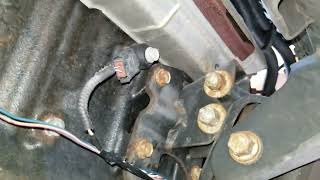
- Visually inspect the wiring harness and connector for cylinder 5. Look for obvious signs of damage like chafing, melting, or corrosion. Pay close attention to the harness where it runs near hot components or under the power steering reservoir.
- Perform a 'wiggle test' by gently moving the connector and harness with the engine idling to see if the misfire changes, indicating an intermittent connection.
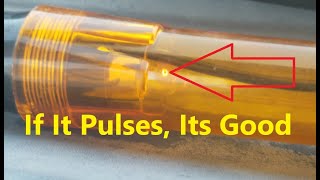
- Use a noid light to test the circuit pulse. Disconnect the injector and plug the noid light into the connector. Crank or start the engine. A rhythmic flashing light means the PCM is sending the signal correctly, pointing to a bad injector. No light or a steady light points to a problem with the wiring or the PCM.
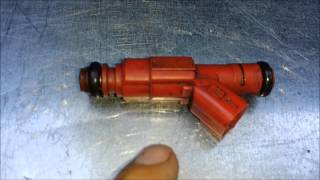
- Test the injector resistance. Disconnect the injector and use a multimeter set to Ohms to measure across the two pins on the injector itself. Compare the reading to the manufacturer's specification (see specific_diagnostic_values). A reading far outside this range indicates a failed injector.
- Check for continuity and shorts in the wiring. If the noid light didn't flash, use a multimeter. Check for continuity on both wires from the PCM connector to the injector connector (resistance should be <5 ohms). Then, check each wire for a short to ground and a short to power.
- Swap injectors. If the wiring seems good but you suspect the injector, swap the #5 injector with an adjacent one (like #3). Clear the codes and run the engine. If the code changes to P0203, the injector is confirmed to be faulty.
- If the wiring and injector test good, the final possibility is a failed injector driver in the PCM.
Parts You'll Likely Need
- Fuel Injector Connector Pigtail
(OEM #5013856AA (superseded by 68353382AA))— This is often the point of failure due to heat and vibration, as highlighted by the TSB. Splicing in a new pigtail is a common and effective repair.
Trusted brands: Mopar, Standard Motor Products, Dorman
OEM price range: $25-$45
Aftermarket price range: $10-$25 - Fuel Injector
(OEM #53030778AB (For 3.9L/5.2L/5.9L Magnum engines))— If the injector's internal coil has failed (tested with a multimeter), it must be replaced. This is the second most likely cause after wiring issues.
Trusted brands: Mopar, Bosch, Standard Motor Products
OEM price range: $80-$150
Aftermarket price range: $40-$100
Related Codes That Often Appear With This One
- P0305 — P0305 means 'Cylinder 5 Misfire Detected'. Since P0205 indicates the injector circuit isn't working, cylinder 5 isn't getting the correct amount of fuel, which directly causes a misfire.
Technical Service Bulletins (TSBs) & Recalls
- 9002688: Advises checking the wiring loom and connector before replacing injectors for P0201-P0206 codes.
Platform-Specific Known Issues
- A Technical Service Bulletin (TSB #9002688) was issued for 2001 models, but the issue is relevant to the entire year range, advising that the wiring loom and/or connector can be the root cause for P020x codes. This should be checked before replacing any fuel injectors. Forum threads on DodgeForum.com corroborate this, with users finding melted or broken wires in the main harness. One user on a Dodge Caravan forum (with a similar harness design) noted a common failure point is the section of harness running under the Power Steering reservoir, which can trap heat and melt the insulation.
Mechanic-Grade Diagnostic Values
- Fuel Injector Coil Resistance (5.2L/5.9L Magnum, 1998-2003) — expected: 10.8 - 15.7 Ohms (13.3-15.7 for '98, 10.8-13.2 for '98-'00). All injectors should be within ~0.5-1.0 Ohm of each other.. Failure: A reading of infinity/OL (open circuit) or near 0 Ohms (short circuit).
- Fuel Injector Coil Resistance (4.7L V8) — expected: 10.8 - 13.2 Ohms. Some sources state a nominal 12.6 Ohms.. Failure: A reading significantly outside the 10.8-13.2 Ohm range, or not consistent with other injectors.
- Injector Connector Voltage (Key On, Engine Off) — expected: Approximately 12 Volts (Battery Voltage) on the power feed wire (common wire for all injectors, often Dark Green/Orange).. Failure: No voltage or significantly low voltage indicates a problem with the ASD (Auto Shutdown) relay or the power feed circuit.
- Wiring Continuity (PCM to Injector Connector) — expected: Less than 5.0 Ohms, with some professional sources recommending less than 0.5 Ohms.. Failure: Resistance higher than 5.0 Ohms, or OL (Open Line), indicates a break or high resistance in the wire.
Scan Tool Commands That Help
- DRB III or equivalent professional scan tool: Injector Actuator Test / ASD Relay Control State — This bidirectional command allows the technician to manually fire the fuel injector or activate the ASD relay from the scan tool. If the injector clicks when commanded by the tool but a noid light doesn't flash when cranking, it can help differentiate between a wiring issue and a PCM driver signal problem during normal operation.
Wiring & Ground Locations
- Cylinder 5 Injector Control Wire — Runs from the PCM connector to the cylinder 5 fuel injector connector. On some Cummins-powered Rams (for reference), the wire color for cylinder 5 is Green/White. The power feed wire to the injectors is often Dark Green with an Orange tracer.. This is the specific wire that the PCM uses to ground-pulse the injector. An open or a short to ground/voltage on this wire is a direct cause of P0205.
- G102 / G104 — G102 is a primary battery ground located at the left front of the engine bay. G104 is another key ground in the left front engine compartment.. A poor engine or chassis ground can cause unstable voltage throughout the electrical system, potentially affecting the PCM's ability to properly control and monitor the injector circuits, leading to intermittent or false P0205 codes.
- Valve Cover Pass-Through Harness — On some engine designs, the injector wiring passes through the valve cover gasket itself.. As noted in TSB 9002688, this connector/harness area is a known failure point due to heat and oil saturation, causing the wiring to become brittle and fail, leading to P020x codes.
Real Owner Repair Stories
- DodgeForum.com user 'cwilsonn1976' (2001 Dodge Ram 1500) — Truck started missing badly, dead miss in the motor.
❌ Tried (didn't work) Replaced the cylinder 5 fuel injector., Replaced the PCM (Powertrain Control Module)., Replaced the TPS (Throttle Position Sensor).
✅ What actually fixed it The user traced all wires and confirmed voltage was present, but the code persisted. Another user advised to specifically check continuity on the wires from the ASD relay (12v+) and the PCM (ground signal) directly to the injector connector, implying the fault was likely in the wiring harness itself, which is the most common cause after multiple parts fail to fix the issue.
OEM Part Supersession History
53030778→53030778AB, RL030778AB— Part revision and remanufactured part number designation.
Heads up: These parts are for the 3.9L/5.2L/5.9L Magnum engines and are generally interchangeable for the specified model years.N/A→53032145AA, RL032145AA— Original part for the 4.7L V8 engine.
Heads up: This injector is specific to the 4.7L PowerTech V8 and is not interchangeable with the Magnum engine injectors.
Model Year Variations Within This Range
- 1998-2000: The specified fuel injector resistance for 5.2L/5.9L engines is often cited as 10.8-13.2 Ohms for these years.
- 2002-2003: These third-generation (DR/DH) models introduced the 4.7L V8 as a common engine, which uses a different fuel injector (p/n 53032145AA) with a different resistance specification (approx. 12.6 Ohms) than the older 5.2L/5.9L Magnum engines.
Helpful Videos
We Have This Part in Stock


The information in this article is provided for general reference and educational purposes only. Vehicle specifications, procedures, and part compatibility can vary by production date, trim level, and region. Always consult your vehicle's factory service manual and verify part numbers before purchasing or performing repairs. Safety-critical components such as airbags, seat belts, and braking systems should be installed by a qualified professional.
- Dodge RAM 1500:
- 🧭 Diagnostic Flowchart
- 🎬 Helpful Videos
- 🛍️ Shop This Part
- What's Unique About the 1998-2003 Dodge RAM 1500
- Symptoms You May Notice
- Most Likely Causes
- Rare But Worth Checking
- Diagnosis Steps
- Parts You'll Likely Need
- Related Codes That Often Appear With This One
- Technical Service Bulletins (TSBs) & Recalls
- Platform-Specific Known Issues
- Mechanic-Grade Diagnostic Values
- Scan Tool Commands That Help
- Wiring & Ground Locations
- Real Owner Repair Stories
- OEM Part Supersession History
- Model Year Variations Within This Range
- 🎟️ Get 5% Off