

P0205 on 2007-2010 Dodge RAM 1500: Injector Circuit Causes & Fixes
On 2007-2010 Dodge RAM 1500s, P0205 is often caused by a faulty wiring harness inside the valve cover gasket, not the fuel injector itself. Before replacing the injector, inspect the wiring as noted in manufacturer TSB #9002688. A new gasket with integrated wiring is the likely fix.
- P0205 on a 2007-2010 RAM 1500 points to an electrical circuit problem for the cylinder 5 fuel injector.
- Before you buy a new fuel injector, inspect the wiring harness, especially where it passes through the valve cover gasket on 4.7L engines. This is a known failure point according to a manufacturer service note.
- The most likely repair is replacing the valve cover gasket that comes with a new integrated wiring harness, or the fuel injector itself if wiring is confirmed good.
- Cylinder 5 is the third cylinder back from the front on the driver's side of the V8 engines.
What's Unique About the 2007-2010 Dodge RAM 1500
For this specific generation of Dodge RAM, a known weak point is the injector wiring harness that passes through the valve cover gasket, particularly on the 4.7L V8. A manufacturer Technical Service Bulletin (TSB #9002688) directly warns technicians not to replace the fuel injector for codes P0201 through P0206 until they have first inspected this wiring loom and its connector. This suggests that a wiring issue, caused by heat and oil degradation, is a very common cause for this code on these trucks, leading to frequent misdiagnosis where a good injector is replaced unnecessarily.
Diagnostic Flowchart
Tap your situation to follow the diagnostic path that matches what you're seeing on this vehicle.
Generation note: This range covers the end of the 3rd generation (2007-2008) and the beginning of the 4th generation (2009-2010). The available engines (3.7L V6, 4.7L V8, 5.7L HEMI V8) were largely carried over, and the TSB regarding wiring issues applies to this entire period, suggesting the core problem is consistent across these model years. The issue is particularly noted on the 4.7L PowerTech V8 and its 3.7L V6 derivative.
Symptoms You May Notice
- Check Engine Light is on
- Rough or unstable idle
- Engine misfire, which may feel like a shake or stumble
- Loss of power and poor acceleration
- Decreased fuel economy
- Smell of raw fuel from the exhaust
- Replacing the fuel injector without checking the wiring harness first. The TSB for this vehicle specifically warns against this.
- Replacing the fuel injector when the issue is a poor connection at the injector's electrical plug.
Most Likely Causes
- Faulty Injector Wiring Harness in Valve Cover Gasket 🔴 High Probability → Shop Engine Wiring Harness As cited in TSB #9002688, the wiring loom and connector that pass through the valve cover gasket are a known point of failure. Engine heat and oil exposure can make the wiring brittle, causing an open or short in the injector circuit. This is especially common on the 4.7L V8.
How to confirm: Visually inspect the wiring harness where it connects to the injector and where it passes through the valve cover gasket. Perform a wiggle test on the harness while the engine is running to see if it affects the misfire. Use a multimeter to check for continuity between the PCM connector and the injector connector. The wire for the cylinder 5 injector driver is typically Brown/Dark Blue.
Typical fix: Replace the valve cover gasket, which includes the integrated wiring harness.
Est. part cost: $50-$150 - Failed Fuel Injector 🟡 Medium Probability → Shop Fuel Injector Injectors can fail electrically (internal coil shorts or opens) or become clogged over time, especially with high mileage or poor fuel quality.
How to confirm: Measure the resistance of the fuel injector with a multimeter. A typical injector should read between 12-16 ohms. An infinite reading means it's open, and a near-zero reading means it's shorted. A definitive test is to swap the cylinder 5 injector with an adjacent one (e.g., cylinder 3 or 7). Clear the codes and drive the truck. If the trouble code follows the injector (e.g., changes to P0203 or P0207), the injector is faulty.
Typical fix: Replace the failed fuel injector.
Est. part cost: $40-$100 - Damaged Wiring or Corroded Connector ⚪ Low Probability Engine vibrations and heat can cause wires to chafe or insulation to become brittle. The injector connector itself can become loose or corroded, preventing a solid connection. In some cases, rodents have been known to chew on injector wiring.
How to confirm: Visually inspect the wiring harness leading to the fuel injector for any signs of physical damage, chafing, or melting. Unplug the connector and check for corrosion or bent pins on both the injector and the connector side.
Typical fix: Repair the damaged section of wire or clean/replace the connector pigtail.
Est. part cost: $5-$25
Rare But Worth Checking
- Faulty Powertrain Control Module (PCM): → Shop Engine Control Module (ECM) This is rare but possible. The internal driver circuit in the PCM that controls the cylinder 5 injector can fail. This should be the last item to consider after all wiring and the injector itself have been proven good. A PCM failure may sometimes be accompanied by other, seemingly unrelated codes.
Diagnosis Steps
- Verify the P0205 code with an OBD-II scanner. Check for any other codes, especially P0305, which is common to see alongside P0205.
- Locate Cylinder #5. On the 5.7L HEMI and 4.7L V8, the cylinders on the driver's side (left bank) are 1, 3, 5, 7, from front to back. Cylinder 5 is the third one back on the driver's side.
- Per TSB #9002688, the first step is to inspect the wiring. Visually check the injector connector for damage or corrosion. Follow the harness back to where it enters the valve cover, looking for brittle or chafed wires.
- Perform a 'wiggle test' on the harness near the valve cover and at the injector connector while the engine is idling. If the engine's idle changes or stumbles, it strongly indicates a wiring fault.
- Test the injector circuit signal with a 'noid light'. Unplug the injector, plug in the noid light, and start the engine. The light should flash steadily. If it doesn't flash, is dim, or stays on continuously, there is a problem with the wiring or the PCM.
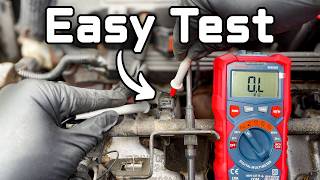
- If the noid light test passes, test the fuel injector itself. Turn off the engine and disconnect the injector. Measure its resistance with a multimeter set to Ohms. 🎬 Watch: How to test fuel injectors with a multimeter. It should be within the typical range of 12-16 ohms. An infinite reading (OL) means an open circuit, while a very low reading (under 1 ohm) indicates a short.
- As a final confirmation, swap the cylinder 5 injector with one from another cylinder (e.g., cylinder 7). Clear the codes and run the engine. If the code changes to P0207, the injector is confirmed to be bad. If the code remains P0205, the problem is in the wiring or the PCM.
- If all tests point to good wiring and a good injector, the issue may be the PCM's injector driver, but this is the least likely cause and should be diagnosed by a professional.
Parts You'll Likely Need
- Valve Cover Gasket with Injector Harness
(OEM #53021895AD (4.7L Left Side - Verify with VIN))— This is the most probable cause according to Manufacturer TSB #9002688, especially on the 4.7L engine. The wiring harness integrated into the gasket fails, causing an open or short.
Trusted brands: Mopar, Fel-Pro
OEM price range: $100-$180
Aftermarket price range: $60-$120 - Fuel Injector
(OEM #53032701AA (4.7L), 05039462AA (5.7L) - Verify with VIN)— If the wiring is confirmed to be good, the injector itself may have failed electrically or become clogged.
Trusted brands: Mopar, Bosch, Standard Motor Products
OEM price range: $80-$150
Aftermarket price range: $40-$90
Related Codes That Often Appear With This One
- P0305 — P0305 means "Cylinder 5 Misfire Detected". Since the P0205 code indicates a problem with the injector circuit for cylinder 5, that cylinder isn't getting the right amount of fuel, which directly causes a misfire.
Technical Service Bulletins (TSBs) & Recalls
- 9002688: This is not a traditional TSB, but a note within the Mopar parts system attached to part numbers for cylinder head cover gaskets. It advises technicians to check the integrated wiring loom/connector before replacing injectors for P0201-P0206 codes.
Platform-Specific Known Issues
- A Mopar parts system note (often referred to as TSB #9002688) was issued for 2007 models specifically highlighting that the wiring loom and/or connector in the valve cover gasket should be checked before replacing fuel injectors for codes P0201 through P0206. This problem is widely discussed in owner forums as a primary cause of P020x codes on the 4.7L engine.
- On the 5.7L HEMI, while still possible, the valve cover harness issue is less common. For HEMI engines, it's more critical to closely inspect the injector connector and the main engine harness for chafing or damage near the fuel rail.
Mechanic-Grade Diagnostic Values
- Fuel Injector Coil Resistance — expected: 12 Ohms +/- 1.2 Ohms (i.e., 10.8 to 13.2 Ohms) for many Dodge V8s. A 4.7L owner reported stock injectors at 12.5 Ohms.. Failure: A reading of infinity (Open Loop) or near zero ohms indicates a failed injector. A reading outside the specified range, or one that deviates significantly (more than 0.5-1.0 Ohm) from the other injectors, points to a faulty injector.
- Injector Circuit Continuity (PCM to Injector) — expected: Less than 0.5 Ohms of resistance.. Failure: High resistance or an open circuit (OL) indicates a break in the wire between the PCM and the injector connector.
- Injector Pulse Width (at idle) — expected: Typically 1.5ms to 3.5ms at idle, depending on engine temperature and load.. Failure: A value of 0ms or an erratic reading on a scan tool for cylinder 5, while other cylinders show normal pulse width, indicates a circuit or PCM driver problem.
- Injector Circuit Voltage (Key On, Engine Off) — expected: Approximately 12 Volts (battery voltage) at the power supply wire of the injector connector.. Failure: Low or no voltage indicates a problem with the power supply from the ASD (Auto Shutdown) relay or a wiring issue upstream of the injector.
Scan Tool Commands That Help
- wiTECH 2.0 (or equivalent professional scanner like Autel/Launch): Fuel Injector Kill / Cylinder Power Balance Test — This bidirectional test allows the technician to command the PCM to stop firing a specific injector (e.g., cylinder 5). While the engine is idling, disabling the cylinder 5 injector should cause a noticeable change in engine RPM and sound. If there is NO change when cylinder 5 is disabled, it confirms that injector was not contributing to engine power, pinpointing the fault to that cylinder.
- wiTECH 2.0 (or equivalent professional scanner like Autel): Injector Balance Test — This automated test pulses each injector for a set duration while monitoring fuel pressure drop. The scan tool displays the pressure drop for each cylinder. If the pressure drop for cylinder 5 is significantly different from the others, it indicates a clogged or malfunctioning injector. Note: This requires a fuel pressure gauge to be connected to the fuel rail.
Wiring & Ground Locations
- Cylinder 5 Injector Control Circuit (PCM Pin) — On some Cummins-powered Rams (which share diagnostic principles), the Cylinder 5 High Side Driver circuit is identified as (K38) and the Low Side as (K638) at the PCM C1 harness connector. While wire colors may vary for the gas engines, this indicates the level of specificity available in service manuals.. Allows for precise continuity and short-to-ground testing directly from the PCM connector, bypassing the entire engine harness to isolate the fault to the wiring, injector, or PCM itself.
- Engine Block Ground — A primary ground cable connects from the negative battery terminal to the front of the engine block, often on the driver's side.. A poor engine ground can cause a host of electrical issues, including erratic sensor readings and injector problems. The PCM and its drivers rely on a solid ground reference to function correctly.
- Firewall/Body Ground — A ground strap or wire typically runs from the rear of the cylinder head or engine block to the firewall. Another common ground point is from the negative battery terminal to the body, often near the driver's side headlight.. The PCM and other modules are grounded to the body. If the engine-to-body ground is weak, the injector driver circuits can malfunction due to unstable voltage potentials.
Real Owner Repair Stories
- DodgeForum.com user (Dodge Ram with stumble/hesitation issues) — Slight engine stumble at 1300-1400 RPM, 50 RPM waver at idle.
❌ Tried (didn't work) Initial inspection of wiring harness connectors.
✅ What actually fixed it The user tested all fuel injectors and found one (#3 in his case, but the principle applies) with a resistance of 13.2 ohms, which was at the very edge of the 12 ohm +/- 1.2 ohm tolerance, while all others were tightly grouped between 12.3-12.6 ohms. The consensus was to replace the outlier injector, as even a slight deviation can cause issues under load or with performance tunes.
Helpful Videos
We Have This Part in Stock


The information in this article is provided for general reference and educational purposes only. Vehicle specifications, procedures, and part compatibility can vary by production date, trim level, and region. Always consult your vehicle's factory service manual and verify part numbers before purchasing or performing repairs. Safety-critical components such as airbags, seat belts, and braking systems should be installed by a qualified professional.
- Dodge RAM 1500:
- 🧭 Diagnostic Flowchart
- 🎬 Helpful Videos
- 🛍️ Shop This Part
- What's Unique About the 2007-2010 Dodge RAM 1500
- Symptoms You May Notice
- Most Likely Causes
- Rare But Worth Checking
- Diagnosis Steps
- Parts You'll Likely Need
- Related Codes That Often Appear With This One
- Technical Service Bulletins (TSBs) & Recalls
- Platform-Specific Known Issues
- Mechanic-Grade Diagnostic Values
- Scan Tool Commands That Help
- Wiring & Ground Locations
- Real Owner Repair Stories
- 🎟️ Get 5% Off