

P0205 on 1998-2005 Dodge RAM 2500: Injector Circuit Malfunction Causes & Fixes
On a 1998-2005 Dodge Ram 2500 with the 5.9L Cummins, P0205 is most often caused by a faulty injector wiring harness integrated into the valve cover gasket, not the injector itself. The constant heat and vibration cause the internal wiring to fail. Replacing the valve cover gasket with the integrated harness is the most common and recommended first repair.
- For a P0205 on a 1998-2005 Ram 2500, suspect the wiring harness under the valve cover before you suspect the injector.
- A TSB exists specifically for this issue, making it a well-documented problem.
- Symptoms include a rough idle, loss of power, and a check engine light.
- The fix is often replacing the valve cover gasket which has an integrated injector harness. OEM part number is 5179091AD.
- Always test components before replacing them; swapping the injector to another cylinder is a definitive way to confirm if the injector is faulty.
What's Unique About the 1998-2005 Dodge RAM 2500
For the 5.9L Cummins engine in this era of Ram trucks, the injector wiring is a known weak point. The wiring harness passes through the valve cover gasket, and over time, heat and vibration cause the connections to fail, leading to intermittent open or short circuits. This is so common that Dodge issued a Technical Service Bulletin (NHTSA ID #10139009, internal #9002688) advising technicians to check this wiring loom before replacing the #5 injector itself. This makes a wiring issue a much higher probability on these trucks compared to others where the injector itself might be the primary suspect. A detailed diagnostic case study from Geno's Garage highlights that even when P0205 points to an injector, the wiring must be tested first to avoid misdiagnosis.
Diagnostic Flowchart
Tap your situation to follow the diagnostic path that matches what you're seeing on this vehicle.
Generation note: This range covers the end of the 2nd Generation (1998.5-2002) and the start of the 3rd Generation (2003-2005) Ram. Both generations used a 5.9L 24-valve Cummins engine, but the fuel systems differ significantly. The 2nd Gen uses a Bosch VP44 injection pump, while the 3rd Gen introduced a Bosch high-pressure common rail (HPCR) system. Despite these differences, the P0205 code and its common cause related to the under-valve-cover wiring harness are prevalent in both generations due to the similar physical design of the harness.
Symptoms You May Notice
- Check Engine Light is on.
- Rough or shaking idle.
- Noticeable loss of power and poor acceleration.
- Engine misfire, which may feel like a stumble or shudder.
- Increased black smoke from the exhaust.
- Decreased fuel economy.
- Engine may die at stops.
- Replacing the fuel injector before testing the wiring harness. The TSB specifically warns against this, as the harness is a more frequent failure point on these engines.
Most Likely Causes
- Faulty Injector Wiring Harness (Under Valve Cover) 🔴 High Probability → Shop Engine Wiring Harness As documented in TSB #9002688, the wiring harness that passes through the valve cover gasket is a very common failure point. Constant engine vibration and heat cycles degrade the electrical connections to the injectors, causing opens or shorts. Forum users on Diesel Truck Resource have noted that the wire lugs can sometimes rotate and touch a rocker arm, causing a short.
How to confirm: Disconnect the main engine harness from the valve cover. Use a multimeter set to Ohms to check for continuity and resistance between the appropriate pins on the external connector and the injector solenoid posts under the valve cover. A reading that is out of specification (typically looking for less than 1 ohm, and not an open circuit 'OL') indicates a harness problem. A 'wiggle test' on the harness while the engine is running can also help identify intermittent connections.
Typical fix: Replace the valve cover gasket, which includes the integrated injector wiring harness. This is the most reliable fix. In some cases, individual pigtail connectors can be repaired, but this is less common.
Est. part cost: $75-$250 - Failed Fuel Injector #5 🟡 Medium Probability → Shop Fuel Injector Injectors are wear items and can fail electrically (solenoid) or mechanically. High mileage or fuel contamination can accelerate failure.
How to confirm: After confirming the wiring is good, test the injector itself. Disconnect the wires from the #5 injector solenoid posts. Measure the resistance across the two terminals of the solenoid. It should be within a specific, low-ohm range (typically under 1.0 ohm). An open circuit (infinite resistance or 'OL') or a shorted circuit (zero resistance) indicates a bad injector solenoid. A more definitive test is to swap the #5 injector with an adjacent one (e.g., #4 or #6) and see if the trouble code follows the injector (e.g., changes to P0204 or P0206).
Typical fix: Replace the #5 fuel injector. It is often recommended to replace the corresponding injector connector tube at the same time.
Est. part cost: $250-$500 - Corroded or Loose Connector Pins ⚪ Low Probability The main electrical connector at the valve cover is exposed to the elements and engine vibration, which can lead to corrosion or pins backing out over time.
How to confirm: Visually inspect the main electrical connector at the valve cover and the connector at the PCM. Look for any signs of corrosion, moisture, or backed-out pins. Perform a 'wiggle test' on the harness while the engine is running to see if it causes the misfire to appear or disappear. Check for poor pin fit, which can cause intermittent faults.
Typical fix: Clean the connectors with electrical contact cleaner and apply dielectric grease. If pins are damaged, the connector pigtail may need to be replaced.
Est. part cost: $5-$30
Rare But Worth Checking
- Faulty Powertrain Control Module (PCM): → Shop Engine Control Module (ECM) This is the least likely cause. The internal driver circuit for the #5 injector within the PCM can fail, but all wiring and the injector itself should be thoroughly tested before condemning the PCM. A user on RamForum.com suspected a bad PCM after extensive wiring and injector testing proved fruitless. A 'noid' light test at the harness connector showing no signal from the PCM, when wiring and injector are known to be good, points towards a PCM issue.
Diagnosis Steps
- Read the code with an OBD-II scanner and note any other codes present, especially P0305 or P2149. 🎬 Watch: Diagnostic steps for P2149 and injector solenoid faults.
- Visually inspect the main engine wiring harness leading to the valve cover for any obvious damage, chafing, or loose connections.
- Perform a 'wiggle test' on the harness with the engine idling to see if the misfire changes, indicating a loose connection.
- Following the advice of TSB #9002688, test the injector harness first. Disconnect the harness at the valve cover. Using a multimeter, test continuity from the external plug pins for cylinder #5 to the injector posts for cylinder #5. The resistance should be very low (<1 Ohm).
- If the harness tests good, remove the valve cover to access the injector. Cylinder #5 is the second cylinder from the firewall.
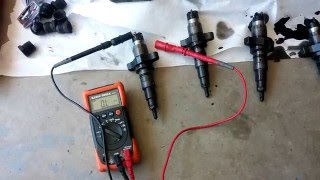
- Measure the resistance of the #5 injector solenoid. Disconnect the wires and measure across the two posts. 🎬 See how to test a fuel injector with a multimeter. Compare the reading to the manufacturer's specification (typically <1.0 ohm). An 'OL' reading indicates an open/failed solenoid.
- If the injector resistance is good, consider swapping injector #5 with an adjacent injector (like #4 or #6). Clear the codes and run the engine. If the code changes to P0204 or P0206, the injector is confirmed to be the problem.
- If both the harness and injector test good, the final step is to check for a signal from the PCM using a 'noid' light plugged into the injector harness connector. If the light doesn't flash while cranking, the issue may be in the main harness or the PCM itself.
Parts You'll Likely Need
- Valve Cover Gasket with Injector Harness
(OEM #5179091AD (supersedes 68086182AA, 3975641, 5264950))— This is the most common failure point for a P0205 code on this vehicle, as identified by a manufacturer TSB.
Trusted brands: Mopar, Fel-Pro (p/n VS50668R), Dorman
OEM price range: $150-$250
Aftermarket price range: $75-$150 - Fuel Injector
(OEM #Bosch 0986435503 (2003-Early 2004), Bosch 0445120238 (2004.5-2005))— If the wiring harness is confirmed to be good, the injector solenoid itself is the next most likely component to have failed. Note: Part numbers differ between early and late 3rd Gen common rail engines.
Trusted brands: Bosch (OEM), Mopar
OEM price range: $400-$500
Aftermarket price range: $250-$350
Related Codes That Often Appear With This One
- P0200 — P0200 indicates a general injector circuit malfunction. It can appear alongside P0205 if the electrical fault is intermittent or affects the entire injector bank.
- P0305 — P0305 indicates a misfire detected on cylinder 5. P0205 is the electrical cause of the mechanical misfire, so it's very common to see both codes together.
- P2149 — P2149 indicates a 'Fuel Injector Group B Supply Voltage Circuit/Open' fault. On the 5.9L Cummins, injectors 4, 5, and 6 are in Group B. A fault in the #5 injector circuit can often trigger this group code as well.
Technical Service Bulletins (TSBs) & Recalls
- 9002688 (NHTSA ID: 10139009): Advises checking the valve cover gasket wiring loom and connector before replacing injectors for P020x codes. Lists multiple potentially superseded part numbers for the gasket/harness assembly.
Platform-Specific Known Issues
- A Technical Service Bulletin (NHTSA ID #10139009 / Mopar #9002688) was issued for this problem, specifically advising to check the wiring loom in the valve cover gasket before replacing any fuel injectors for codes P0201 through P0206.
- The injector harness passes through the valve cover gasket, making it susceptible to damage from heat and vibration, which is the primary cause of P020x codes on this platform.
Mechanic-Grade Diagnostic Values
- Common Rail Injector Solenoid Resistance — expected: 0.3 - 0.6 Ohms. Failure: A reading of 1.0 Ohm or higher, or an open circuit (OL), indicates a faulty solenoid.
- Injector Harness/Circuit Resistance (from ECM connector to injector) — expected: Less than 1.0 Ohm, ideally close to 0 Ohms.. Failure: High resistance (several ohms) or an open circuit (OL) indicates a break or corrosion in the wiring.
- Injector Circuit Voltage (using a noid light or multimeter) — expected: A flashing light or pulsing 12V signal at the injector connector while cranking the engine.. Failure: No light/pulse, or a constantly lit light, indicates a problem with the wiring or the PCM driver circuit.
Scan Tool Commands That Help
- DRB III or equivalent professional scanner (e.g., Launch X431, Snap-on): Injector Kill Test / Cylinder Cutout Test — This test is used to confirm which cylinder is misfiring. The scanner commands the ECM to shut off one injector at a time. If shutting off cylinder #5 causes no change in engine idle or sound, it confirms that injector was not firing correctly to begin with.
Wiring & Ground Locations
- ECM C1 Connector (Bank 2 Injectors) — The main 50 or 60-pin connector at the Engine Control Module (ECM), typically mounted on the driver's side of the engine block.. Allows testing the injector circuit directly from the ECM. For cylinder 5 (in Bank 2), the high side driver is circuit K38 and the low side is K638. Testing for continuity and shorts at these pins can isolate a wiring fault from a PCM fault.
- Main Engine Ground (2nd Gen) — A ground stud on the sheet metal below the driver's side battery.. This ground point is critical for the ECM and other electronics. Corrosion at this point can cause a host of intermittent electrical gremlins, including communication codes and what appears to be injector circuit faults.
- Engine Block Grounds (General) — Various points, including the center of the firewall and the right-hand side of the engine block.. A poor engine ground can cause voltage drops and electrical noise, which may lead the PCM to incorrectly flag an injector circuit fault.
Real Owner Repair Stories
- RamForum.com user (Unknown year Ram, likely 3rd Gen) — P0205 and P0305 (Cylinder 5 injector circuit and misfire), injector stuck open and dumping fuel.
❌ Tried (didn't work) Load tested all wiring for injector #5 - passed., Tested for short to ground and short to power on both injector wires - passed., Swapped injectors to other cylinders - problem stayed on cylinder #5.
✅ What actually fixed it The user concluded the Powertrain Control Module (PCM) was corrupted, as it was the only remaining component after all wiring and the injector itself were ruled out.
"I Checked Everything" — The Actual Cause
- In cases where the injector wiring harness and the fuel injector itself both test good with a multimeter (correct resistance, no opens/shorts), and swapping the injector to another cylinder does not move the fault, the root cause is likely the injector driver circuit within the Powertrain Control Module (PCM). This scenario is rare, but mechanics can waste significant time re-checking the harness and replacing injectors when the PCM is the actual point of failure.
When the Usual Fixes Don't Work
- While the vast majority of P0205 codes on this platform are caused by the under-valve-cover wiring harness, there are documented cases where the fault lies elsewhere even when symptoms are identical. One owner performed exhaustive tests on the wiring and swapped injectors, only to find the problem remained on cylinder 5, leading to the conclusion that the PCM's internal injector driver had failed. This highlights the importance of not stopping diagnosis at the most common cause if it doesn't resolve the issue.
OEM Part Supersession History
68086182AA, 5179091AA, 5179091AB, 5179091AC→5179091AD— Revisions to improve durability and resolve known wiring failure issues.
Heads up: The TSB also references older part numbers like R8027067A$ and RL002012A$, indicating a long history of revisions for this valve cover gasket/harness assembly.
Model Year Variations Within This Range
- 2003-2004 vs 2004.5-2005: The mid-production-year change in 2004 was significant. '03-'04 engines use injectors with 8-hole nozzles and a wide (143-degree) spray angle. '04.5+ engines use injectors with 5-hole nozzles and a narrow (124-degree) spray angle. The piston bowls were also redesigned to match. Installing the wrong injector for the piston type will lead to incorrect fuel atomization, poor performance, and smoke, even if it physically fits.
- 2004.5+: Engines built from January 2004 onward ('04.5 models) included a catalytic converter in the exhaust system to meet stricter emissions, which was not present on earlier 3rd Gen models. The turbocharger was also changed from a Holset HE341CW to an HE351CW.
Helpful Videos
We Have This Part in Stock



The information in this article is provided for general reference and educational purposes only. Vehicle specifications, procedures, and part compatibility can vary by production date, trim level, and region. Always consult your vehicle's factory service manual and verify part numbers before purchasing or performing repairs. Safety-critical components such as airbags, seat belts, and braking systems should be installed by a qualified professional.
- Dodge RAM 2500:
- 🧭 Diagnostic Flowchart
- 🎬 Helpful Videos
- 🛍️ Shop This Part
- What's Unique About the 1998-2005 Dodge RAM 2500
- Symptoms You May Notice
- Most Likely Causes
- Rare But Worth Checking
- Diagnosis Steps
- Parts You'll Likely Need
- Related Codes That Often Appear With This One
- Technical Service Bulletins (TSBs) & Recalls
- Platform-Specific Known Issues
- Mechanic-Grade Diagnostic Values
- Scan Tool Commands That Help
- Wiring & Ground Locations
- Real Owner Repair Stories
- "I Checked Everything" — The Actual Cause
- When the Usual Fixes Don't Work
- OEM Part Supersession History
- Model Year Variations Within This Range
- 🎟️ Get 5% Off