

P0205 on 1995-1999 Dodge RAM WAGON: Injector Circuit Fixes
This code means a problem with the cylinder 5 fuel injector circuit. Before replacing the injector, inspect the wiring harness and connector for damage, as this is a common failure point. Specifically, the harness section inside the valve cover gasket and the harness under the intake manifold are known weak spots. A faulty injector is also possible.
- P0205 indicates an electrical problem with the cylinder 5 fuel injector circuit.
- The most common symptoms are a rough idle, engine misfire, and the Check Engine Light.
- **Crucially, check the wiring first!** A damaged wire or connector is a very common cause for this code on Dodge vans and is mentioned in a manufacturer TSB.
- A noid light and a multimeter are essential tools for diagnosing whether the problem is the wiring, the injector, or the PCM.
- Cylinder 5 is the third cylinder from the front on the driver's side of the engine.
What's Unique About the 1995-1999 Dodge RAM WAGON
On Dodge trucks and vans from this era, wiring issues are a frequent cause of injector circuit codes. While the injector itself can fail, the wiring harnesses are subjected to years of heat and vibration. There are two particularly notorious failure points. First, as highlighted in NHTSA Technical Service Bulletin (TSB #9002688), the wiring loom is integrated *inside* the valve cover gasket, and this internal harness can break down, requiring replacement of the entire gasket assembly. Second, the main harness section that runs under the intake manifold is susceptible to heat damage from the exhaust and degradation from oil leaks, which can cause wires to become brittle, melt, and short together. These common wiring issues mean a P0205 code is often misdiagnosed as a bad injector.
Diagnostic Flowchart
Tap your situation to follow the diagnostic path that matches what you're seeing on this vehicle.
Symptoms You May Notice
- Check Engine Light is on
- Rough or unstable idle
- Engine misfires, which may be felt as a shudder or stumble
- Loss of power and poor acceleration
- Reduced fuel economy
- Engine may be hard to start
- Noticeable smell of raw fuel
- White smoke from the exhaust and a strong fuel smell (if the injector is stuck open due to a short).
- Replacing the fuel injector without first inspecting and testing the wiring harness and connector, as advised by Dodge's own service bulletin and common field experience.
Most Likely Causes
- Damaged or Faulty Injector Wiring/Connector 🔴 High Probability The wiring harnesses on these Magnum engines are known for failing in specific locations due to prolonged exposure to high heat and oil contamination.
How to confirm: Visually inspect the wiring harness for any signs of chafing, melting, or corrosion at the connector for cylinder 5. Perform a 'wiggle test' on the harness while the engine is running to see if it affects the idle. Use a multimeter to check for continuity and voltage at the injector connector. Test for a short to ground on the control wire.
Typical fix: Repair the damaged section of the wire or replace the pigtail connector. If the failure is internal to the valve cover gasket harness, the entire gasket assembly must be replaced. If the under-intake harness is damaged, it may require significant disassembly to repair or replace the affected section.
Est. part cost: $15-$50 for a pigtail connector. - Defective Fuel Injector 🟡 Medium Probability → Shop Fuel Injector Fuel injectors can fail electrically (internal coil shorts or opens) or mechanically (clogging) after many years and miles of service. However, it is often incorrectly blamed before the wiring is thoroughly checked.
How to confirm: Check the injector's internal resistance with a multimeter. A typical reading should be between 12-16 Ohms. You can also use a 'noid light' to confirm the electrical pulse is reaching the injector. If the light flashes but the engine still misfires on that cylinder, the injector is likely faulty. Swapping the injector with an adjacent cylinder (e.g., cylinder 3) and seeing if the code follows (to P0203) is a definitive test.
Typical fix: Replace the fuel injector for cylinder 5. 🎬 See this walkthrough on how to replace the fuel injector.
Est. part cost: $40-$100 for an aftermarket injector, $120-$200 for an OEM part. - Faulty Powertrain Control Module (PCM) ⚪ Low Probability → Shop Engine Control Module (ECM)
How to confirm: This should be the last resort after thoroughly testing the wiring and the injector. If both the wiring and injector are confirmed to be good, but there is no pulse signal from the PCM (tested with a noid light), the module's internal driver circuit may have failed.
Typical fix: Replace and reprogram the Powertrain Control Module.
Est. part cost: $200-$500+ for a replacement PCM.
Diagnosis Steps
- Scan for Codes: Use an OBD-II scanner to confirm P0205 and check for any other related codes, like P0305. 🎬 Watch: Understanding and fixing a cylinder 5 misfire code.
- Locate Cylinder 5: On the Dodge 5.2L and 5.9L V8 engines, the cylinders are numbered 1-3-5-7 on the driver's side (front to back) and 2-4-6-8 on the passenger's side. Cylinder 5 is the third cylinder back on the driver's side.
- Visual Inspection: Carefully inspect the wiring harness and connector going to the cylinder 5 fuel injector. Look for any visible signs of damage, such as melted plastic, chafed wires, rodent chew marks, or corrosion on the connector pins. Pay close attention to the harness where it enters the valve cover gasket and where it runs under the intake manifold.
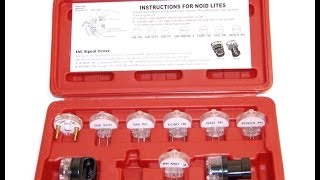
- Check for Pulse with a Noid Light: Disconnect the wiring harness from the injector and plug in a noid light. Start the engine. 🎬 Watch: How to use a noid light to check for pulse. The light should flash steadily. If it flashes, the PCM and wiring are likely sending a signal. If it does not flash or stays on continuously, there is a problem in the wiring or the PCM.
- Test the Injector Resistance: Disconnect the injector and use a multimeter to measure the resistance across its two electrical terminals. A reading between 12 and 16 ohms is typical. A reading of infinity indicates an open circuit, while a very low reading indicates a short. In either case, the injector is bad.
- Test the Wiring for Shorts/Opens: If the noid light test failed, check the wiring itself. Check for 12-volt power on one wire of the connector with the key on. Then, check for continuity between the other wire (the driver circuit) and the corresponding pin at the PCM connector. A detailed test for a short involves connecting a test light to the battery positive terminal and probing the injector's control wire at the connector (with the engine running). If the test light illuminates, the control wire is shorted to ground.
- Swap Injectors (Definitive Test): If you suspect the injector but aren't certain, swap the cylinder 5 injector with an adjacent one (e.g., cylinder 3). Clear the codes and run the engine. If the code changes to P0203 ('Cylinder 3 Injector Circuit Malfunction'), the injector is confirmed to be the problem.
- Diagnose PCM: If all wiring and the injector test good, the problem may be a faulty injector driver in the PCM, which is rare.
Parts You'll Likely Need
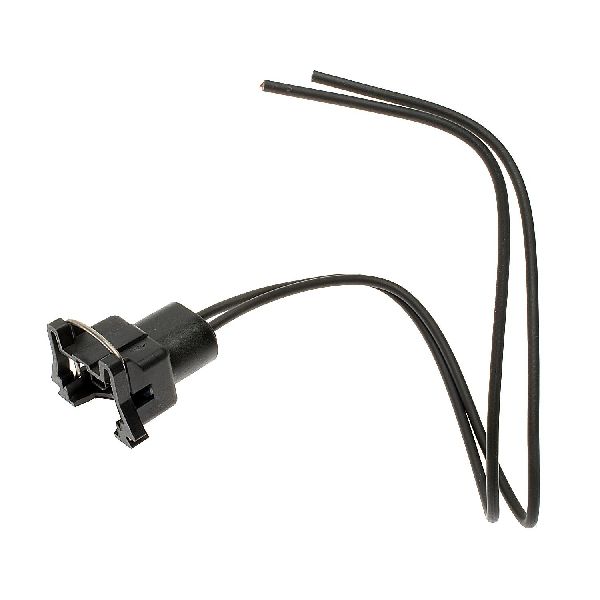
- Fuel Injector Connector Pigtail
(OEM #5183448AA)— The plastic connector and its wires are a common failure point due to heat and vibration. Replacing the connector is often the fix if the damage is localized at the injector.
Trusted brands: Mopar, Dorman, Standard Motor Products
OEM price range: $30-$60
Aftermarket price range: $15-$40 - Fuel Injector
(OEM #53030778AB (replaces 53030778, RL030778AB))— If the injector's internal coil has failed (tested with a multimeter), it must be replaced to restore the circuit's function.
Trusted brands: Mopar, Bosch, Delphi
OEM price range: $120-$200
Aftermarket price range: $40-$100 - Cylinder Head Cover Gasket
(OEM #R8027067A$, RL002012A$)— The TSB specifically mentions that the wiring loom in the valve cover gasket can be the root cause. If this internal harness fails, the gasket and harness assembly must be replaced. The part numbers are from the TSB.
Trusted brands: Mopar, Fel-Pro
OEM price range: $50-$90
Aftermarket price range: $30-$60
Related Codes That Often Appear With This One
- P0305 — P0305 means 'Cylinder 5 Misfire Detected'. Since a faulty injector circuit prevents proper fueling of cylinder 5, it will directly cause a misfire on that same cylinder.
- P0200 — P0200 stands for 'Injector Circuit/Open'. This is a more general code that may appear alongside P0205 if there is a widespread issue affecting the injector circuits.
Technical Service Bulletins (TSBs) & Recalls
- 9002688: Advises checking the wiring loom/connector in the valve cover gasket before replacing injectors for P0201-P0206 codes.
Platform-Specific Known Issues
- Per TSB #9002688, the wiring loom and/or connector located in the valve cover gasket is a known failure point that can cause P0205 and related codes. This should be inspected before replacing the fuel injector itself.
- The injector wiring harness that runs under the intake manifold is also a very common failure point due to extreme heat and oil contamination, causing wires to melt and short out.
Mechanic-Grade Diagnostic Values
- Fuel Injector Resistance (1996-1997 5.2L/5.9L) — expected: 13.3 - 15.7 Ohms at 68°F (20°C). Failure: A reading of infinity (open circuit) or near zero (short circuit).
- Fuel Injector Resistance (1998-1999 5.2L/5.9L) — expected: 10.8 - 13.2 Ohms at 68°F (20°C). Failure: A reading significantly outside this range, or showing open/shorted.
- Injector Power Supply Voltage — expected: Battery voltage (approx. 12V) with Key On, Engine Off.. Failure: Low or no voltage indicates a problem with the power supply wire from the PDC/fuse.
- Injector Control Signal (using a noid light) — expected: The noid light should flash steadily while the engine is cranking or running.. Failure: No flash, or a constantly lit light, indicates a problem with the wiring from the PCM or the PCM itself.
Scan Tool Commands That Help
- DRB III: Injector Kill / Power Balance Test — This function allows the technician to individually disable each fuel injector while monitoring engine RPM drop. If disabling cylinder 5 causes no change in RPM, it confirms that cylinder is not contributing, which is expected with a P0205. It helps verify the symptom electronically before physical inspection. The DRB III was the OEM dealer scan tool for this vehicle era.
- DRB III Simulator: Read Fault Codes, View Live Data, Actuator Tests — Modern Wi-Tech systems used by dealers can run a DRB III simulator to diagnose older vehicles. This provides the same level of diagnostic access as the original tool, including the ability to perform actuator tests on components like injectors.
Wiring & Ground Locations
- PCM Connector C1 (Black) — On the Powertrain Control Module (PCM), typically located on the passenger-side firewall.. This connector contains the driver circuit wire for the fuel injectors. For a 1996 model, the Cylinder 5 injector driver wire is typically on Pin 15. This is the wire that must be tested for continuity back to the injector and checked for shorts to ground or voltage.
- G104 / G105 — G104 is for the alternator ground; G105 is a primary engine ground on the right side of the engine block, connected to the battery negative cable.. A poor engine ground can cause a host of electrical issues, including erratic sensor readings and problems with actuator circuits like fuel injectors. The PCM relies on a stable ground reference. Ensuring G105 is clean and tight is a critical step in diagnosing any electrical fault.
- Injector Harness Power Feed — Originates from the Power Distribution Center (PDC) under the hood.. The injectors receive their 12V power from a shared circuit that is fused in the PDC. If this fuse is blown or the wire is damaged, multiple injectors (not just one) would lose power. The PCM provides the ground to fire the injector.
Real Owner Repair Stories
- dodgetalk.com forum user (Dodge Ram with 5.9L Magnum V8) — Engine running rough, codes for injector circuit on cylinder 5 and cylinder 7.
❌ Tried (didn't work) Replacing the fuel injectors., Checking for continuity at the injector connectors (which initially tested okay).
✅ What actually fixed it The wiring harness that runs under the intake manifold had melted. The insulation on several wires, including those for injectors 5 and 7, was gone, causing them to short against each other and the engine block. The fix required removing the intake manifold to access and repair the damaged section of the harness.
OEM Part Supersession History
53030778→53030778AB, RL030778AB— Standard part revision and update by the manufacturer.
Heads up: The parts are generally interchangeable for the specified model years, but it's always best to use the latest revision (53030778AB) for reliability.
Model Year Variations Within This Range
- 1996-1997 vs 1998-1999: The Powertrain Control Modules (PCMs) are different and generally not interchangeable between these year groups. 1996-1997 are a specific pair, and 1998+ are different. A PCM from a 1999 truck will not work in a 1996 truck, even with the same engine. This is critical if the PCM is suspected, as the correct part number for the specific year and configuration must be used.
- 1996-1997 vs 1998-1999: The specified resistance for the fuel injectors changed. For 1996-1997 models, the spec is ~13.3-15.7 ohms, while for 1998-1999 models, it is ~10.8-13.2 ohms. While injectors may function across these years, using an injector with the wrong resistance can affect fuel delivery and performance.
Helpful Videos

We Have This Part in Stock


The information in this article is provided for general reference and educational purposes only. Vehicle specifications, procedures, and part compatibility can vary by production date, trim level, and region. Always consult your vehicle's factory service manual and verify part numbers before purchasing or performing repairs. Safety-critical components such as airbags, seat belts, and braking systems should be installed by a qualified professional.
- Dodge RAM WAGON:
- 🧭 Diagnostic Flowchart
- 🎬 Helpful Videos
- 🛍️ Shop This Part
- What's Unique About the 1995-1999 Dodge RAM WAGON
- Symptoms You May Notice
- Most Likely Causes
- Diagnosis Steps
- Parts You'll Likely Need
- Related Codes That Often Appear With This One
- Technical Service Bulletins (TSBs) & Recalls
- Platform-Specific Known Issues
- Mechanic-Grade Diagnostic Values
- Scan Tool Commands That Help
- Wiring & Ground Locations
- Real Owner Repair Stories
- OEM Part Supersession History
- Model Year Variations Within This Range
- 🎟️ Get 5% Off