

P0205 on 2009-2016 Lincoln MKS 3.7L: Cylinder 5 Injector Circuit Fixes
P0205 on a Lincoln MKS with the 3.7L V6 almost always means the fuel injector for cylinder #5 has failed. It's a common issue where the injector's internal coil develops an open circuit, especially when cold. Replacing the single injector is the typical fix, costing around $50-$90 for an OEM part. The issue is well-documented by owners and mechanics across multiple platforms using this Ford Cyclone engine.
- P0205 on the 2009-2016 MKS 3.7L almost always points to a failed fuel injector on cylinder 5.
- The failure is often electrical and can be intermittent, appearing when the engine is cold and disappearing when warm.
- Confirm the failure by testing the injector's resistance with a multimeter when the engine is cold; a reading outside 11-18 ohms (especially an open circuit) confirms it's bad.
- Cylinder 5 is easily accessible on the front of the engine, making this a relatively simple DIY repair.
- If you also have a P0305 misfire code, focus on fixing the P0205 injector issue first, as it is the likely cause.
What's Unique About the 2009-2016 Lincoln MKS
The 3.7L V6 engine, part of Ford's Cyclone family, has a documented history of fuel injector failures. Owners and technicians report that the injectors, particularly on Lincolns, can fail by developing an open circuit internally. A unique characteristic of this failure is that it's often temperature-dependent; the injector may test as 'open' (bad) when the engine is cold and then start working correctly once it heats up and thermal expansion reconnects the broken internal wire. This makes diagnosis tricky if not tested under the right cold-start conditions.
Symptoms You May Notice
- Check Engine Light is on
- Rough or vibrating idle
- Engine misfires, which may be more noticeable under load or when cold
- Hesitation or loss of power during acceleration
- Reduced fuel economy
- Strong smell of gasoline from the engine bay if the injector is leaking externally
- Replacing the ignition coil or spark plug. While these can cause a misfire (P0305), the P0205 code specifically points to an electrical circuit issue with the injector, not the ignition system. If you have both P0305 and P0205, the injector is the primary suspect.
Most Likely Causes
- Failed Fuel Injector (Cylinder 5) 🔴 High Probability → Shop Fuel Injector Injectors on this platform are known to fail internally, creating an open circuit. This failure is often intermittent and temperature-sensitive, typically occurring when the engine is cold and resolving itself once warm.
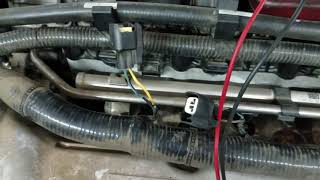
How to confirm: With the engine cold, unplug the injector and measure its resistance with a multimeter. 🎬 Watch a mechanic demonstrate how to test these specific Ford injectors. A good injector should read between 11-18 ohms. A reading of 'O.L.' (Open Loop) or infinite resistance confirms a bad injector. If the code only appears when cold, you may need to let the car sit overnight to replicate the failure. You can also swap the #5 injector with an adjacent one (e.g., #4 or #6), clear the codes, and see if the fault moves to P0204 or P0206. If it does, the injector is faulty.
Typical fix: Replace the fuel injector for cylinder 5. It is highly recommended to use an OEM Motorcraft part (Part # BR3Z-9F593-A or CM-5188) for best results. While some suggest replacing all injectors at once, it is not strictly necessary if only one has failed electrically, especially since the front bank is easily accessible.
Est. part cost: $50-$90 - Wiring Harness or Connector Issue ⚪ Low Probability Wiring can become brittle over time due to engine heat cycles, but widespread harness issues for this specific circuit are not commonly reported.
How to confirm: Visually inspect the wiring and connector going to the cylinder 5 injector for any signs of damage, corrosion, or loose pins. Use a 'noid light' on the connector; it should flash when the engine is cranked, indicating the PCM is sending a signal. If the noid light flashes but the injector doesn't work (and has bad resistance), the injector is bad. If it doesn't flash, the problem is in the wiring or the PCM.
Typical fix: Repair the damaged section of the wiring harness or clean/replace the connector.
Est. part cost: $5-$50
Rare But Worth Checking
- Powertrain Control Module (PCM) Failure: → Shop Engine Control Module (ECM) This is very rare. The internal driver circuit for the injector can fail, but you should exhaust all other possibilities first. A PCM failure will typically set other codes as well. On some Ford platforms, a failing ignition coil can short and damage the PCM driver for that cylinder, but this is more commonly associated with misfire codes, not injector circuit codes.
Diagnosis Steps
- Confirm the code with an OBD-II scanner. Note any other codes present, especially P0305 (misfire) or P0174 (lean bank 2).
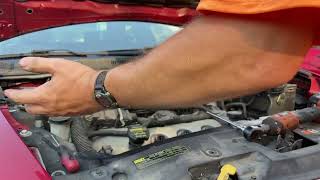
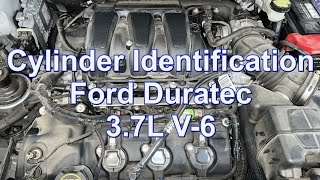
- Identify Cylinder 5. 🎬 Watch this guide to identify cylinders and banks on your engine. On the transverse 3.7L V6, Bank 1 (firewall) has cylinders 1-2-3 and Bank 2 (radiator) has 4-5-6, from passenger to driver side. Cylinder 5 is the middle cylinder on the front bank.
- Listen to the injector. With the engine running, use a mechanic's stethoscope or a long screwdriver placed on the injector body to listen for a steady clicking sound. Compare the sound of injector #5 to #4 or #6. No clicking or an irregular sound points to a problem.
- Perform a resistance test (engine cold). This is the most critical step for this specific issue. Disconnect the electrical connector from the #5 injector. Set a multimeter to Ohms (Ω) and measure the resistance across the two pins on the injector itself. A good injector will read between 11-18 ohms. An 'open' or infinite reading (O.L.) means the injector's internal coil is broken and it must be replaced.
- Test the circuit signal. If the injector resistance is good, the problem is likely in the wiring or PCM. Use a 'noid light' plugged into the injector's electrical connector. Have a helper crank or start the engine. The light should flash rhythmically, indicating the PCM is sending a signal. If it flashes, but the injector resistance was also good, the injector may have a mechanical clog. If the noid light does not flash, there is a problem with the wiring harness or the PCM itself.
- (Optional) Swap injectors. If you are unsure, swap the injector from cylinder 5 with the one from cylinder 4 or 6. Clear the codes and drive the vehicle (or let it cool down and restart). If the code changes to P0204 or P0206, you have definitively proven the injector is the faulty component.
Parts You'll Likely Need
- Fuel Injector
(OEM #BR3Z-9F593-A (Ford) / CM-5188 (Motorcraft))— This is the most common failure point for a P0205 code on this engine, often due to an internal electrical failure that is sensitive to temperature.
Trusted brands: Motorcraft, Bosch
OEM price range: $55-$75
Aftermarket price range: $35-$60
Related Codes That Often Appear With This One
- P0305 — P0305 means 'Cylinder 5 Misfire Detected'. Since the P0205 code indicates the injector isn't firing correctly, the cylinder won't combust properly, leading to a misfire. Seeing both codes together strongly points to the injector as the root cause.
- P0174 — P0174 means 'System Too Lean (Bank 2)'. Cylinder 5 is on Bank 2. If the injector is failing to deliver fuel, the oxygen sensors will detect the excess air in the exhaust for that bank and set a lean code. A technician video on an MKS with P0205 noted the short-term fuel trim on Bank 2 was +35% 🎬 See a technician diagnose this exact P0205 code on an MKS. before the repair.
Technical Service Bulletins (TSBs) & Recalls
- While no TSB is specific to P0205 on the MKS, Ford has issued TSBs for injector-related issues on similar engines, such as TSB 20-2324 for leaking injectors on EcoBoost models and TSB 10-16-14 for rough idle on some 2009 models, indicating a history of fuel system issues in this era.
Mechanic-Grade Diagnostic Values
- Injector Power Wire Voltage (Key On, Engine Off) — expected: ~12V (Battery Voltage). Failure: Voltage significantly below battery voltage indicates a problem in the power supply wire or related fuse.
- Injector Control Wire Voltage (Key On, Engine Off) — expected: ~12V (Battery Voltage). Failure: 0V on the control wire (when the power wire is confirmed good) points to an open circuit inside the fuel injector's coil.
- Injector Pulse Width at Idle (Live Scan Tool Data) — expected: 2.0 - 4.0 milliseconds (ms). Failure: A value of 0 ms or an erratic reading for cylinder 5 while other cylinders are stable indicates a circuit fault or PCM driver issue.
- Wiring Continuity (PCM to Injector Connector) — expected: < 0.5 Ω. Failure: Higher resistance indicates corrosion or a break in the wire between the PCM and the injector.
Hidden / Shadow Codes Worth Checking
- Mode $06, TID $53, CID 05: This is not a DTC, but a monitor within the PCM that tracks misfire counts for each cylinder. A technician can view this data to see the number of misfire events on cylinder 5, even if the count is not high enough to trigger a P0305 trouble code. For Ford, the monitor ID for cylinder 5 is often A5, with test IDs like $80 or $81 showing misfire rates. (see via A professional scan tool capable of displaying Mode $06 data.)
Scan Tool Commands That Help
- Ford IDS (or equivalent professional scanner): Power Balance Test — This live graphical test shows the power contribution of each cylinder. For a P0205, it will visually confirm a significant performance drop on cylinder 5, helping to isolate the issue without disassembly.
- Ford IDS (or equivalent professional scanner): Injector Buzz Test / Actuator Activation — With the engine off, this command individually fires each injector, creating an audible click. If cylinder 5 is silent while others click, it confirms the fault is with the injector or its immediate wiring/connector, ruling out a more complex PCM issue.
Wiring & Ground Locations
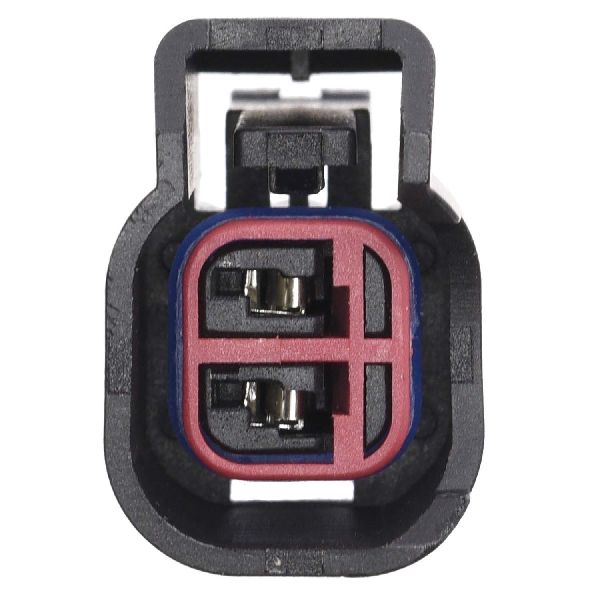
- Injector Connector — On the fuel injector for cylinder 5, which is the middle cylinder on the engine bank closer to the radiator.. This is the primary connection point to test. It is a 2-terminal female connector, often with black and red components. Check for corrosion, backed-out pins, or damage here first.
- Engine Block Ground Strap — On similar Ford V6 platforms, a primary ground strap runs from the firewall to the engine block, and another is often located on the passenger side motor mount.. A poor engine ground can cause unstable voltage for all engine electronics, including the injector circuits, leading to intermittent faults.
- PCM Ground (e.g., G201) — On related Ford platforms like the Mustang, the PCM ground is located behind the passenger side kick panel.. The PCM controls the injectors by switching the ground side of the circuit. A faulty PCM ground can disrupt this signal and cause injector circuit codes.
Real Owner Repair Stories
- YouTube video by fsteddie98 (2011 Lincoln MKS 3.7L) — Check engine light with code P0205, rough running, especially when cold.
❌ Tried (didn't work) Initial diagnosis when the engine was warm showed the injector had correct resistance.
✅ What actually fixed it The mechanic let the vehicle cool down completely. A cold resistance test of the cylinder 5 injector showed an open circuit ('O.L.' on the multimeter). Replacing the single faulty fuel injector resolved the code and symptoms. - Autodana.eu case study (2015 Ford F-150 (similar electrical architecture)) — P0205, misfiring, and reduced power.
❌ Tried (didn't work) The owner suspected a bad injector.
✅ What actually fixed it A technician found a corroded electrical connector leading to the cylinder 5 injector. Cleaning the connector and ensuring a secure connection fixed the problem without replacing any parts.
OEM Part Supersession History
Unknown (for 2009-2010 models)→BR3Z-9F593-A / Motorcraft CM-5188— Likely corresponds to the engine update for the 2011 model year.
Heads up: The part BR3Z-9F593-A is specified for 2011 and newer models with the Ti-VCT 3.7L engine. Pre-2011 models may use a different injector. Always verify the part number with the vehicle's VIN.
Model Year Variations Within This Range
- 2009-2012 vs 2013-2016: The MKS received a major refresh for the 2013 model year. The standard 3.7L V6 was upgraded with Ti-VCT, increasing horsepower from 273 to 304. This change in engine technology means that fuel system components, including injectors and PCM software, may not be interchangeable across this refresh boundary. The common injector part number found (BR3Z-9F593-A) is listed for 2011+ models, suggesting it applies to the later engine variant.
Diagnostic Flowchart
Other Known Issues on This Vehicle
Issues unrelated to this code that are worth knowing about as an owner of this generation:
- Internal Water Pump Failure 🔴 High — Common after 80,000-120,000 miles. Failure can be catastrophic, as the timing-chain-driven pump leaks coolant directly into the engine oil, destroying engine bearings.
- Electronic Throttle Body (ETB) Failure 🟠 Medium — Very common. Internal electronics fail, causing the vehicle to suddenly enter a low-power 'limp home mode', which can be dangerous in traffic. Often logs codes P2111 or P2112. (Ref: Ford Customer Satisfaction Program 13N03 (Expired))
- Power Transfer Unit (PTU) Overheating/Failure (AWD Models) 🔴 High — Common on AWD models. The PTU is located near the hot exhaust with 'lifetime' fluid that breaks down from heat, leading to gear/bearing failure. Symptoms include a burning gear oil smell and grinding noises. (Ref: TSB 19-2017 (for fluid leaks))
- Variable Cam Timing (VVT) Solenoid Failure 🟡 Low — Moderately common. Clogging from old or dirty oil causes solenoids to stick, leading to rough idle, poor performance, and rattling noises. Typically sets codes like P0016, P0018, etc. (Ref: TSB 16-0038 (diagnostic guidance))
Used vs. New Parts: Buying Guide for This Vehicle
When a used part is the smart pick: Only for a very budget-conscious DIY repair where the risk of repeat labor is acceptable. Since the injector is on the easily-accessible front bank, a failed used part is not a catastrophic time loss. However, given the failure mode is an internal electrical fault, a used injector carries a high risk of having the same latent issue.
Donor-vehicle mileage cap: roughly under 60000 miles for the part to have meaningful remaining life.
What to inspect on the donor part:
- Ask the seller to measure the resistance with a multimeter before shipping; it must be between 11-18 ohms.
- Visually inspect photos for any cracks in the plastic connector body.
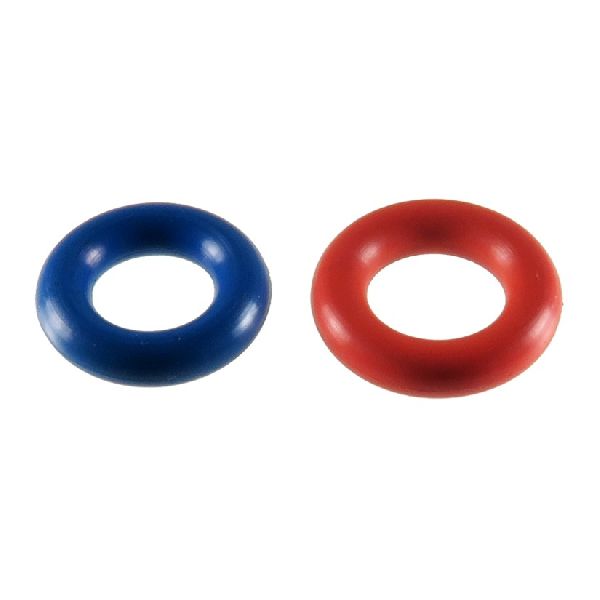
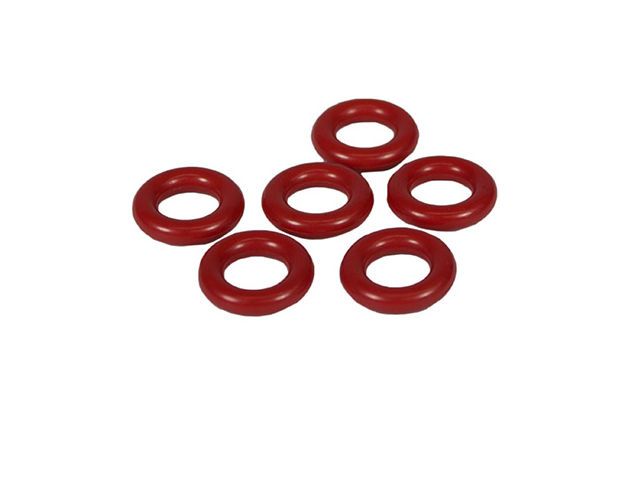
- Ensure the tip and O-rings are free from visible damage.
OEM-only on this vehicle (don't cheap out):
- Powertrain Control Module (PCM) - Must be a new or professionally reprogrammed unit matched to the vehicle's VIN and options.
Aftermarket brands forum-validated for this vehicle:
- Bosch
Real Owner Stories
Aggregated from forums and TSBs cited above. Mileages and costs reflect what owners reported in those sources.
2011 Lincoln MKS 3.7L
Symptoms: Customer complaint of a Check Engine Light with code P0205. The issue was intermittent and temperature-sensitive, with the injector testing as an open circuit when cold but testing good once the engine warmed up.
What fixed it: The faulty #5 fuel injector was replaced, which resolved the code.
Source hint: YouTube: fsteddie98 - '2011 MKS 3.7L Bad fuel injector P0205'
Related OBD-II Codes
Frequently Asked Questions
Where is cylinder #5 located on my 2009-2016 Lincoln MKS 3.7L engine?
My Check Engine Light for P0205 only comes on when the engine is cold. Is this a known issue?
How can I test the fuel injector myself to confirm it's bad?
What is the recommended replacement fuel injector part number for my MKS?
If the #5 injector has failed, do I need to replace all six of them at the same time?
Are there any official Ford TSBs for the P0205 code on the Lincoln MKS?
Helpful Videos
We Have This Part in Stock



The information in this article is provided for general reference and educational purposes only. Vehicle specifications, procedures, and part compatibility can vary by production date, trim level, and region. Always consult your vehicle's factory service manual and verify part numbers before purchasing or performing repairs. Safety-critical components such as airbags, seat belts, and braking systems should be installed by a qualified professional.
- Lincoln MKS:
- 🧭 Diagnostic Flowchart
- 🎬 Helpful Videos
- 🛍️ Shop This Part
- What's Unique About the 2009-2016 Lincoln MKS
- Symptoms You May Notice
- Most Likely Causes
- Rare But Worth Checking
- Diagnosis Steps
- Parts You'll Likely Need
- Related Codes That Often Appear With This One
- Technical Service Bulletins (TSBs) & Recalls
- Mechanic-Grade Diagnostic Values
- Hidden / Shadow Codes Worth Checking
- Scan Tool Commands That Help
- Wiring & Ground Locations
- Real Owner Repair Stories
- OEM Part Supersession History
- Model Year Variations Within This Range
- Other Known Issues on This Vehicle
- Used vs. New Parts: Buying Guide for This Vehicle
- Real Owner Stories
- 2011 Lincoln MKS 3.7L
- Related OBD-II Codes
- Frequently Asked Questions
- 🎟️ Get 5% Off