

P0217 on 2017-2024 Chrysler Pacifica: Engine Overtemperature Causes and Fixes
P0217 means your Pacifica's engine is overheating. Stop driving immediately. The most common causes are a coolant leak, a failed thermostat, or a malfunctioning radiator fan. A coolant leak from the plastic thermostat housing or the oil filter housing are well-known issues on this engine, which is notorious for plastic cooling component failures.
- P0217 is a critical code that means your engine is overheating. Stop driving immediately to prevent severe engine damage.
- The most likely causes on your Pacifica are a coolant leak, a failed thermostat, or a bad radiator fan.
- Pay special attention to leaks from the plastic thermostat housing and the oil filter/cooler housing in the engine valley, as these are known weak points on the 3.6L Pentastar engine.
- After any cooling system repair, it is essential to properly bleed all air from the system to prevent a repeat overheating issue.
- Always use the specified Mopar OAT coolant (part number MS-12106) when refilling the system.
What's Unique About the 2017-2024 Chrysler Pacifica
The 3.6L Pentastar V6 in the Pacifica has several known cooling system weaknesses that make it susceptible to overheating. Many components, such as the thermostat housing and the engine oil cooler/filter housing, are made of plastic and sit in the high-heat valley of the engine. Over time, these parts can become brittle, crack, and cause significant coolant leaks, which are a primary trigger for the P0217 code.
Symptoms You May Notice
- Temperature gauge reading in the red or 'H' zone.
- Engine temperature warning light illuminated on the dashboard.
- Reduced engine power or vehicle entering 'limp mode'.
- Audible chimes or warnings from the instrument cluster.
- Steam or smoke coming from the engine bay.
- A/C may blow warm air, especially when stopped.
- Loud boiling or gurgling sounds from the engine area.
- Replacing only the Engine Coolant Temperature (ECT) sensor. The P0217 code indicates a genuine overheating condition, which is almost always a mechanical cooling system problem, not a sensor error.
- Failing to properly bleed air from the cooling system after a repair. Air pockets are a common cause of repeat overheating on the 3.6L Pentastar engine if the system is not bled correctly using the bleeder screw on the thermostat housing.
Most Likely Causes
- Low Engine Coolant (due to a leak) 🔴 High Probability The 3.6L Pentastar engine is known for leaks from the plastic thermostat housing and the oil filter/cooler housing located in the 'V' of the engine. Hoses and the radiator are also potential leak points.
How to confirm: Visually inspect the engine bay for signs of pink/orange coolant residue, especially in the engine valley or on the transmission bell housing. Check the coolant reservoir level. A cooling system pressure test is the most effective way to find a leak.
Typical fix: Find and repair the source of the leak. This often involves replacing the failed component, such as the thermostat housing, oil cooler housing, a hose, or the radiator.
Est. part cost: $50-$400 - Failed Thermostat (Stuck Closed) 🔴 High Probability → Shop Integrated Thermostat Housing Assembly The integrated plastic thermostat housing is a common failure point; the internal thermostat can fail and stick closed, preventing coolant circulation. It is not recommended to replace just the thermostat insert.
How to confirm: After the engine has warmed up, carefully feel the upper and lower radiator hoses. If the upper hose is hot and the lower hose is cool, it indicates coolant is not circulating, and the thermostat is likely stuck closed.
Typical fix: Replace the entire thermostat and housing assembly. The OEM part number is a safer bet than aftermarket for this component.
Est. part cost: $40-$150 - Malfunctioning Radiator Cooling Fan 🟡 Medium Probability → Shop Engine Cooling Fan Blade The electric cooling fan assembly can fail due to a bad motor, faulty integrated control module, or wiring issues, preventing it from activating when needed, especially in traffic.
How to confirm: With the engine running and the A/C turned on high, the cooling fan(s) should activate. If they do not, or if they don't turn on when the temperature gauge starts to climb, the fan system is likely faulty. A scan tool can be used to command the fan on to test its operation directly.
Typical fix: Replace the cooling fan assembly, which typically includes the motor, shroud, and blades. Sometimes the fan control module or relay can be replaced separately.
Est. part cost: $150-$400 - Failing Water Pump ⚪ Low Probability → Shop Engine Water Pump While less common than thermostat or housing leaks, the water pump can fail by leaking from its seal or the impeller can stop circulating coolant effectively.
How to confirm: Look for coolant leaks from the front-passenger side of the engine where the pump is located. A rumbling or grinding noise from the pump pulley can also indicate a failing bearing.
Typical fix: Replace the water pump and gasket. It's often recommended to replace the thermostat at the same time.
Est. part cost: $100-$300
Rare But Worth Checking
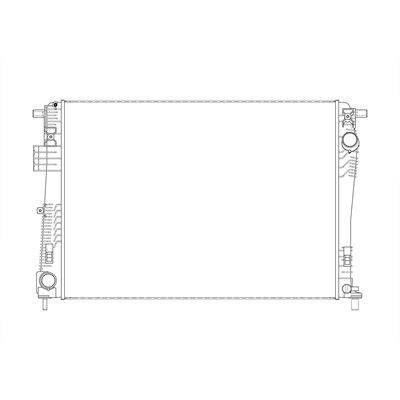
- Clogged or Restricted Radiator: → Shop Radiator Internal passages can become clogged with debris or sludge, especially on earlier Pentastar engines that may have had casting sand residue from manufacturing. External fins can also be blocked by road debris.
- Blown Head Gasket: This is a major engine failure where combustion gases leak into the cooling system, causing rapid overheating. Symptoms include white smoke from the exhaust, milky engine oil, or constant bubbles in the coolant reservoir.
Diagnosis Steps
- CRITICAL FIRST STEP: As soon as it is safe, pull over and turn off the engine to prevent damage. Do not open the radiator cap when the engine is hot.
- Once the engine is cool, check the coolant level in the overflow reservoir. If it is low, you have a leak.
- Visually inspect the engine bay for obvious signs of coolant leaks. Pay close attention to the thermostat housing (top front of the engine), the radiator and its hoses, and the water pump area (front passenger side of the engine). Also check for coolant pooling in the 'V' of the engine under the intake manifold, which points to a leaking oil cooler housing.
- If no leaks are obvious, perform a cooling system pressure test to reveal hard-to-see leaks.
- Start the engine and turn the A/C on maximum. Verify that the radiator cooling fan(s) turn on. A capable scan tool can also be used to command the fan on for testing purposes.
- Monitor the temperature gauge. As it approaches the normal operating range, carefully check if both the upper and lower radiator hoses are hot. A hot upper hose and a cool lower hose strongly suggest a stuck thermostat.
- If the fan works and coolant is circulating, the radiator may be clogged internally or externally. Inspect the radiator fins for blockage from leaves or debris.
- If the cause is still not found, consider more serious issues like a failing water pump or a blown head gasket. A chemical test can be used to check for combustion gases in the coolant, which would confirm a blown head gasket.
Parts You'll Likely Need
- Thermostat Housing Assembly
(OEM #68217305AH (supersedes previous versions))— This is one of the most common failure points on the 3.6L Pentastar, either leaking externally or causing the thermostat to stick closed. It should be replaced as a complete assembly.
Trusted brands: Mopar, Dorman, Gates
OEM price range: $80-$150
Aftermarket price range: $40-$100 - Engine Oil Cooler / Filter Housing Assembly
(OEM #68596317AB or 68596318AB (verify by VIN, supersedes multiple older numbers))— The original plastic housing is prone to cracking from heat cycles, causing major coolant and/or oil leaks in the valley of the engine. This is arguably the most notorious flaw of the Pentastar engine.
Trusted brands: Mopar, Dorman (including upgraded aluminum versions like 926-959)
OEM price range: $150-$250
Aftermarket price range: $80-$200 (aluminum versions are often more expensive but more durable) - Radiator Fan Assembly — Failure of the fan motor or control module will cause overheating, especially at low speeds.
Trusted brands: Mopar, TYC, Four Seasons
OEM price range: $300-$500
Aftermarket price range: $150-$300
Related Codes That Often Appear With This One
- P0128 — This code for 'Coolant Temperature Below Thermostat Regulating Temperature' often points to the same faulty thermostat assembly, but indicates it's stuck open rather than closed. A failing thermostat can behave erratically before it fails completely.
- P0480 — This code indicates a 'Cooling Fan 1 Control Circuit Malfunction'. If the fan fails to activate, the engine will overheat and trigger P0217, especially in stop-and-go traffic or at idle.
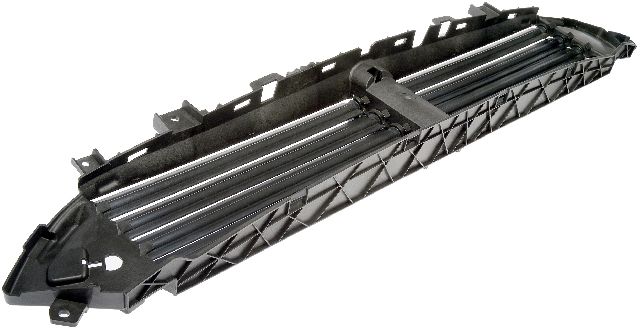
- U11E9 — This code for 'Lost Communication With Active Grille Shutter' can lead to overheating. If the grille shutters fail in the closed position, they will block airflow to the radiator, causing a P0217 code in traffic or at low speeds.
Technical Service Bulletins (TSBs) & Recalls
- S1809000007 - This TSB addresses customer complaints of engine oil leaks or consumption, which are often traced back to the failure of the oil filter/cooler housing assembly, a part that also carries engine coolant and can be a source of coolant leaks.
Platform-Specific Known Issues
- title
- description
Mechanic-Grade Diagnostic Values
- Engine Coolant Temperature (ECT) Sensor Resistance — expected: Between 2,000 and 3,000 Ohms (2.0-3.0 kΩ) at 68°F (20°C). Resistance should drop to 200-300 Ohms at 194°F (90°C).. Failure: A reading of infinite resistance (open circuit), near-zero resistance (short circuit), or values that do not change smoothly with temperature.
- Engine Coolant Temperature (ECT) Sensor Signal Voltage (Key-On, Engine-Off, Cold Engine) — expected: Approximately 2.0V - 3.5V at around 68°F (20°C).. Failure: Voltage stuck near 5V indicates an open circuit (e.g., unplugged sensor or broken wire). Voltage near 0V indicates a short circuit.
Scan Tool Commands That Help
- wiTECH 2.0 (or equivalent professional scanner): Radiator Fan Control — To manually command the cooling fan on and off to verify the functionality of the fan motor, control module, and wiring, independent of the ECT sensor reading. This is a primary step to rule out a failed fan assembly when diagnosing P0217.
- wiTECH 2.0 (or equivalent professional scanner): Active Grille Shutter (AGS) Actuator Test — If overheating occurs primarily in stop-and-go traffic and codes like U11E9 are also present, this command forces the shutters to open and close to verify if they are physically stuck, which would block airflow and cause overheating.
Wiring & Ground Locations
- ECT Sensor Signal Wire at PCM — Pin 17 of the C2 connector on the Powertrain Control Module (PCM).. If the ECT sensor itself tests good, a technician can test for a correct voltage signal directly at the PCM. A good voltage here but a bad reading on the scan tool could indicate a PCM issue, while a bad voltage here points to a wiring problem between the sensor and the PCM.
- Active Grille Shutter Connector — Located at the front of the vehicle, plugged into the active grille shutter assembly motor, behind the front bumper cover.. This connector is exposed to the elements and is a common point of failure due to corrosion, leading to a loss of communication (U11E9) and the shutters failing in the closed position, which can cause a P0217 overheat condition.
OEM Part Supersession History
68105583AA, 68105583AB, 68105583AC, 68105583AD, 68105583AE, 68105583AF, 68105583AG, 68310865AA, and many others.→68596317AB— The oil filter/cooler housing has gone through numerous revisions to address the chronic cracking and leaking issues of the original plastic design.
Heads up: The latest part number, 68596317AB, is the most current OEM revision designed to be more robust. When replacing, it is critical to use the entire new assembly and its included gaskets.68217321AA, 68217321AB→68217321AC— Revisions to the radiator cooling fan assembly for standard (non-tow package) gasoline models.
Heads up: It is critical to verify the correct fan assembly. Models with the factory tow package use a different, heavy-duty fan. Hybrid models also use a unique fan assembly. Installing the wrong fan can lead to connector mismatches and inadequate cooling.
Model Year Variations Within This Range
- 2017-2024: Chrysler Pacifica models equipped with the factory tow package have a different, more powerful radiator cooling fan assembly than standard models to cope with higher heat loads. Using the standard fan on a tow-package-equipped vehicle can lead to overheating when towing.
- 2018: A wiring pinout change for the Active Grille Shutter (AGS) connector occurred during the 2018 model year. When replacing the AGS assembly or its connector, compatibility must be verified by VIN to ensure proper communication.
Diagnostic Flowchart
Other Known Issues on This Vehicle
Issues unrelated to this code that are worth knowing about as an owner of this generation:
- ZF 9-Speed Automatic Transmission Issues 🟠 Medium — Commonly reported on 2017-2021 models. Symptoms include harsh/jerky shifting, hesitation, and sudden lurching, particularly at low speeds. (Ref: Multiple TSBs exist for software updates (e.g., 21-006-21) to improve shift logic. Some owners report temporary improvement after a software flash or adaptive learning reset.)
- Engine Start-Stop (ESS) System Failure 🟡 Low — Very common across all model years. The system becomes unavailable and displays a warning light, typically due to the failure of the small, secondary auxiliary battery. (Ref: No recall, but it's a widely documented issue. The fix is to replace the auxiliary battery (AGM type YTX14-BS or similar) located next to the main battery.)
- Infotainment System Glitches (Uconnect) 🟡 Low — Frequently reported issues include screen freezing, unresponsiveness, phantom touches (delamination), and Bluetooth connectivity problems. (Ref: Various software update TSBs have been released to address specific bugs.)
- Casting Sand Contamination in Cooling System 🟠 Medium — More prevalent in earlier Pentastar engines (pre-2014) but can still affect later models. Residual sand from the engine block casting process can form a sludge, clogging the radiator and heater core, leading to overheating. (Ref: No recall, but it is a known manufacturing issue. The fix often requires extensive flushing or replacement of the radiator and heater core.)
Used vs. New Parts: Buying Guide for This Vehicle
When a used part is the smart pick: A used OEM radiator fan assembly can be a good value. Given that the failure is usually the electric motor, a low-mileage donor part can provide significant savings over a new OEM unit. Structural components with no moving parts, like engine brackets or covers, are also excellent candidates for used parts.
Donor-vehicle mileage cap: roughly under 75000 miles for the part to have meaningful remaining life.
What to inspect on the donor part:
- For a fan assembly, inspect the plastic shroud for cracks or brittleness.
- Manually spin the fan blades to ensure the motor turns smoothly with no grinding or resistance.
- Check the electrical connector for any signs of corrosion, melting, or broken pins.
- Verify the part number matches your vehicle's configuration (standard, tow package, or hybrid).
OEM-only on this vehicle (don't cheap out):
- Thermostat Housing Assembly: Many owners and technicians report issues with aftermarket thermostats (even from reputable brands) causing persistent rationality codes (like P0128) or premature failure. Sticking with a genuine Mopar part is strongly advised for this specific component.
- Engine Sensors (ECT, Cam/Crank): The 3.6L Pentastar can be sensitive to the precise resistance and voltage curves of its sensors. While aftermarket sensors may function, they can sometimes provide slightly different readings that affect fuel trims and performance. Using Mopar sensors is a safer bet to avoid chasing phantom issues.
Aftermarket brands forum-validated for this vehicle:
- Dorman (Aluminum OE-FIX versions): For the oil filter/cooler housing, the Dorman 926-959 aluminum upgrade is widely regarded by mechanics and owners as a superior, permanent fix compared to the failure-prone OEM plastic part. Similarly, Dorman's aluminum thermostat housing is a popular upgrade.
- Mishimoto: Known for performance cooling products, Mishimoto also offers a cast aluminum thermostat housing for the 3.6L Pentastar that is a durable alternative to the OEM plastic.
- TYC / Four Seasons: These brands are well-regarded for producing reliable, OE-comparable aftermarket radiator fan assemblies.
Brands owners have reported issues with on this vehicle:
- Unbranded/No-Name Oil Filter Housings: Avoid cheap, unbranded plastic oil filter housings from online marketplaces. They often use inferior materials and seals that can fail even faster than the original OEM part, leading to a repeat of a very labor-intensive job.
Real Owner Stories
Aggregated from forums and TSBs cited above. Mileages and costs reflect what owners reported in those sources.
2017 Chrysler Pacifica 3.6L — 72000 miles
Symptoms: Sudden, major oil leak from the housing.
What fixed it: Replacement of the oil filter housing.
Cost: $1,800
Source hint: vehicle_specific_issues (Owner report)
Chrysler Pacifica 3.6L
Symptoms: Original plastic housing leaked; after replacing with an aftermarket aluminum unit, a new leak appeared weeks later.
What fixed it: Diagnosis revealed the new leak was actually caused by cracked plastic valve covers.
Cost: $1,100
Source hint: vehicle_specific_issues (Reddit user report)
Related OBD-II Codes
Frequently Asked Questions
Is there a TSB for the oil cooler leaks that cause overheating on my Pacifica?
Can I just replace the thermostat insert in my 3.6L Pentastar engine?
Why is my Pacifica's A/C blowing warm air when I'm stopped at a light?
Where is the most common place to look for a coolant leak on the 3.6L engine?
Should I use aftermarket parts for the thermostat housing repair?
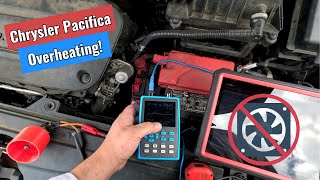
Helpful Videos
Used OEM Parts in Stock
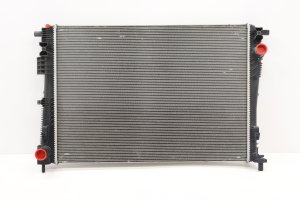
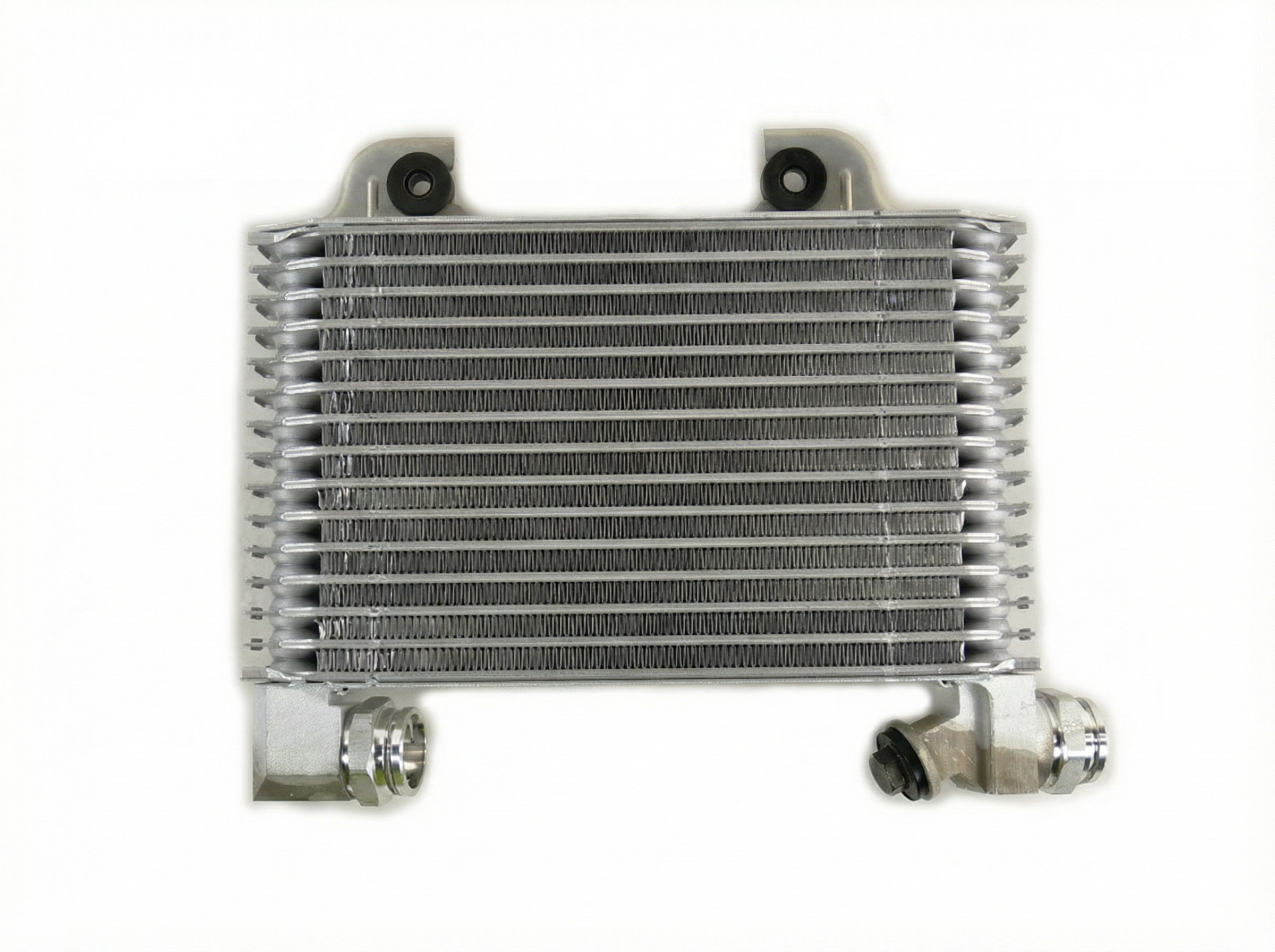
New Aftermarket Parts Available


The information in this article is provided for general reference and educational purposes only. Vehicle specifications, procedures, and part compatibility can vary by production date, trim level, and region. Always consult your vehicle's factory service manual and verify part numbers before purchasing or performing repairs. Safety-critical components such as airbags, seat belts, and braking systems should be installed by a qualified professional.
- Chrysler Pacifica:
- 🧭 Diagnostic Flowchart
- 🎬 Helpful Videos
- 🛍️ Shop This Part
- What's Unique About the 2017-2024 Chrysler Pacifica
- Symptoms You May Notice
- Most Likely Causes
- Rare But Worth Checking
- Diagnosis Steps
- Parts You'll Likely Need
- Related Codes That Often Appear With This One
- Technical Service Bulletins (TSBs) & Recalls
- Platform-Specific Known Issues
- Mechanic-Grade Diagnostic Values
- Scan Tool Commands That Help
- Wiring & Ground Locations
- OEM Part Supersession History
- Model Year Variations Within This Range
- Other Known Issues on This Vehicle
- Used vs. New Parts: Buying Guide for This Vehicle
- Real Owner Stories
- 2017 Chrysler Pacifica 3.6L — 72000 miles
- Chrysler Pacifica 3.6L
- Related OBD-II Codes
- Frequently Asked Questions
- 🎟️ Get 5% Off