

P0217 on 2017-2019 Ford Escape 1.5L EcoBoost: Engine Overheating Causes and Fixes
This code means your engine is overheating. On this specific vehicle, P0217 is a critical warning most often caused by a known engine design flaw where coolant leaks into the cylinders. This is a severe issue that typically requires engine short block replacement, a very expensive repair potentially costing over $9,000. Ford has acknowledged this with Customer Satisfaction Program 21N12, which may cover the repair.
- P0217 on a 2017-2019 Escape 1.5L is a critical code that means you must stop driving immediately.
- The most likely cause is a major, well-documented engine defect known as 'coolant intrusion', not a simple thermostat or water pump failure.
- Symptoms like unexplained coolant loss, white exhaust smoke, and engine misfires are strong indicators of this specific engine flaw.
- Diagnosis requires a professional cooling system pressure test and borescope inspection before any parts are replaced.
- Check with a Ford dealer about eligibility for Customer Satisfaction Program 21N12, which may cover the cost of the engine replacement.
What's Unique About the 2017-2019 Ford Escape
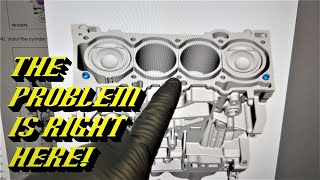
The 2017-2019 Ford Escape with the 1.5L EcoBoost engine is notorious for a specific 'open-deck' engine block design flaw. This defect creates insufficient sealing surface area for the head gasket between the cylinders, allowing coolant to leak internally into the combustion chambers, a condition known as 'coolant intrusion'. This problem is so prevalent that Ford has issued multiple Technical Service Bulletins (TSBs) and a Customer Satisfaction Program (21N12) to address it. Therefore, a P0217 code on this vehicle is much more likely to indicate a need for major engine repair than on a typical vehicle where it might just be a bad thermostat.
Symptoms You May Notice
- Temperature gauge reading in the red or 'Hot'
- Engine temperature warning light illuminated on the dashboard
- Reduced engine power or 'limp mode'
- White, sweet-smelling smoke coming from the exhaust, especially on a cold start
- Unexplained loss of coolant with no visible external leaks
- Rough running engine or misfires, particularly on startup
- Steam or smoke coming from the engine bay
- Boiling or gurgling sounds from the engine
- Check engine light is on
- Replacing the water pump for an external leak when the primary issue is internal coolant intrusion causing white smoke. An external leak will not put coolant in the exhaust.
- Replacing the thermostat without first performing a pressure test and borescope inspection to rule out the much more common coolant intrusion issue.
- Replacing only the head gasket. The issue is the engine block surface, not the gasket itself, so a new gasket will fail again.
Most Likely Causes
- Internal Coolant Leak (Coolant Intrusion into Cylinders) 🔴 High Probability A known design flaw in the 'open-deck' engine block creates a weak point between cylinders, allowing coolant to seep past the head gasket. This is officially documented by Ford in TSBs like 19-2139, 20-2100, and Customer Satisfaction Program 21N12. The flaw is not the head gasket itself, but the engine block surface it seals against.
How to confirm: A mechanic must perform a cooling system pressure test; a significant drop in pressure with no external leaks is a strong indicator. A borescope is then used to visually inspect inside the cylinders for the presence of coolant, which may look like droplets or make the piston top appear 'steam cleaned'. A white paper held over the spark plug hole while cranking the engine may also show sprayed coolant.
Typical fix: Replacement of the engine short block with a revised part that has cross-drilled coolant passages instead of the original open slit design. The official Ford part number was DS7Z-6009-G, which has been superseded by newer revisions like DS7Z-6009-J. A new head gasket and other associated gaskets are also required.
Est. part cost: $1400-$4000 - Failed Thermostat ⚪ Low Probability → Shop Integrated Thermostat Housing Assembly While less common than coolant intrusion on this engine, thermostats are a standard wear item in any cooling system. Failure is possible but should be considered a secondary diagnosis.
How to confirm: If the engine is overheating but the upper radiator hose feels cool, the thermostat is likely stuck closed. This should only be diagnosed after coolant intrusion has been definitively ruled out via pressure testing and a borescope inspection.
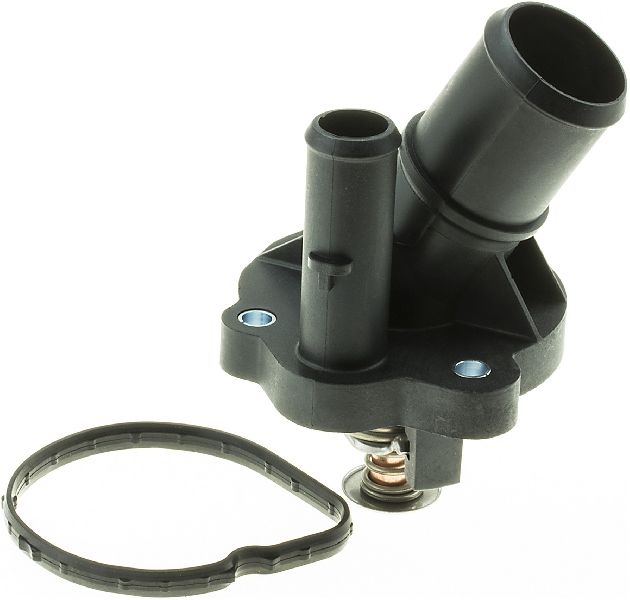
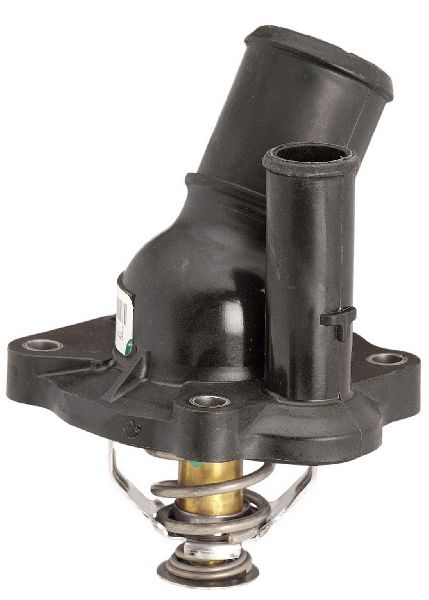
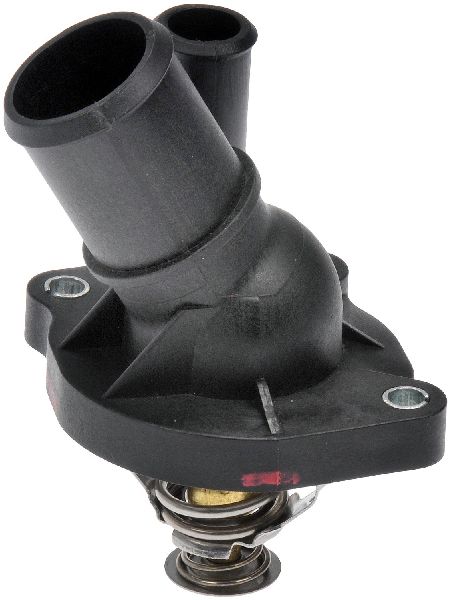
Typical fix: Replace the thermostat and housing assembly. The OEM part number for the assembly is DS7Z-8592-F. This is a very labor-intensive job on this engine.
Est. part cost: $70-$120 - Failed Water Pump ⚪ Low Probability → Shop Engine Water Pump The water pump is a critical component that can fail over time, though it is far less likely to be the root cause of P0217 on this engine than coolant intrusion.
How to confirm: Look for visible coolant leaks from the front of the engine, or listen for a high-pitched whining or grinding noise that changes with engine RPM. A failure here would typically cause a visible external leak, which is different from the primary symptom of coolant intrusion (coolant loss with no visible leak).
Typical fix: Replace the water pump. This is a complex job on the 1.5L EcoBoost.
Est. part cost: $350-$400
Rare But Worth Checking
- Faulty Cylinder Head Temperature (CHT) Sensor: A failing CHT sensor can send false overheating signals to the PCM, triggering a P0217 or P1299 code even if the engine is not actually hot. Check live sensor data on a cold engine; if it reads hot, the sensor is likely bad.
- Restricted Radiator or Cooling Fan Failure: → Shop Engine Cooling Fan Blade Debris blocking the radiator or a malfunctioning electric cooling fan can cause a genuine overheat condition, especially in stop-and-go traffic.
Diagnosis Steps
- STOP DRIVING IMMEDIATELY. Verify if the engine is genuinely overheating (steam, high temperature gauge).
- Check the coolant level in the expansion tank. If it is low, this is a key symptom.
- Scan for other DTCs. The presence of P1299, P1285, or P030x/P0316 codes strongly suggests coolant intrusion.
- If coolant is low but there are no visible external leaks, suspect an internal leak.
- A professional should perform a cooling system pressure test. The system is pressurized and monitored for several hours. A loss of pressure indicates a leak.
- If the pressure test fails with no external leak found, use a borescope to inspect the inside of each cylinder for coolant. The presence of liquid or 'washed clean' pistons confirms coolant intrusion.
- If the pressure test holds and no coolant is found in the cylinders, proceed with diagnosing other cooling system components like the thermostat, water pump, and CHT sensor.
Parts You'll Likely Need
- Engine Short Block Assembly
(OEM #DS7Z-6009-J (supersedes DS7Z-6009-G))— This is the definitive fix for the common coolant intrusion problem, as it replaces the defective engine block with a revised design featuring cross-drilled coolant passages.
Trusted brands: Motorcraft
OEM price range: $1400-$4000
Aftermarket price range: N/A - Engine Coolant Thermostat Housing
(OEM #DS7Z-8592-F)— A stuck thermostat is a possible, though less likely, cause of overheating. Replacement is difficult and costly in labor.
Trusted brands: Motorcraft, SKP, Gates, Motorad
OEM price range: $70-$120
Aftermarket price range: $40-$80
Related Codes That Often Appear With This One
- P1299 — This Ford-specific code for 'Cylinder Head Overtemperature Protection Active' is often set with P0217. It indicates the PCM has entered a fail-safe 'limp mode' to protect the engine. Its presence is explicitly mentioned in the coolant intrusion TSBs.
- P0300-P0304 — These are cylinder-specific misfire codes. They are commonly triggered when coolant intrudes into a cylinder, fouling the spark plug and preventing proper combustion.
- P0316 — This code indicates a misfire was detected within the first 1,000 engine revolutions on startup. It's a strong companion code to coolant intrusion, as coolant that has leaked into a cylinder overnight will cause an immediate startup misfire.
- P1285 — This code for 'Cylinder Head Temperature Sensor Circuit High' points to an overheat condition being detected by the CHT sensor and is also listed as a key indicator in Ford's coolant intrusion TSBs.
Technical Service Bulletins (TSBs) & Recalls
- TSB 20-2100: Supersedes previous TSBs. Describes the coolant intrusion issue, lists P0217 as a symptom, and outlines the procedure to replace the short block for the 1.5L engine.
- TSB 19-2139: An earlier version of the bulletin that also details the diagnosis and short block replacement fix for coolant intrusion.
Platform-Specific Known Issues
- A design defect in the 1.5L EcoBoost engine block can lead to coolant leaking into the cylinders, causing overheating and eventual engine failure. This is the primary issue associated with code P0217 on this vehicle.
- Ford issued Customer Satisfaction Program 21N12, which extended the warranty for this specific issue to 7 years or 84,000 miles for a one-time short block replacement. Owners should check with a Ford dealer to see if their vehicle is eligible, though the program had a final claim date for out-of-warranty vehicles of November 30, 2022.
- Prior to qualifying for the 21N12 engine replacement, Ford required that Customer Satisfaction Program 19B37 (a PCM reprogram to improve cooling) be completed first.
Mechanic-Grade Diagnostic Values
- Cylinder Head Temperature (CHT) Sensor Resistance — expected: Approximately 37 kΩ at 68°F (20°C), dropping to 2.4 kΩ at 194°F (90°C).. Failure: An open circuit (infinite resistance), a short circuit (near-zero resistance), or a reading that doesn't correspond to the current head temperature indicates a faulty sensor.
- Cylinder Head Temperature (CHT) Sensor Voltage (Live Data) — expected: On a cold engine (e.g., 86°F/30°C), voltage should be high, around 4.29V. As the engine warms to operating temperature (e.g., 194°F/90°C), voltage should drop to around 2.03V.. Failure: A voltage reading that is stuck high (near 5V) or low, or one that jumps erratically, points to a sensor or wiring circuit issue. A reading that goes to maximum immediately on startup is a classic sign of a failed CHT sensor.
- Cooling System Pressure Test — expected: The system should hold the specified pressure (typically 20-21 PSI for this system) for at least 30 minutes with no significant drop.. Failure: A steady drop in pressure indicates a leak. If no external leak is visible, an internal leak (coolant intrusion) is highly suspected.
Hidden / Shadow Codes Worth Checking
- Mode 6, TID $A2-$A5, CID $0C: These are not true 'hidden codes' but are misfire counters stored in Mode 6 data. TID $A2 is for Cylinder 1, $A3 for Cylinder 2, and so on. They track misfires over the current and last 10 driving cycles. Even if a specific P030x code hasn't set, these counters can reveal which cylinder is being affected by coolant intrusion before the misfire is severe enough to trigger the Check Engine Light. (see via A capable OBD-II scanner that can display Mode 6 data is required.)
Scan Tool Commands That Help
- Ford IDS (Integrated Diagnostic System): Datalogger > CHT PID — This is used to monitor the live temperature reading from the CHT sensor. It is the first step to determine if the engine is truly overheating or if the sensor is providing a false reading (e.g., spiking to max temp on a cold engine).
- Ford IDS (Integrated Diagnostic System): Powertrain > Power Balance — This test graphically displays the power contribution of each cylinder. When P0217/P1299 is active due to a real overheat, the PCM may disable fuel injectors to certain cylinders as a protective measure. This test can visualize which cylinders are being shut down. It is also extremely useful for identifying the specific misfiring cylinder caused by coolant intrusion.
Wiring & Ground Locations
- Cylinder Head Temperature (CHT) Sensor — On the 1.5L EcoBoost, the CHT sensor is located on the cylinder head, between the engine and the firewall, right behind ignition coil #2. It is notoriously difficult to access, often requiring removal of the cowl and intake components.. A failure of this sensor or its wiring can cause a false P0217/P1299 code, leading to an incorrect diagnosis of a major engine problem. The sensor's location makes it susceptible to heat and vibration, and its connector is a common point of failure.
- Engine Ground Cable — There are multiple ground points, but a key engine-to-chassis ground strap is critical for all sensor readings. An example part number for a main ground cable is GV6T-14324-R59CL. A primary ground point for engine components is often designated G104, located on the right side of the engine compartment.. The CHT sensor circuit relies on a solid ground reference. A corroded or loose engine ground can create a voltage drop, causing erratic or false high-temperature readings from the CHT sensor, which could trigger a P0217 code without a true overheat condition.
Real Owner Repair Stories
- Reddit user in r/fordescape (2017 Ford Escape 1.5L) — Problems starting, 'Engine Fault - Service Now' message, vibrations. Later, smoke from exhaust on startup, Check Engine Light, and 'High Engine Temp - stop car safely' message with severe limp mode.
❌ Tried (didn't work) A Ford dealer initially could not duplicate the concern. A local mechanic suspected a PCM issue.
✅ What actually fixed it A second Ford dealer diagnosed coolant intrusion and stated the long block engine needed to be replaced. The owner was then faced with a $10,000 repair estimate as their vehicle was 6 months out of the Customer Satisfaction Program 21N12 warranty period by time, despite being under the mileage limit.
OEM Part Supersession History
DS7Z-6009-G (and prior revisions)→DS7Z-6009-J (and subsequent revisions)— The original engine short block used a 'saw-cut' design for the coolant passages between the cylinders. This design was prone to developing micro-cracks, leading to coolant intrusion. The revised short block features a 'cross-drilled' design that provides more support for the head gasket and cylinder walls, correcting the defect.
Heads up: When replacing a saw-cut block with a cross-drilled block, the head gasket required for the repair may differ from the one listed in the standard parts catalog for the vehicle's VIN. The TSB specifies the correct gasket to use with the new block design.
Model Year Variations Within This Range
- 2017-2019: While the core coolant intrusion issue affects the entire 2017-2019 range for the 1.5L I4, engines manufactured after April 2019 are supposed to have the revised engine block design from the factory, making them less susceptible to this specific failure. However, some vehicles may use a traditional Engine Coolant Temperature (ECT) sensor while others use a Cylinder Head Temperature (CHT) sensor, which can affect diagnostics for temperature-related codes.
Diagnostic Flowchart
Other Known Issues on This Vehicle
Issues unrelated to this code that are worth knowing about as an owner of this generation:
- Transmission Failure / Leaking Axle Seal 🟠 Medium — More common in earlier models (2013-2016), but can still occur. A leaking driver-side front axle seal can lead to low transmission fluid and eventual failure. (Ref: TSB 16-0043)
- Torque Converter Failure 🟠 Medium — Some owners report torque converter issues, sometimes occurring after the engine has been replaced for the coolant intrusion issue, suggesting potential stress on the drivetrain.
- Faulty Coolant Bypass Solenoid 🟡 Low — A fairly common failure that can cause a check engine light with code P26B7. It's a relatively simple and inexpensive repair compared to other engine issues. (Ref: TSB 15-0162 (related to 1.6L but component is similar))
Used vs. New Parts: Buying Guide for This Vehicle
When a used part is the smart pick: For this specific repair, a used part only makes sense for peripheral components like the thermostat housing, radiator, or cooling fans if they are the confirmed point of failure AFTER coolant intrusion has been definitively ruled out. A used engine assembly is an extremely high-risk purchase.
Donor-vehicle mileage cap: roughly under 60000 miles for the part to have meaningful remaining life.
What to inspect on the donor part:
- For a thermostat or radiator, check for signs of corrosion, leaks (crusty residue), or physical damage to fins and plastic end tanks.
- For a cooling fan assembly, spin the blades by hand to check for bearing noise or resistance. Inspect the wiring and connector for damage.
OEM-only on this vehicle (don't cheap out):
- Engine Short Block: DO NOT install a used engine from another 2017-2019 Escape unless you can 100% verify it is the revised 'cross-drilled' design (Part No. DS7Z-6009-J or newer) or a remanufactured unit from a reputable source that addresses the flaw. Installing another defective 'saw-cut' block will lead to repeat failure.
- Cylinder Head Temperature (CHT) Sensor: Given the high labor cost to access this sensor, using a new OEM (Motorcraft) part is strongly recommended to avoid repeat repairs.
Aftermarket brands forum-validated for this vehicle:
- Thermostat Housing: Gates, Motorad
Brands owners have reported issues with on this vehicle:
- No-name/unbranded engine blocks or head gaskets. The repair is too critical and labor-intensive to risk using parts that don't meet or exceed OEM specifications for the revised design.
Real Owner Stories
Aggregated from forums and TSBs cited above. Mileages and costs reflect what owners reported in those sources.
2018 Ford Escape 1.5L — 89000 miles
Symptoms: Dreaded coolant intrusion issue; described as a blown head gasket.
What fixed it: Fixed by a shop via an aftermarket warranty, though the issue recurred 5,600 miles later.
Cost: $5000-$5000
Source hint: r/MechanicAdvice
2019 Ford Escape 1.5L EcoBoost — 94000 miles
Symptoms: Coolant intrusion issue leading to a need for a short block replacement.
What fixed it: Dealer quoted a short block replacement, but coverage was denied due to mileage.
Cost: $9000-$9000
Source hint: Reddit: r/fordescape - Seeking advice on the 1.5L coolant intrusion issue
2019 Ford Escape 1.5L EcoBoost — 36000 miles
Symptoms: Coolant intrusion confirmed in cylinder #3.
What fixed it: Engine replaced under warranty.
Source hint: Blue Oval Forums: 2019 Escape 1.5L EB coolant intrusion, long term effect on other powertrain components..
2018 Ford Fusion SE 1.5L EcoBoost — ~100000 miles
Symptoms: Coolant intrusion issue on the 1.5L platform mate.
What fixed it: Short block replacement; Ford offered partial financial assistance outside of the warranty period.
Cost: $7000-$7000
Source hint: Reddit: r/fordfusion - 2018 Ford Fusion SE 1.5L EcoBoost - Coolant Intrusion
Related OBD-II Codes
Frequently Asked Questions
Is there a specific Ford program that covers the coolant intrusion issue on my 2017-2019 Escape 1.5L?
Which TSBs describe the engine block design flaw for the 1.5L EcoBoost?
What is the specific replacement part recommended by Ford to fix the P0217 overheating issue permanently?
Can I just replace the head gasket to fix the coolant loss on my 1.5L EcoBoost?
What other symptoms should I look for if I suspect coolant intrusion is causing my P0217 code?
Is the 1.5L Ford Fusion affected by the same P0217 overheating issues as the Escape?
Helpful Videos
We Have This Part in Stock


The information in this article is provided for general reference and educational purposes only. Vehicle specifications, procedures, and part compatibility can vary by production date, trim level, and region. Always consult your vehicle's factory service manual and verify part numbers before purchasing or performing repairs. Safety-critical components such as airbags, seat belts, and braking systems should be installed by a qualified professional.
- Ford Escape:
- 🧭 Diagnostic Flowchart
- 🎬 Helpful Videos
- 🛍️ Shop This Part
- What's Unique About the 2017-2019 Ford Escape
- Symptoms You May Notice
- Most Likely Causes
- Rare But Worth Checking
- Diagnosis Steps
- Parts You'll Likely Need
- Related Codes That Often Appear With This One
- Technical Service Bulletins (TSBs) & Recalls
- Platform-Specific Known Issues
- Mechanic-Grade Diagnostic Values
- Hidden / Shadow Codes Worth Checking
- Scan Tool Commands That Help
- Wiring & Ground Locations
- Real Owner Repair Stories
- OEM Part Supersession History
- Model Year Variations Within This Range
- Other Known Issues on This Vehicle
- Used vs. New Parts: Buying Guide for This Vehicle
- Real Owner Stories
- 2018 Ford Escape 1.5L — 89000 miles
- 2019 Ford Escape 1.5L EcoBoost — 94000 miles
- 2019 Ford Escape 1.5L EcoBoost — 36000 miles
- 2018 Ford Fusion SE 1.5L EcoBoost — ~100000 miles
- Related OBD-II Codes
- Frequently Asked Questions
- 🎟️ Get 5% Off