

P0217 on 2016-2019 Ford Explorer 2.3L EcoBoost: Engine Overheating Causes and Fixes
Code P0217 means your Explorer's engine is dangerously hot. The most common causes are a low coolant level from a leak, a stuck thermostat, or a failing water pump. On this specific engine, it can also be a primary symptom of coolant leaking into the cylinders due to a known head gasket/engine block issue. Stop driving immediately to prevent catastrophic engine damage.
- P0217 is a critical code indicating your engine is overheating, or the computer believes it is. Stop driving immediately.
- The first step is to verify if the engine is actually hot. If you see steam or the temperature gauge is in the red, it's a real overheat. If not, it could be a faulty sensor.
- For a real overheat, the most likely causes are a coolant leak (check for the known head gasket issue), a stuck thermostat, or a failed water pump.
- If it's a false alarm, the Cylinder Head Temperature (CHT) sensor is the primary suspect.
- Due to a known engine design issue, any unexplained coolant loss should be professionally diagnosed to rule out an internal engine leak.
What's Unique About the 2016-2019 Ford Explorer
The 2.3L EcoBoost engine in the Ford Explorer has two distinct vulnerabilities related to overheating. First, it is part of an engine family known for a specific block design that can allow coolant to leak into the cylinders, causing coolant loss and genuine overheating; this issue has led to class-action lawsuits. While Ford TSB 19-2346 and 20-2315 officially address this 'coolant intrusion' on the related 2.0L engine, the 2.3L engine is widely known to suffer the same failure mode. Second, this engine uses a Cylinder Head Temperature (CHT) sensor that measures the engine's metal temperature directly. While this provides a more accurate reading, a failure of this sensor or its wiring can trigger a false P0217 code and put the car in limp mode even if the engine isn't actually hot.
Symptoms You May Notice
- Engine temperature gauge reading in the 'H' or red zone
- Warning message on the dashboard like 'Engine Coolant Overtemperature'
- Drastic loss of engine power (limp mode)
- Steam or smoke coming from the engine bay
- Boiling or gurgling sounds from the engine or coolant reservoir
- Check Engine Light is on
- White smoke from the exhaust, especially on startup (indicates coolant intrusion)
- Sweet smell from the exhaust (indicates burning coolant)
- Replacing the temperature sensor without first confirming if the engine is actually overheating. If there are physical signs of overheating (steam, boiling), the sensor is likely working correctly and reporting a real problem.
- Attributing coolant loss to a simple external leak (hose, radiator) when it is actually the more serious internal coolant intrusion issue. A pressure test is crucial.
Most Likely Causes
- Low Engine Coolant Level (Internal Leak) 🔴 High Probability This engine family has a well-documented design flaw that can cause coolant to leak internally into cylinders 2 and 3. This is often referred to as 'coolant intrusion' and has been the subject of class-action lawsuits. The issue is believed to stem from the open-deck block design. 🎬 Watch: Why these EcoBoost engines suffer from internal coolant leaks Though official TSBs like 19-2346 primarily name the 2.0L engine, the 2.3L is known to experience the same failure.
How to confirm: Let the engine cool completely. Check the coolant level in the overflow reservoir; unexplained loss is a key symptom. A cooling system pressure test that loses pressure with no visible external leak is a strong indicator. A mechanic can use a borescope to look for coolant inside the cylinders or perform a chemical 'block test' to detect combustion gases in the coolant.
Typical fix: The official Ford-recommended fix per related TSBs is a complete long block engine replacement. This is an extremely expensive repair.
Est. part cost: $4000-$8000 (for long block) - Faulty Thermostat 🟡 Medium Probability → Shop Integrated Thermostat Housing Assembly
How to confirm: After the engine has warmed up, carefully feel the upper and lower radiator hoses. If the engine is hot but the lower radiator hose remains cool, the thermostat is likely stuck closed and not allowing coolant to circulate to the radiator.
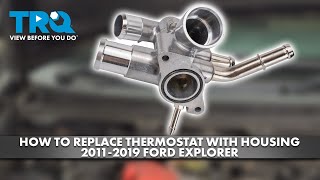
Typical fix: Replace the thermostat and housing assembly. It is highly recommended to use an OEM Motorcraft part (RT-1233). 🎬 See this walkthrough on replacing the thermostat and housing assembly
Est. part cost: $35-$75 - Failing Water Pump 🟡 Medium Probability → Shop Engine Water Pump The 2.3L EcoBoost uses an external, belt-driven water pump, which is a standard wear item. Unlike the internal, timing-chain-driven pump on the V6 Explorer which is a major failure point, this one is more conventional but can still fail.
How to confirm: Look for coolant leaking from the 'weep hole' on the bottom of the pump housing. Listen for a grinding or whining noise from the front of the engine. With the engine off and cool, check for excessive play in the water pump pulley.
Typical fix: Replace the water pump and the serpentine belt. The OEM Motorcraft part number is PW-625 (superceded by EJ7Z-8501-H). 🎬 Watch: Step-by-step 2.3L EcoBoost water pump replacement guide
Est. part cost: $80-$250 - Malfunctioning Cooling Fan Assembly ⚪ Low Probability → Shop Engine Cooling Fan Blade
How to confirm: Let the engine idle and watch the temperature gauge. As it passes the halfway mark, or if you turn the A/C on, the cooling fan(s) should turn on at high speed. If they do not, the issue could be the fan motor, relay, fuse, or wiring.
Typical fix: Diagnose and replace the faulty component, which is most often the fan motor assembly or control relay.
Est. part cost: $50-$400 - Faulty Cylinder Head Temperature (CHT) Sensor ⚪ Low Probability
How to confirm: This is a likely cause if the P0217 code appears when the engine is cold, or if the temperature gauge spikes to hot instantly with no other physical signs of overheating (no steam, no boiling). A scan tool can monitor the CHT sensor data for erratic readings. An infrared thermometer pointed at the cylinder head can confirm the engine is not actually overheating.
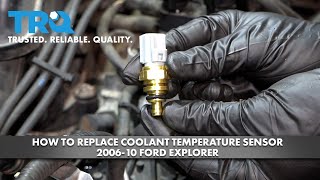
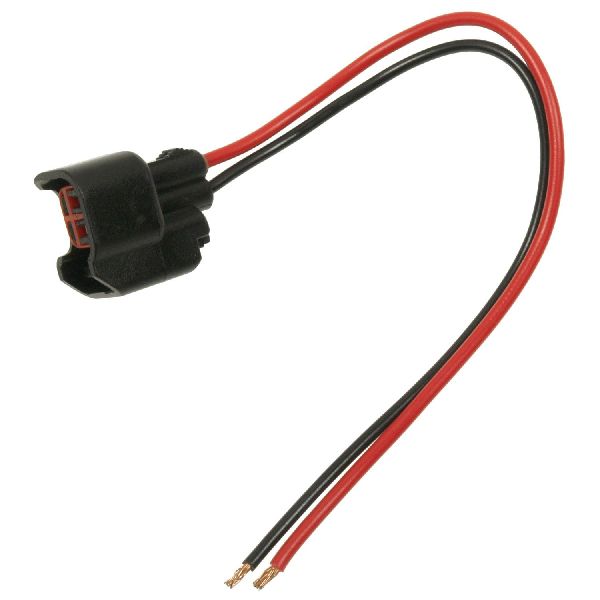
Typical fix: Replace the CHT sensor and its wiring connector pigtail, which can become brittle from heat. The OEM part number is 8S4Z-6G004-A.
Est. part cost: $30-$90
Rare But Worth Checking
- Active Grille Shutter Malfunction: The active grille shutters in front of the radiator open and close to improve aerodynamics. If they become stuck in the closed position, they can restrict airflow and cause overheating, sometimes triggering code P05A1 along with P0217. The assembly part number is JB5Z8475A.
- Clogged Radiator: → Shop Radiator External debris like leaves and plastic bags can block the front of the radiator. Internally, using the wrong coolant or having a severe internal leak can create sludge that blocks coolant flow, reducing the cooling system's efficiency.
Diagnosis Steps
- CRITICAL FIRST STEP: Determine if the engine is genuinely overheating. Look for steam, listen for boiling, and check for a pegged temperature gauge. If signs are present, shut off the engine immediately and let it cool for several hours.
- Once cool, check the coolant level in the reservoir. If low, you have a leak. Top it off with the correct Ford-spec coolant.
- Scan for other trouble codes. P1299 confirms the computer is commanding limp mode. P030x codes strongly suggest coolant intrusion. P05A1 points to the grille shutters.
- If coolant was low, perform a cooling system pressure test. If pressure drops but no external leaks are found, suspect an internal leak (coolant intrusion). Use a borescope to inspect cylinders 2 and 3 for evidence of coolant.
- If coolant is full and the engine still overheats, check for coolant circulation. A stuck thermostat is a likely cause if the upper radiator hose is hot and the lower one is cool.
- Verify the electric cooling fans are turning on. They should activate when the A/C is turned on or when the engine temperature rises.
- If the engine shows signs of overheating on the dash but there are no physical symptoms, suspect a faulty Cylinder Head Temperature (CHT) sensor. Use a scan tool to monitor its output and an infrared thermometer to verify the actual engine temperature.
Parts You'll Likely Need
- Thermostat Assembly
(OEM #RT-1233)— A thermostat stuck in the closed position is a frequent cause of overheating by preventing coolant circulation.
Trusted brands: Motorcraft, Gates, Four Seasons
OEM price range: $35-$50
Aftermarket price range: $25-$45 - Water Pump
(OEM #PW-625 / EJ7Z-8501-H)— The water pump circulates coolant through the engine. A failure of its bearing or seal will stop circulation and cause a leak, leading to overheating.
Trusted brands: Motorcraft, Gates, Bosch
OEM price range: $80-$150
Aftermarket price range: $70-$120 - Cylinder Head Temperature (CHT) Sensor
(OEM #8S4Z-6G004-A)— This sensor can fail and send false overheating signals to the computer, triggering a P0217 code and limp mode even on a cool engine.
Trusted brands: Motorcraft, Standard Motor Products, Dorman
OEM price range: $35-$50
Aftermarket price range: $20-$40 - Long Block Engine — In cases of the 'coolant intrusion' design flaw, the only permanent fix recommended by Ford is a complete long block replacement.
Trusted brands: Ford, Jasper (Remanufactured)
OEM price range: $4000-$8000
Aftermarket price range: $3500-$6000
Related Codes That Often Appear With This One
- P1299 — This is a Ford-specific code for 'Cylinder Head Overtemperature Protection Active'. It is set when the PCM takes protective action (limp mode) based on the CHT sensor reading. It is a direct companion to P0217 and is often triggered by the same conditions, whether a real overheat or a faulty sensor.
- P0300-P0304 — These are misfire codes (P0300 for random, P0301-P0304 for specific cylinders). If coolant is leaking into the cylinders due to a failed head gasket/block, it will foul the spark plugs and cause misfires, which can appear alongside the P0217 overheating code.
- P05A1 — This code indicates a fault with the Active Grille Air Shutter system. If the shutters are stuck closed, it can restrict airflow, cause overheating, and trigger P0217.
Technical Service Bulletins (TSBs) & Recalls
- TSB 19-2346 / 20-2315: While officially for the 2.0L EcoBoost, this TSB describes the exact symptoms of coolant intrusion (low coolant, white smoke, misfire codes P030x, and overheat codes P0217/P1299) and prescribes a long block replacement. It is highly relevant context for the same issue on the 2.3L.
Platform-Specific Known Issues
- A class-action lawsuit was filed concerning the 2.3L EcoBoost engine family, alleging a design flaw in the cylinder head and block that allows coolant to intrude into the cylinders, leading to coolant loss, overheating, and eventual engine failure. This is a known potential root cause for a P0217 code on this vehicle.
Mechanic-Grade Diagnostic Values
- Cylinder Head Temperature (CHT) Sensor Resistance (Cold Engine) — expected: Approximately 29,000 Ohms (29 kΩ) at 77°F (25°C).. Failure: A reading that is significantly higher (open circuit) or lower (short circuit) than the expected value for the ambient temperature.
- Cylinder Head Temperature (CHT) Sensor Resistance (Hot Engine) — expected: Approximately 2,000 - 3,000 Ohms (2-3 kΩ) at 194-212°F (90-100°C).. Failure: Resistance does not decrease smoothly as the engine warms up, or gives an out-of-range reading.
- Cylinder Head Temperature (CHT) Sensor Signal Voltage (KOEO, Cold) — expected: Typically between 2.0V and 3.0V, depending on ambient temperature.. Failure: Voltage is near 5.0V (indicating an open circuit) or near 0V (indicating a short to ground). An instant spike to a very low voltage on a cold start also indicates sensor failure.
- Cylinder Head Temperature (CHT) Sensor Reference Voltage (VREF) — expected: Approximately 5.0 Volts at the connector with the sensor disconnected and Key On, Engine Off (KOEO).. Failure: No voltage or significantly lower voltage indicates a problem with the wiring or the Powertrain Control Module (PCM).
Scan Tool Commands That Help
- Ford IDS / FORScan: Active Commands - Cooling Fan Control — Use this to command the cooling fan(s) on and off directly. This bypasses sensors and relays, allowing you to quickly determine if the fan motor itself is functional. If the fan runs with this command, the problem lies in the control circuit (sensor, wiring, PCM).
- Ford IDS / FORScan: Service Functions - Cooling System Degas / Air Purge — This function should be run after any repair that involves draining the coolant (e.g., water pump, thermostat, radiator replacement). It cycles the system to purge trapped air pockets that can cause localized hot spots, inaccurate sensor readings, and lead to a P0217 code.
- Ford IDS / FORScan: Datalogger - CHT and ECT PIDs — Monitor the Cylinder Head Temperature (CHT) and Engine Coolant Temperature (ECT) PIDs at the same time. While the CHT is the primary sensor, a large, illogical difference between the two can indicate a fault with one of the sensors or its wiring, rather than a true global overheating event.
Wiring & Ground Locations
- CHT Sensor Location — On the cylinder head, often near the coolant outlet housing or on the rear (firewall side) of the engine, which can make access difficult.. This sensor provides the direct metal temperature reading that triggers P0217 and P1299. Its wiring harness is exposed to significant heat and can become brittle or damaged, leading to false signals. The connector pigtail is a common replacement item along with the sensor.
- G105 — A common engine block ground point.. A poor ground connection at this point can cause erratic voltage readings from various engine sensors, including the CHT sensor. Verifying ground integrity (resistance less than 0.1 ohm to battery negative) is a crucial step in diagnosing electrical faults.
Real Owner Repair Stories
- NHTSA ODI #11397265 (2017 Ford Fusion (with related EcoBoost engine)) — Overheating, stalling, white smoke from exhaust, and coolant loss. PCM self-test showed P0217.
❌ Tried (didn't work) Initial diagnosis at a non-dealer shop was inconclusive.
✅ What actually fixed it A Ford dealership diagnosed a misfire in Cylinder 2 (P0302) and found coolant inside the cylinder using a borescope, confirming the coolant intrusion issue. The required repair was a complete engine long block assembly replacement.
"I Checked Everything" — The Actual Cause
- A common scenario for a false P0217 is when a technician performs a cooling system pressure test and finds no leaks, and the thermostat and water pump appear to be functioning. The actual cause is often an electrical fault in the Cylinder Head Temperature (CHT) sensor circuit. The sensor itself may test correctly when cold, but fail intermittently when hot, or the wiring harness may have an internal break that only causes a signal drop under specific heat and vibration conditions. This leads the PCM to believe the engine is overheating when it is not, triggering limp mode and the P0217 code.
OEM Part Supersession History
PW-548 / EJ7Z-8501-A→PW-625 / EJ7Z-8501-H— Design update for the water pump. An early version was specified for 2.3L EcoBoost engines built before March 30, 2015. The later part number is the current replacement.
Heads up: While the vehicle range is 2016-2019, very early 2016 production might have used an engine built with the earlier part. Always verify the correct part number with the vehicle's VIN.
Model Year Variations Within This Range
- 2016: The 2016 model year was the first for the 2.3L EcoBoost I4 in the Ford Explorer, replacing the previous 2.0L EcoBoost option. This marked a significant powertrain change for the 4-cylinder option, making it available with AWD for the first time.
Diagnostic Flowchart
Other Known Issues on This Vehicle
Issues unrelated to this code that are worth knowing about as an owner of this generation:
- Coolant Intrusion into Cylinders 🔴 High — A known design flaw, most common on pre-2020 models. Can occur at any mileage, but often reported between 60,000 and 120,000 miles. (Ref: TSB 19-2346 (for related 2.0L engine) describes the failure mode. Subject of multiple class-action lawsuits.)
- Carbon Buildup on Intake Valves 🟠 Medium — Common to all direct-injection engines, including the 2.3L EcoBoost. Becomes noticeable after 50,000-80,000 miles, causing rough idle and reduced performance.
- Warped Rear Brake Rotors 🟡 Low — A common complaint on 5th generation Explorers. Owners report premature warping and vibration during braking, often requiring replacement sooner than expected.
- Cracking on Applique Panel Below Rear Window 🟡 Low — A cosmetic but very common issue where the black plastic trim panel on the liftgate develops cracks. Widespread enough to be part of a class-action lawsuit for some model years.
- Water Leaks into Cabin (A-Pillar) 🟠 Medium — Some owners report water leaking into the cabin near the A-pillars, often due to improperly sealed body seams from the factory, requiring resealing by a body shop.
Used vs. New Parts: Buying Guide for This Vehicle
When a used part is the smart pick: Used parts are a reasonable choice for simple, non-critical components like the coolant overflow reservoir, hoses in good condition, or the cooling fan shroud. Avoid used electronic sensors or wear items like pumps and thermostats.
Donor-vehicle mileage cap: roughly under 60000 miles for the part to have meaningful remaining life.
What to inspect on the donor part:
- For a used engine, demand service records to check for regular oil changes.
- Before purchase, pull the dipstick and oil cap to check for milky, brown sludge indicating oil/coolant mixing.
- If possible, have a mechanic perform a compression test and a cylinder leak-down test to verify internal health.
- Inspect the exterior for signs of extreme corrosion or physical damage.
OEM-only on this vehicle (don't cheap out):
- Thermostat: Many Ford engines, including the EcoBoost family, use a 'cold-side' thermostat that operates differently from typical aftermarket versions. Using a non-Motorcraft thermostat is a very common cause of repeat overheating issues or incorrect temperature regulation.
- Cylinder Head Temperature (CHT) Sensor: This is a high-authority sensor that directly controls the engine's fail-safe mode. Aftermarket sensors can have different resistance curves, leading to inaccurate readings and false P0217 codes. Always use a genuine Motorcraft sensor.
Aftermarket brands forum-validated for this vehicle:
- Gates: Widely regarded as a high-quality OEM equivalent for water pumps, belts, and hoses.
- Stant: A known OEM supplier for thermostats. Their 'SuperStat' line is designed to fail in the open position, which can prevent a catastrophic overheat if the part fails.
Brands owners have reported issues with on this vehicle:
- Generic/Unbranded Plastic Thermostat Housings: Many forum users report that cheap, unbranded plastic thermostat housings are prone to cracking and leaking shortly after installation. It is better to pay more for an OEM housing or a reputable aftermarket brand.
Real Owner Stories
Aggregated from forums and TSBs cited above. Mileages and costs reflect what owners reported in those sources.
2017 Ford Explorer 2.3L EcoBoost
Symptoms: Low coolant levels, white smoke from the exhaust, and engine misfires along with the P0217 overheat code.
What fixed it: Complete long block engine replacement as prescribed by the manufacturer for coolant intrusion issues.
Cost: $4000-$8000
Source hint: TSB 19-2346 / 20-2315 and related class-action lawsuit documentation
2016-2018 Ford Focus RS 2.3L EcoBoost
Symptoms: Coolant intrusion into the cylinders leading to overheating and engine performance issues.
What fixed it: Head gasket replacement under a specific recall/service program.
Source hint: Vehicle-specific issues citing Ford Focus RS 2.3L head gasket failure
Related OBD-II Codes
Frequently Asked Questions
Does TSB 19-2346 apply to my 2.3L EcoBoost Explorer even though it mentions the 2.0L engine?
Is there a specific thermostat part recommended for the 2016-2019 Explorer 2.3L?
My 2.3L Explorer is overheating, but I heard the water pump is different than the V6 model. Is that true?
What is the 'coolant intrusion' issue mentioned in the class-action lawsuits for this vehicle?
The dash says 'Engine Coolant Overtemperature' but the engine doesn't seem hot. What could it be?
Helpful Videos

We Have This Part in Stock


The information in this article is provided for general reference and educational purposes only. Vehicle specifications, procedures, and part compatibility can vary by production date, trim level, and region. Always consult your vehicle's factory service manual and verify part numbers before purchasing or performing repairs. Safety-critical components such as airbags, seat belts, and braking systems should be installed by a qualified professional.
- Ford Explorer:
- 🧭 Diagnostic Flowchart
- 🎬 Helpful Videos
- 🛍️ Shop This Part
- What's Unique About the 2016-2019 Ford Explorer
- Symptoms You May Notice
- Most Likely Causes
- Rare But Worth Checking
- Diagnosis Steps
- Parts You'll Likely Need
- Related Codes That Often Appear With This One
- Technical Service Bulletins (TSBs) & Recalls
- Platform-Specific Known Issues
- Mechanic-Grade Diagnostic Values
- Scan Tool Commands That Help
- Wiring & Ground Locations
- Real Owner Repair Stories
- "I Checked Everything" — The Actual Cause
- OEM Part Supersession History
- Model Year Variations Within This Range
- Other Known Issues on This Vehicle
- Used vs. New Parts: Buying Guide for This Vehicle
- Real Owner Stories
- 2017 Ford Explorer 2.3L EcoBoost
- 2016-2018 Ford Focus RS 2.3L EcoBoost
- Related OBD-II Codes
- Frequently Asked Questions
- 🎟️ Get 5% Off