

P0217 on 2019 Ford Fusion Energi: Engine Overheat Causes and Fixes
P0217 indicates an engine overheat condition. On the 2019 Fusion Energi, this can be caused by common cooling system failures like a bad thermostat or electric water pump. However, it is also a documented symptom of a serious engine design flaw leading to coolant intrusion into the cylinders, a problem covered by Ford's TSB 22-2322. This code can also be triggered falsely by a faulty ECT sensor circuit (TSB SSM 48991).
- P0217 is a critical code for an overheating engine; stop driving immediately.
- On the 2019 Fusion Energi, this code is NOT typically caused by the major 'coolant intrusion' engine failure seen on other Fusion models.
- The most likely causes are a faulty Engine Coolant Temperature (ECT) sensor giving a false reading (per TSB SSM 48991), a stuck thermostat, or a failed electric water pump.
- Diagnosis should begin by verifying if the engine is actually overheating using an infrared thermometer.
- If other codes like P0117 or P0118 are present, it strongly points to an electrical/sensor issue rather than a mechanical cooling problem.
What's Unique About the 2019-2019 Ford FUSION ENERGI
The 2019 Ford Fusion Energi uses a 2.0L Atkinson-cycle gasoline engine. While Pass 1 suggested this engine was immune to the coolant intrusion issues plaguing Ford's EcoBoost engines, official Technical Service Bulletins (TSBs) tell a different story. TSB 22-2322 and others confirm that this 2.0L engine family can also suffer from a design flaw that allows coolant to leak into the cylinders, causing overheating and setting a P0217 code. Therefore, diagnosis must consider both common cooling system failures and this severe, known engine defect.
Diagnostic Flowchart
Tap your situation to follow the diagnostic path that matches what you're seeing on this vehicle.
Symptoms You May Notice
- Temperature gauge reading in the 'Hot' or red zone
- Illuminated engine temperature warning light
- Check Engine Light is on
- Reduced engine power or entering 'limp mode'
- Steam or smoke coming from the engine bay
- A sweet, syrupy smell of coolant around the vehicle
- Boiling or gurgling sounds from the engine or coolant reservoir
- Unexplained, gradual coolant loss over time (symptom of coolant intrusion)
- White smoke from the exhaust, especially on startup (symptom of coolant intrusion)
- Replacing the engine. Mechanics familiar with the widespread coolant intrusion issues on 1.5L and 2.0L EcoBoost Fusions might incorrectly assume the same failure on an Energi model. The 2.0L Atkinson-cycle engine in the Energi has a different design and is not subject to the same TSBs regarding coolant intrusion.
- Replacing cooling system components (thermostat, water pump) without first ruling out coolant intrusion. If the root cause is the engine block flaw, replacing these parts will not solve the overheating problem.
Most Likely Causes
- Internal Coolant Leak (Coolant Intrusion) 🔴 High Probability Contrary to common belief that only EcoBoost engines are affected, Ford TSB 22-2322 and 22-2229 explicitly include the 2.0L engine family in vehicles that may exhibit P0217 due to coolant intrusion into the cylinders. The issue stems from a flaw in the engine block casting that allows a leak path to form between cylinders.
How to confirm: A mechanic will perform a cooling system pressure test to check for internal leaks. A borescope inspection of the cylinders is the definitive diagnostic step, often revealing one piston top as 'steam cleaned' from coolant burning off. The presence of misfire codes (P0300-P0304) alongside P0217 strongly suggests this failure.
Typical fix: The official Ford-recommended repair is the replacement of the engine short block or long block assembly with an updated part. This is a major and expensive repair.
Est. part cost: $3500-$5000+ - Faulty Engine Coolant Temperature (ECT) Sensor or Wiring 🟡 Medium Probability → Shop Engine Coolant Temperature Sensor Ford TSB SSM 48991 specifically identifies the ECT sensor or its wiring harness as a potential cause for false P0217 codes on some Fusion models. The sensor can fail and send an incorrect high-temperature reading to the computer even if the engine is not actually overheating.
How to confirm: Use a scan tool to read live ECT data. Compare this reading to a physical temperature measurement taken with an infrared thermometer at the thermostat housing. If the scan tool shows a hot temperature but the physical reading is normal, the sensor or wiring is likely faulty. The presence of codes like P0117 or P0118 further points to a sensor circuit issue.
Typical fix: Replace the Engine Coolant Temperature (ECT) sensor and inspect the wiring harness for damage. Per TSB SSM 48991, the knock sensor may also need to be replaced as part of the same harness.
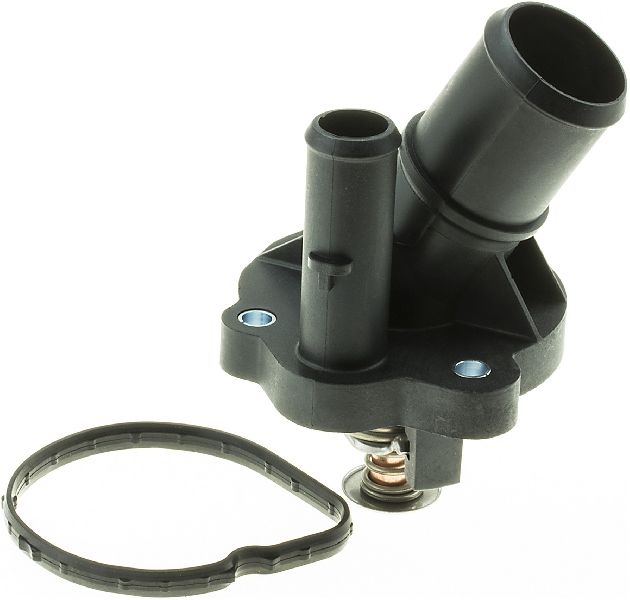
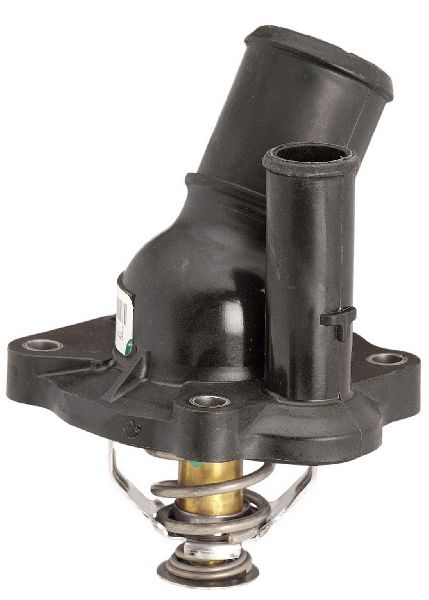
Est. part cost: $25-$75 - Stuck-Closed Thermostat 🟡 Medium Probability → Shop Integrated Thermostat Housing Assembly
How to confirm: After a cold start, feel the upper radiator hose, which should get hot. The lower radiator hose should remain cool until the engine reaches operating temperature (around 190-200°F), at which point the thermostat opens and the lower hose should also become hot. If the lower hose stays cool as the engine overheats, the thermostat is likely stuck closed.
Typical fix: Replace the thermostat and gasket. 🎬 See this walkthrough for replacing the thermostat on a hybrid. Refill and bleed the cooling system. The thermostat is relatively easy to access on this engine.
Est. part cost: $40-$100 - Failing Electric Water Pump 🟡 Medium Probability → Shop Engine Water Pump The Fusion Energi uses an electric water pump for the engine cooling system, which can fail over time, leading to a complete loss of coolant circulation. Unlike a mechanical pump, failure can be sudden.
How to confirm: With the engine running, there should be visible coolant circulation in the degas bottle (coolant reservoir). A lack of flow, whining noises from the pump area, or leaks from the pump body can indicate failure. A scan tool may also be able to command the pump on/off to test functionality.
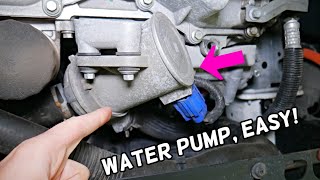
Typical fix: Replace the electric water pump assembly. 🎬 Watch: How to locate and replace the electric water pump. This is more complex and expensive than a traditional mechanical pump.
Est. part cost: $200-$500 - Low Engine Coolant Level 🟡 Medium Probability While any car can have a leak, on this platform, low coolant should be treated as a potential symptom of the more serious coolant intrusion issue until proven otherwise.
How to confirm: Visually inspect the coolant level in the coolant reservoir (degas bottle) when the engine is cold. If it is below the 'MIN' line, a cooling system pressure test is required to find the source of the leak (e.g., hoses, radiator, water pump, or an internal engine leak).
Typical fix: Identify the source of the leak with a pressure test and replace the faulty component. If no external leaks are found, suspect coolant intrusion.
Est. part cost: $20-$400+ - Cooling Fan Malfunction ⚪ Low Probability → Shop Engine Cooling Fan Blade
How to confirm: Let the engine idle and watch the temperature gauge. As it passes the halfway mark, the cooling fan(s) should turn on. You can also turn the A/C on high, which should command the fans to run. If they do not, there is an issue with the fan motor, relay, or control circuit.
Typical fix: Diagnose and replace the faulty component, which could be the fan motor, fan control module, or a relay/fuse.
Est. part cost: $150-$600
Rare But Worth Checking
- Clogged Radiator: → Shop Radiator Internal blockage from sediment or external blockage from debris can reduce cooling efficiency and lead to overheating, especially at low speeds.
Diagnosis Steps
- SAFETY FIRST: Do not open the coolant reservoir cap when the engine is hot. Allow the engine to cool completely.
- Check the coolant level in the reservoir. Note if it is low, as this is a key symptom.
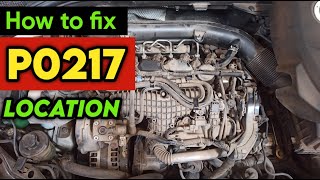
- Scan the PCM for P0217 and any other stored trouble codes. 🎬 Watch: A quick overview of the P0217 overtemp code. The presence of misfire codes (P030x) or ECT circuit codes (P011x) is a critical diagnostic clue.
- Verify if the engine is actually overheating. Use an infrared thermometer to measure the temperature at the thermostat housing or cylinder head. Compare this to the temperature reported by the scan tool's live data.
- If physical temperature is normal but scan tool reports hot, suspect a faulty ECT sensor or wiring per TSB SSM 48991.
- If the engine is confirmed to be overheating, perform a cooling system pressure test. If the system fails to hold pressure, check for external leaks (hoses, radiator, water pump).
- If no external leaks are found during the pressure test, use a borescope to inspect the inside of each cylinder for signs of coolant (e.g., an unusually clean piston top). This is the key step to confirm or deny internal coolant intrusion.
- If no internal leak is found, proceed with diagnosing standard cooling system components: check for cooling fan operation, feel radiator hoses to check thermostat function, and inspect for coolant flow in the reservoir to check the water pump.
Parts You'll Likely Need
- Engine Coolant Temperature (ECT) Sensor
(OEM #3L8Z-12A648-A)— A common failure point that can send false overheat signals, as identified in Ford TSB SSM 48991.
Trusted brands: Motorcraft, NTK, Delphi
OEM price range: $30-$50
Aftermarket price range: $20-$40 - Thermostat
(OEM #DS7Z-8575-B)— A thermostat stuck in the closed position will prevent coolant from circulating and is a classic cause of overheating.
Trusted brands: Motorcraft, Stant, Gates
OEM price range: $40-$60
Aftermarket price range: $20-$40 - Engine Short Block Assembly
(OEM #HS7Z-6009-A)— This is the official repair recommended by Ford in TSB 22-2322 to fix the root cause of the coolant intrusion issue. It replaces the flawed engine block with an updated design.
Trusted brands: Motorcraft
OEM price range: $3500-$5000
Aftermarket price range: N/A
Related Codes That Often Appear With This One
- P1299 — This code for 'Cylinder Head Overtemperature Protection Active' is a direct result of the high temperatures detected by the PCM, which triggers P0217. The PCM may limit engine power to prevent damage. It is explicitly mentioned in the coolant intrusion TSBs.
- P0300, P0301-P0304 — When these misfire codes appear with P0217, it is a very strong indicator of the coolant intrusion failure. Coolant entering a cylinder fouls the spark plug, preventing proper combustion and causing a misfire. The presence of these codes makes the coolant intrusion diagnosis much more likely than a simple cooling system part failure.
- P0117, P0118, P0128 — These codes relate to the Engine Coolant Temperature (ECT) sensor circuit (low input, high input, and thermostat rationality). Their presence strongly suggests the P0217 code is being triggered by a faulty sensor or wiring, rather than an actual overheat condition, as noted in TSB SSM 48991.
Technical Service Bulletins (TSBs) & Recalls
- TSB 22-2322: Links P0217 with misfire codes (P0300-P0304) and P1299 to coolant intrusion into the cylinders, recommending engine replacement.
- TSB 22-2229: Superseded by 22-2322, but also documents the coolant intrusion issue causing rough running, white smoke, and codes including P0217.
- SSM 48991: Identifies a faulty ECT sensor or its wiring harness as a cause for false P0217 and other related codes, recommending replacement of the ECT sensor and knock sensor harness.
Platform-Specific Known Issues
- TSB SSM 48991: Some Fusions may exhibit a false overheat warning (P0217, P1299) due to an issue with the ECT sensor or knock sensor wiring harness. The fix involves replacing both the ECT and knock sensors.
Mechanic-Grade Diagnostic Values
- Engine Coolant Temperature (ECT) Sensor Resistance — expected: Approximately 37,000 Ω at 32°F (0°C), 9,420 Ω at 68°F (20°C), 2,238 Ω at 176°F (80°C), and 177 Ω at 212°F (100°C).. Failure: Infinite resistance (open circuit), zero resistance (short circuit), or readings that deviate significantly from the expected values at a measured temperature.
- ECT Sensor Connector Voltage (Key On, Engine Off) — expected: One pin should show a 5-volt reference signal from the PCM; the other is the signal return (ground). The signal wire voltage should read between ~4.8V (cold) and ~0.2V (hot).. Failure: Absence of the 5V reference voltage points to a wiring or PCM issue. A signal voltage stuck at 5V or 0V indicates an open or short in the circuit.
- Cooling System Pressure Test (for Coolant Intrusion) — expected: The system should hold 20 psi of pressure for 5 hours with less than 4 psi of pressure drop.. Failure: A pressure drop of 4 psi or more over 5 hours, with no external leaks visible, strongly suggests an internal leak like coolant intrusion into a cylinder.
Hidden / Shadow Codes Worth Checking
- P0217:00-2F: The ':00' is a standard suffix. The '-2F' is a Failure Type Code indicating an 'Erratic or Intermittent' signal. This points strongly toward a failing sensor providing jumpy readings, or a loose/corroded connection in the wiring harness, rather than a steady overheating condition. (see via This extended code is typically only visible using a professional-grade scan tool or Ford's Integrated Diagnostic System (IDS), not a basic OBD-II reader.)
Scan Tool Commands That Help
- Ford IDS (Integrated Diagnostic System): Datalogger > Powertrain > Engine — To monitor live PID data for Engine Coolant Temperature (ECT), Cylinder Head Temperature (CHT), and cooling fan command percentage. This is the primary step to verify if the PCM's reported temperature matches the physical temperature of the engine.
- Ford IDS (Integrated Diagnostic System): Active Commands / Output State Control — To manually command the cooling fans on and off to verify their operation. A similar command may exist to test the functionality of the electric water pump, confirming if the pump responds to PCM commands.
Wiring & Ground Locations
- Main ECT Sensor — On top of the engine, located in the cylinder head between the ignition coils for cylinders #2 and #3.. This is the primary sensor the PCM uses to determine engine temperature for the P0217 code. A faulty sensor or damaged connector here is a direct cause of false codes.
- Second ECT Sensor (Energi models) — On the back side of the engine, located on one of the heater lines/hoses going toward the firewall.. The Fusion Energi has two ECT sensors. A fault in this second sensor or its circuit can also contribute to incorrect temperature readings or trigger related codes.
- G105 / G106 — Located on the right front of the engine compartment.. These are primary engine compartment grounds. A poor ground connection at these points can cause erratic voltage readings for various sensors, including the ECT sensor, leading to false codes.
OEM Part Supersession History
DS7Z-8501-A, DS7Z-8501-B→DS7Z-8501-C— Revisions by the manufacturer to improve the reliability of the electric engine water pump.
Heads up: DS7Z-8501-C is the current recommended OEM replacement for the 2013-2020 2.0L Hybrid/Energi engine and is backward compatible.Engine Block (various PNs for 2017-early 2019 models)→Redesigned Engine Block (post April 2019)— The original engine block design used a 'slot-style' open-deck coolant passage between cylinders, which was prone to cracking. The redesigned block uses 'drilled holes' for coolant flow, which is significantly stronger and resolves the coolant intrusion defect.
Heads up: This is not a direct part swap. The fix requires a complete short or long block assembly with the updated design. When sourcing a replacement engine, it is critical to ensure it is the post-2019 redesigned version to permanently fix the issue.
Model Year Variations Within This Range
- Early 2019 (built on or before April 8, 2019): Vehicles built in this timeframe may have the original engine block design that is prone to the coolant intrusion failure described in TSBs 22-2322 and 19-2346. Models built after this date are more likely to have the updated engine block from the factory, making them less susceptible to this specific cause of P0217.
Helpful Videos
We Have This Part in Stock



The information in this article is provided for general reference and educational purposes only. Vehicle specifications, procedures, and part compatibility can vary by production date, trim level, and region. Always consult your vehicle's factory service manual and verify part numbers before purchasing or performing repairs. Safety-critical components such as airbags, seat belts, and braking systems should be installed by a qualified professional.
- Ford FUSION ENERGI:
- 🧭 Diagnostic Flowchart
- 🎬 Helpful Videos
- 🛍️ Shop This Part
- What's Unique About the 2019-2019 Ford FUSION ENERGI
- Symptoms You May Notice
- Most Likely Causes
- Rare But Worth Checking
- Diagnosis Steps
- Parts You'll Likely Need
- Related Codes That Often Appear With This One
- Technical Service Bulletins (TSBs) & Recalls
- Platform-Specific Known Issues
- Mechanic-Grade Diagnostic Values
- Hidden / Shadow Codes Worth Checking
- Scan Tool Commands That Help
- Wiring & Ground Locations
- OEM Part Supersession History
- Model Year Variations Within This Range
- 🎟️ Get 5% Off