

P0217 on 2018-2023 Kia Stinger 3.3T: Engine Overheat Causes and Fixes
P0217 means your Stinger's engine is overheating. Stop driving immediately. The most common causes are a failing electronic thermostat, a leaking water pump, or coolant leaks/trapped air caused by improper service during the SC300 turbo oil line recall. A new thermostat costs around $150-$250 for the part.
- P0217 is a critical overheat code. Pull over and shut off the engine immediately to prevent severe damage.
- On the Stinger 3.3T, suspect the electronic thermostat first, especially if you also have codes P0597/P0598 or erratic cooling fan behavior.
- If the car recently had the SC300 turbo oil line recall performed, there is a high probability the overheating is caused by a leak or trapped air from that service.
- Always use the correct pink, phosphate-based Asian vehicle coolant. Using the wrong type can cause damage.
- Due to the complexity of bleeding air from the system, professional repair is strongly recommended for any cooling system work on this vehicle.
What's Unique About the 2018-2023 Kia Stinger
The 3.3L twin-turbo V6 in the Stinger is a high-performance engine that generates significant heat and relies on a sophisticated cooling system. Unlike simpler cars, it uses an electronically controlled thermostat which can fail due to internal coolant leaks into its electrical connector, causing erratic cooling fan behavior even before a full overheat. Additionally, a common cause of cooling system problems on this specific vehicle is technician error; many owners report coolant leaks and overheating from trapped air or improperly secured hoses after the 'SC300' turbo oil line recall service was performed. A Kia technician on a forum noted that the SC300 recall procedure requires draining coolant and removing multiple coolant lines, and that bleeding the system properly is difficult, leading to post-service issues if not done correctly.
Symptoms You May Notice
- Temperature gauge reading in the red or 'H'
- Check Engine Light and/or a dedicated engine temperature warning light is on.
- Drastic reduction in engine power as the car enters 'limp mode'.
- Steam or smoke coming from the engine bay.
- A sweet, syrupy smell of hot coolant.
- Audible boiling or gurgling sounds from the engine area.
- Heater inside the car blows cold air even when the engine is hot (a sign of low coolant or a large air pocket).
- Replacing the Engine Coolant Temperature (ECT) sensor. While possible for it to fail, it's less common than the electronic thermostat or a coolant leak on this platform. A faulty ECT sensor would likely show erratic gauge behavior without actual signs of overheating (like boiling or steam).
Most Likely Causes
- Faulty Electronic Thermostat 🔴 High Probability → Shop Integrated Thermostat Housing Assembly The 3.3T engine uses an electronic thermostat. A common failure mode is an internal seal failing, allowing coolant to leak into the electrical connector, causing corrosion and failure of the internal heater circuit.
How to confirm: Check for stored codes P0597 or P0598, which point directly to a thermostat heater circuit fault. Visually inspect the thermostat's electrical connector for pink, crusty residue or corrosion. A technician can also monitor commanded vs. actual temperature with a scan tool. A resistance test across the thermostat's electrical pins should read approximately 11 ohms; an open circuit (infinite resistance) confirms failure.
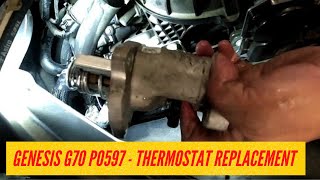
Typical fix: Replace the entire thermostat assembly. 🎬 Watch: Step-by-step 3.3T thermostat replacement guide The system must be drained, refilled, and properly bled of air, which is a known difficult procedure on this car.
Est. part cost: $150-$250 - Coolant Leak / Air in System After Service 🔴 High Probability The SC300 (NHTSA 24V-169) recall for the turbo oil feed pipe requires draining and refilling coolant. Many owners report new leaks from improperly reinstalled hoses or overheating from air pockets left in the system after this service. A technician noted the recall is difficult, requiring removal of many components in a tight space, and that bleeding the air out is challenging.
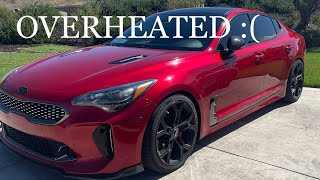
How to confirm: If the overheating issue began shortly after the SC300 recall was performed, this is a very likely cause. Inspect all coolant hoses, especially near the top of the radiator and firewall, for loose clamps or leaks. A gurgling sound from the heater core inside the car or lack of heat can indicate air in the system. One owner recommends checking coolant levels and verifying heat on both driver and passenger sides after picking the car up from service. 🎬 Watch: Owner explains post-recall coolant issues
Typical fix: Properly secure all hose clamps and perform a vacuum-fill procedure to bleed all air from the cooling system. Top off with Kia-specified pink long-life coolant. This may require a return trip to the dealer that performed the service.
Est. part cost: $0-$30 (for coolant) - Leaking Water Pump 🟡 Medium Probability → Shop Engine Water Pump Premature water pump failure is a known issue on the wider Lambda V6 engine family. Forum members have documented leaks from the water pump, identifiable by pink or green crusty coolant residue around the pump pulley on the front of the engine.
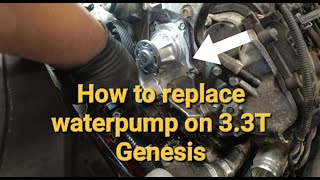
How to confirm: Visually inspect the area around the water pump (front of the engine, driven by the serpentine belt) for signs of dried pink/green coolant. A pressure test of the cooling system will confirm the leak's location. One owner was alerted to the issue by a mechanic who spotted green buildup behind the belt. 🎬 Watch: How to replace the 3.3L water pump
Typical fix: Replace the water pump and serpentine belt. The cooling system must be drained, refilled, and bled.
Est. part cost: $100-$200 - Cooling Fan Malfunction ⚪ Low Probability → Shop Engine Cooling Fan Blade
How to confirm: With the engine warm and the A/C turned on, both cooling fans should be running. If they are not, a technician will need to check the fan motors, relays, and wiring. Note that erratic fan behavior can also be a symptom of a failing electronic thermostat.
Typical fix: Replace the faulty cooling fan assembly, relay, or repair the wiring.
Est. part cost: $300-$600
Rare But Worth Checking
- Blown Head Gasket: While not common, a severe overheating event can cause a head gasket to fail. Symptoms include milky-looking oil, white sweet-smelling exhaust smoke, and persistent bubbles in the coolant reservoir. This is a catastrophic and very expensive repair.
- Clogged Radiator: → Shop Radiator Internal blockages from using incorrect coolant or external blockages from road debris can reduce cooling efficiency. This is more likely on higher-mileage vehicles.
Diagnosis Steps
- DO NOT open the radiator cap when the engine is hot. Let the vehicle cool down completely.
- Check the coolant level in the overflow reservoir. If it is low, this confirms a leak or consumption.
- Visually inspect the engine bay for obvious signs of leaks: puddles of pink fluid, or white/pink crusty residue on hoses, the radiator, the water pump, and around the thermostat housing.
- If the vehicle recently had the SC300 recall service, pay close attention to the upper radiator hose and heater hoses for loose clamps or signs of leaking.
- Scan for other codes. P0597 or P0598 strongly indicates a failed electronic thermostat.
- With the engine running and A/C on max, verify that the radiator fans are spinning.
- If no obvious leaks are found, a professional should perform a cooling system pressure test to locate hard-to-see leaks.
- A professional should also perform a proper vacuum-fill and bleeding procedure to rule out trapped air in the system. Forum users report this is a common failure point even for dealerships.
Parts You'll Likely Need
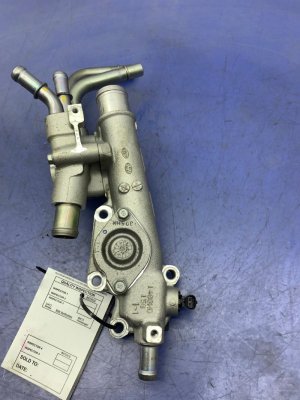
- Electronic Thermostat Assembly
(OEM #25500-3L200)— This is a very common failure point on the 3.3T engine, where coolant leaks into the electronics, causing circuit faults and overheating.
Trusted brands: Kia (OEM)
OEM price range: $150-$250
Aftermarket price range: $100-$180 - Water Pump
(OEM #25100-3L100)— The water pump is a known leak point on this engine family, leading to coolant loss and overheating.
Trusted brands: Kia (OEM), GMB, Aisin, DOLZ
OEM price range: $200-$275
Aftermarket price range: $50-$150 - Engine Coolant / Antifreeze — Required for refilling the system after any repair. Use only a pink, phosphate-based Asian vehicle coolant (HOAT) specified for Kia.
Trusted brands: Kia (OEM), Pentofrost A3, Zerex Asian Vehicle
OEM price range: $25-$40 per gallon
Aftermarket price range: $20-$30 per gallon
Related Codes That Often Appear With This One
- P0597 — This code for 'Thermostat Heater Control Circuit Open' often appears when the electronic thermostat fails due to an internal open circuit, a common issue on the Stinger 3.3T.
- P0598 — This code for 'Thermostat Heater Control Circuit Low' can also be triggered by the same electronic thermostat failure, where coolant intrusion causes a short.
Technical Service Bulletins (TSBs) & Recalls
- SC300 / NHTSA 24V-169: While a recall for a turbo oil feed pipe, the repair procedure involves the cooling system and has been linked to subsequent overheating issues.
- TSB SA479: 'Heater Hose Clamp Inspection and Replacement' for some 2022 models, indicating potential factory issues with hose clamps.
Platform-Specific Known Issues
- Post-Recall Leaks: A significant number of owners have experienced coolant leaks or overheating due to improperly installed hoses or air trapped in the cooling system after the SC300 recall service. One owner on Reddit reported taking their car back to the dealer after the recall due to a strong coolant smell, and was told the dealer had forgotten to tighten everything back up and then failed to refill the coolant after a second flush.
- Difficult Bleeding Procedure: The cooling system on the 3.3T is notoriously difficult to bleed completely. Even after repairs, trapped air can cause overheating issues. A Kia technician on a forum described the process as 'ass to bleed'. This makes professional service with a vacuum-fill tool highly recommended.
Mechanic-Grade Diagnostic Values
- Electronic Thermostat Heater Resistance — expected: Approximately 11 Ω (acceptable range 5-30 Ω). Failure: An open circuit (OL) or infinite resistance reading confirms the internal heater has failed.
- Engine Coolant Temperature (ECT) Sensor Resistance (Cold Engine) — expected: 2.31 kΩ ~ 2.59 kΩ at 20°C (68°F). Failure: Resistance significantly outside this range at a known ambient temperature points to a faulty sensor.
- Engine Coolant Temperature (ECT) Sensor Resistance (Warm Engine) — expected: ~0.32 kΩ at 80°C (176°F). Failure: Resistance that does not drop into this range as the engine reaches operating temperature indicates a faulty sensor.
- Normal Operating Temperature Range (Scan Tool Live Data) — expected: 190–221°F (88–105°C). Failure: Sustained temperatures above 221°F, especially when not under heavy load, indicate a cooling system fault.
Scan Tool Commands That Help
- Kia GDS (Global Diagnostic System): Actuation Test — Can be used to command cooling fans on/off to test their operation independently of the thermostat or ECT sensor. Can also be used to test other electronic components of the cooling system.
- Kia GDS (Global Diagnostic System): Vehicle S/W Management (Special Function) — Used for 'Resetting Adaptive Values' after a major component replacement, such as the thermostat or PCM. This ensures the engine control module relearns the operating parameters of the new part.
Wiring & Ground Locations
- Electronic Thermostat Connector — On the left side of the engine (U.S. passenger side), located behind the engine and near the firewall. Access is very tight, requiring removal of other components.. This is the primary inspection point for diagnosing a failed electronic thermostat. Look for pink coolant residue and corrosion on the pins, which is a tell-tale sign of internal leakage and failure.
- Engine Ground — Main engine ground straps connect the engine block to the chassis. A general inspection of the main battery ground and engine-to-chassis grounds is recommended.. While not a primary cause, a poor engine ground can cause erratic behavior from sensors and electronic components, including the electronic thermostat and cooling fans, leading to incorrect readings or operation.
Real Owner Repair Stories
- Reddit user on /r/kiastinger (Kia Stinger 3.3L AWD) — Check engine light with codes P0597 and P0598. Abnormal radiator fan behavior: running at high speed for no reason, turning on too early. No actual overheating was observed, but the system was in a failsafe mode.
❌ Tried (didn't work) Initial thought was a faulty fan or sensor.
✅ What actually fixed it Replaced the electronic thermostat assembly. Upon removal, the old thermostat's electrical connector was full of pink coolant residue and the pins were corroded, confirming an internal leak had caused an electrical failure. A multimeter test on the old part showed an open circuit. After replacement, fan behavior returned to normal and codes were cleared. - Kia technician on Reddit /r/StingerGT (Multiple 2018-2023 Kia Stinger 3.3T vehicles) — Overheating, coolant leaks, or coolant smell reported by customers after having the SC300 turbo oil line recall performed.
❌ Tried (didn't work) Customers topping off coolant, which did not address the root cause (air pocket or leak).
✅ What actually fixed it The technician confirmed the SC300 recall procedure is very difficult. It requires draining coolant and removing water banjo bolts and a hard water pipe in a blind, tight space. He states that dropping hardware is common and that bleeding the air from the Stinger's cooling system is 'ass'. The fix is for the dealer to re-do the service correctly: properly secure all clamps and perform a thorough vacuum-bleed of the cooling system.
Model Year Variations Within This Range
- 2022-2023: The 2022 model year marked a facelift for the Stinger, which included cosmetic updates, a larger infotainment screen, and a slight horsepower bump for the 3.3T V6 (from 365 to 368 hp) due to a new electronic variable exhaust system. However, the core engine architecture and cooling system components, including the electronic thermostat (25500-3L200) and water pump, remained the same. Therefore, the causes and fixes for P0217 are identical across the 2018-2023 range.
Diagnostic Flowchart
Other Known Issues on This Vehicle
Issues unrelated to this code that are worth knowing about as an owner of this generation:
- Premature Brake Pad/Rotor Wear and Vibration 🟠 Medium — Very common, especially on North American models, often appearing within 10,000-25,000 miles. Caused by OEM pad material depositing on rotors, not 'warping'.
- Left Turbocharger Oil Feed Pipe Leak 🔴 High — Common enough to warrant a recall. The hose deteriorates from exhaust heat, leaking oil and creating a fire risk. (Ref: Kia Recall SC300 / NHTSA 24V-169)
- High-Pressure Fuel Pump (HPFP) Failure 🔴 High — A known failure point, though less frequent than brakes. Can cause stalling and loss of power. A recall (SC281) was issued for the 2.0T engine, but the 3.3T is also known to have issues. (Ref: NHTSA 21V162000 (covers 2018-2021 models))
- Interior Rattles 🟡 Low — Frequently reported by owners, especially from the sunroof, dashboard, rear hatch, and door panels. More common in earlier model years.
- HECU (Brake Module) Fire Risk 🔴 High — Affects certain 2018-2021 models. An electrical short in the Hydraulic Electronic Control Unit can cause a fire, even when the vehicle is parked. (Ref: Kia Recall SC206 / NHTSA 21V164000)
- Intake Valve Carbon Buildup 🟠 Medium — An inherent issue with all Gasoline Direct Injection (GDI) engines. Becomes noticeable between 40,000-80,000 miles, causing rough idle and misfires. Requires manual cleaning (walnut blasting).
Used vs. New Parts: Buying Guide for This Vehicle
When a used part is the smart pick: For purely mechanical or cosmetic parts like the radiator shroud, coolant reservoir tank (if not brittle), or hose clamps, a used part from a low-mileage donor is acceptable. Cooling fans can be considered if they can be tested for full functionality before purchase.
Donor-vehicle mileage cap: roughly under 50000 miles for the part to have meaningful remaining life.
What to inspect on the donor part:
- Check for signs of front-end collision on the donor car, which could have caused unseen damage to the radiator or fans.
- Inspect the coolant reservoir for heavy staining or sludge, which indicates poor maintenance.
- For fan assemblies, ensure the blades are not cracked and the shroud is intact.
- Verify the part is from the correct engine (3.3T vs 2.0T/2.5T).
OEM-only on this vehicle (don't cheap out):
- Electronic Thermostat: This is a high-failure-rate, electronically controlled part. Given the difficulty of replacement, using a new OEM part (PN 25500-3L200) is critical to ensure longevity and prevent repeat labor costs. Aftermarket versions are not as well-documented for reliability.
- Water Pump: As a critical wear item located deep in the engine, the labor cost of replacement justifies using a new, high-quality OEM or reputable OEM-supplier (like Aisin) part. A used water pump is a significant gamble.
Aftermarket brands forum-validated for this vehicle:
- Coolant: Zerex Asian Vehicle (Pink), Pentofrost A3. These are specified as compatible phosphate-based HOAT coolants for Kia/Hyundai.
- Water Pump: GMB, Aisin, DOLZ are reputable aftermarket suppliers for water pumps.
Brands owners have reported issues with on this vehicle:
- Unknown / no-name electronic thermostats from online marketplaces. The complexity of this part makes quality control from unproven brands a major risk.
Real Owner Stories
Aggregated from forums and TSBs cited above. Mileages and costs reflect what owners reported in those sources.
2018-2023 Kia Stinger 3.3T
Symptoms: A strong coolant smell was noticed after the SC300 recall service. It was discovered the dealer forgot to tighten clamps and failed to refill the coolant after a second flush, leaving the system empty.
What fixed it: The dealer had to tighten all clamps and properly refill the cooling system.
Source hint: Reddit: Recall - Horror story after SC300 service
2022 Kia Stinger GT1 3.3T
Symptoms: Discovered a coolant leak and found that the hose clamps were in the wrong position.
What fixed it: Adjusting the hose clamps to the correct position.
Source hint: Reddit: New to me stinger help. Coolant leak.
2018-2023 Kia Stinger 3.3T
Symptoms: Persistent overheating occurred even after the thermostat was replaced. The owner noted a difficult 'burping process' to get air out of the system.
What fixed it: Resolving a trapped air bubble at the thermostat, which is a known issue during the bleeding process.
Source hint: Kia Stinger Forum: overheat but no leak
2018-2023 Kia Stinger 3.3T
Symptoms: Green buildup was spotted behind the engine belt by a mechanic, indicating a leak even though the dealer was skeptical.
What fixed it: Replacement of the water pump.
Source hint: Reddit: Water pump replacement
Related OBD-II Codes
Frequently Asked Questions
Could the SC300 turbo oil feed pipe recall be the reason my Stinger is overheating?
My 2022 Stinger has a coolant leak near a hose; is there a specific bulletin for this?
How can I tell if my electronic thermostat has failed on my 3.3T engine?
I hear a gurgling sound from the dashboard after a coolant flush. Is this normal?
Why is my heater blowing cold air even though the temperature gauge is in the red?
Are there any visual signs of a water pump failure on the Lambda II V6?
Helpful Videos

Used OEM Parts in Stock
New Aftermarket Parts Available

The information in this article is provided for general reference and educational purposes only. Vehicle specifications, procedures, and part compatibility can vary by production date, trim level, and region. Always consult your vehicle's factory service manual and verify part numbers before purchasing or performing repairs. Safety-critical components such as airbags, seat belts, and braking systems should be installed by a qualified professional.
- Kia Stinger:
- 🧭 Diagnostic Flowchart
- 🎬 Helpful Videos
- 🛍️ Shop This Part
- What's Unique About the 2018-2023 Kia Stinger
- Symptoms You May Notice
- Most Likely Causes
- Rare But Worth Checking
- Diagnosis Steps
- Parts You'll Likely Need
- Related Codes That Often Appear With This One
- Technical Service Bulletins (TSBs) & Recalls
- Platform-Specific Known Issues
- Mechanic-Grade Diagnostic Values
- Scan Tool Commands That Help
- Wiring & Ground Locations
- Real Owner Repair Stories
- Model Year Variations Within This Range
- Other Known Issues on This Vehicle
- Used vs. New Parts: Buying Guide for This Vehicle
- Real Owner Stories
- 2018-2023 Kia Stinger 3.3T
- 2022 Kia Stinger GT1 3.3T
- 2018-2023 Kia Stinger 3.3T
- 2018-2023 Kia Stinger 3.3T
- Related OBD-II Codes
- Frequently Asked Questions
- 🎟️ Get 5% Off