

P0217 on 2005-2012 Subaru Legacy GT: Engine Overheat Causes and Fixes
P0217 means your Legacy GT's engine is critically overheating. Stop driving immediately. The most common causes are a failed thermostat, a coolant leak from the stock radiator's plastic end tanks, or air trapped in the system. A new OEM thermostat is around $25-$40, while a new new radiator can cost $150-$400. Always check for leaks at the upper radiator seam.
- P0217 is a critical code that means your engine is overheating. Stop driving immediately.
- Start your diagnosis with the most likely and cheapest fixes: check for coolant leaks (especially the radiator), test the thermostat, and ensure the cooling fans are working.
- The factory radiator with plastic end tanks is a known weak point on this car; inspect it carefully for cracks or leaks.
- When refilling the system, use Subaru Super Coolant (blue) and be meticulous about bleeding all air out to prevent future issues.
- Do not immediately assume a head gasket failure; it is a possibility, but it's much less common than a bad radiator or thermostat.
What's Unique About the 2005-2012 Subaru Legacy GT
The turbocharged EJ255 engine in the Legacy GT generates significant heat, placing high demands on its cooling system. This platform is particularly known for two vulnerabilities. First, the original equipment (OE) radiators feature plastic end tanks crimped to an aluminum core, which are notorious for developing cracks and leaks over time, leading to coolant loss and overheating. This failure commonly occurs along the top seam, just below the plastic. Second, the turbo models have a unique upper coolant expansion tank (in addition to the main radiator and overflow bottle) which has its own pressure cap; a failure of this small cap can lead to a loss of system pressure and overheating. While the EJ255 is more robust than its naturally aspirated counterparts, the specter of head gasket failure is always a consideration in the background for any EJ-series engine, especially after an overheating event has occurred.
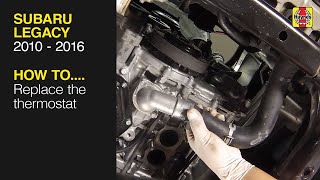
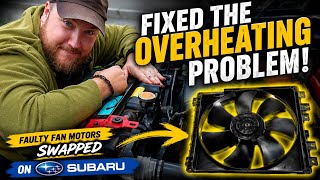
Generation note: This guide covers the 4th generation (2005-2009) and 5th generation (2010-2012) Legacy GT. Both generations used the EJ255 2.5L turbo engine. 🎬 See this 2010 Legacy 2.5GT thermostat replacement walkthrough While body styles and some components differ, the fundamental cooling system design and the common causes of overheating listed here are applicable to both generations.
Symptoms You May Notice
- Temperature gauge spiking into the red zone
- Illuminated red coolant temperature warning light
- Steam or smoke coming from under the hood
- Sweet smell of burning coolant
- Noticeable loss of engine power as the ECU enters a protection mode
- Gurgling or boiling sounds from the engine bay
- Coolant being pushed out of the overflow reservoir
- Replacing the coolant temperature sensor. A faulty sensor is more likely to cause an incorrect gauge reading or other codes, not a genuine overheating event confirmed by steam and a boiling reservoir.
- Immediately assuming a head gasket failure. While possible, it's crucial to rule out the much more common and cheaper-to-fix issues like the thermostat, radiator, and fans first.
Most Likely Causes
- Failed (Stuck Closed) Thermostat 🔴 High Probability → Shop Integrated Thermostat Housing Assembly Thermostats are a common wear item on all vehicles. Failure in the closed position prevents coolant from circulating to the radiator. It is highly recommended to use an OEM Subaru thermostat (21200AA072) as aftermarket versions can cause issues.
How to confirm: After the engine has warmed up, carefully feel the upper and lower radiator hoses. If the upper hose is hot and the lower hose is significantly cooler or cold, the thermostat is likely stuck closed and not allowing coolant to circulate.
Typical fix: Replace the thermostat and gasket. It's recommended to use an OEM Subaru thermostat.
Est. part cost: $25-$40 - Leaking Radiator 🔴 High Probability → Shop Radiator The factory radiators use plastic end tanks crimped onto an aluminum core. Over time, the plastic becomes brittle and cracks, typically where the upper radiator hose connects or along the top seam, causing coolant leaks. This is a well-documented failure on LegacyGT.com forums.
How to confirm: Visually inspect the top and bottom of the radiator for white or greenish crusty residue (dried coolant) or active drips, especially along the seam where the plastic meets the aluminum. A cooling system pressure test will definitively show a leak.
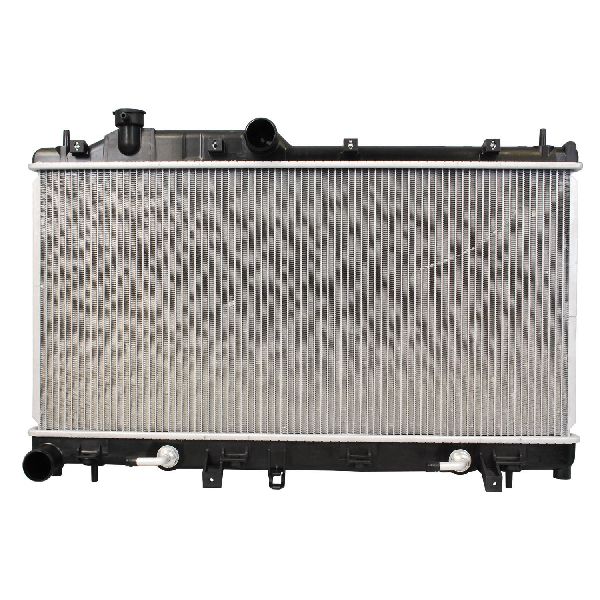
Typical fix: Replace the radiator. Many owners upgrade to an all-aluminum radiator (e.g., from brands like Koyo or Mishimoto) to prevent future failure.
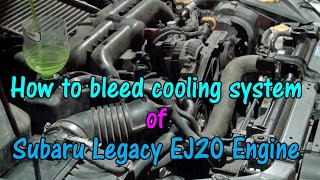
Est. part cost: $150-$400 - Low Engine Coolant / Air in System 🟡 Medium Probability Often a consequence of another issue like a leak. Subaru cooling systems can also be tricky to bleed, and trapped air pockets can cause localized boiling and overheating, even if the system is full. A proper 'burping' procedure with a spill-free funnel is critical after any cooling system service.
How to confirm: Check the coolant level in the overflow tank (when cold) and in the upper coolant expansion tank near the turbo (when cold). If levels are low, a leak is present. If the system was recently serviced, an air pocket is a strong possibility.
Typical fix: Top off the coolant with Subaru Super Coolant (blue) or equivalent. Properly 'burp' or bleed the cooling system using a spill-free funnel to remove all air pockets.
Est. part cost: $25-$40 for coolant - Malfunctioning Radiator Fans 🟡 Medium Probability → Shop Radiator Electric fan motors or their control relays can fail. This is especially noticeable when overheating occurs at idle or in slow-moving traffic but improves at highway speeds.
How to confirm: With the engine warm and the A/C turned on, both radiator fans should be spinning. If they are not, check the fan fuses and relays first. If those are good, the fan motor itself may have failed.
Typical fix: Replace the faulty fuse, relay, or the entire fan assembly.
Est. part cost: $5 (fuse) - $250 (fan assembly) - Failing Water Pump ⚪ Low Probability → Shop Engine Water Pump The water pump impeller can break or the bearing can fail, stopping coolant circulation. This is less common as a sudden failure but is a critical maintenance item that is typically replaced with the timing belt service every 105,000 miles.
How to confirm: This is difficult to confirm without disassembly. A grinding or whining noise from the front of the engine can be a sign of a failing bearing. It's often diagnosed after other, more common causes are ruled out.
Typical fix: Replace the water pump. This is almost always done as part of a complete timing belt service, which also includes the timing belt, tensioner, and idler pulleys.
Est. part cost: $300-$500 for a full timing belt kit with water pump - Failed Upper Expansion Tank Cap ⚪ Low Probability The turbo models have a secondary, high-pressure radiator cap on the small aluminum tank near the turbo. This cap (rated to 1.1 bar / 108 kPa) is critical for maintaining system pressure. If its seal fails, the coolant's boiling point is lowered, leading to overheating under load.
How to confirm: Inspect the cap for a worn or cracked rubber seal. Look for signs of dried coolant around the neck of the expansion tank. It's an inexpensive part that is often replaced as a preventative measure.
Typical fix: Replace the cap with a new OEM part (Subaru P/N 45137AE003).
Est. part cost: $15-$25
Rare But Worth Checking
- Blown Head Gasket: While less common on the turbo EJ255 than on naturally aspirated Subarus, a head gasket failure can introduce hot combustion gases into the cooling system, causing rapid overheating. Check for this with a combustion leak tester ('block tester') if other causes are ruled out, especially if you see constant bubbles in the coolant reservoir.
- Clogged Radiator or Heater Core: → Shop Radiator Using incorrect coolant types or neglecting coolant changes can lead to internal corrosion and blockages, restricting flow. This is more likely on high-mileage vehicles with poor service history.
Diagnosis Steps
- IMMEDIATELY pull over and shut off the engine to prevent damage.
- Allow the engine to cool completely (several hours) before proceeding.
- Visually inspect the coolant level in the overflow reservoir and the upper expansion tank (near the turbo). If low, you have a leak.
- Inspect the radiator, especially the top and bottom plastic end tanks, for signs of leaks (white/green crust, wetness).
- Check all radiator and heater hoses for cracks, swelling, or leaks at the connection points.
- Inspect the upper expansion tank cap (P/N 45137AE003) for damage and ensure it is tight.
- Once cool, start the engine and turn the A/C on full blast. Verify that both radiator fans turn on.
- Let the engine warm up. Carefully feel the upper and lower radiator hoses. If the top is hot and the bottom is cold, the thermostat is the likely culprit.
- If you suspect a leak but cannot see it, use a cooling system pressure tester to pressurize the system and reveal the source.
- If all else fails, use a combustion leak tester (block tester) to check for exhaust gases in the coolant, which would indicate a head gasket failure.
Parts You'll Likely Need
- Engine Coolant Thermostat
(OEM #21200AA072)— A stuck-closed thermostat is a very common cause of overheating and is a relatively simple and inexpensive part to replace. OEM is strongly recommended.
Trusted brands: Subaru (OEM), Gates
OEM price range: $25-$40
Aftermarket price range: $15-$30 - Radiator
(OEM #45111AG01A (4th Gen, 2005-2009), 45119AJ000 (5th Gen, 2010-2012))— The factory radiator with plastic end tanks is a well-known weak point and a frequent source of leaks that lead to overheating.
Trusted brands: Denso, Koyo, Mishimoto
OEM price range: $350-$500
Aftermarket price range: $150-$400 - Radiator Cap (Upper Expansion Tank)
(OEM #45137AE003)— This cap on the turbo coolant tank is critical for maintaining system pressure. A weak seal lowers the coolant's boiling point, leading to overheating under load. It's an inexpensive and wise preventative replacement item.
Platform-Specific Known Issues
- The plastic end tanks on the stock radiator are a primary failure point, often cracking near the upper hose connection or along the top seam.
- The cooling system can be difficult to bleed completely. Using a spill-free funnel and parking the car on an incline (nose up) is highly recommended to remove all air pockets after a repair.
Mechanic-Grade Diagnostic Values
- Engine Coolant Temperature (ECT) Sensor Resistance — expected: Approximately 2,200-3,000 Ω at 20°C (68°F) and 250-350 Ω at 80°C (176°F).. Failure: Readings significantly outside the expected range for a given temperature, or an open/short circuit.
- Engine Coolant Temperature (ECT) Sensor Signal Voltage — expected: Approximately 2.0V - 3.0V with a cold engine (20°C/68°F), dropping to around 0.5V when the engine is fully warmed up.. Failure: A static voltage (e.g., near 5V or 0V) or a voltage that does not decrease as the engine warms indicates a sensor or wiring fault.
Scan Tool Commands That Help
- Subaru Select Monitor (SSM) or equivalent professional scan tool: Radiator Fan Relay ON/OFF Check — This bidirectional command allows a technician to manually activate the cooling fans, bypassing the temperature sensor and ECU logic. It is the fastest way to confirm if the fan motors, relays, and wiring are functional. If the fans turn on with this command, the fault lies with the control side (ECT sensor, wiring, ECU) and not the fan circuit itself.
Wiring & Ground Locations
- Engine Control Module (ECM) — Located under the right side of the dashboard, typically behind the glove box.. The ECM receives the signal from the ECT sensor and commands the cooling fans. Verifying its connections is a final step if sensor and wiring checks pass.
- Main Engine Grounds — Key grounding points are located on the strut towers, on the engine block under the intercooler, and on the intake manifold.. A poor ground connection for the ECT sensor circuit can cause incorrect readings, leading to improper fan operation or false overheat signals. Ensuring engine grounds are clean and tight is a crucial, often overlooked, step.
- Data Link Connector (OBD-II Port) — Located in the lower portion of the instrument panel on the driver's side.. This is the connection point for the scan tool needed to read the P0217 code, view live data, and perform bidirectional tests like the fan relay check.
Real Owner Repair Stories
- LegacyGT.com forum user 'Infosecdad' (2007 Legacy GT Limited, 5EAT, ~130,000 miles) — Engine temperature would climb steadily to 210°F+ when going up an incline, but was normal otherwise.
❌ Tried (didn't work) New Belts, New Water Pump, New Thermostat, New Radiator Caps, New Mishimoto WRX Radiator
✅ What actually fixed it A Subaru specialist diagnosed head gaskets. The head gaskets were replaced and heads were machined. However, the problem returned, although less severely. The forum thread concluded with the possibilities that the heads were not machined to the correct RA finish, a small crack was missed, or a persistent air bubble was still in the system. This highlights that even after replacing all common cooling parts and head gaskets, the issue can persist if the head gasket repair is not performed perfectly.
"I Checked Everything" — The Actual Cause
- The cooling system equivalent is 'Pressure Test Clean, But Still Overheats'. This can occur if a head gasket leak only opens up under high temperature and combustion pressure, allowing exhaust gases to enter the coolant. A static cold pressure test will not reveal this leak. It can also be caused by stubborn air pockets that disrupt flow but don't represent a leak, or an internally clogged radiator that holds pressure but has poor flow.
When the Usual Fixes Don't Work
- In one documented case, a vehicle owner replaced nearly the entire cooling system (radiator, thermostat, water pump, caps) to fix an overheating issue, but the problem persisted. The cause was ultimately diagnosed as a failing head gasket. This demonstrates that while it's wise to start with the most common and inexpensive parts, a methodical diagnosis is critical, as simply throwing parts at the problem can be costly and ineffective if the root cause is more severe.
Model Year Variations Within This Range
- 2005-2009 vs. 2010-2012: The primary part difference affecting this repair is the radiator itself, with different part numbers for the 4th generation (45111AG01A) and 5th generation (45119AJ000). However, the fundamental design of the cooling system and the root causes of P0217 (thermostat, radiator end tanks, caps, water pump, head gaskets) are consistent across both generations covered in this guide.
Diagnostic Flowchart
Other Known Issues on This Vehicle
Issues unrelated to this code that are worth knowing about as an owner of this generation:
- Piston Ringland Failure 🔴 High — More common on modified engines, but can occur on stock vehicles. Caused by detonation, which cracks the part of the piston between the rings.
- Turbo Oil Starvation (Banjo Bolt Filter) 🔴 High — A small mesh filter in the banjo bolt supplying oil to the turbo can clog over time, starving the turbo of oil and causing catastrophic failure. Many owners proactively remove the filter.
- Rod Bearing Failure 🔴 High — Considered a weak point on the EJ255, often exacerbated by oiling issues or high-load, high-RPM use.
- Catted Up-Pipe Failure (2005 models) 🟠 Medium — Early 2005 models had a catalytic converter in the up-pipe before the turbo. This can disintegrate, sending debris into the turbocharger and destroying it. Most have been replaced with a catless up-pipe.
- Wheel Bearing Failure 🟡 Low — A commonly reported maintenance item that tends to wear out sooner than on other vehicles, leading to a humming or grinding noise from the wheel area.
Used vs. New Parts: Buying Guide for This Vehicle
When a used part is the smart pick: For this repair, used parts are only recommended for components that are easy to inspect and have low failure rates from simple wear. Good candidates include the radiator fan assembly, the plastic coolant overflow tank, and the upper aluminum expansion tank (inspect for cracks).
Donor-vehicle mileage cap: roughly under 80000 miles for the part to have meaningful remaining life.
What to inspect on the donor part:
- For a fan assembly, ensure the blades are intact and the motor spins freely.
- For tanks, check thoroughly for hairline cracks, especially around hose fittings.
- For hoses, squeeze them to ensure they are pliable and not hard, brittle, or swollen.
- Avoid any parts from a vehicle that shows signs of a severe front-end collision.
OEM-only on this vehicle (don't cheap out):
- Engine Coolant Thermostat: Aftermarket thermostats are a frequent source of problems on this platform; the OEM part is strongly recommended by forum veterans.
- Radiator Caps (both main and upper expansion tank): The precise pressure rating is critical. OEM caps are inexpensive and reliable.
- Head Gaskets: Given the sensitivity of the EJ255 engine, only use high-quality OEM or equivalent (e.g., Six-Star) multi-layer steel gaskets.
Aftermarket brands forum-validated for this vehicle:
- Radiator: Koyo and Mishimoto are well-regarded for their all-aluminum radiator upgrades, which eliminate the failure-prone plastic end tanks.
- Thermostat: Gates is a reputable alternative if an OEM Subaru thermostat is not available.
Brands owners have reported issues with on this vehicle:
- Avoid generic, 'white-box' or unbranded thermostats and radiators. The potential for incorrect calibration or poor build quality is high and not worth the risk of engine damage.
Real Owner Stories
Aggregated from forums and TSBs cited above. Mileages and costs reflect what owners reported in those sources.
2005 Subaru Legacy GT 2.5L Turbo — ~120000 miles
Symptoms: Radiator leaking at the top plastic end tank; common failure point on higher mileage vehicles.
What fixed it: Replacement of the radiator; many owners choose to upgrade to an all-aluminum unit like Koyo or Mishimoto.
Source hint: LegacyGT.com - Common problems with 05 LGT?
2005-2012 Subaru Legacy GT 2.5L Turbo
Symptoms: Owner experienced persistent overheating even after replacing various components; highlighted the difficulty of removing air from the system.
What fixed it: Properly 'burping' or bleeding the cooling system using a spill-free funnel to remove air pockets.
Source hint: LegacyGT.com - OVERHEATING - new everything
2005-2012 Subaru Legacy GT 2.5L Turbo
Symptoms: Coolant leak identified as a cracked radiator, specifically at the upper plastic tank seam.
What fixed it: Replacing the cracked factory radiator.
Source hint: Reddit r/subaru - Coolant leak... Cracked radiator???
Related OBD-II Codes
Frequently Asked Questions
Why is my Legacy GT's temperature gauge spiking and the ECU losing power?
Is there a specific thermostat I should use for my 2.5L Turbo engine?
My radiator is leaking at the top seam; is this a known issue for the 2005-2012 models?
I just changed my coolant and now it's overheating. What did I do wrong?
What is the purpose of the cap on the small tank near the turbo?
Should I replace my water pump if I'm not sure it's failing?
Helpful Videos
Used OEM Parts in Stock
New Aftermarket Parts Available


The information in this article is provided for general reference and educational purposes only. Vehicle specifications, procedures, and part compatibility can vary by production date, trim level, and region. Always consult your vehicle's factory service manual and verify part numbers before purchasing or performing repairs. Safety-critical components such as airbags, seat belts, and braking systems should be installed by a qualified professional.
- Subaru Legacy GT:
- 🧭 Diagnostic Flowchart
- 🎬 Helpful Videos
- 🛍️ Shop This Part
- What's Unique About the 2005-2012 Subaru Legacy GT
- Symptoms You May Notice
- Most Likely Causes
- Rare But Worth Checking
- Diagnosis Steps
- Parts You'll Likely Need
- Platform-Specific Known Issues
- Mechanic-Grade Diagnostic Values
- Scan Tool Commands That Help
- Wiring & Ground Locations
- Real Owner Repair Stories
- "I Checked Everything" — The Actual Cause
- When the Usual Fixes Don't Work
- Model Year Variations Within This Range
- Other Known Issues on This Vehicle
- Used vs. New Parts: Buying Guide for This Vehicle
- Real Owner Stories
- 2005 Subaru Legacy GT 2.5L Turbo — ~120000 miles
- 2005-2012 Subaru Legacy GT 2.5L Turbo
- 2005-2012 Subaru Legacy GT 2.5L Turbo
- Related OBD-II Codes
- Frequently Asked Questions
- 🎟️ Get 5% Off