

OBD-II Code P0220: Throttle/Pedal Position Sensor 'B' Circuit Malfunction
The Ultimate Expert Guide to Diagnosing and Fixing P0220
- Stop driving immediately; code P0220 triggers a 30-50 mph 'limp mode' that creates a severe collision risk in traffic.
- Graph live data for both the APP and TPS sensors using an OBD-II scanner to pinpoint the exact 0.5V to 4.5V signal dropout before buying parts.
- Perform a physical 'wiggle test' on the throttle body wiring harness, as broken wires inside the pigtail connector cause over 40% of false sensor failures on GM trucks.
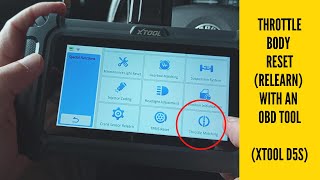
- Execute the manufacturer-specific throttle 'relearn' procedure after replacing any component, or the vehicle will suffer from a permanent high idle and returning codes.
What Does P0220 Mean?
Your car's Powertrain Control Module (PCM) detected a malfunction in the 'B' circuit of the throttle position sensor (TPS) or the accelerator pedal position (APP) sensor. These sensors tell the engine how much power to deliver when you press the gas pedal. Modern cars use two or more sensors for redundancy; this code signifies the signal from the secondary 'B' sensor is illogical, missing, or outside its expected voltage range.
Technical definition: The SAE/OBD-II definition is "Throttle/Pedal Position Sensor/Switch 'B' Circuit Malfunction." The PCM detected the voltage signal from the 'B' sensor circuit is outside the manufacturer's specified range. On most drive-by-wire systems, a closed throttle reports approximately 0.5 volts, while wide-open throttle reports 4.5 to 5.0 volts. Code P0220 sets when the 'B' circuit signal deviates from this expected behavior for more than 0.2 seconds.
Can I Drive With P0220?
No — Do Not Drive. Do not drive the vehicle. The engine unpredictably enters a reduced power 'limp mode,' causing sudden and severe loss of acceleration—a major safety hazard in traffic. The vehicle also stalls, hesitates, or fails to start. Continuing to drive forces an incorrect air-fuel mixture that destroys the catalytic converter, adding $800 to $2,500 to your final repair bill.
Common Causes
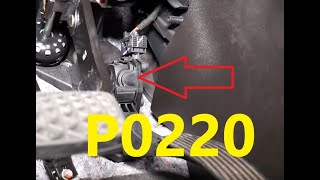
- Faulty Accelerator Pedal Position (APP) Sensor (Very Common) — The sensor assembly attached to your gas pedal is the most frequent culprit. Internal wear creates 'dead spots' in the electrical contacts, causing it to send an erratic or nonexistent signal to the computer.
- Damaged Wiring or Connector Pigtail (Very Common) — Corroded, loose, or frayed wires between the sensors and the PCM disrupt the signal. This frequently occurs at the throttle body connector pigtail, which suffers from broken wires inside the insulation due to engine vibration and heat.
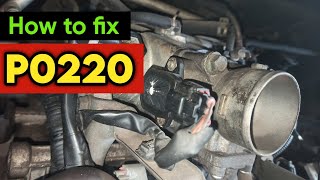
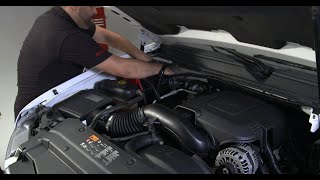
- Faulty Throttle Position Sensor (TPS) or Throttle Body Assembly (Common) — The sensor measuring the throttle blade's angle wears out and provides bad data. On modern cars, the TPS is integrated into the electronic throttle body; if the internal motor, gears, or electronics fail, you must replace the entire $300+ assembly. 🎬 See this walkthrough on replacing a faulty throttle body assembly
- Dirty or Sticking Throttle Body (Less Common) — Carbon and grime buildup in the throttle bore causes the throttle plate to stick. This creates a physical mismatch between the position the PCM expects and what the sensor reports, triggering the code.
- Poor Ground Connection (Less Common) — A corroded ground wire for the sensor circuit or the PCM causes erratic voltage readings that mimic a failed sensor. This overlooked issue leads to expensive misdiagnoses.
- PCM Software/Calibration Glitch (Rare) — Outdated software in the Powertrain Control Module misinterprets a valid sensor signal. Manufacturers occasionally release software updates (reflashes) to resolve these intermittent false codes.
Symptoms
- Reduced Engine Power or 'Limp Mode' — The vehicle intentionally limits engine speed to 30-50 mph to prevent further damage, severely restricting acceleration. 🎬 Watch: How P0220 causes reduced engine power on GM vehicles
- Check Engine Light is On — The primary indicator of the fault, illuminating steadily on the dashboard.
- Hesitation or Stumbling on Acceleration — The car jerks, surges, or has a delayed response when pressing the gas pedal because the engine lacks a clear command.
- Engine Stalls or Idles Erratically — The engine stalls when coming to a stop, has a rough idle, or refuses to idle altogether.
- Hard Starting or No Start — The engine struggles to start or immediately stalls because the PCM cannot determine the correct throttle position for startup.
Diagnostic Flowchart
Tap your situation to follow the diagnostic path that matches what you're seeing on this code.
Common Fixes & Costs
- Clean Throttle Body — Parts: $10-$20, Labor: $75-$150, ~0.8 hr book time (DIY)
- Replace Accelerator Pedal Position (APP) Sensor — Parts: $70-$250, Labor: $50-$150, ~0.8 hr book time (DIY)
- Repair Wiring or Replace Connector Pigtail — Parts: $20-$60, Labor: $150-$300, ~2.0 hr book time (Professional)
- Replace Electronic Throttle Body Assembly — Parts: $200-$600, Labor: $100-$200, ~1.2 hr book time (Intermediate)
- Replace Throttle Position Sensor (TPS) — Parts: $40-$150, Labor: $80-$150, ~1.0 hr book time (Intermediate)
Used vs. New Parts: Buying Guide
When a used part is worth it: A used part makes sense only if the vehicle is over 15 years old, the budget is extremely tight, and you accept the high risk of a shorter part lifespan. For electronic parts like the APP sensor or throttle body, the risk of premature failure is extremely high.
Donor-vehicle mileage cap: roughly under 60000 miles for the part to have meaningful remaining life.
Donor quality checklist:
- Verify the exact part number matches; electronic components have non-interchangeable versions.
- Source from a reputable salvage yard with a testing process and a short-term warranty.
- Avoid parts from vehicles involved in front-end collisions or floods.
Decision logic:
- If The part is an electronic sensor (APP or TPS) or a complete electronic throttle body. → Buy new. The savings do not justify the high risk of early failure and repeat labor costs.
- If Vehicle is over 10 years old and has high mileage (>150k). → A tested used part from a low-mileage donor is a reasonable budget option.
- If The new part costs less than $200. → Buy new. The peace of mind and warranty outweigh the minimal savings.
Warranty tradeoff: Used parts typically come with a 30-90 day functional warranty that does not cover labor. New aftermarket parts offer a 1-year to limited lifetime warranty. New OEM parts carry a 1-2 year warranty.
Worst-case if a used part fails: $300-600 if a used electronic part fails after 30 days, requiring a second purchase and repeat labor charges.
What Happens If You Wait — Timeline
- 0-1 month: Check Engine Light illuminates. You experience intermittent hesitation or a single 'Reduced Power' event that resets after restarting the car. (MPG impact: 0-5%% · Added cost: $0-50 in wasted fuel)
- 1-3 months: 'Reduced Power' mode or stalling occurs daily. The car is a severe safety hazard. Fuel economy drops as the PCM defaults to a rich air-fuel mixture. (MPG impact: 5-15%% · Added cost: $50-150 in wasted fuel)
- 3-6 months: The constant rich fuel mixture overheats and damages the catalytic converter. The internal ceramic substrate cracks or melts. (MPG impact: 10-20%% · Added cost: $800-$2,500 (catalytic converter replacement required))
- 6+ months: Complete catalytic converter failure triggers a P0420 code. The engine suffers fouled spark plugs and damaged oxygen sensors. The vehicle fails to start. (MPG impact: 15-25%+% · Added cost: $1,200-$4,000+ (catalytic converter, O2 sensors, and spark plugs))
Cost of Not Fixing It
- Immediate (0-1 month): Unpredictable stalling and 'limp mode' create a severe safety hazard. Failed emissions test. 5-15% drop in fuel economy. (Added cost: $50)
- Short Term (1-6 months): An incorrect air-fuel ratio overheats the catalytic converter, leading to internal damage and reduced efficiency. (Added cost: $1000-$2500)
- Long Term (6+ months): Complete failure of the catalytic converter. Chronic misfires lead to fouled spark plugs and damaged oxygen sensors. (Added cost: $1500-$4000)
Diagnosis Steps
- Scan Codes and Review Freeze Frame Data
Use an OBD-II scanner to confirm P0220 is active. Check for related codes like P0120 ('A' Circuit) or P2135 (Correlation). Record the freeze frame data to see the exact engine conditions when the fault triggered.
Tools: OBD-II Scanner (Beginner) - Analyze Live Sensor Data (PID Analysis)
With the key on and engine off, graph the live data for APP Sensor 1 and APP Sensor 2 (or TPS1 and TPS2). Slowly press and release the gas pedal. The data must show two smooth, sweeping lines. Any jumps, flat spots, or dropouts in the 'B' sensor's graph confirms a fault in that circuit.
Tools: OBD-II Scanner with Live Data (Intermediate) - Perform a 'Wiggle Test'
While monitoring live sensor data, gently wiggle the wiring harness and connector at the APP sensor and the throttle body. If the voltage reading for Sensor 'B' jumps or drops out during the wiggle, you have an intermittent wiring or connector fault.
Tools: OBD-II Scanner with Live Data (Intermediate) - Inspect and Clean the Throttle Body
Remove the air intake hose and inspect the throttle plate for heavy carbon buildup. Clean it thoroughly using throttle body cleaner and a soft rag. Do not push the throttle plate open by hand on an electronic throttle body; have a helper press the gas pedal with the key on (engine off) to open it.
Tools: Screwdriver/Socket Set, Throttle Body Cleaner, Rags (Intermediate) - Visual Wiring Inspection
Ensure floor mats are not obstructing the accelerator pedal. Inspect the wiring harnesses and connectors at the pedal and throttle body for visible damage, corrosion, loose pins, or chafing.
Tools: Flashlight (Beginner) - Verify Circuit Integrity with a Multimeter
Disconnect the sensor connector and turn the key 'ON'. Use a multimeter to verify a stable 5-volt reference on the VREF pin. Check the ground pin (must read <0.1V). Check the signal wire for continuity to the PCM (resistance <5 ohms, no short to ground).
Tools: Digital Multimeter, Vehicle-Specific Wiring Diagram, Backprobe Kit (Advanced) - Check for Technical Service Bulletins (TSBs)
Check for TSBs related to P0220 for your specific vehicle. Manufacturers frequently release bulletins for known issues, such as faulty GM wiring harnesses or mandatory PCM software updates.
Tools: Online Repair Database or Dealer Access (Intermediate)
When This Code Triggers (Freeze-Frame Conditions)
- Engine Coolant Temp: 180-210°F (Fully warmed up, during normal operation.)
- RPM: 1500-3000 (During light to moderate acceleration or steady cruise.)
- Engine Load: 25-50% (The fault often appears under steady-state driving rather than at idle or full throttle.)
- Vehicle Speed: 30-60 mph (Triggers during city or highway cruise conditions when the pedal position is held relatively constant.)
Related Codes
- P0120 — Indicates a malfunction in the 'A' Circuit. Seeing P0120 and P0220 together strongly suggests a fault in a shared component, like the sensor assembly itself, the main connector, or the 5V power supply.
- P0222 — Indicates the 'B' circuit voltage is specifically too low. This points directly towards an open signal wire, a short to ground, or an internally failed sensor.
- P0223 — Indicates the 'B' circuit voltage is specifically too high. This points directly towards a short to power, where the signal wire is receiving higher voltage than it should.
- P2135 — Means 'Throttle/Pedal Position Sensor A/B Voltage Correlation' error. The PCM receives signals from both 'A' and 'B' sensors, but they conflict (e.g., A reports 10% throttle, B reports 50%). This triggers limp mode instantly and commonly accompanies P0220.
Climate & Environmental Factors
- High Humidity / Water Intrusion: Moisture penetrates poorly sealed wiring connectors at the throttle body, leading to pin corrosion and intermittent signal loss.
- Extreme Cold/Heat Cycles: Temperature fluctuations cause plastic connectors and wires to become brittle, leading to hairline cracks in insulation and loose terminal connections.
How to Talk to a Mechanic About This Code
Say this: "I have a P0220 code and the car is going into limp mode. Please start by checking the live data from both the accelerator pedal and throttle position sensors while performing a wiggle test on the harnesses. I want to rule out a simple wiring or connector issue before replacing the throttle body."
This signals you understand the common causes (sensors vs. wiring) and directs the technician to perform an efficient diagnostic procedure. It prevents them from immediately quoting a high-cost part replacement.
Avoid saying:
- 'My check engine light is on, can you just fix it?'
- 'The car is acting funny, I think it's the gas pedal.'
- 'Just replace the throttle sensor.'
Questions to ask before authorizing the repair:
- Did you see the voltage for the 'B' sensor drop out or spike on the scan tool during the wiggle test?
- How did you rule out a bad connection, poor ground, or a dirty throttle body?
- Does this repair require a throttle relearn procedure, and is that included in the labor quote?
- What is the warranty on the recommended part and the labor?
Where to Take It: Dealer vs Independent vs Chain
- Dealer:
Best for: Vehicles still under powertrain or emissions warranty., Complex, manufacturer-specific relearn procedures (e.g., Nissan, BMW)., Known issues covered by a Technical Service Bulletin (TSB).
Downsides: Highest labor rates, often 1.5-2x more than an independent shop., Defaults to replacing an entire assembly when a smaller component or wiring repair suffices. (Typical cost: +50% vs. baseline) - Independent Shop:
Best overall fit. A reputable independent shop is perfectly equipped to handle a P0220 fault, from diagnosis to relearn procedures, at a much better price than the dealer.
Best for: Out-of-warranty vehicles where cost is a major factor., Diagnosing common electrical faults and performing wiring repairs., Most common vehicle makes (Toyota, Honda, Ford, etc.).
Downsides: Diagnostic skill varies greatly; look for ASE certifications in electrical diagnostics. (Typical cost: +0% vs. baseline) - Chain Shop:
Avoid for initial diagnosis. Acceptable only for a simple, confirmed APP sensor swap.
Best for: Simple, straightforward part replacements like an accelerator pedal sensor if you've already diagnosed it yourself.
Downsides: Technician skill is inconsistent., Lacks advanced diagnostic tools for intermittent electrical faults or complex relearn procedures., High pressure to upsell services. (Typical cost: -10% vs. baseline)
When to Walk Away From the Repair
If the estimated repair cost exceeds 40-50% of the car's private-party value, seriously consider selling or trading it in instead of repairing it.
- Car worth $4000, fix is $2000: Walk away. The repair cost is 50% of the car's value. It is not financially sound to invest this much into an older vehicle.
- Car worth $12000, fix is $900: Fix it. The repair is less than 10% of the vehicle's value and restores critical safety and drivability.
- Car worth $2500, fix is $1500: Walk away. The repair cost is 60% of the car's value. You will lose money on this repair.
What Scan Tool You Need for This Code
Minimum: An OBD-II scanner that displays and graphs live data for sensor PIDs (Parameter IDs).
A basic $20 code reader only tells you P0220 is present. It cannot show the live voltage signal from the sensor, which is essential to determine if the sensor is faulty or if you have a wiring problem.
Budget: BlueDriver Pro (~$100) — Connects to your smartphone via Bluetooth to display and graph live data for the APP and TPS sensors, allowing you to spot voltage dropouts.
Mid-range: Foxwell NT510 Elite / Autel MaxiCOM MK808 (~$150-500) — Offers robust live data and crucial bidirectional controls. These scanners can command the mandatory throttle relearn procedure after repairs.
Professional: Autel MaxiSys Series / Launch X431 Series (~$600-1500+) — Provides dealership-level functionality, fast scope-like live data graphing to catch the quickest dropouts, and advanced ECU coding capabilities.
Rent vs buy: AutoZone lets you use a scanner for free through their 'Loan-A-Tool' program. If you just need to confirm the code and check live data once, this is the most cost-effective option.
How to Clear the Code After You Fix It
- Reconnect battery if disconnected for the repair.
- Use an OBD-II scan tool to formally clear the P0220 and related codes.
- Perform the vehicle-specific throttle body relearn procedure.
- Complete a full OBD-II drive cycle to allow readiness monitors to run.
Drive cycle (~30 minutes): Cold start (sit for 8+ hours). Idle for 3 minutes with accessories on. Drive for 15 minutes in mixed city conditions. Drive for 10 minutes at a steady highway speed (55-60 mph). Allow the vehicle to cool down.
Readiness monitors affected: Catalyst Monitor, Evaporative System Monitor, Oxygen Sensor Monitor
Before emissions retest: drive at least 100 miles to fully set monitors.
Watch out for:
- Disconnecting the battery does not fix the root cause; the code returns immediately.
- Forgetting the mandatory throttle relearn procedure causes new idle or performance issues.
- Testing before readiness monitors are set to 'Ready' results in an automatic emissions failure.
Will This Fail Emissions / State Inspection?
Yes — this code typically fails an OBD-II emissions inspection.
- California: An active P0220 code is an automatic failure. All OBD readiness monitors must be 'Ready'. After repair, a specific drive cycle taking over 100 miles is required before a re-test.
- New York: The NYS DMV emissions inspection includes an OBD-II scan. A Check Engine Light with code P0220 results in an immediate failure.
- Texas: In the 17 counties requiring emissions testing, an illuminated Check Engine Light for P0220 causes the vehicle to fail the OBD portion of the annual inspection.
Most Commonly Affected Vehicles
- Ford F-150, Explorer, Mustang (2004-2012) — Frequently caused by failure of the entire electronic throttle body assembly. Replacement of the complete unit is the standard repair.
- Chevrolet / GMC Silverado, Tahoe, Suburban, Yukon (2006-2014) — Prone to broken wires within the harness connector at the throttle body due to heat and vibration. GM TSB 07-06-04-019G recommends a replacement pigtail.
- Nissan Altima, Sentra, Titan (2002-2012) — Known for TPS failures. After replacement, a strict three-part manual 'relearn' procedure is mandatory to fix idle issues.
- Toyota Camry, Corolla, RAV4 (2007-2020) — The Accelerator Pedal Position (APP) sensor is a more common failure point than the throttle body itself.
- Honda Accord, Civic, CR-V (2003-2015) — Experiences P0220 due to a failing TPS integrated into the throttle body assembly, requiring full replacement.
- Hyundai / Kia Sonata, Elantra, Optima (2010-2021) — A dirty throttle body is a frequent cause. NHTSA recall 21V726000 was issued for 2.0L 'Nu' engines for stalling risks related to throttle control.
- BMW 3-Series (E90), 5-Series (E60) (2006-2013) — Often related to the accelerator pedal module. A 'Throttle Body Adaptation Reset' via a specific pedal sequence is required after replacement.
Manufacturer-Specific Notes
- General Motors (Chevrolet, GMC): The most common cause is broken wires inside the insulation right at the throttle body connector. A 'wiggle test' on the harness is the key diagnostic step.
- Nissan / Infiniti: After replacing the throttle body or sensor, a specific three-step manual relearn procedure is mandatory. Failure to perform this precisely-timed sequence results in a permanent high or unstable idle.
- Ford: On many models, especially F-150s with the 5.4L engine, the entire electronic throttle body assembly is the failure point. The internal TPS is not serviceable.
- BMW: A 'Throttle Body Adaptation Reset' is required after repairs. This is frequently done without a scan tool by following a key-on, pedal-down sequence for a specific duration.
Real Owner Stories
2007 Chevrolet Silverado with P0220 & P2135
Truck entered 'Reduced Engine Power' mode intermittently when merging onto the highway. Codes P0220 and P2135 were present.
What they tried:
- Replaced the accelerator pedal position (APP) sensor - no change.
- Replaced the entire throttle body assembly.
- Discovered the real issue was the wiring pigtail at the throttle body breaking inside the insulation.
Outcome: Splicing in a new throttle body connector pigtail and soldering the connections permanently fixed the issue. The problem was a $30 wire, not $400 in sensors.
Lesson: On GM trucks, the throttle body wiring harness is a known failure point. Always perform a 'wiggle test' on the harness while watching live data before replacing expensive parts.
2008 Nissan Altima with P0220 and high idle
Check Engine Light came on with code P0220. After replacing the throttle body, the car had a very high and unstable idle.
What they tried:
- Replaced the throttle body assembly.
- Attempted to clear the code by disconnecting the battery, but the high idle persisted.
Outcome: The problem resolved only after performing Nissan's specific manual 'relearn' procedure: Accelerator Pedal Released Position Learning, Throttle Valve Closed Position Learning, and Idle Air Volume Learning.
Lesson: Replacing throttle components is not enough. A mandatory manual relearn procedure is required to calibrate new parts with the ECU. Skipping this causes severe drivability problems.
2010 Ford Explorer at 115K miles with intermittent P0220
Vehicle occasionally hesitated and illuminated the wrench light, followed by P0220. The problem worsened in hot weather.
What they tried:
- Cleaned the throttle body, providing a temporary fix for a few weeks.
- Replaced the accelerator pedal assembly, but the code returned.
Outcome: The root cause was a failing electronic throttle body assembly. The internal electronics of the integrated TPS failed intermittently. Replacing the entire throttle body resolved the issue permanently.
Lesson: An intermittent fault sensitive to temperature points to failing electronics within a component. On many Fords, the TPS is not sold separately, requiring full throttle body replacement.
How to Prevent This Code From Triggering
- Clean the throttle body periodically. (Every 30,000-40,000 miles.) — Removes carbon buildup that causes the throttle plate to stick, preventing the physical mismatch that triggers P0220.
- Apply dielectric grease to connector seals. (Whenever a relevant connector is disconnected.) — Protects rubber gaskets from moisture and corrosion, preventing the water intrusion that causes intermittent circuit faults.
- Address battery and ground issues promptly. (As needed.) — The throttle system relies on a stable 5-volt reference signal. A weak battery or corroded grounds cause voltage fluctuations the PCM misinterprets as a sensor fault.
Frequently Asked Questions
What's the difference between the accelerator pedal sensor and the throttle position sensor?
The Accelerator Pedal Position (APP) sensor attaches to your gas pedal and translates your physical input into a voltage signal. The Throttle Position Sensor (TPS) is located on the engine's throttle body and reports the actual opening angle of the throttle blade. They work in tandem as a system of checks and balances.
What are the most common mistakes when diagnosing P0220?
The biggest mistake is immediately replacing a sensor without a full diagnosis. Technicians often find the real problem is a simple wiring issue, a bad ground, or a dirty throttle body. Another common error is failing to perform the required throttle 'relearn' procedure after replacing a component.
Do I need to perform a 'relearn' procedure after repairs?
Yes, on most modern vehicles this is a critical, non-negotiable step. The PCM must learn the new sensor's baseline values for closed and wide-open throttle to prevent high idle or erratic performance. Some vehicles require a scan tool, while others use a manual pedal-dance procedure.
Can a vacuum leak cause a P0220 code?
No, a vacuum leak introduces unmetered air after the throttle body, causing a lean condition and codes like P0171. P0220 is strictly an electrical circuit code specific to the throttle/pedal sensors and their wiring.
Will P0220 cause my car to fail an emissions test?
Yes. The active Check Engine Light causes an automatic failure in any region requiring an OBD-II check. The fault also directly impacts the engine's air-fuel management, increasing harmful emissions.
Why did the code come back after I replaced the sensor?
This means the replaced sensor was not the root cause. The actual problem is likely a hidden wiring issue, a poor ground, a fault in the other sensor, or a missed relearn procedure.
What happens if I disconnect the battery?
Disconnecting the battery clears the Check Engine Light temporarily, but does not fix the underlying hardware or wiring problem. The code returns as soon as the PCM runs its self-test on the circuit, often within minutes of driving. It also erases learned idle values, worsening idle quality.
Can P0220 damage my transmission?
Not directly, but erratic signals cause the engine to behave unpredictably, leading to harsh shifting. While it won't cause direct mechanical damage to the transmission, prolonged driving puts extra stress on drivetrain components.
Key Takeaways
- Stop driving immediately; code P0220 triggers a 30-50 mph 'limp mode' that creates a severe collision risk in traffic.
- Graph live data for both the APP and TPS sensors using an OBD-II scanner to pinpoint the exact 0.5V to 4.5V signal dropout before buying parts.
- Perform a physical 'wiggle test' on the throttle body wiring harness, as broken wires inside the pigtail connector cause over 40% of false sensor failures on GM trucks.
- Execute the manufacturer-specific throttle 'relearn' procedure after replacing any component, or the vehicle will suffer from a permanent high idle and returning codes.
Helpful Videos

Shop the Parts Behind P0220
Below are the parts most often responsible for code P0220, ranked by how frequently each one is the actual culprit (per the diagnosis above). Tap any to see what we have for your vehicle.



The information in this article is provided for general reference and educational purposes only. Vehicle specifications, procedures, and part compatibility can vary by production date, trim level, and region. Always consult your vehicle's factory service manual and verify part numbers before purchasing or performing repairs. Safety-critical components such as airbags, seat belts, and braking systems should be installed by a qualified professional.
- 🧭 Diagnostic Flowchart
- 🎬 Helpful Videos
- 🛍️ Shop This Part
- What Does P0220 Mean?
- Can I Drive With P0220?
- Common Causes
- Symptoms
- Common Fixes & Costs
- Used vs. New Parts: Buying Guide
- What Happens If You Wait — Timeline
- Cost of Not Fixing It
- Diagnosis Steps
- When This Code Triggers (Freeze-Frame Conditions)
- Related Codes
- Climate & Environmental Factors
- How to Talk to a Mechanic About This Code
- Where to Take It: Dealer vs Independent vs Chain
- When to Walk Away From the Repair
- What Scan Tool You Need for This Code
- How to Clear the Code After You Fix It
- Will This Fail Emissions / State Inspection?
- Most Commonly Affected Vehicles
- Manufacturer-Specific Notes
- Real Owner Stories
- 2007 Chevrolet Silverado with P0220 & P2135
- 2008 Nissan Altima with P0220 and high idle
- 2010 Ford Explorer at 115K miles with intermittent P0220
- How to Prevent This Code From Triggering
- Frequently Asked Questions
- What's the difference between the accelerator pedal sensor and the throttle position sensor?
- What are the most common mistakes when diagnosing P0220?
- Do I need to perform a 'relearn' procedure after repairs?
- Can a vacuum leak cause a P0220 code?
- Will P0220 cause my car to fail an emissions test?
- Why did the code come back after I replaced the sensor?
- What happens if I disconnect the battery?
- Can P0220 damage my transmission?
- Key Takeaways
- 🎟️ Get 5% Off