

P0222 on 2014-2024 Chevrolet Silverado: Causes and Fixes for Reduced Engine Power
On a 2014-2024 Silverado, code P0222 almost always means the electronic throttle body has failed. This will trigger a 'Reduced Engine Power' warning. The most common fix is replacing the entire throttle body assembly, which costs about $150-$300 for the part. A throttle relearn procedure is required after replacement.
- P0222 on a 2014-2024 Silverado will almost certainly put the truck in 'Reduced Engine Power' mode.
- The most likely cause is a failed electronic throttle body assembly.
- Before replacing parts, check the wiring and connector at the throttle body for damage or corrosion.
- Replacing the throttle body is a DIY-friendly job (Difficulty 2/5), but a throttle relearn procedure is required afterward.
- Do not mistake this for a faulty gas pedal (APP sensor); while possible, it's much less likely to be the cause for this specific code.
What's Unique About the 2014-2024 Chevrolet Silverado
While P0222 is a generic code, on GM trucks like the Silverado, it has a strong reputation for one primary cause: internal failure of the electronic throttle body assembly. The throttle position sensors are integrated into this assembly and are not typically sold separately. This issue was common enough on previous generations that GM issued special coverage programs, and the pattern of failure often continues in newer models, making the throttle body the first and most likely component to suspect. This is often seen with companion code P2135 (Throttle Position Sensor A/B Voltage Correlation).
Generation note: This range covers the end of the third generation (K2XX, 2014-2019) and the fourth generation (T1XX, 2019-2024) Silverado. While the specific part numbers for the throttle body may differ, the cause of the P0222 code and the diagnostic approach are consistent across these generations. The primary cause is typically the electronic throttle body assembly on both platforms.
Symptoms You May Notice
- "Reduced Engine Power" message displayed on the dash
- Check Engine Light is on
- Vehicle will not accelerate properly (limp mode)
- Hesitation or stumbling during acceleration
- Rough or unstable idle
- Difficulty starting the engine
- "Service Stability System" or "Traction Control Disabled" message may also appear
- Replacing the accelerator pedal assembly when the issue is actually the throttle body. The diagnostic codes for the pedal are different, but sometimes it is replaced unnecessarily.
- Performing only a throttle body cleaning when the internal sensor has failed electronically. Cleaning will not fix the circuit low error.
Most Likely Causes
- Failed Throttle Body Assembly 🔴 High Probability → Shop Fuel Injection Throttle Body The internal electronics of the throttle position sensors, which are integrated into the throttle body, are a known failure point on GM trucks. Wear and tear from heat and vibration lead to the sensor circuit failing and reporting a low voltage, often triggering P0222 and P2135 together.
How to confirm: With a scan tool, monitor the live data for TPS Sensor 1 and TPS Sensor 2 voltages. If Sensor 2's voltage is stuck low (e.g., below 0.5V) and doesn't change when the throttle is commanded open, while Sensor 1 reads normally, the throttle body has failed.
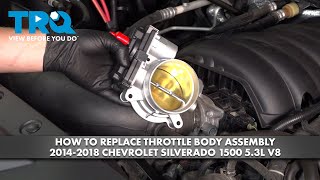
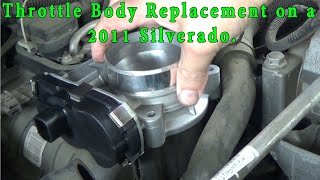
Typical fix: Replace the entire throttle body assembly. A throttle relearn procedure is required after installation. Torque for the mounting bolts is typically 89 in-lbs. 🎬 Watch this step-by-step throttle body replacement walkthrough.
Est. part cost: $150-$350 - Wiring Harness or Connector Issue 🟡 Medium Probability The engine bay environment can cause wiring to become brittle, or connectors can suffer from corrosion or fretting. The harness near the throttle body can chafe against other components, leading to a short to ground and a low voltage signal.
How to confirm: Visually inspect the wiring harness going to the throttle body for any signs of damage, chafing, or melting. Disconnect the connector (with ignition off) and check for corroded, bent, or backed-out pins. Use a multimeter to check for a 5-volt reference (often on a Light Blue/Black wire) and a good ground at the connector.
Typical fix: Repair the damaged section of the harness or clean/replace the connector pigtail. On older models, checking and cleaning the main engine block ground was a common fix for similar throttle-related codes.
Est. part cost: $20-$100 - Dirty Throttle Body ⚪ Low Probability → Shop Fuel Injection Throttle Body Carbon and oil vapor from the PCV system can build up around the throttle plate, causing it to stick or not close properly. While this can cause idle and performance issues, it is less likely to cause a persistent circuit low code like P0222 unless the buildup is extreme enough to prevent the sensor from reaching its baseline reading.
How to confirm: Remove the air intake tube and inspect the throttle bore and plate for significant black carbon buildup.
Typical fix: Clean the throttle body thoroughly with a dedicated throttle body cleaner and a soft brush. Be careful not to force the throttle plate by hand. While cleaning is good maintenance, it rarely fixes an electronic fault like P0222.
Est. part cost: $10-$20
Rare But Worth Checking
- Faulty Accelerator Pedal Position (APP) Sensor: → Shop Accelerator Pedal Assembly While possible, this is less common for a P0222 code. The APP sensor has its own set of specific trouble codes (like P2138) that are more likely to be triggered if it fails.
- Faulty Engine Control Module (ECM): → Shop Engine Control Module (ECM) This is extremely rare. The ECM should only be considered after all other possibilities, including the throttle body and all related wiring, have been exhaustively tested and ruled out. A failed communication test or incorrect reference voltage from the ECM would point to this.
Diagnosis Steps
- Connect an OBD-II scanner and confirm the presence of P0222. Check for any other related codes like P0122 or P2135, which are very common.
- Using the scanner's live data, monitor the voltage readings for 'TPS Sensor 1' and 'TPS Sensor 2'.
- With the key on and engine off, slowly press the accelerator pedal. TPS Sensor 1 voltage should sweep smoothly from low to high (e.g., ~1.0V to ~4.5V). TPS Sensor 2 should also sweep smoothly, though its range is typically inverted or different (e.g., ~4.0V down to ~0.5V).
- If TPS Sensor 2's voltage is stuck at a very low value (e.g., under 0.5V) and does not respond, the throttle body assembly is the most likely culprit.
- If the readings are erratic, perform a 'wiggle test'. Wiggle the wiring harness and connector at the throttle body while watching the live data. If the voltage jumps or cuts out, you have a wiring issue.
- Turn the ignition off and disconnect the throttle body connector. Check the 6 pins in the connector for corrosion, moisture, or bent/backed-out pins.
- With a multimeter and the key on, verify you have a 5-volt reference signal and a good ground at the connector pins. If these are missing, the problem is upstream in the wiring or ECM.
- If wiring and power/ground are good, but the sensor voltage is still low, the throttle body assembly is faulty and needs replacement.
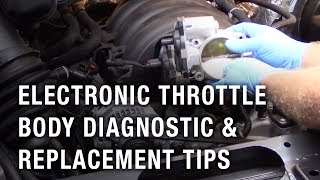
- After replacement, clear the codes and perform the throttle body relearn procedure. This can often be done by letting the vehicle idle for several minutes, sometimes with the A/C on, to allow the ECM to learn the new idle positions.
Parts You'll Likely Need
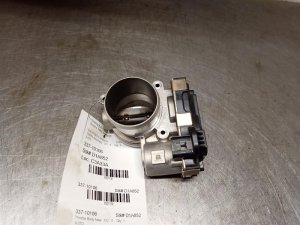
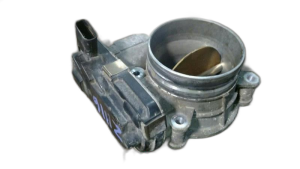
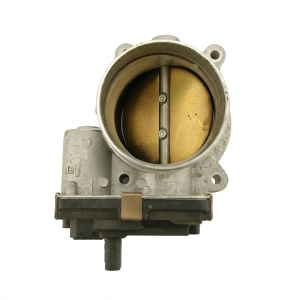
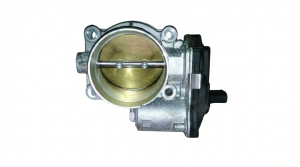
- Electronic Throttle Body Assembly
(OEM #12740725 (supercedes 12678224, 12617792, etc. for 5.3L T1XX models); 12670838 (common for 5.3L/6.2L K2XX models))— This is the most frequent cause of a P0222 code on these trucks, as the internal Throttle Position Sensor (TPS) fails. The sensors are integrated and not serviced separately.
Trusted brands: ACDelco, Bosch, Delphi, Standard Motor Products
OEM price range: $250-$350
Aftermarket price range: $150-$250
Related Codes That Often Appear With This One
- P0122 — This code is for 'Throttle/Pedal Position Sensor/Switch 'A' Circuit Low Input'. If both P0122 and P0222 are present, it points more strongly to a common cause like a wiring or power/ground issue affecting the entire throttle body, or a complete internal failure.
- P2135 — This code means 'Throttle/Pedal Position Sensor/Switch 'A'/'B' Voltage Correlation'. It is set when the ECM sees a disagreement between the two throttle position sensor signals, which is a very common companion code when one sensor fails and triggers P0222.
Technical Service Bulletins (TSBs) & Recalls
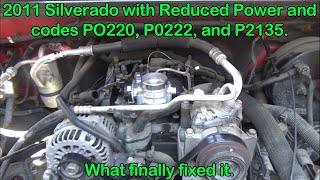
- 11273 - Special Coverage Adjustment for Throttle Position Sensor Replacement on 2008-2011 models, which shows a history of this type of failure on GM trucks. 🎬 Watch how a similar GM throttle code issue was resolved.
- While not directly for P0222, TSBs like PIP5162G address intermittent throttle body-related codes and often recommend checking wiring and grounds before replacing the throttle body, highlighting the frequency of electrical issues.
Platform-Specific Known Issues
- GM has a history of throttle body-related issues that trigger the 'Reduced Engine Power' mode. A Special Coverage Adjustment (11273) was issued for earlier model years (2008-2011) for a similar problem, indicating a pattern of this component being a weak point for the platform.
- The issue is extremely common across the entire GM truck and SUV lineup that shares these engines and platforms, including the GMC Sierra, Tahoe, Suburban, Yukon, and Escalade.
Mechanic-Grade Diagnostic Values
- TPS Sensor 'B' (TP2) Signal Voltage — expected: Sweeps smoothly. The exact range varies, but a common failure value is a stuck reading.. Failure: Voltage is stuck below the PCM's minimum threshold, specifically less than 0.3125 volts.
- 5-Volt Reference at Throttle Body Connector — expected: 4.8V to 5.2V with key on, engine off.. Failure: Voltage near 0V or significantly below 4.8V, indicating a wiring or ECM issue.
- Low Reference (Ground) Circuit Resistance at Connector — expected: Less than 5.0 Ohms between the ground pin at the connector and a known good chassis ground.. Failure: Resistance greater than 5.0 Ohms, indicating an open or high-resistance ground circuit.
- Throttle Actuator Control (TAC) Motor Resistance — expected: Between 2 to 15 Ohms between the two motor control pins on the throttle body.. Failure: A reading of Over Limit (OL) indicates an open circuit; less than 1 Ohm indicates a short circuit.
Scan Tool Commands That Help
- GDS2 / Tech2 (or equivalent professional scanner): Idle Learn Reset / Throttle Body Learn — This function must be used after replacing the throttle body or cleaning it. It resets the learned idle and throttle position values in the ECM, allowing it to learn the new component's characteristics.
- GDS2 / Tech2 (or equivalent professional scanner): Throttle Sweep Test / Live Data Monitoring — During diagnosis, to observe the TP Sensor 1 and 2 voltage or percentage readings as the throttle is commanded open and closed. This helps confirm if a sensor's reading is stuck or not responding.
Wiring & Ground Locations
- Throttle Body Connector (Example Pinout) — The 6-pin or 8-pin electrical connector on the electronic throttle body.. This is where all voltage and resistance tests are performed. For P0222, the key wires are the 5V reference (often Pin B, Lt Blue/Black), the TP2 signal (often Pin D, Purple), and the low reference/ground (often Pin H, Black/White).
- G102 / G104 (or similar) — Engine block grounds. Typically located on the left (driver's) side of the engine block or on the rear of the cylinder heads.. The ECM and its sensors rely on a clean ground path through the engine block. A loose or corroded ground here can cause erratic sensor readings and phantom codes like P0222, mimicking a component failure.
- Negative Battery Cable Ground — The point where the main negative battery cable bolts to the chassis or engine block.. This is the master ground for the entire electrical system. Corrosion or a loose connection here can cause widespread, difficult-to-diagnose electrical problems, including sensor circuit low voltage codes.
Real Owner Repair Stories
- YouTube channel '737mechanic' (2011 Chevrolet Silverado (similar GMT900 platform, principles directly apply)) — Reduced Engine Power light, codes P0220, P0222, P1516, and P2135.
❌ Tried (didn't work) Replacing the throttle body assembly., Replacing the Engine Control Module (ECM).
✅ What actually fixed it The final fix was inspecting, loosening, and re-tightening the main engine ground connections, particularly the ones on the back of the cylinder heads. One of the factory battery ground cable crimps was also found to be loose. This restored a solid ground path, resolving the low voltage condition without replacing any more parts.
"I Checked Everything" — The Actual Cause
- The diagnostic equivalent for this electronic code is when all component swaps fail. In a widely documented case for this platform, a new throttle body and even a new ECM failed to fix the P0222 and related codes. The actual root cause was a high-resistance ground connection at the engine block. The voltage drop across the bad ground was enough to pull the sensor signal below the threshold, but it was missed because technicians assumed the new, expensive electronic parts must be the problem area. The fix was simply cleaning and tightening the ground straps.
OEM Part Supersession History
12617792, 12678224, 12713775, 12713796, 12729500→12740725— Standard part evolution for improved reliability, material changes, or manufacturing updates.
Heads up: These parts are generally forward-compatible (the newest number replaces the older ones). Using an old, superseded part number is not recommended. Part 12740725 is specified for many 5.3L T1XX (2019+) models.
Model Year Variations Within This Range
- 2019: In 2019, Chevrolet sold both the all-new T1XX platform Silverado and the previous generation K2XX platform, branded as the 'Silverado 1500 LD'. These trucks have different architectures and may use different throttle body part numbers. The K2XX (LD) often uses part number 12670838, while the new T1XX uses the 12740725 series. It is critical to verify the correct part by VIN.
Diagnostic Flowchart
Other Known Issues on This Vehicle
Issues unrelated to this code that are worth knowing about as an owner of this generation:
- AFM/DFM Lifter Failure 🔴 High — Common, can occur as early as 40,000 miles but more frequent around 80,000-120,000 miles. Affects 5.3L and 6.2L V8s. (Ref: Multiple TSBs exist, but no universal recall. The issue is widely documented in owner forums.)
- 8L90 / 8L45 Transmission Shudder ('Chevy Shake') 🟠 Medium — Very common on 2015-2019 models with the 8-speed transmission. A shudder or vibration is felt under light acceleration, often described as driving over rumble strips. (Ref: TSB 18-NA-355 recommends a specific fluid flush with an updated Mobil 1 fluid. Class action lawsuits have been filed over this issue.)
- Torque Converter Failure 🔴 High — Related to the 8-speed transmission issues, the torque converter itself can fail, causing harsh shifts, shuddering, and eventual transmission damage. (Ref: Often addressed as part of the transmission shudder TSBs, but sometimes requires complete torque converter replacement.)
- Cracked Dashboard (2014-2015 models) 🟡 Low — Very common on early K2XX trucks, especially in warmer climates. The plastic around the driver's side instrument cluster and passenger airbag area is prone to cracking. (Ref: No recall, but a widely known cosmetic defect discussed extensively in owner forums.)
- Driveshaft Vibration ('Chevy Shake') 🟠 Medium — Distinct from the transmission shudder, this is a high-speed vibration (60-75 mph) on 2014-2019 K2XX trucks, often attributed to an imbalanced aluminum driveshaft. (Ref: GM has issued TSBs to dealers for diagnosing driveline vibrations, but a definitive fix has been elusive for many owners.)
Used vs. New Parts: Buying Guide for This Vehicle
When a used part is the smart pick: A used throttle body is a high-risk, budget-only option for this repair. Since the failure mode is electronic wear-and-tear, a used part has an unknown lifespan and may fail soon after installation. It should only be considered for a short-term fix while awaiting a new part.
Donor-vehicle mileage cap: roughly under 50000 miles for the part to have meaningful remaining life.
What to inspect on the donor part:
- Verify the part number matches your required OEM number or a valid superseded number.
- Inspect the electrical connector pins for any signs of corrosion, moisture, or damage.
- Check the throttle bore for extreme carbon buildup, which might suggest a hard life.
- If possible, get the VIN of the donor vehicle to confirm compatibility and check its history.
OEM-only on this vehicle (don't cheap out):
- While not strictly 'OEM-only', the electronic throttle body is a critical component. Using a new OEM (ACDelco) or a reputable OE supplier (Bosch, Delphi) part is strongly recommended for long-term reliability.
Aftermarket brands forum-validated for this vehicle:
- ACDelco (OEM)
- Bosch
- Standard Motor Products (SMP)
- Dorman (ensure it is not a remanufactured unit with old electronics)
Brands owners have reported issues with on this vehicle:
- Unbranded, no-name parts from online marketplaces. These often use lower-quality sensors and electronics that can fail prematurely or be out of calibration from the start, causing persistent issues even after replacement.
Real Owner Stories
Aggregated from forums and TSBs cited above. Mileages and costs reflect what owners reported in those sources.
2014-2018 Chevrolet Silverado
Symptoms: Reduced Engine Power message on the dash; vehicle would not accelerate properly in limp mode.
What fixed it: Replacement of the entire throttle body assembly followed by a throttle relearn procedure.
Source hint: YouTube: 1A Auto 'How to Replace Throttle Body 2014-2018 Chevrolet Silverado'
GM Truck (Silverado/Sierra Platform)
Symptoms: Owner experienced P0120, P0220, and P2135 codes alongside the 'Reduced Engine Power' warning.
What fixed it: Cleaning a ground connection on the engine block.
Source hint: SilveradoSierra.com: 'Reduced Engine Power' Discussion
Related OBD-II Codes
Frequently Asked Questions
Does the Special Coverage Adjustment 11273 apply to my 2014-2024 Chevrolet Silverado?
What is the specific voltage threshold that triggers P0222 on my Silverado?
Can I just clean the throttle body on my 5.3L V8 to fix the P0222 code?
Is there a specific wiring check I should perform before replacing the throttle body?
Do I need to perform a special procedure after replacing the throttle body on my Silverado?
What is the torque specification for the throttle body mounting bolts on this engine?
Helpful Videos
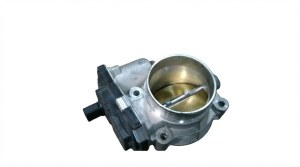
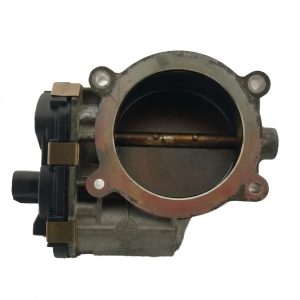
Used OEM Parts in Stock
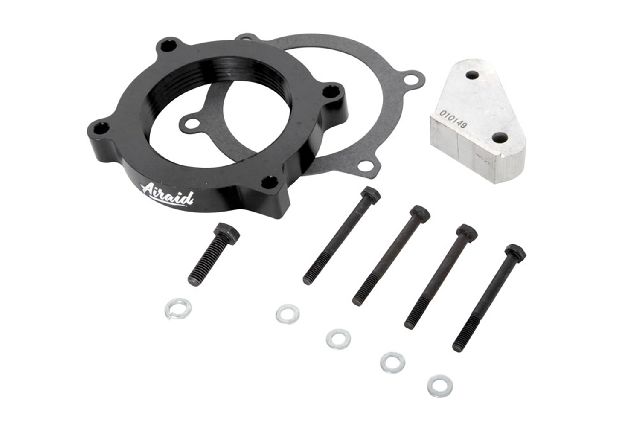
New Aftermarket Parts Available


The information in this article is provided for general reference and educational purposes only. Vehicle specifications, procedures, and part compatibility can vary by production date, trim level, and region. Always consult your vehicle's factory service manual and verify part numbers before purchasing or performing repairs. Safety-critical components such as airbags, seat belts, and braking systems should be installed by a qualified professional.
- Chevrolet Silverado:
- 🧭 Diagnostic Flowchart
- 🎬 Helpful Videos
- 🛍️ Shop This Part
- What's Unique About the 2014-2024 Chevrolet Silverado
- Symptoms You May Notice
- Most Likely Causes
- Rare But Worth Checking
- Diagnosis Steps
- Parts You'll Likely Need
- Related Codes That Often Appear With This One
- Technical Service Bulletins (TSBs) & Recalls
- Platform-Specific Known Issues
- Mechanic-Grade Diagnostic Values
- Scan Tool Commands That Help
- Wiring & Ground Locations
- Real Owner Repair Stories
- "I Checked Everything" — The Actual Cause
- OEM Part Supersession History
- Model Year Variations Within This Range
- Other Known Issues on This Vehicle
- Used vs. New Parts: Buying Guide for This Vehicle
- Real Owner Stories
- 2014-2018 Chevrolet Silverado
- GM Truck (Silverado/Sierra Platform)
- Related OBD-II Codes
- Frequently Asked Questions
- 🎟️ Get 5% Off