

P0222 on 2011-2017 Chrysler 200: Throttle Position Sensor 'B' Circuit Low Causes and Fixes
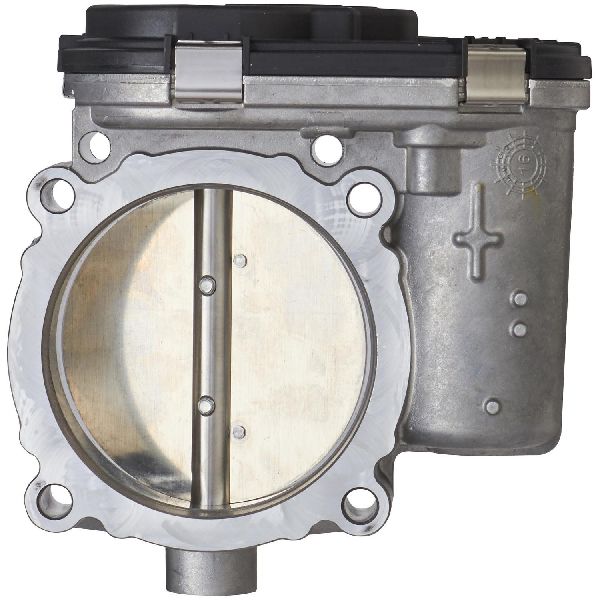
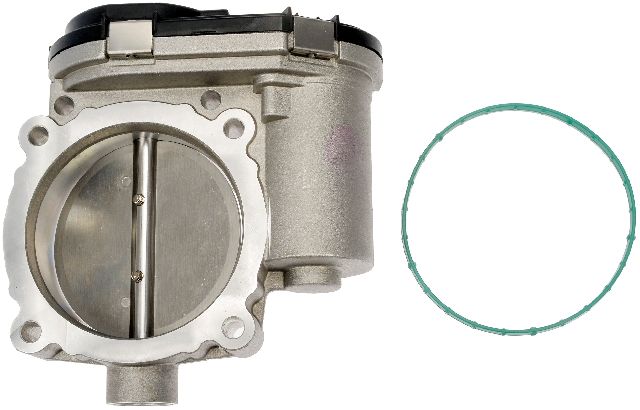
On a 2011-2017 Chrysler 200, code P0222 is almost always caused by a failed electronic throttle body assembly. This triggers the 'lightning bolt' warning light and forces the car into a low-power limp mode. Replacing the entire throttle body is the standard fix, costing between $100 and $250 for the part.
- P0222 on a Chrysler 200 will cause a flashing 'lightning bolt' light and put the car into a dangerous low-power limp mode.
- The cause is almost certainly an internal failure of the electronic throttle body assembly. This is a very common problem for this vehicle.
- Do not waste money replacing the accelerator pedal; the fault is at the engine's throttle body.
- Verify you are buying the correct throttle body for your specific engine (2.4L vs 3.6L) and model year, as they are different.
- After replacing the part, you must perform a throttle relearn procedure to ensure the car idles and drives correctly.
What's Unique About the 2011-2017 Chrysler 200
The Chrysler 200, across both its generations and engine options, uses an electronic throttle body where the position sensors are integrated and cannot be replaced separately. This design makes throttle body failure a very common and well-documented issue, not just on the 200 but on many related Chrysler, Dodge, and Jeep vehicles that share the 2.4L and 3.6L engines. When this code appears, it's a strong indicator of an internal electronic failure within the throttle body unit itself, rather than a simple adjustment or cleaning issue.
Generation note: The 2011-2017 Chrysler 200 spans two generations: the first (JS) from 2011-2014 and the second (UF) from 2015-2017. While the P0222 code points to the same fundamental problem on both, they use different throttle bodies for the 2.4L engine. The 3.6L Pentastar V6, available in both generations, uses the same throttle body throughout this period.
Symptoms You May Notice
- Flashing red 'lightning bolt' Electronic Throttle Control (ETC) warning light.
- Vehicle enters 'limp mode' with severely limited acceleration and power.
- Check Engine Light is illuminated.
- Unresponsive or delayed accelerator pedal.
- Hesitation or stumbling during acceleration.
- Rough, unstable, or high idle.
- Engine may stall, especially at low speeds or when coming to a stop.
- Difficulty starting the engine or engine won't start at all.
- Replacing the accelerator pedal assembly. The P0222 code specifically refers to the 'B' circuit sensor located on the throttle body, not the sensor at the pedal.
Most Likely Causes
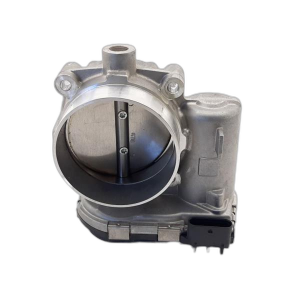
- Faulty Electronic Throttle Body Assembly 🔴 High Probability → Shop Fuel Injection Throttle Body This is a widely documented failure point on both the 2.4L and 3.6L engines used across the Chrysler/Dodge/Jeep lineup. The internal sensors and motor circuitry wear out over time, causing electrical faults.
How to confirm: With the key on and engine off, use a scan tool to monitor live data for TPS1 and TPS2 voltages. If the TPS2 ('B' circuit) voltage is stuck low (e.g., <0.5V) and doesn't change as the pedal is pressed, the throttle body has failed internally. The presence of codes P0123 or P2135 alongside P0222 strongly confirms this diagnosis. 🎬 See how to test and replace a faulty electronic throttle body.
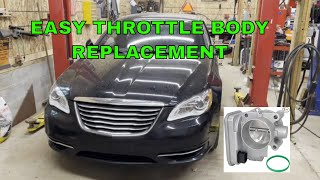
Typical fix: Replace the entire electronic throttle body assembly. 🎬 Watch this step-by-step Chrysler 200 throttle body replacement guide. The sensors are not serviceable separately. After replacement, a throttle relearn procedure is required.
Est. part cost: $100-$250 - Wiring Harness or Connector Issue 🟡 Medium Probability The engine bay environment involves heat and vibration, which can lead to chafed wires or corroded pins in the 6-pin connector at the throttle body over time.
How to confirm: Visually inspect the wiring harness leading to the throttle body for any signs of fraying, melting, or damage. Unplug the connector (depress the tab and pull) and check for corroded, bent, or loose pins. Ensure the red locking tab is intact and engages securely.
Typical fix: Repair the damaged section of wire or clean the connector pins with electrical contact cleaner. If the connector itself is damaged, it may need to be replaced with a pigtail connector kit.
Est. part cost: $10-$50 - Dirty or Sticking Throttle Body ⚪ Low Probability → Shop Fuel Injection Throttle Body Carbon and oil vapor from the PCV system can build up around the throttle plate, causing it to stick. However, this usually causes performance issues or different codes, not a specific 'circuit low' fault.
How to confirm: Remove the air intake hose from the throttle body and inspect the throttle bore and plate for heavy carbon buildup.
Typical fix: Clean the throttle body thoroughly with a dedicated throttle body cleaner and a soft cloth. While this is good maintenance, it is unlikely to resolve a P0222 code, which indicates an electrical problem.
Est. part cost: $5-$15
Rare But Worth Checking
- Failing Battery or Poor Ground Connection: The electronic throttle control system is very sensitive to voltage. A weak battery or a corroded/loose engine ground strap can cause a variety of strange electrical issues, including throttle body codes. Before replacing expensive parts, ensure the battery is healthy and check the main ground connections.
- Faulty Powertrain Control Module (PCM): → Shop Engine Control Module (ECM) In rare instances, the PCM itself can fail. This should be the last consideration after the throttle body and wiring have been definitively ruled out by a professional. Sometimes a software update from a dealer can also resolve overly sensitive fault logic.
Diagnosis Steps
- Connect an OBD-II scanner and confirm P0222 is present. Note any other codes, especially P0123, P2135, or P2110.
- Visually inspect the wiring harness and the 6-pin electrical connector at the throttle body for any obvious damage, corrosion, or loose connections.
- Using a scan tool with live data, monitor the voltage for TPS1 and TPS2 (sometimes labeled as TP1/TP2 or similar). With the key on but the engine off, slowly press and release the accelerator pedal.
- Observe the TPS2 voltage. If it remains stuck at a very low value (e.g., 0.1V) and does not change with the pedal, while TPS1 shows a smooth sweep from ~0.8V to ~4.5V, the throttle body has an internal electrical failure.
- If the wiring is confirmed to be good and the sensor voltage is stuck low, replace the entire electronic throttle body assembly.
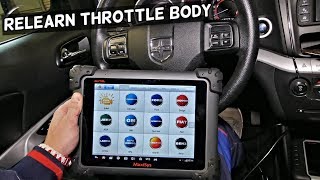
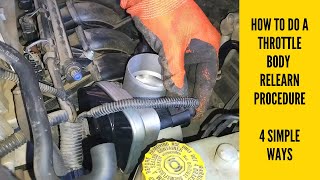
- After installation, perform a throttle relearn procedure. This can often be done without a scan tool: Turn the key to 'ON' (engine off) for 10-15 seconds, then slowly press the accelerator pedal to the floor and release it slowly. Turn the key 'OFF' for 10 seconds. You may hear clicking from the throttle body during this process. Finally, start the engine. 🎬 Watch a demonstration of the Chrysler throttle body relearn procedure.
- Clear all codes and test drive the vehicle to ensure the issue is resolved.
Parts You'll Likely Need
- Electronic Throttle Body Assembly (3.6L Pentastar V6)
(OEM #05184349AF)— This is the most common failure part for P0222 on the 3.6L engine. The OEM part number supersedes previous versions (AB, AC, AD, AE).
Trusted brands: Mopar, Bosch, Hitachi, Standard Motor Products (SMP), Dorman
OEM price range: $180-$250
Aftermarket price range: $80-$160 - Electronic Throttle Body Assembly (2.4L MultiAir, 2015-2017)
(OEM #04891970AD)— This is the likely replacement part for the second-generation 2.4L engine, shared with the Jeep Cherokee and others.
Trusted brands: Mopar, Standard Motor Products (SMP), SKP, Dorman, Cardone (Remanufactured)
OEM price range: $150-$220
Aftermarket price range: $130-$250 - Electronic Throttle Body Assembly (2.4L, 2011-2014)
(OEM #04891735AC)— This is the replacement part for the first-generation 2.4L engine. Note that some parts listings specify checking if your connector is single or dual row.
Trusted brands: Mopar, Bosch, SKP, DIY Solutions, TRQ
OEM price range: $150-$220
Aftermarket price range: $70-$150
Related Codes That Often Appear With This One
- P0123 — This code is for 'Throttle Position Sensor 'A' Circuit High'. Seeing P0123 and P0222 together is a very strong indication that the entire throttle body assembly has failed internally, as both sensor circuits are faulting.
- P2135 — This code means 'Throttle/Pedal Position Sensor/Switch A/B Voltage Correlation'. It sets when the PCM sees a disagreement between the two TPS signals, which is the direct cause of the P0222 fault.
- P2110 — This code, 'Throttle Actuator Control System - Forced Limited RPM,' is not a cause but a result. It confirms the PCM has intentionally placed the vehicle in 'limp mode' due to the detected throttle fault.
Technical Service Bulletins (TSBs) & Recalls
- 18-031-14 Rev. A — Flash: MIL Illumination P1239, P0298, P0300, Includes Powertrain System Improvements/Enhancements
Mechanic-Grade Diagnostic Values
- TPS 'B' (TP2) Signal Voltage — expected: Sweeps smoothly from a high voltage (~4.5V) at closed throttle down to a low voltage (~0.5V) at Wide-Open Throttle (WOT). This is often inverse to the TPS 'A' signal.. Failure: Voltage is stuck low (typically below 0.5V) and does not change when the accelerator pedal is pressed.
- 5-Volt Reference at Throttle Body Connector — expected: 4.5V to 5.2V with Key On, Engine Off (KOEO).. Failure: Voltage is significantly below 4.5V, indicating a wiring issue or a problem with the PCM.
- Sensor Ground Circuit Resistance — expected: Less than 5.0 ohms between the ground pin at the connector and a known good chassis ground.. Failure: High resistance (or an open circuit) indicates a bad ground connection, which can cause erratic sensor readings.
Scan Tool Commands That Help
- wiTECH (Chrysler Dealer Tool): ETC Learn / Throttle Follower Test — After replacing the throttle body, the 'ETC Learn' function must be run to calibrate the new part to the PCM. The 'Throttle Follower Test' is a bidirectional diagnostic that commands the throttle plate to open to specific percentages, allowing a technician to verify sensor readings and actuator response without needing to press the accelerator pedal.
Wiring & Ground Locations
- Throttle Body Connector (3.6L Engine) — The 6-pin electrical connector plugged directly into the electronic throttle body assembly.. This is the primary interface for all power, ground, and signal wires for the integrated throttle position sensors. Testing occurs at these pins. Pin 4 is the specific signal wire for TPS 'B' (TPS2).
- Throttle Body Connector Pinout (3.6L) — On the 6-pin connector at the throttle body.. Pin 2: TP2 Signal (The 'B' circuit). Pin 3: 5V Reference. Pin 4: TP1 Signal (The 'A' circuit). Pin 6: Sensor Return (Ground). A short to ground on the wire to Pin 2 will cause P0222. A fault in Pin 3 or Pin 6 will likely cause codes for both sensors.
- G308 — Located at the right rear of the engine compartment.. This is a major engine ground point. While not exclusively for the throttle body, a poor connection here can introduce electrical noise and voltage drops, potentially causing intermittent and difficult-to-diagnose electronic throttle codes.
- G105 — Located on the right side of the engine compartment.. Another key engine-area ground point. Verifying that this ground is clean and tight is a crucial step when diagnosing any electrical fault, including an intermittent P0222.
Real Owner Repair Stories
- YouTube user comment section / Forum discussions (2016 Chrysler 200 2.4L) — Car would not start, or would stall. Check engine light and ETC 'lightning bolt' light were on. Codes P0123 and P0222 were present.
❌ Tried (didn't work) Cleaning the throttle body.
✅ What actually fixed it The cleaning provided only a very temporary fix (minutes). The combination of opposing sensor codes (circuit high and circuit low) confirmed an internal electronic failure. Replacing the entire throttle body assembly resolved all symptoms and codes. - Owner forum post (2013 Chrysler 200 V6) — Intermittent no-start, no-crank condition. Sometimes worked fine, other times completely dead.
❌ Tried (didn't work) Replacing the battery.
✅ What actually fixed it The owner discovered that poor factory grounding was a known issue. They added an additional 4-gauge ground wire from the battery's negative terminal directly to a clean spot on the chassis. This permanently resolved the intermittent no-start condition, suggesting unstable system voltage was the root cause.
OEM Part Supersession History
5184349AB, 5184349AC, 5184349AD, 5184349AE→05184349AF— Progressive design improvements to enhance durability and address known failure modes of the internal electronics and seals.
Heads up: All previous versions are replaced by the 'AF' revision. While an older version might fit, installing the latest 'AF' part is highly recommended to get the most recent engineering updates.
Model Year Variations Within This Range
- 2011-2014 vs 2015-2017 (2.4L Engine): The first generation (JS body, 2011-2014) and second generation (UF body, 2015-2017) use physically different throttle bodies for the 2.4L engine. Part numbers are not interchangeable between these generations. The 3.6L V6 uses the same throttle body (PN: 05184349AF and its predecessors) across all years from 2011-2017.
Diagnostic Flowchart
Other Known Issues on This Vehicle
Issues unrelated to this code that are worth knowing about as an owner of this generation:
- ZF 9-Speed Automatic Transmission Problems 🔴 High — Very common on 2015-2017 models. Problems include rough/hard shifting, lurching, hesitation, and sudden shifts to neutral. (Ref: Recall S55 / NHTSA 16V-529 was issued to address some transmission concerns, but many owners report persistent issues.)
- Excessive Oil Consumption (2.4L Tigershark Engine) 🔴 High — Widespread on 2015-2017 models with the 2.4L engine. Caused by a piston ring design defect, leading to oil consumption of a quart or more per 1,000 miles. (Ref: A class-action lawsuit led to warranty extension XB1 and TSB 09-003-23, which may provide for an oil consumption test and potential engine replacement.)
- Left Cylinder Head Failure (3.6L Pentastar V6) 🟠 Medium — Primarily affects early Pentastar engines from 2011-2013. A design flaw can lead to premature wear of valve guides/seats on the left-side cylinder head, causing a ticking noise, misfires (P0300), and a check engine light. (Ref: Not a recall, but Chrysler issued a warranty extension (10 years/150,000 miles) for the left cylinder head. This period has likely expired for most vehicles.)
- Engine Stalling / Shutting Off While Driving 🔴 High — Reported on both generations and with both engines. Can be caused by the throttle body failure (P0222), but also by transmission wiring harness issues or low oil levels from the consumption problem. (Ref: Multiple recalls and investigations have been launched, including for wiring harness issues that could cause a loss of propulsion.)
- Cracked Oil Filter Housing / Cooler (3.6L Pentastar V6) 🟠 Medium — A common failure point where the plastic housing develops cracks, leading to significant oil leaks onto the engine and exhaust. Often occurs around 50,000 miles.
Used vs. New Parts: Buying Guide for This Vehicle
When a used part is the smart pick: For this specific repair, buying a used throttle body is NOT recommended. The electronic throttle body is a known high-failure part on this platform due to wear on its internal electronics. A used part from a junkyard is likely to have significant wear and could fail soon after installation, forcing you to do the job twice.
Donor-vehicle mileage cap: roughly under 30000 miles for the part to have meaningful remaining life.
What to inspect on the donor part:
- If you must buy used, insist on a part from a very low-mileage vehicle.
- Inspect the electrical connector pins for any signs of corrosion, bending, or damage.
- Look at the throttle plate and bore; it should be relatively clean with minimal carbon buildup, which can indicate a well-maintained donor vehicle.
- Ensure the seller offers a warranty or return period to protect against a dead-on-arrival part.
OEM-only on this vehicle (don't cheap out):
- Electronic Throttle Body
Aftermarket brands forum-validated for this vehicle:
- Bosch (Often the OEM supplier)
- Hitachi
- Standard Motor Products (SMP)
Brands owners have reported issues with on this vehicle:
- Unbranded/No-name parts from online marketplaces.
- Some owners have reported mixed results with Dorman for this specific part, with some units failing prematurely or causing compatibility issues, while others work fine. Given the critical nature of the part, sticking to OEM or a proven OEM supplier is the safer bet.
Real Owner Stories
Aggregated from forums and TSBs cited above. Mileages and costs reflect what owners reported in those sources.
2016 Jeep Cherokee 2.4L MultiAir
Symptoms: Owner experienced codes P2172, P0123, and P0222 simultaneously. Attempted cleaning the throttle body, but it only provided a temporary fix.
What fixed it: Replacement of the electronic throttle body assembly.
Source hint: Reddit r/MechanicAdvice: 2016 Jeep Cherokee 2.4L Throttle body issue
2016 Chrysler 200 2.4L
Symptoms: Vehicle experienced a no-start condition along with throttle-related fault codes.
What fixed it: Changing the Electronic Throttle Body.
Source hint: YouTube: FIXING My 2016 Chrysler 200 No Start - [Changing My Electronic Throttle Body]
Related OBD-II Codes
Frequently Asked Questions
Can I fix the P0222 code on my Chrysler 200 by just cleaning the throttle body?
Is there a software update for my Chrysler 200 that addresses throttle or engine codes?
My 2012 Chrysler 200 3.6L has a ticking noise and a P0300 code along with throttle issues; are they related?
Do I need a professional scan tool to perform the throttle relearn on my 2.4L MultiAir engine?
Why does my Chrysler 200 go into 'limp mode' when the red lightning bolt light flashes?
Helpful Videos
![FIXING My 2016 Chrysler 200 No Start - [Changing My Electronic Throttle Body]](https://img.youtube.com/vi/q6t56-EmHlM/mqdefault.jpg)

Used OEM Parts in Stock
New Aftermarket Parts Available


The information in this article is provided for general reference and educational purposes only. Vehicle specifications, procedures, and part compatibility can vary by production date, trim level, and region. Always consult your vehicle's factory service manual and verify part numbers before purchasing or performing repairs. Safety-critical components such as airbags, seat belts, and braking systems should be installed by a qualified professional.
- Chrysler 200:
- 🧭 Diagnostic Flowchart
- 🎬 Helpful Videos
- 🛍️ Shop This Part
- What's Unique About the 2011-2017 Chrysler 200
- Symptoms You May Notice
- Most Likely Causes
- Rare But Worth Checking
- Diagnosis Steps
- Parts You'll Likely Need
- Related Codes That Often Appear With This One
- Technical Service Bulletins (TSBs) & Recalls
- Mechanic-Grade Diagnostic Values
- Scan Tool Commands That Help
- Wiring & Ground Locations
- Real Owner Repair Stories
- OEM Part Supersession History
- Model Year Variations Within This Range
- Other Known Issues on This Vehicle
- Used vs. New Parts: Buying Guide for This Vehicle
- Real Owner Stories
- 2016 Jeep Cherokee 2.4L MultiAir
- 2016 Chrysler 200 2.4L
- Related OBD-II Codes
- Frequently Asked Questions
- 🎟️ Get 5% Off