

P0222 on 2013-2016 Dodge Charger: Throttle Position Sensor Causes and Fixes
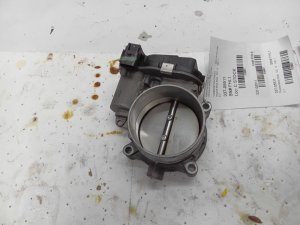
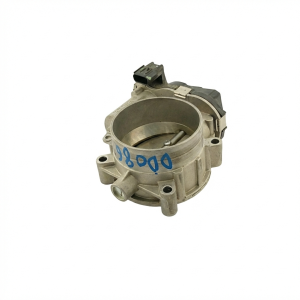
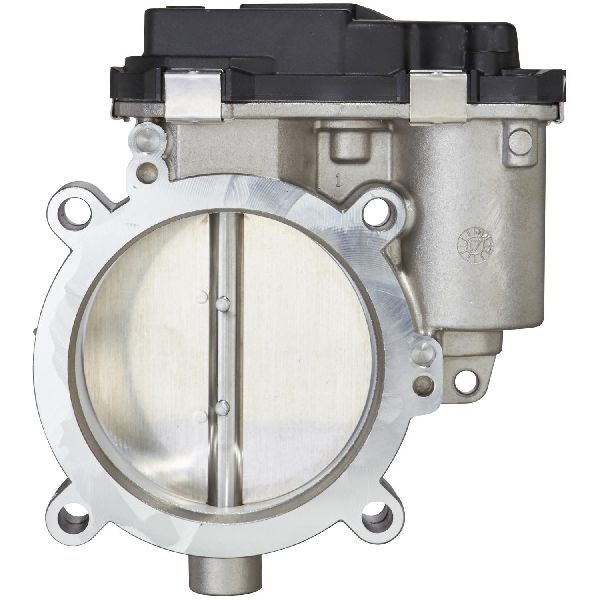
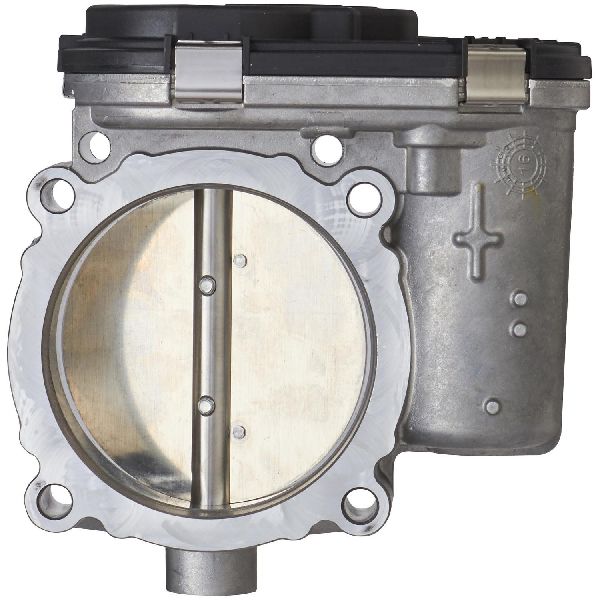
P0222 on a 2013-2016 Dodge Charger almost always means the throttle body has failed. The throttle position sensors are integrated and not sold separately. Expect to replace the entire throttle body assembly, which costs about $70-$150 for an aftermarket part and around $500 for OEM. In some cases, a PCM software update is required per a TSB, either instead of or in addition to the replacement.
- P0222 on a 2013-2016 Charger indicates a 'low voltage' fault from the secondary throttle position sensor.
- This code will cause serious drivability issues, including 'limp mode,' and the vehicle should not be driven.
- The most common cause by far is a failed throttle body assembly, as the sensors are integrated and cannot be replaced separately.
- Before replacing the throttle body, perform a quick visual inspection of the wiring and connector for obvious damage.
- Check if any manufacturer TSBs apply to your vehicle's VIN, as a PCM software update may be part of the complete repair.
What's Unique About the 2013-2016 Dodge CHARGER
The 2013-2016 Dodge Charger, part of the LD generation, is well-documented for issues with its electronic throttle control system. Numerous Technical Service Bulletins (TSBs) have been issued by the manufacturer that group P0222 with other throttle sensor codes, indicating a known pattern. Unlike some vehicles where you can replace just the sensor, on the Charger's 3.6L and HEMI engines, the sensors are built into the throttle body assembly. This means a sensor failure almost always requires replacing the entire unit. Several TSBs recommend a PCM software update as the primary fix, which addresses the logic for interpreting sensor data.
Diagnostic Flowchart
Tap your situation to follow the diagnostic path that matches what you're seeing on this vehicle.
Symptoms You May Notice
- Check Engine Light is on
- Electronic Throttle Control (ETC) or 'red lightning bolt' warning light is on
- Vehicle enters 'limp mode' with severely reduced engine power
- Poor, hesitant, or no acceleration
- Engine may stall, especially at idle
- Rough or unstable idle
- Hard starting or long crank times
- Unresponsive or 'spongy' feel to the accelerator pedal
- Replacing the accelerator pedal position (APP) sensor. While the APP sensor can cause similar symptoms, code P0222 specifically points to the sensor at the throttle body, not the pedal. A failure of the APP sensor would typically set different codes.
Most Likely Causes
- Faulty Throttle Body Assembly 🔴 High Probability → Shop Fuel Injection Throttle Body The throttle position sensors are integrated into the throttle body and are a common failure point, as evidenced by multiple manufacturer TSBs and owner forums. The internal electronics or plastic gears of the sensor can wear out, leading to a permanent low voltage signal.
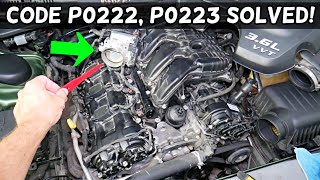
How to confirm: Using a scan tool, monitor the live data for 'TPS 2 Voltage'. If the voltage is stuck low (e.g., under 0.2V) and does not change when the accelerator is pressed, the throttle body is almost certainly the cause. TPS 1 voltage should rise smoothly while TPS 2 remains static. 🎬 Watch: How to diagnose P0222 and P0223 sensor codes
Typical fix: Replace the entire throttle body assembly. A throttle relearn procedure is recommended after installation, though many systems will relearn automatically after a short drive cycle.
Est. part cost: $70 - $550 - Wiring Harness or Connector Issue 🟡 Medium Probability The wiring harness leading to the throttle body is exposed to engine heat and vibration, which can cause wires to fray, short to ground, or pins in the connector to become corroded or loose. Moisture intrusion is also a common cause of corrosion at the connector.
How to confirm: Visually inspect the wiring and connector for any signs of damage, melting, or corrosion. Perform a 'wiggle test' on the harness while watching the TPS 2 voltage on a scan tool to see if the reading fluctuates. Use a multimeter to check for 5V reference voltage and ground at the connector.
Typical fix: Repair the damaged section of wiring or clean/replace the connector pigtail. This can cost between $50 and $150 for parts and labor.
Est. part cost: $15 - $50 - Needs a PCM Software Update 🟡 Medium Probability FCA has released multiple TSBs (e.g., 18-045-16 REV. A, 18-062-17) that call for a PCM reflash to correct overly sensitive diagnostic logic for throttle and crank sensor codes. The update can prevent false codes from being set.
How to confirm: A Dodge dealership or a well-equipped independent shop can check your vehicle's VIN against the TSB database to see if a software update is available and has not been performed.
Typical fix: Reprogram the PCM with the latest software using a wiTECH scan tool. This is typically a dealer-only procedure.
Est. part cost: $0 - $200 - Dirty or Obstructed Throttle Body ⚪ Low Probability → Shop Fuel Injection Throttle Body Carbon buildup can, in some cases, prevent the throttle plate from closing properly, which might cause the sensor readings to be out of range. While this can cause performance issues, it's less likely to cause a persistent 'circuit low' code than an electronic failure.
How to confirm: Remove the air intake tube and visually inspect the throttle plate and bore for heavy carbon deposits.
Typical fix: Clean the throttle body bore and plate with a dedicated throttle body cleaner and a soft brush. Be careful not to damage the electronic components or push debris into the intake.
Est. part cost: $10 - $20
Rare But Worth Checking
- Faulty Powertrain Control Module (PCM): → Shop Engine Control Module (ECM) This is a rare cause and should only be considered after the throttle body and wiring have been thoroughly checked and ruled out. A PCM failure can mimic sensor circuit faults. A PCM reflash should be attempted before condemning the module itself.
Diagnosis Steps
- Connect an OBD-II scanner and confirm P0222 is present. Record any other codes and freeze-frame data.
- Observe live data from TPS 1 and TPS 2. With the key on and engine off, both should show a steady baseline voltage. As you slowly press the accelerator, both voltages should rise smoothly. P0222 will likely show TPS 2 voltage as stuck low (e.g., <0.2V). TPS 1 should rise from ~0.5V to ~4.5V, while TPS 2 remains fixed at a very low voltage.
- Turn the vehicle off and disconnect the throttle body electrical connector. Inspect the pins on both the harness and throttle body sides for corrosion, moisture, or damage.
- Inspect the wiring harness leading to the throttle body for any signs of chafing, melting, or breaks. Pay close attention to where the harness may rub against the engine or other components.
- Check for a PCM software update. Contact a dealer with your VIN to see if TSBs like 18-045-16 REV. A or 18-062-17 apply to your vehicle. A reflash may be the required fix.
- If the wiring and connector appear intact and no software update is pending, the most probable cause is a failed throttle body assembly.
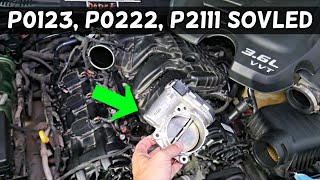
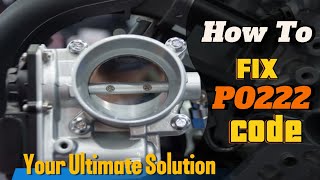
- Replace the throttle body. After installation, perform a throttle relearn procedure. A common method is to turn the ignition to 'ON' (without starting), wait for dash lights to settle, slowly press the accelerator to the floor, slowly release it, then turn the ignition 'OFF' for 10 seconds before starting the engine. 🎬 Watch: An easy walkthrough for fixing the P0222 code
- If the problem persists after replacing the throttle body, a more advanced diagnosis of the wiring continuity back to the PCM or the PCM itself is necessary.
Parts You'll Likely Need
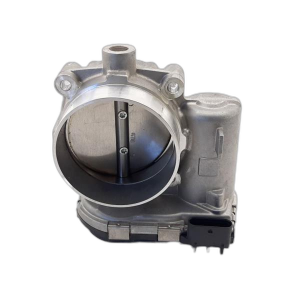
- Throttle Body Assembly
(OEM #4861661AB (for 3.6L V6), 04591847AC (for 5.7L/6.1L V8) - verify with VIN)— This is the most common fix because the throttle position sensors (TPS) are integrated into the assembly and are not available for separate purchase. Failure of the internal sensor electronics is the typical root cause of P0222.
Trusted brands: Mopar, Bosch, Hitachi, Standard Motor Products
OEM price range: $450-$550
Aftermarket price range: $70-$200
Related Codes That Often Appear With This One
- P0122 — This is the 'Circuit Low' code for the primary throttle position sensor (TPS 1). They often fail together as they are part of the same throttle body assembly.
- P0123 / P0223 — These are the 'Circuit High' equivalents for TPS 1 and TPS 2. Seeing them alongside P0222 can indicate erratic electrical failure within the throttle body.
- P2299 — This code means 'Brake Pedal Position / Accelerator Pedal Position Incompatible'. The PCM may set this code when it sees a throttle fault (like P0222) while the brake is applied, as a safety cross-check. This is explicitly mentioned in TSBs 18-062-17 and 18-045-16 REV. A.
- P0335 — Crankshaft Position Sensor Circuit. Several TSBs list this code alongside the TPS codes, suggesting a potential for related electrical issues or a required PCM software update to address multiple sensor logic faults.
- U1424 — Implausible Engine Torque Signal. This code is often triggered when the PCM receives conflicting information from the throttle position sensor and other engine sensors, which is a direct consequence of the fault causing P0222.
Technical Service Bulletins (TSBs) & Recalls
- 18-062-17
- 18-045-16 REV. A
- 1809416
- 18-074-15 REV A
- 18-032-16
Platform-Specific Known Issues
- Multiple Technical Service Bulletins (TSBs) have been released by the manufacturer for the 2013-2016 Charger powertrain, which include code P0222. These bulletins often recommend a PCM software update in conjunction with, or sometimes instead of, parts replacement. The TSBs are #18-062-17, #18-045-16 REV. A, #1809416, #18-074-15 REV A, and #18-032-16.
- The remedy for many of these TSBs, such as 18-045-16 REV. A, is to reprogram the PCM with updated software to improve diagnostic logic and prevent false codes. This should be investigated before replacing parts.
Mechanic-Grade Diagnostic Values
- TPS 2 Signal Voltage (Set Condition) — expected: Greater than 0.16 V. Failure: Voltage at the PCM is less than 0.16 V for 0.7 seconds.
- TPS 5V Reference Voltage at Connector — expected: 4.8 V to 5.2 V. Failure: Voltage is outside this range, indicating a supply issue from the PCM or a short.
- TPS 2 Signal Voltage (Throttle Sweep) — expected: Smoothly decreases from approx. 4.3 V to 0.7 V as pedal is pressed.. Failure: Voltage is stuck low, does not change, or has dropouts/spikes.
- Signal Circuit (K122) Resistance to PCM — expected: Below 5.0 Ohms. Failure: Resistance above 5.0 Ohms indicates an open or high resistance in the signal wire.
- Signal Circuit to Return Circuit Short — expected: Greater than 100 Ohms. Failure: Resistance below 100 Ohms indicates a short between the signal and return wires.
Scan Tool Commands That Help
- wiTECH or equivalent professional scan tool: ETC RELEARN — This function must be performed after replacing the throttle body assembly to calibrate the new part with the PCM.
- wiTECH or equivalent professional scan tool: ETC Throttle Follower Test — This is a diagnostic test used to monitor the TP Sensor voltage while the scan tool commands the throttle through its range of motion, helping to verify sensor functionality.
Wiring & Ground Locations
- Throttle Body Connector (3.6L V6) — On the throttle body, which is located at the right rear of the intake manifold.. This is the primary connection point to inspect for damage, corrosion, or loose pins causing the circuit low fault.
- Throttle Body Connector (5.7L V8) — On the throttle body, which is located at the front of the intake manifold.. This is the primary connection point to inspect for damage, corrosion, or loose pins causing the circuit low fault.
- K122 Circuit — This is the wire for the 'TP Sensor No. 2 Signal' running from the throttle body connector to the C2 PCM harness connector.. An open, high resistance, or short to ground on this specific wire will directly cause a P0222 code.
- F855 Circuit — This is the wire for the '5 Volt Supply' running from the PCM to the throttle body connector.. A fault on this shared supply circuit could cause P0222 along with other sensor codes like P0122.
- C2 PCM Connector — This is one of the main harness connectors at the Powertrain Control Module (PCM).. Technicians need to access this connector to perform continuity and resistance tests on the throttle body circuits back to the computer.
Real Owner Repair Stories
- DodgeForum.com user 'kennyken11' (2005 Ram 1500 5.7L Hemi (similar ETC system)) — ETC light comes on, car enters limp mode, code P0222 is present.
❌ Tried (didn't work) Replacing the entire throttle body assembly., Disconnecting the battery for over 30 minutes to reset the ECM.
✅ What actually fixed it The user suspected a wiring short was the root cause, as the problem was intermittent and they were also getting an unrelated P0107 MAP sensor code, suggesting a shared wiring issue rather than a component failure.
"I Checked Everything" — The Actual Cause
- In cases where replacing the throttle body assembly—the most common fix—does not resolve the P0222 code, the root cause is often an intermittent electrical issue in the wiring harness. A user on a Dodge forum replaced the throttle body on their 5.7L Hemi for a P0222 code, but the issue returned intermittently. The presence of another unrelated sensor code (P0107) led them to conclude the actual cause was a wiring short affecting multiple circuits, a problem that component replacement alone could not fix.
When the Usual Fixes Don't Work
- While the most common cause of P0222 is a failed throttle body assembly, it is not the only cause. There are documented cases where owners have replaced the throttle body, only for the code and symptoms to return. In these instances, the underlying issue was often found to be an intermittent problem within the engine wiring harness. A short or open in the signal, ground, or voltage supply wire can mimic a failed sensor, but will not be fixed by replacing the part. Therefore, if a new throttle body does not resolve the issue, a thorough inspection and electrical testing of the harness between the throttle body and the PCM is the critical next step.
OEM Part Supersession History
4861661AA→4861661AB— Part revision by manufacturer.
Heads up: Applies to 3.6L V6 engine.4591847AB, 68060354AA→04591847AC— Part revision by manufacturer.
Heads up: Applies to 5.7L/6.1L V8 engines. This part (04591847AC) is noted by multiple vendors as being discontinued by Mopar, which may require sourcing aftermarket alternatives.
Model Year Variations Within This Range
- 2013-2016: The physical location of the throttle body varies by engine. For the 3.6L V6, it is at the right rear of the intake manifold. For the 5.7L V8, it is at the front of the intake manifold.
- 2015-2016: The 2015 model year marked a significant refresh, including the adoption of the 8-speed automatic transmission for all engine options. While not directly linked to P0222, this represents a major powertrain architecture change from the 2013-2014 models.
Helpful Videos
Used OEM Parts in Stock
New Aftermarket Parts Available



The information in this article is provided for general reference and educational purposes only. Vehicle specifications, procedures, and part compatibility can vary by production date, trim level, and region. Always consult your vehicle's factory service manual and verify part numbers before purchasing or performing repairs. Safety-critical components such as airbags, seat belts, and braking systems should be installed by a qualified professional.
- Dodge CHARGER:
- 🧭 Diagnostic Flowchart
- 🎬 Helpful Videos
- 🛍️ Shop This Part
- What's Unique About the 2013-2016 Dodge CHARGER
- Symptoms You May Notice
- Most Likely Causes
- Rare But Worth Checking
- Diagnosis Steps
- Parts You'll Likely Need
- Related Codes That Often Appear With This One
- Technical Service Bulletins (TSBs) & Recalls
- Platform-Specific Known Issues
- Mechanic-Grade Diagnostic Values
- Scan Tool Commands That Help
- Wiring & Ground Locations
- Real Owner Repair Stories
- "I Checked Everything" — The Actual Cause
- When the Usual Fixes Don't Work
- OEM Part Supersession History
- Model Year Variations Within This Range
- 🎟️ Get 5% Off